fishing for words

(and tossing out random thoughts)


Leave a comment

inaugural m/c trip, part 2 (the good stuff)

The inaugural Konoske Boys Two-Wheel/Fly Fishing Road Trip 2010 is in the books. We’d talked about this trip for a couple of years, and almost on a whim, it became reality.

It began on a Saturday morning. The sun was rising, the air was just this side of chilly. It was time to mount up.

[singlepic id=907 w=474 h=356 float=center]

Sean and me @Sonora Pass (State Route 108)

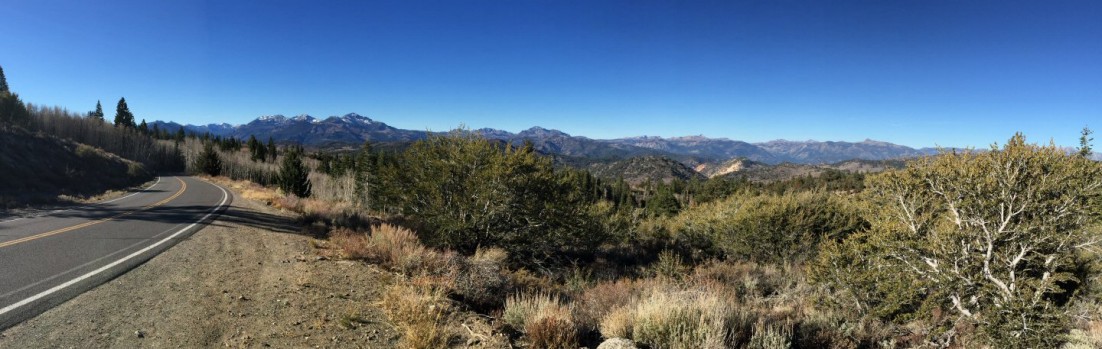
The first leg of our trip would wind up the central Sierra Nevada via Califorina State Route 108, finally peaking at the 9,624-foot high Sonora Pass, then descend with a good many twists and turns on the way to U.S. Highway 395 and our first stop near Bridgeport. It’s a scenic drive, but the open-air experience of a motorcycle brings nature just a shade closer. Especially the seemingly suicidal chipmunks and squirrels that would dash into the roadway, only to reverse direction inches from Sean’s wheels.

We knew I’d be comfy in my full-on riding gear. Any question regarding Sean’s comfort was quickly dismissed with references to youthful vigor and his machismo. He’d only have to tough it out a few times, when we passed through sheltered valleys kept cold by overshadowing mountains. That’d change at the pass. The sun is always brighter on the Eastern side of the Sierras, where high desert terrain takes hold. Via hand signals and the occasional tap on the horn, we’d coordinate stops here and there so I could describe to Sean the lay of the land. About 9:30 a.m. we pulled off the road to park alongside the East Walker River, our first of two fishing venues.

Blue skies and warming temperatures greeted us as we changed from riding gear to waders and assembled our rods. The river wasn’t so welcoming. It was a tad high for my tastes. I gave Sean a few suggestions regarding fly selection and possible fish locations.

The East Walker’s always been friendly to me, or at least the trout that live there have been willing to play during previous visits. This time there must have been a collective agreement to make me work for my first and only fish of the day. Sean wandered off and I moved upstream to some likely riffles.

[singlepic id=910 w=190 h=142 float=center]

East Walker Brown

I switched flies, taking cues from the hatch of small mayflies to choose a size 20 WD40, and trailed behind it a size 18 Broken Back Tiger Midge. I’m no expert, but my experience on the East Walker suggested that the fish would be hugging the banks, calling for drifts on seams no more than 3 feet out. Sure enough, just before it was time to head back to meet Sean at the bikes, I was rewarded with a decent tug at the end of a nice drift. Without room for a net on the bike, landing this 11- to 12-inch brown trout required a little more play and care. It was a nice reward for a bit of harder fishing.

The ride from Bridgeport to Lee Vining is easy, with good pavement, multiple lanes much of the way and incredible views of Long Valley and Mono Lake. The back up plan for lunch was Whoa Nellie Deli in the Tioga Gas Mart, but Bodie Mike’s Barbeque caught our eye midway through town. Splitting a tasty sampler plate, we enjoyed an outdoor table and great weather for a spell.

After topping off the tanks at Tioga Gas Mart, we began the ride up Tioga Pass. We’d be rising 3,162 feet in less than 12 miles on State Route 120; from Lee Vining (elev. 6,781 feet/2,067 m.) to Tioga Pass (elevation 9,943 ft./3,031 m.). We’d stop just short of the pass to wet the lines again.

A favorite roadside “tailwater” of ours is a small section of Lee Vining Creek, just below Tioga Lake. This area takes on a wholly different flavor with the seasons of the year. Spring seems to offer the greatest challenge. The reeds are still bent, dead and brown from the killing cold of winter, offering little protection for the wild brookies and dramatically reducing an angler’s ability to camouflage an approach. Even though it’s controlled, the water is a bit high. The channels and pockets of this upper section had dissolved into wide flats extending across gravel bars.

[singlepic id=913 w=190 h=142 float=center]

High Sierra Brook Trout

I tried to meet this challenge with a long leader of 13 to 14 feet and 6x tippet. My leader terminated with a size 18 red humpy trailed by a size 20 zebra midge — standard fare for the high Sierras. I paid the price for forgetting that the first cast is the best opportunity to hook a fish by missing a strike at the dry fly by a decent fish. That’d be my only strike in this stretch. Sean couldn’t get a rise either, so we decided to hike downstream a bit to a truly roadside section (one can stand on the edge of the asphalt and cast into the stream).

This is typical high Sierra freestone stream, with granite pebbles and larger rocks providing perfect concealment for trout, particularly brook trout. It requires reading the water and picking pockets. I found a few such pockets and was able to bring a few fish up to my flies but without hooking them. Sean tried a few other sections as we walked along.

Though this stream rarely offers channels deeper than 12 inches, I had put on my waders knowing that the meadows through which it flowed would still be more of a marsh. So I left Sean behind to continue further downstream, where the higher volume of water forced the creek into multiple braids. (Later in the season the creek would settle down into two main channels.) In customary high Sierra fashion, the creek would expand to a few feet in width to bubble over runs of granite stones, then shrink to less than a foot across, rushing through bends to create undercut banks.

I finally found more brook trout in the small tailouts at the end of those undercut banks. Thanks to the velocity of the water, they hooked themselves well enough that I landed three. Small, as one would expect at an altitude where the growing season is four months at best, but good wild fish. Soon we saddled up to head over Tioga Pass.

[singlepic id=914 w=474 h=356 float=center]

@the Tioga Pass Entrance Station (Yosemite National Park)

 
For me, the entrance station at Tioga Pass has held grander significance that its small dimensions suggest. Many years ago, it was a welcome sign that the family camping destination for more than a few summers, Tuolumne Meadows Campground, was a only few minutes away. On this trip, it was evidence that three quarters of our route was behind us and that we were entering some of the prettiest high country you’ll find anywhere. It also meant that, with a good pace, we’d be dining on buffalo burgers in a few hours. The only question was Sean’s bike, which stalled out as we stopped to fish Lee Vining Creek.

The road through Tuolumne Meadows, in addition to passing the meadows and the Tuolumne River, passes Lembert Dome (there’s a family story about how not to descend it), Tenya Lake, Olmstead Point (overlooking Yosemite Valley), and the Tuolumne Grove of sequoias. Thankfully, we were able to bump start Sean’s bike the 3 times it was necessary. Nonetheless, we kept our stops to a minimum and made good progress. The ride took longer than expected as a motor home, which should be anticipated on these roads, kept our speed well below 40 mph.

It was probably a good thing we were operating at a reduced speed. Just short of Tuolumne Grove, out from a stand of spring-green trees shading a sharp turn bolted a buck with a decent rack of antlers, crossing the road directly in front of Sean. I never did ask Sean if he needed to stop and change his underwear.

The rest of the ride was relatively uneventful. We cleared the western entrance station, filled up at Big Oak Flat, where Sean declared a “butt break.” We enjoyed buffalo burgers at Diamondback Grill, and Sean treated me to some goodies at the Candy Vault. Then it was a short ride to The Cabin.

The stats:

    263 miles
    11.97 gallons of fuel
    43.94 mpg
    1 platoon of suicidal chipmunks
    3 daredevil gray squirrels
    2 stops to fish
    1 brown trout
    1 shared lunch of 4 ribs and 1 chicken breast
    3 brook trout
    1 crazy buck
    2 buffalo burgers

The dream is now a memory. Our arses may never be the same again.

The Trip in Pictures
(Use “Compatibility View” in Internet Explorer if pictures overlap.)
[nggallery id=69]


2 Comments

post-m/c trip deconstruction……in reverse… sort of

Chronological order be damned; the middle often is the best. Bread is the handy carrier for PB&J. It’s the cream filling that makes the Twinkie.

So, in this tale we’ll shove the more mundane stuff out of the way first.

The last Friday in June, Sean and I loaded up the motorcycles with more gear than each has ever been asked to carry. A quick review of the route, and we began the inaugural Konoske Boys Two-Wheel/Fly Fishing RoadTrip 2010. The fishing looked iffy. The weather looked good. We knew the scenery would be great.

[singlepic id=890 w=474 h=356 float=center]

Two bikes, two fly rods, two reels and an extra gallon of gas.


Thanks largely to me, Sean was riding his ’82 Honda CB650SC (my first motorcycle), and I was riding my ’97 Honda CB750. Both shod with fresh rubber and recently inspected by the shop. Saddlebags hung from their haunches, fly rods balanced on their tails.

Our first multi-day m/c trip would push the total mileage into triple digits three days in a row. Call it a trial run.

The thing about a trial run — “a test or rehearsal of something new or untried to assess its effectiveness” — is the haunting expectation that something will be found to be ineffective. Skipping ahead to the end of our last day, that’s when the battery on Sean’s bike went kaput, thanks to a charging system known to be most effective above 5,000 rpm. A few attempts to bump start the engine ended as quickly as started. Thankfully, we weren’t so far from The Cabin that we…actually Sean, it’s his bike after all…couldn’t push it back.

So our fantastic weekend ended on a subdued note. Sean rode my bike home as he had to get to work and I awaited rescue. A few hours later The Wife delivered a battery tender.  Sean’s bike was charging and I was headed home.

Forty-five hours and 408 miles earlier Sean and I had only edged onto Hwy 780. Somewhere around Livermore any idea of membership in the Iron Butt Association was out the window. In the end, the biggest “trial” of this trial run was butt endurance. Actually, lack thereof. Our longest run without a stop was 62 miles. My butt went numb at mile 46. You can bet I’ll be researching custom seats during the coming months.

Luckily, short breaks were all it took to restore a semblance of normalness to our gait. And with a smaller tank on the CB650, we made up excuses and stopped often enough. Of course, there was the traditional A&W root beer stop in Oakdale.

Thankfully, the road just outside of Oakdale twists over rolling hills; a welcome change from the monotony of the highway slabs. We pulled into the driveway less than an hour later, unpacked and sat for a spell.

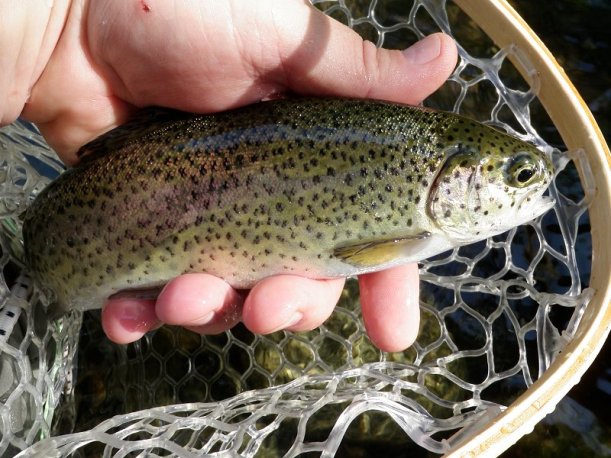
Sean's Stocked Rainbow

The decent stocked rainbow that surprised Sean at the canal.

Then Sean began to give me the eye. He’s so keen on fishing that, apparently, it was ill-mannered of me to take time to rest my weary rear when there’s trout to play with. A quick ride to the outskirts of town put us on the canal. Most of the time we’re hard pressed to entice anything but wild browns that live there to take a fly. I plucked about 5 out. Sean pulled out another of the wild brethren as well as a decent stocker rainbow estimated at 14 to 15 inches. Deeming that 2 hours or so was enough of a warm up for Saturday, we headed off to fill the tanks and grab dinner. We discovered, however, that the only gas station in town no longer dispenses fuel. We’d solve that dilemma later.

In hindsight, the 40 miles from Oakdale to The Cabin presaged the fun we’d find on Hwy 108, 395 and 120 the next day.

But that’s next week’s post.

[singlepic id=905 w=474 h=356 float=center]

The where we were.


3 Comments

big lake, up high, big fish: part two

Five o’clock in the morning doesn’t seem to come as early when it heralds a day of late June fishing. A quick “good morning” call from The Wife, a hot shower, a slathering of sunscreen and the packing of lunch and gear took thirty minutes. I was ready for what would be the best Monday. Ever.

Eagle Lake Sunrise

Sunrise on Eagle Lake, June 22, 2010

Tom Loe, who owns the guide service, kindly allowed me to hitch a ride to the marina, while Darryl (guessing at the spelling here), another client, regaled me with claims of incredible fishing and trout of unparalleled quality.

Then it all came to a screeching halt.

I was asked if I had my license. I glanced at my chest. No lanyard, no license. Damn. Rookie mistake. A quick run back to camp. Frantic searching of the car, the bed, the cooler. Nothing. My license was in my backpack. Which was back at the dock. Lesson learned. I should trust in my preparations.

The sun creeping over the mountains signaled that the time had come to head out. Fifteen minutes later our guide, Doug Rodricks, was doing the “guide thing” — watching the Lowrance, peering into the crystal clear water, on the lookout for rock piles and drop offs. Soon enough, anchors were thrown, nymph depth checked, and Don, my fishing partner for this trip, and I cast out. We were fishing.

Don's First Hookup Monday Morning

Don's First Hookup Monday Morning

Helping temper our expectations was the knowledge, reinforced by comments from Tom and Doug, that calm water doesn’t make for good fishing on Eagle Lake. Especially with fish that seem to be a bit more photosensitive than most.

Managing expectations is a good thing; it makes that first takedown all the more sweet.

That sweetness came within the first thirty minutes.  Don’s rod went bendo, big time. Neither of us were prepared for the strength of these trout, nor the overall quality of every fish brought to the net. Soon came my first takedown.

My First Eagle Lake Rainbow-June 21, 2010

My First Eagle Lake Rainbow

One doesn’t simply horse these fish to the net. And each fish brings a distinct fighting style to the game. Head shaking was common. Some would sound for the bottom. Others “play possum” until the boat is in sight, then make a wild dash. A number of fish would take us on blistering runs as far as they could. A few would jump, often more than once.

I quickly learned to hate jumping fish. More than one trout successfully resorted to this tactic to throw my hook. Keep in mind, they threw the hook. I did nothing wrong.

Soon enough, the coolness of the early morning air went unnoticed as Don and I brought a second, third and fourth Eagle Lake trout to the net, slabs of fish rarely measuring less than eighteen inches. Photos were taken; photos much like many seen before, but now featuring these beauties in our hands.

Eagle Lake Goddard Caddis

One reason the bite was on, the Goddard Caddis.

The number and quality of the fish in Eagle Lake are astonishing. There’s no getting used to such strong, larger and exquisite trout. Whether hatchery raised or wild born, all display full fins, with particularly massive caudal fins, and incredible coloration. The main difference between the wild and hatchery fish is in the markings. The wild fish are almost leopard like, with a dense collection of black spots extending from the tip of the nose to the end of the tail fin and below the lateral line.

Doug called it a tough day of fishing. Probably because he had to haul the anchor and reposition the boat more than usual, adjusting to the faint winds. I, however, don’t think a ten-fish day is all that bad.

Don’t get me wrong, we weren’t getting takedowns on every cast. Stillwater nymphing is less about figuring where these trout are; it’s more about finding locations where one can intercept them. Without wind to create ripples, it’s up to the fisherman to impart some action to the flies. More often than this amateur fly fisherman might deserve, a twitch would elicit a strike. Even unintentional twitches, such as the result of a bad mend, would mean fish on.

Monday would end with a boat total of approximately 20 fish to the net. We probably took photos of at least 19. Flies for the day were pheasant tail nymphs, midge pupa and “Agent Orange.” The afternoon was dedicated to caring for sore wrists and forearms.

the big day

In retrospect, Day 1 was a warm up. Tuesday morning brought predictions of increasing winds and the promise of a better bite. The excitement was palpable as we pulled into “Shrimp,” so named because of nearby Shrimp Island. We would end up staying there all day.

Slanting early morning sun and a breeze wrinkling the water equated to a quick start to the catching. Multiple doubles throughout the day would bring twin trout to the net. Intermittent winds marked the first half of the day, and the catch rate was directly proportional to the wind.

Don's Big Fish

Don's awesome Big Fish of the Trip

Agent Orange was the name of the game. So strong was this fly’s power to entice a grab, Doug doubled up our rigs, using Agent Orange as both the top and bottom flies.

Once and a while Doug would reposition the boat, adjusting to a shift in the wind, and we’d glimpse large fish cruising the shallows.

After one repositioning, I let my flies dangle in the water while Doug adjusted the depth of Don’s rig. I wasn’t paying attention and soon felt a familiar, slow tug hinting that I had snagged bottom. Starting to flush with embarrassment and moving slowly as to not catch Doug’s eye, I carefully angled the rod to help free the fly.

Line began to peel off the reel. I ended up landing a nice, fat Eagle Lake rainbow. The slowest and the easiest hookup I’ve ever experienced fly fishing. I hope that Doug appreciated this hookset; he’d admonished me the entire trip to slow down in setting the hook.

My Best Looking Eagle Lake Rainbow

My Best Looking Eagle Lake Rainbow, a Wild Fish

Then a few funny things began to happen. I’d solidly hook a fish, only to have the reel scream as the trout ran, possibly jump, and eventually throw the hook. This happened five times. Doug swears he didn’t straighten my hooks.

Also, as the afternoon wore on, the wind would die, leaving Don and I to believe we’d get a respite from the wrist straining action. Not so. Contrary to expectations, the bite continued despite the mirror like surface and I, for one, ignored hunger pains so as to keep my flies below the surface as much as possible.

Eight hours later, and with over 50 fish between Don and I, Doug gave the 15-minute warning. Both Don and I made good use of the time…both landing one more Eagle Lake Rainbow. The wind was picking up just as we headed back to the marina, but that good feeling fatigue that comes with a day of hard fishing guaranteed only a half-hearted lament.

Crazy fishing.

The Evidence:
(Use “Compatibility View” in Internet Explorer if pictures overlap.)
[nggallery id=68]


1 Comment

big lake, up high, big fish: part one

It’s still hard to decide if I just got it right or if it was the trout throwing me a bone.

Crazy fishing.

The morning of June 19th marked the start of my inaugural trip to volcano country in the northeastern corner of California. A driving time of 5 hours and 30 minutes would bring me to my destination at the east edge of Lassen National Park, roughly 93 miles south of the Oregon border and 40 miles from the Nevada state line.

Shakey's Special Pizza

Shakey's SpecialTM Pizza

Like many fly fishing trips, it began with food. When it came to my attention that Oroville was home to one of the few Shakey’s Pizza restaurants in my end of the Golden State, I appropriately adjusted my route. Pulling into Oroville, a town surviving on the generosity of travelers passing through, the old school design of the Skakey’s was a good sign. Not so good was the new school menu. That meant no Bunch of Lunch buffet (a $9.95 lunchtime experience) for me. The pizza, however, was a memory inducing event. Shakey’s pizza, at the older restaurants mind you, is one of the few foods that matches what I remember from childhood.

After dosing the body with slices of Shakey’s Special and Diet Coke, it was on to Chester, where I met up with Tom Maumoynier, owner of The Lake Almanor Fly Fishing Company. Tom’s passion about the area and the fly fishing it has to offer can be contagious. He’s so passionate about fly fishing, and his wife apparently very understanding, that Tom seems to spend many an evening “testing” various venues around Lake Almanor, and the lake itself. With advice from Tom, a close examination of an area map and a handful of flies, it was time to wet a line in Yellow Creek.

I checked into the modest but quite comfy Cedar Lodge, and headed down Hwy 89, along the western shore of Lake Almanor. A few miles later I pulled onto one of the nicest Forest Service roads I’ve had the pleasure to driven. Tom told me it was eight miles to the creek. Thankfully, signs to the Yellow Creek Campground kept me on the right path. Until I crested a hill to find the road branching in four directions.

I’d like to say I took the macho course of action (Eeny, meeny, miny, moe, catch a tiger by the toe…), but that hill was a blessing. Wimping out, I checked the cell phone for a signal and called Tom back at the shop. It was the middle road, he told me, clarifying that just about the time you think you missed a turn a few mile back, you’ll arrive at the campground. He was right.

Yellow Creek is a fantastic medium-sized creek, meandering through a meadow nestled within a gentle valley. It doesn’t offer much fishy water immediately downstream from the campground, at least not early in the season, when most of the moving water in the area is high. A 15-minute hike, however, brings nice looking riffles and pools into view.

I rigged up with Tom’s recommendation of a light green drake, which had worked well for him the previous evening, with a pheasant tail nymph dropper. Casting as I walked, the first take came a few minutes later and yielded a small, wild brown trout.

Yellow Creek Brown

Yellow Creek Brown

I believe that, like many things in life, confidence is a big factor in fly fishing. So, after 30 minutes of a lot of nothing, I switched to my “confidence flies”: a yellow-green bodied stimulator trailed by a bead-head A.P. Nymph.

A few minutes later, an 8-inch brown ate the nymph. Another nailed the stimulator on the surface. The total for the next 90 minutes was five browns and one rainbow to the net, twice as many missed strikes, and the farming of one of the “toads” I was warned about.

That toad, perhaps a fair 12 or 13 inches (big for a creek this size), didn’t hesitate when it took the nymph. Stunned that it had been fooled, it didn’t move for a minuscule but still discernable amount time. Then it exploded downstream, jumping three times before turning upstream and burying its nose in the weeds at my feet. Gaining the angle and applying gentle pressure, I turned the fish back into open water. I blinked, and with one final jump, he was off. Good times.

While I collected myself and gathered up my net, allowing my flies to swing in the current, I missed another strike. That’s a hint how fun the fishing can be on Yellow Creek.

The downside of tracking down more remote creeks and the wild fish in them is the drive out on unfamiliar dirt roads in the dark. Let’s just say that I was grateful to find pavement after a wrong turn that had me, for the first time, thinking I might have to spend the night sleeping in the car.

Instead, I got a restful night’s sleep at the motel. Good thing, too. I would soon find out that I needed it.

The plan Sunday was to head back towards Yellow Creek, but to stop short at Butt Creek, which I crossed the previous day. I had been warned that the unseasonably cold water and air temperatures were limiting insect hatches, and thus trout feeding, to the evenings. But I was there and I had the means to cast a few flies.

If one were to use my results as scientific measurement, there are no trout in Butt Creek. I did have beautiful weather, and after a few hours, enjoyed a streamside sandwich. Fly fishing, in beautiful country, is never a bad thing, regardless of the catch rate.

That afternoon I visited Susan Creek, a portion of which is maintained as a wild fishery. Yes, I only visited it. To say the water was too high would be an understatement.

As darkness descended, I was comfortably secure in my Kamping Kabin at Eagle Lake RV Park. Eagle Lake was less than 200 yards away.

Why I was there:

Eagle Lake

Eagle Lake. Looking southeast, with conditions looking good.


  • Surface Elevation: 5,098 ft./1,554 m.
  • Surface Area: 24,000 Acres/97.1 km2
  • Maximum Depth: 85 ft./26 m.
  • Location: Lassen County, Calif. (40°38′42″N / 120°44′38″W)
  • Second largest natural lake entirely in the state of California.
  • Home to the Eagle Lake Trout, which are uniquely adapted to the lake’s alkaline waters.


3 Comments

where we’ll be tomorrow

For those who haven’t traveled Tioga Road – where out two-wheeled fly fishing day trip will take us – here’s an interesting time-lapse video. (We’ll travel a tad bit slower.)

http://vimeo.com/moogaloop.swf?clip_id=12742304&server=vimeo.com&show_title=1&show_byline=1&show_portrait=0&color=00ADEF&fullscreen=1
Google Street View: Tioga Pass Road from Austin Leirvik on Vimeo.


3 Comments

motorcycles, fly fishing, fun, and good eats

It’s on in 7 days and 4 hours.

That’s when we set out on the inaugural Konoske Boys Two-Wheel/Fly Fishing RoadTrip 2010.

After years of talking about it, miles of practice rides, a few hours of tinkering with gear, and a sudden opportunity to stay at the family cabin, it’s nearly go time. The route is planned. Soon the bikes will be sorted.

One day up to Twain Harte and one day back. From sea level to 9943 feet/3031 meters over 530 miles/853 kilometers. Squeezed into that total is a one-day, 250-mile/403-kilometer loop up and over and back over the Sierra Nevadas.

Kinks just past Sonora Pass.

The first leg of our one-day tour will take us over Sonora Pass (elevation 9624 ft./2933 m.). This is the only stretch that gives me pause: 15 miles with 9 blind or partially blind hairpin turns, often with steep uphill or downhill grades. The greater cause for concern is oncoming drivers cutting corners short. We’ll take it slow, to be sure. We’ll put our training to good use, following the adage “Look ahead, then look where you want to go.” We’ll be looking as far ahead as we can.

First stop: East Walker River. Reports put this tailwater fishery a bit high right now, but with any luck a dry/dropper combo will get us into some brown trout.

A quick ride south, past Bodie and Mono Lake, will put us in Lee Vining. A left turn and we’re gaining elevation again, up Hwy 120 toward Tioga Pass (elevation 9943 ft./3031 m.) and Yosemite National Park. Hopefully we’ll wet our lines again in a section of Lee Vining Creek. That’s if we don’t have to hike through too much snow to reach what we trust will be hungry brook trout.

After the Tioga Pass entrance station we’ll wheel past likely still-snowy Tuolumne Meadows, with a stop here and there, perhaps at Tenaya Lake (no fish there), and Olmsted Point, before winding up the engines, flicking into fifth gear and making tracks for Old Priest Grade.

A portion of Old Priest Grade.

A portion of Old Priest Grade.

Old Priest Grade is one heck of a road. Two miles long with an approximately 1,500 feet elevation gain and an average gradient of 14 percent. To compare, New Priest Grade (SR120) is three times as long with twice as many curves, and an average gradient of less than 10 percent. However, Old Priest Grade is a great shortcut with relatively new asphalt. It just commands a bit of respect. So we’ll take the shortcut. At least that’s the plan for now.

After Old Priest Grade, it’s an easy and fast road toward the cabin, with the promise of a dinner of our favorite burgers fueling anticipation.

As for this weekend, I’ll be selflessly gathering fodder for future fishing posts by dragging myself up to the Eagle Lake area for a few days of playing with big rainbows in the lake and making a few casts on nearby streams and rivers. Rotten business, I know, but I do it for you.


1 Comment

more catching through technology

No one’s ever accused me of being a luddite. Nor am I a rabid early adopter of technology. This, however, is too promising to ignore.

Fish are followers; trout pod up.

While there’s something to be said about tradition in fly fishing, I’m game for anything that might lend a competitive edge. And if I can’t be the Pied Piper of Oncorhynchus, Salmo or Salvelinus, maybe, just maybe, technology can bring the fish to me.

Enter Robofish.

Researchers suggest that this technology could be used to steer schools of fish away from hydroelectric turbines. And, you know, that’s nice and all, but let’s think outside the tank for a minute… We now have the capability to use robots to control schools of fish.Read more on BotJunkie.com

…pods of trout steered in my direction thanks to the all new Orvis TLS Robotic Fish Escort. Coming soon to trout water near you.


Leave a comment

it’s invasive species week:Asian carp’s little bro’ on the attack

Earlier this year we had the fight to keep Asian carp out of the Great Lakes by ending the Chicago diversion that artificially connects Lake Michigan to the Mississippi River system. Now the Asian carp’s little brother is assaulting Mann Lake in Eastern Oregon.

According to an Associated Press article, biologists with the Oregon Department of Fish and Wildlife are pondering a plan to poison Mann Lake, in the hope of ridding the lake of invasive goldfish.

The first step requires volunteers to catch trout, in the hope that the trout can be restocked after poisoning the lake with the chemical rotenone, which kills fish by interfering with cellular use of oxygen.

Mann Lake, at the base of Steens Mountain, has a long history as a well-known trout fishery. Scientists believe that in 2001 live goldfish were somehow deposited in the lake, perhaps used for bait, and reproduced. Fishermen now catch goldfish up to 13 inches long, and the trout population has experienced a decline.

To answer the question we know is on your mind, yes, there is an overall U.S. IGFA record for goldfish (Carassius auratus auratus) from 2002: 9 lbs. 6 oz. (4.26 kgs), out of Lindo Lakes, California.  No fly rod record. Yet.

That said, I’d much prefer rainbow trout as an invasive species.


Leave a comment

corruption or conservation?

The evolution of an angler to fly fisherman often includes embracing the concept of the ‘catch and release’ ethic — along the lines of Lee Wulff’s assertion that “The fish you release is your gift to another angler and remember, it may have been someone’s similar gift to you.” Conservation is part of our credo. In more recent years that credo has grown to adopt the concept that the survival of native fish is preferable.

Now Trout Unlimited and the Idaho Department of Fish and Game have crafted a cash-for-rainbow program in the hope that the almighty dollar can sway fly fishermen to revert to the hunter/gather mentality to harvest the nonnative rainbows in the South Fork of the Snake River.

Seeking to thin out the competition for native Yellowstone cutthroat trout in the blue ribbon fishery, Woodard’s organization, Trout Unlimited, has partnered with the Idaho Department of Fish and Game to place a bounty on rainbows.

Fish and Game has inserted tiny, invisible tags in the noses of 571 South Fork rainbows with corresponding monetary awards ranging from $5 to $1,000.”

With any luck, maybe this fly fishing habit can pay off.


1 Comment

opening day 2010 – new wild places

Each Opening Day Weekend — with or without company — I charge into the Sierra Foothills in pursuit of the first trout of the season. This year Older Son Sean accompanied me.

Sean left earlier than I could Opening Day — I had a commitment — and he had some luck flogging a few spots before my arrival. We met up at The Cabin late in the afternoon. Sean brimmed with confidence that this would be the year he outfishes dad. The refrigerator was stocked with beer and the pantry with basic staples and, with daylight waning, we opted to warm up on the surprisingly trout-friendly irrigation canal behind town.

Opening Day brings nearly half the town to the canal, knowing that sometime during the prior week, days or hours, that the state DFG hatchery truck will have dropped a load of pan-sized rainbows into the water. I’ve seen everything brought to bear on the canal — the ubiquitous baits of questionable manmade formulations, bass lures, even 10 foot saltwater rods — with the results being full stringers, as well as the seemingly inevitable string of injured, dead, or dying stocked rainbows. (Wild or not, wasteful in my book.)

Snow along the way, in late April.

Snow along the way, in late April.

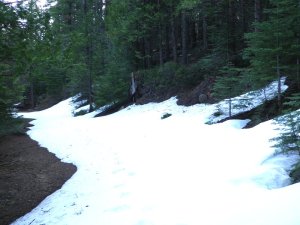
The first full day began with a five a.m. departure. This year it meant driving east on Hwy 108 during at dawn. Not surprisingly, remnants of dirty snow appeared at approximately 4,500 feet and drifts defined the snowplow’s reach after 5,000 feet. Most summers I will end up driving this route at least six times. Sometimes to destinations before the summit; other times to traverse Sonora Pass as I make tracks for the East Slope of the Sierras. So, knowing full well (and happily) that Old Man Winter laid down a healthy snowpack, we set out Sunday morning to reach the Promised Water, the Clarks Fork of the Stanislaus River, which is littered with boulders and sprinkled with wild trout and their domesticated brethren.

Outside the car windows the air was crisp and cold, and snow began to dominate the landscape. That should have been our warning. Apparently the road to Clarks Fork doesn’t warrant the same attention as the highway when it comes to snow removal. Disappointment was tamed somewhat by the acknowledgement that we were taking risk this time around by checking on waters never before visited this early in the season.

The next attempt to reach unvisited water— Sand Bar Flat and Spring Gap on the Middle Fork of the Stanislaus River — was prevented by (1) lack of signage and (2) lack of a Stanislaus National Forest map. Fishing near Spring Gap can legitimately be called epic: a few years ago Christopher and I stumbled upon it late in the afternoon; late enough that we had about two hours of fishing, but those two hours yielded some beautiful wild rainbows. But Sean and I weren’t getting there this year.

Apparently gluttons for the punishment doled out by Forest Service roads, we threw caution to the wind to set the GPS for Wild Trout Stream X. It’s been mentioned here before as a location revealed in confidence by two old and grizzled fishermen who appreciated the fact that Sean and I were fly fishing and practicing catch and release. We had visited the stream in the off season, when flows were about half of what we’d find, and saw a good number of dark shadows that presaged good times. It’s about ten miles from pavement, on roads littered with potholes (and mud at this time of year) winding through dry pine forests, by meadows and over one river and a few creeks. Sean claims that no matter which direction we were headed that the potholes seems to line up on his side. It certainly wasn’t my driving.

Was the long, 20-miles-per-hour drive worth it? You betchya.

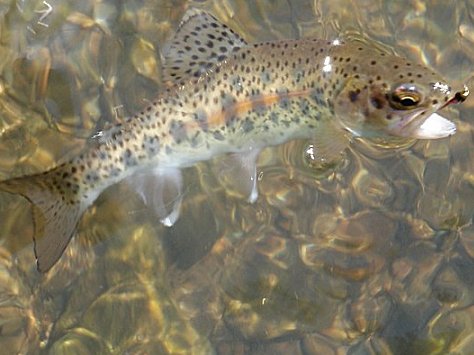
Smaller streams are always a great excuse to get out my smaller 3 wt. rod, so while I was getting that ready Sean nearly ran to a pool downstream of an old-school stone bridge. You’d have to ask him, but I would swear that it wasn’t more than one drift before I heard an exclamation affirming a hook up. Sure enough, a small wild rainbow was the first of many rewards for the torturous ride in.

What I call a Trophy – a wild rainbow in Stream X.

I’m always amazed to find trout in streams like this one. It was rarely more than six feet across and more than two feet deep. Its crystal-clear water danced over the rocks, creating riffles and small plunge pools. Short stretches offered a riffle-pool-tailout configuration in miniature.

This small stream made the day. There’s nothing like wild fish. Particularly in light of The Unaccomplished Angler‘s “Adages as Pertaining to Smallish (Wild) Fish”:

  • What they lack in size, they make up for in beauty.
  • A size 22 fly in the mouth of a 2-inch fish is equivalent to a size 2 fly in the mouth of a 22-inch fish. Or something like that.
  • It’s not about the size of the fish in the fight, but the size of the fight in the fish. And little fish are scrappers.
  • There’s more fishing than catching big fish.
  • Small fish, in the hands of those with small hands, look relatively large.

While I hear that Mr. Unaccomplished is good in the small hands department, it’s not so true for me. We’re in agreement on everything else.

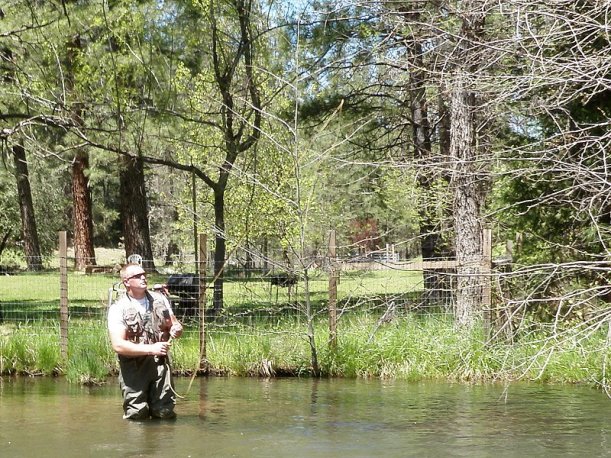
Sean on Stream X.

Sean on a fish.

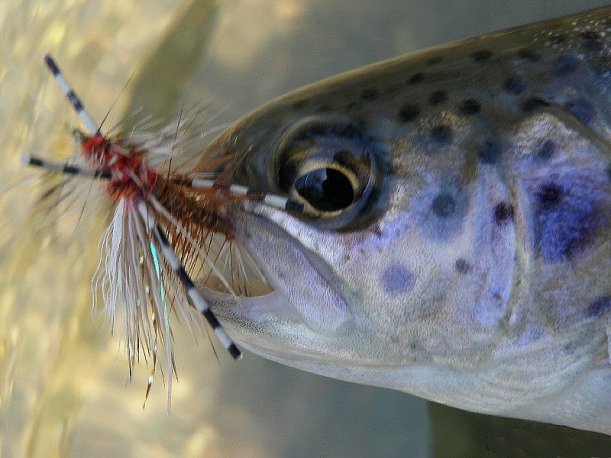
And the wild fish at Stream X were h-u-n-g-r-y. We were casting a dry/dropper rig (a dry fly with a dropper, i.e. a subsurface nymph imitation) and these little guys chased both flies with abandon. Even the dry fly, despite it being a size 12 stimulator in my case. (The dropper was a size 18/20 Copper John.) As a relatively new fly fisherman who cut his teeth on nymphing as a nearly surefire way to dredge up trout, the last two years I’ve gained a greater understanding for the pure joy of presenting a dry fly in a manner adequate enough to elicit a strike.

Rubber-legged stimulatior doing the job.

Rubber-legged stimulatior doing the job.

Steam X also offered plenty of dry fly fun. Sean spent much of his time at the downstream pool, while employed my shorter rod in dappling various riffles and plunge pools as I made my way upstream. Disappointment was rare. Fish would rise out of bubbles of plunging water to inhale the rubber-legged stimulator. Others in riffles would pounce on the dropper at the last minute, just as it began to drift toward the water’s surface on the swing. Nearly four hours flew by. We capped the day with a great buffalo burger at the well-known Diamondback Grill in downtown Sonora.

Monday would mark Sean’s last day of the trip and a responsible but unfortunate decision to leave a bit early to make it to class. His original plan was to skip class to spend a bit more time on what I’ll call Hatchery Creek. (More on why later.) We were on the water just after sunrise, but with the water temperature at 50°F, there was no love that morning. Two hours or so later, Sean made his fateful decision. As for me, perhaps I’m too stubborn. Sometimes stubbornness pays off.

First fish of Opening Day 2010.

Hatchery fish, Opening Day 2010.

Mid morning, with sun dappling the water and the air temperature rising enough so that I could no longer see my breath, bugs began to hatch. A few small mayflies darted here and there. Then the bite was on. During the next two hours I would hook fourteen fish and bring ten to the net. (I’ll attribute the hooked/landed ratio to the fact that size matter that morning…nothing larger than size 18 got their attention.) Every fish was a cookie cutter stocker, ranging from ten to twelve inches. I’ll give ‘em credit, every single one of these fish put on a good show, either jumping multiple times or offering me a challenge by sounding for the bottom. I stuck around through the afternoon, trying to land that last fish. It never came. The evening entailed cleaning The Cabin and packing most of the gear.

The last bit of fishing for this trip came when the last load of laundry was in the dryer. I made the short drive to The Canal and casually walked upstream with drifting a couple of nymphs through likely locations, particularly the undercut bank just underfoot. Things looked good after the second case, when a colorful, ten-inch brown absolutely nailed the lower fly, a Copper John. During the 30-minute walk up to flume I picked up two more trout, both brownies. Below the flume, where the force of the water create a pool full of eddies, another five fish came to hand. (I missed two hooksets as well.)

Overall it was a great Opening Day trip. The catching wasn’t red hot as it’s been during previous Opening Days. Stream X, however, offered the highlight of the trip, the kind of fishing memory that will grow grander with each telling. But don’t ask for the GPS coordinates. You’ll only get there if I take you there. Blindfolded. Probably in the trunk.