I’ve seen the results of the sickness. It’s not pretty. Often, it means a car can’t be parked in the garage.
An unchecked inventory of rods, reels, waders, vests and more spills from the shelves. A lathe, peppered with bits of grip cork, sits front and center, over fading oil stains. Boxes of feathers, thread, fur and hooks litter the floor. A pontoon boat or float tubes fill much of the rest of the space.
After taking an unblinking look at my array of fly fishing gear, it’s become clear that the time to act is now, before I lose control to an outside intervention. The rule around the house is that if an item hasn’t been used in a year, you’d better have a darn good reason — other than unshared sentimentality — for hanging on to it.
That hard look uncovered that 10-foot, 7 wt. rod that’s been wetted only once, chasing bass three years ago. I wouldn’t say I’m a trout snob, but bass fishin’ just hasn’t grabbed hold of me. And the trout I do chase generally don’t require much more than a 5 wt. (I’m actually leaning more toward a 4 wt. nowadays, but that’d require another acquisition.)
Luckily, I don’t have much, yet. There’s an old bamboo rod in one of those cases, but it’s safe; the wife suggested it could be decorative in the fly tying room that’ll be occupied by the last kid at home, probably for another three years. The spinning rods were long ago tucked into the garage at the cabin in the hope that visiting nephews might enjoy them. A boxful of spinners should join them shortly.
I expect that one’s collection of fly rods and reels is acquired for no other reason than fishing. Sometimes we want the latest and greatest, and forget what we already have. Sometimes it’s the search for the gear that will allow for longer casts, straighter cast, more accurate casts, or all of the above. Other considerations include differences in feel, flex, power, speed and fit and finish.
Maybe it’s a quixotic quest, but after casting various rods owned by friends and guides’ rods during the last year, I’m hoping to apply greater scrutiny any future gear acquisitions…buying only what I need, spending the money to get what I really want (with the required scrimping and saving). And there’ll still be room for a back up rod.
I’m hopeful that my belief that garages are for cars — many Californians seem to think that garages are above-ground basements — will keep to a minimum prevent any hoarding.
I suppose it’s inevitable that with time and age I’ll someday become that “get off my lawn” guy. This week, however, I purposely took a step in that direction.
Over the last few years I have dealt with customer service at Sage, Redington (prior to its acquisition by Sage), TFO, Orvis and Galvan. In every case, response was immediate and exceeded my expectations.
Last month I contacted [name redacted], the manufacturer of a now relatively well-known brand, regarding the replacement of an integrated iPhone adapter. Apparently, I can replace it myself, saving a bit of money, but the part can only be bought from the manufacturer.
Hindsight being 20/20, I should have seen trouble on [name redacted]’s website email form, which stated, “Due to extremely high email volume, if you require order changes or immediate assistance, please call our Customer Service Department,” followed by a toll free phone number and the typical office hours. Heeding this advice, I called. After a cursory “hello,” I described the issue to the customer service representative, offered the model number and was told they could certainly send out the part.
“Can you take a credit card,” I asked. The answer: “No.”
The silence that followed was finally disturbed by the representative telling me that I could send a check or money order. I did so on Oct. 5.
Life interrupted and it wasn’t until earlier this week that I realized the part had not arrived. The check had been cashed, but no part. So I called. And called. And called. And called. And called.
Each of those five calls, no matter the extension I chose, entailed more than a few seconds of silence before an automated message told me that my call was important and a representative would get to me shortly. That message was immediately followed by a click and dial tone. I’ve since sent an email, despite the advice mentioned above, and three days later there has been no reply.
Sidestepping any debate of the merits or problems of growing the sport of fly fishing, it dawned on me this week that the relatively small population of fly fisherman — those who regularly support manufacturers and retailers of fly fishing gear — offers a benefit rarely seen in other consumer segments. Strong customer service.
That’s why I’m now more inclined to encourage only a limited number of folks join the sport. The fewer of us who fly fish, the harder retailers and manufacturers have to work to keep our business. Not necessarily a bad thing.
If the headline got you here, great. But let’s first clear the air…
I’m not the master; I’m more of a jack of all trades and master of none.
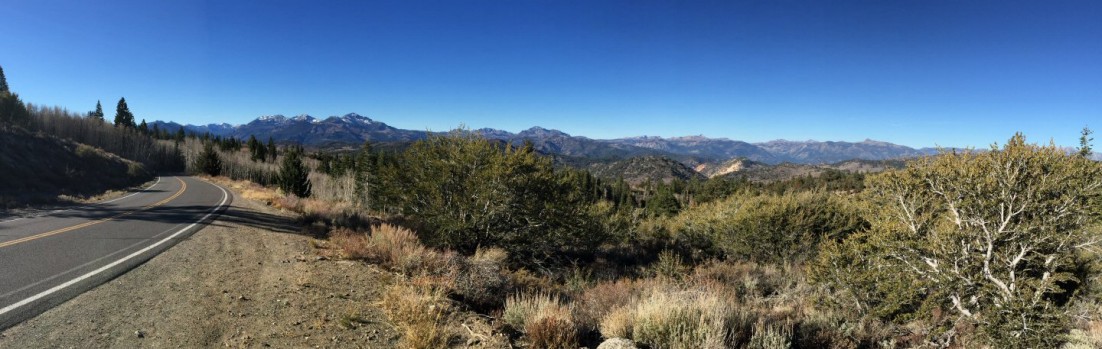
My last trip of this trout season to the foothills of the Sierra Nevada was like many before it. It offered solitude and a stillness that can only be found in the fall.
It is possible to spend time on most moving waters here — even those that are well stocked — without any company, and my usual arrival at sunup ensures that it’s just me and the fish for a few hours.
Such was the case on one of those streams, one that also sees a small fall run of spawning browns. I hooked only one of those browns this year, a big one that, after we eyeballed each other, promptly snapped my tippet and headed back downstream. Before and after I lost him, there were plenty of raceway rainbows that were willing to play.
When the sun finally warmed up the landscape enough, four gentlemen waded into the stream downstream from me, and slowly began to work their way upstream. I gave them a welcoming wave. Eventually, they were close enough that I could hear their conversation. Phrases drifted over the water…
“They biting?”
“Some, but that guy up there is getting five for every one of mine.” (‘That guy’ was me.)
“Wonder what he’s using?”
“It’s gotta be a nymph or something ‘cause I’m getting nothing on my Adams.”
During my few years of fly fishing I’ve learned to discern the experienced fly fisherman from those new to the sport. It was clear that despite their apparent age, two of the gentlemen had probably cast a fly rod only once before.
I can’t say whether it was the ego boost that comes with someone’s admiration of my catch rate or a more altruistic pay-it-forward attitude, but since I had long lost count of how many fish had wet my net, I offered my spot to the group. After assurances that I had caught plenty of fish, they gratefully accepted. I mentioned that black nymphs of almost any style might work, offered a bit of advice on depth, and the two more experienced guys helped the other two rig up. I think between the four of them they used four different types of indicators.
One of the gentlemen broke away to chat with me. All four gentlemen were over 70 years old. While two of them were more experienced, that experience was with bass or in Alaska, not so much in the Central Sierras. There was no bragging between us, a simple sharing of information and stories. One of their group was from South Africa and had never caught a trout. He did that morning and gave me one of the biggest smiles you might imagine.
I’d end up showing these guys where to find the fish on this stretch, explaining then showing that during a limited window — when the sun is at the proper angle on this stream — during which dry flies will get some attention.
All of us accepted each other in the common bond of fly fishing. While most fish were caught and released, there was a stringer produced and a few fish taken by one guy who was recently retired, but only after asking if we thought it okay. (He somewhat sheepishly explained that he wife had complained that through all his years of fly fishing, and all the money spent, that not once had he brought home trout for dinner.) There was no dissention, knowing that these were stocked fish that might not last through the winter.
When I left, there were smiles all around. We were friends that might have never met were it not for our shared hobby. It was a good way to end my season.
On a stream last week my needs (a solid and reliable rod and reel) transcended desires (the latest and greatest gear). Maybe it’s the fact that I landed a good number of fish, and not one looked at my rod in disgust. (I did get the downturned eye of disdain, but only once they were in the net.)
And while that argument has been settled, this week it’s become clear that I’ll forever covet any conveyance that’ll get me to the water with a dollop of awesomeness.
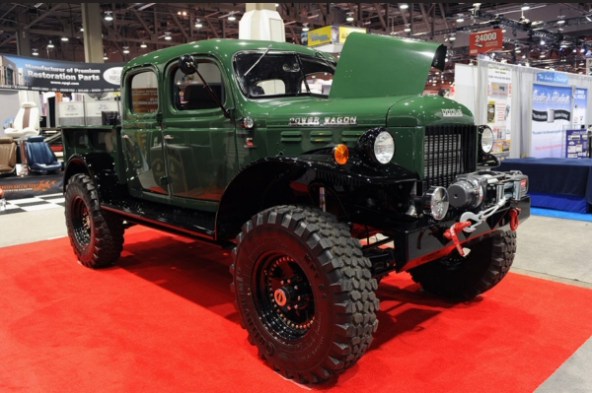
Nothing screams “Get off my lawn river!” like three tons of vintage Dodge Power Wagon.
Legacy Classic Trucks brought this beast to this year’s Specialty Equipment Market Association (SEMA) Show. The Legacy Power Wagon is available in a two-door configuration for the less social fly fishermen and a four door for those friends who bring beer. Engine options are either a 426-cubic-inch V8 with 425 horsepower from Mopar or a 3.9-liter Cummins turbo diesel four-cylinder good for 480 pound-feet of torque. This one would set you back about $180,000. Equal to just a few Helios 2 rods, huh? Best of all, you can pick one up at the workshop in Jackson Hole, Wyo., not too far some decent fishing.
I don’t remember how it was learned. There has been a lot of trail and error, fishing trips and advice from guides and fly fishing friends. It certainly wasn’t during my first year of fly fishing, when it was all new and mysterious — and happiness was fooling a single wild trout. Mistakenly filled with a dream of never being skunked again, all virgin water held promise, particularly without the knowledge that is only gathered with time on the water. Maybe, at first, this knowledge is founded upon a dog-eared book authored by Whitlock, Humphreys, Cutter or Rosenbauer. But over time, those written words merge with experiences to become more instinct than reason.
Only lately did it become clear — while reflecting on fishing an Eastern Sierra river a bit more than a few weeks ago — that my approach to water, at least assessment of it, was without conscious thought that day. A first trout that came to the net early that morning would be the only fish for a period of time longer than I liked. But there was a lot of water to fish. It wasn’t too long before the burble of the river, the lowing of cattle and the rhythm of casting encouraged giving in to just being there and trusting in my strategy.
I no longer feel frustration (I’ll admit to a bit of irritation) when the net remains dry and the fish don’t respond to sound tactics. Digging a bit deeper often reveals a smidgen of an idea that I may be employing the appropriate tactics, just not in the right place. If asked, I usually can’t describe the right place, but I’ll know it when I see it.
I saw that right place that morning on the Upper Owens River, but it wasn’t until long after the fact did I recognize my knowing that it was the right place. At the moment, it simply felt right. It was a small bend where the water tumbled over and through a few polished rocks, with enough speed to carve underneath the bank a small undercut. Above this bend, a confluence of two braids would funnel any food to where fish should be waiting.
What those books don’t tell you, and can’t if they hope to find new readers, is that as insight is accumulated, at sometime it’ll be a gut feeling telling you that you’re in the right place, at the right time, casting the right fly with the right technique. With a lot of luck, you may even feel that a drift is so right that a hook up is almost — almost — guaranteed. That day half a dozen trout from that bend would end up in my net.
It took some thinking about that day before I realized that it was following a feeling, a learned intuition perhaps, and that not overthinking worked out pretty well.
Ask around, do a little research and you’ll likely find that the question “what’s the best vehicle for fly fishing” is often answered “truck.”
But I’m still paying into social security so others can fly fish when they want a working stiff. I need transportation that is, first and foremost, reliable, and just as important, economical. I have to spend money on gas to make money, and the less I spend upfront the better.
During better weather, the Honda CB750 and its 45+ miles per gallon is a fine option. But it’s difficult to load the necessary fly fishing gear, and the cooler of post-fishing beer, on a motorcycle. I’ve tried.
Being a bit obsessive about conducting research on anything that will cost more than $50, I’ve been thinking — probably too much according to those around me — about the vehicle that, in about 1½ to 2 years, will replace my current 2003 Honda Accord. Since I’ll likely buy a certified pre-owned car, it’s going to be something currently on the market. My current car gets 30 to 32 mpg most of the time, and on long trips to fishing venues, I’ve seen 34+ mpg. But over 80% of my driving is commuting to and from work.
I’ve debated the merits of various models, including sport utility vehicles and all-wheel-drive cars. A hybrid is out of the question; too heavy and not enough clearance for the occasional Forest Service road. Subaru is a commonly offered up make as an all-encompassing solution. But I’ve noticed two things: most Subaru owners talk about the sportiness of the ride, the go-almost-anywhere capability, but rarely praise their cars’ mpg, and it seems to be a roll of the dice when it comes to build quality. That might be said about any make, but that’s my experience.
Despite the fact that I’ve been a Honda owner for well over 20 years, I opened up my consideration to other options, particularly now that the mpg on midsize sedans is edging up.
But, and a bit ironically, it’s fly fishing that helped firmed up my decision. At least for now.
I’ve driven my Honda on a good many, only slightly improved, Forest Service roads. Sometimes for miles, over the relatively soft dirt along the Upper Owens River, for example, or over rocks on my way to the Little Walker River, and on washboard roads in the hills behind the cabin.
Still, the doggone car doesn’t squeak or rattle.
I’m hoping this will still hold true for my next car, until that someday when I can justify a dedicated fishing truck.
Yesterday the shield on my helmet was dotted with mist. Clouds showed up early in the morning and again hover above today. Temperatures have noticeably dropped and the first reports of snow in the Sierras have filtered down to the lowlands. Tomorrow we’ll be making the annual trek to Camino, Calif., and the ranches that make up Apple Hill. It’s clear that fall has hit Northern California.
It’s a time of year that sparks in me some introspection. Though it’s far from over, there’s an almost instinctive looking back on the year; recalling the new friendships — however temporary they may be — as the days are filled with one activity or another. The opportunity for these friendships was the answer to a recent question, as I was beginning to adopt another hobby, if it might just be one hobby too many.
The answer is no. Whether motorcycling, fly fishing or shooting, a welcome sense of belonging emerges as I learn from, and about, those pursuing similar interests, or simply enjoy the camaraderie.
It may be a bit early, but that’s certainly a reason for thanksgiving.
There are times when the catching is good, but the fishing still unsatisfying. I was felt this way on Hot Creek, just a bit, during this last club trip to the Eastern Sierra.
I may not eagerly jump out of bed on a work day, but by nature — likely because I’m in tune with nature on most fishing trips — I’m an early morning fly fisher.
It’s a strategy that works for me. It puts me on the water long before almost anyone else. Nymphs work well for me in the twilight of the morning. The darkness lends the fish in my net a a mysterious, ghostly quality.
That’s what put me on Hot Creek about mid afternoon on a Thursday.
It was nicer than I expected, with a mid week crowd comprised of a single fisherman and myself, and the normally frustrating winds almost nonexistent. Caddis coated the bushes. An errant mayfly dipped up and down in the air.
I’d been told that a certain crane fly imitation would work well. I didn’t have one. The hoppers that were suggested didn’t get even a glance from fish clearly seen to be eating. For a time I watched the graceful and economical movements of a pod of trout, rising to feed and falling back to the bottom. Obviously, there was something that I couldn’t see bringing them to the surface.
Like most any water, Hot Creek comes with its own piece of counseling: go small. And in the afternoon, dry flies.
Normally I’d head upstream and work my way down, but after a friendly conversation with older gent already fishing (and giving him a size 20 caddis for use as an indicator above a trailing something about size 22-24), I decided to stick and move as I worked my way up the creek.
I rigged up in similar fashion, with a black caddis trailing a size 24 parachute Adams. This time of year, tactics at Hot Creek are often dictated by the abundant weed growth. A soft footfall serves one well, and I carefully picked my way around bushes while watching the “lanes.” In the past, I bypassed these areas under the pretext of one excuse or another. (My casting isn’t good enough, I won’t get a long enough drift, too many people, etc.)
It wasn’t too long before I saw that first nose, more of a bump in the water, a tell-tale sign of a feeding trout.
I cast well upstream. It took a few more casts, but with some skill luck, a good drift put the fly where it needed to be.
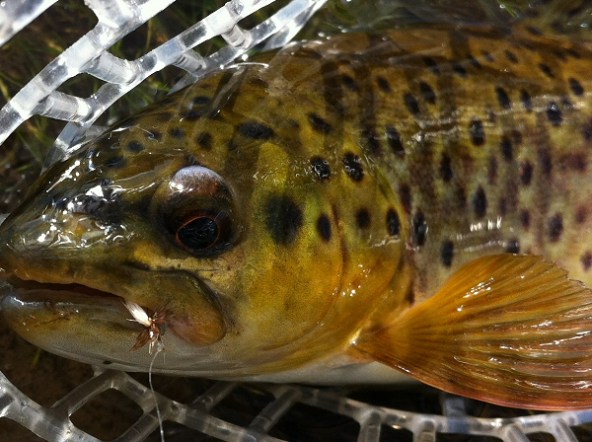
It still amazes me that a nice Hot Creek brown like this can be landed on so small a fly.
I’d repeat this more times than I care to recall but was rewarded with eight beautiful trout, mostly browns, all of which were no less than 13”. The biggest and prettiest crowded about 24” of beauty into 15” of fish.
Next year, I think this place will deserve an entire day of my attention.
This year’s annual club trip to the Eastern Sierras — organized by yours truly — came a tad bit later this year, but its planning nearly nine months ago couldn’t anticipate the snowfall that wouldn’t arrive last winter. From afar I watched the guide reports and river flows, but all of that was forgotten two Sundays ago, once an amazingly fat brook trout slammed the first dry fly cast into a suspect pool.
This is a good time of year to be in the Eastern Sierras. Fewer people, perhaps only the hardier (and those without kids), remain to fish, hike and camp. Being a bit more mature, our group rents a couple of rustic cabins, though we do cook dinner ourselves (clam linguine one night). The days are often cloudless and, at an elevation of 7,000 feet, this expanse of high desert warms up fast. Temperatures swing the other direction just as fast, dropping to the mid-to-low 30s in the evening. Startlingly brilliant stars illuminate the clear nights.
Once over Sonora Pass, my first stop was on the Little Walker River. This small water is often overshadowed by its bigger brethren, the East Walker and West Walker rivers, which offer bigger and more fish. A year after discovering the charm of the Little Walker, and during my first turn as “fishmaster” for this trip, I fished this creek with the club’s outings chairman. We had a wonderful time finding wild brook, brown and rainbow trout exactly where they should be. Jim has since passed away, but the Little Walker reminds me of his broad smile.
It surprised me to see a brookie so big in the Little Walker.
It was with Jim that I first explored Hot Creek, one of the waters that would be frequented during the week. Since I’d have six full days to fish, and in light of Hot Creek’s popularity, the plan was to fish it during midweek. It was a sound philosophy; avoiding as many other fly fishermen as possible and hoping that reduced fishing pressure over a day or two would improve my chances.
Hot Creek Morning.
Hot Creek has been the marlin to my Santiago. It’s a spring creek with a high fish population, estimated to be 8,000 to 10,000 trout per mile. But these are highly educated trout that have probably seen every fly in the catalog. Throw in clear, low water and weeds that limit opportunities to small lanes and the chance of a drag-free drift, and this fly fishing heaven can become hellish, particularly late in the year. Most descriptions of Hot Creek include words that tend to scare me: “technical,” “attentive mends,” “drag-free drifts,” “multiple hatches.” That first visit with Jim five years ago didn’t dispel any of my trepidation, despite my landing two decent fish.
Although I was on the road Tuesday morning later than intended, I descended into the canyon well before the sun was fully on the water. A single fly fisherman had arrived before me. Reminding myself that there was no need to rush, I slowly and softly walked upstream, taking time to stop and watch the water. In the absence of light, the water was dark and unyielding.
Trusting to my experience that fish would be in a familiar spot, I finally stopped to cast a size 16 dark brown-bodied caddis trailing a smaller dropper (maybe size 22, or 24); a red-butt zebra midge type of fly made up during a fit of madness inspiration at the fly-tying vise. This was truly blind casting. There was a lane big enough to allow for a decent drift of about two feet. I kept my false casts short and out of view of the trout I hoped were there, and used a single-haul cast to finally lay the flies on target. The caddis dipped on my third cast and a good-looking 11 inches of brown trout went airborne. I don’t know if it’s the lack of depth in the creek, but I don’t think I’ve seen brown trout as acrobatic as those in Hot Creek.
Hot Creek Brown. Love that pectoral fin!
With the first fish to the net, my pulse finally began to slow and my body relaxed. My casting settled down. Two more fish made it to my net during the next hour, one a dark-hued rainbow of about 14 inches. There are bigger fish in Hot Creek, but any decent fish hooked, played through the mass of weeds, and landed, is still a pretty big deal in my book.
Soon the first few caddisflies and mayflies appeared in the air as sunlight began to warm the water. The sunlight also revealed pods of fish, some hovering between weeds, others just on the edge.
Yes it was dark, but this wild fish also has a dark cast to it.
I downsized my caddis fly to a size 22, hoping that it might get a look or two. It did, but only in passing. I would land a total of six fish that morning and walk out of the canyon feeling pretty good about it. But it was a conversation — with a friendly guy who toughs out his year splitting time between fly fishing the Eastern Sierra and running a scuba shop in Cabo San Lucas — that had me pondering a return in the evening.


 fishing for words