fishing for words

(and tossing out random thoughts)


6 Comments

chasing frog balls*

Met with a lack of success in finding frog balls during my Opening Day fly fishing trip, I was back at the cabin this past weekend, this time with The Wife, hoping to track down the elusive and delectable pickled morsels.

[singlepic id=1098 w=300 h=452 float=center]

Who said frogs have no style?

We first found these little globes of goodness a couple of years ago at a wine tasting room in the Sierra Nevada foothills. That’s how we found ourselves near the little town of Angels Camp. Perhaps you know it better as “…the ancient mining camp of Angel’s,” or as the setting for “The Celebrated Jumping Frog of Calaveras County.”

What better place or time to find frog balls than at the Calaveras County Fair & Jumping Frog Jubilee?

The Calaveras County Fair is a relatively small affair, condensed into a few buildings, with the obligatory display of hit-and-miss engines powering pumps. One powered an old wash tub. Filling space in one of the buildings was the regular complement of vendors hawking their goods, some unique, some tasty and a few suspiciously smacking of snake oil. Other buildings housed the winning entries in horticulture, art and photography, as well as a display of locally produced wines. Our visit was flavored by the requisite fair food: corn dogs and cotton candy.

Most surprising was the entertainment value of the jumping frog competition. Since 1928, and inspired by Mark Twain’s story, frog jumping is a serious sport in Angels Camp. After all, there are rules:

Frog Requirements
1. Must be at least four inches (4”) from nose to tail.
2. Must begin jump with all four (4) feet, including toes, on the eight inch (8”) launch pad.
3. No substitutions.
4. Evidence of jumping the same frog twice will result in disqualification and forfeiture of prizes.

Jump Measuring
1. The distance will be measured on the third jump in a straight line from the center of the pad to the tail of the frog. A walk or skip is counted as a jump.
2. If a frog jumps into the Jockey or the Jockey’s equipment, the frog will be disqualified.
3. If a frog jumps into other people or other people’s equipment on the stage, the Jockey may allow a re-jump or take the mark.
4. During the jump only the person jockeying the frog may move ahead of the launching pad.
5. Frog catchers shall be on the right– or left-hand corners of the stage and cannot move until the frog has finished jumping.
6. The jump must occur within one (1) minute from start to finish. A one-minute clock will start when the Announcer announces the Jockey’s name. If the jump is not completed within one (1) minute the horn will sound and the frog will be disqualified.
7. Touching the frog after it leaves the pad is cause for immediate disqualification.
8. All marks are final. Any interference by a participant or team member may be cause for disqualification.”

[singlepic id=1089 w=300 h=199 float=center]

Fun with frogs.

An amusing kids’ competition is held to the side of the main stage, with all kids encouraged to kiss their frogs for good luck. Most precious was the look on the younger kids’ faces when their frogs took flight.

On the main stage, however, the competition was serious. Veteran “frog jockeys” competed alongside youngsters. Organized teams competed for top honors, including a trophy at least three feet tall and cash prize of $750. A frog that beats the world record of 21’ 5¾” can earn $5,000 worth of greenbacks for the jockey.

We ended up spending more time than expected watching folks flail their arms, hoot, holler and jump in an effort to motive their amphibian friends. (Not to worry, these athlete frogs, after just about 30 seconds of competitive effort, are pampered at a frog spa under the main stage.)

This year’s winner was a frog named “4Peat,” jockeyed by Michael Wright of Team Bozos. 4Peat’s three jumps totaled 19′ 1”.

The Running Man Frog

With his impression of the the "running man," this frog gained inches fast.

[singlepic id=1097 w=600 h=399 float=center]

This frog showed style...or just showed off...with a mid-air pirouette.

Alas, we were not to find frog balls. Not at the fair, not in local stores. It seems that the purveyor of these spherical snacks pushed prices a bit too high for the retailers we talked with. It was still a good time.

[nggallery id=79]


*No, they’re not real frog balls. They’re pickled Brussels sprouts. The story goes that the man who would make these delicious orbs needed a name for his product. His little sister, when served the vegetable at about six years old, decided that the odd green things on her dinner plate were green like a frog and round like a meatball, thus “frog balls.”
8 Comments

the slow lesson of fly fishing

Fly Fishing Trip Goals: Fish New Water(s), Fish for New Species/Strains of Trout,
Drink New Beer(s), Repeat. Note: Do so slowly, with great deliberation.

It’s not casting, presentation or fly selection; it’s a deliberate and slower pace that offers the best chance of success in fly fishing.

This isn’t a new or unfamiliar idea. My first appreciation of a slower approach was the pace at which I entered any water, familiar or unfamiliar. Slowing down to take the time to make a few observations. To watch the sun rise. To look for that one rising trout. To take time to fish that small seam a few feet out from the bank.

[singlepic id=1088 w=275 h=368 float=center]The decision to try my hand at tying flies required a slow, methodical approach as I learned techniques and how materials responded to the tying process. I’m not a production tyer, and probably think more what I’m doing when tying than I should. That’s okay; a lot of that thinking is about the fish I expect or hope to fool with that fly; or memories of already having done so.

Rod building again necessitates slowing down. Wrapping thread seems simple, and it is. Wrapping thread well isn’t. Five-minute epoxy is the fastest part of the process. Laying down multiple coats is not.

More experienced fly fisherman might wonder why it took so long for me to come to this conclusion. In my defense, there were trout to fool and success was measured by body count.

Two weeks ago, while setting aside the desire to get on higher-elevation trout water as soon as legally possible, it dawned on me that the fish would still be there even if my arrival was delayed a day or two. Like dominoes falling, decisions were then made to purposely plan a slower pace.

It’s a huge thing to slow down in today’s world. To take a slow, long look at that wild trout. And, when the sunlight’s too dim to fish, to slowly relish the day’s adventures, seasoned with good food and, if you’re lucky, a good beer.

It’s all worth savoring.

To be certain, we lugged along a few new brews to the cabin during our Opening Day trip, but didn’t pass up the opportunity to try something from the tap during dinner at The Rock.

Told by the waitress that customers had complained that New Belgium’s Ranger IPA was too hoppy, Sean naturally went ahead and ordered it. Apparently those customers have sensitive palates. I’m not a huge fan of too much hoppiness on the back end, but even I found the Ranger rather mild. So did Sean.

Though not an extreme beer snob, I favor trying local suds, and opted to try Snowshoe’s Grizzly Brown Ale. (And, honestly, I felt an obligation to try the Grizzly as research. The Snowshoe brewery is an hour away from the cabin and will be on the itinerary during my brother’s visit next month.) I’ve grown increasingly fond of a well-done brown ale. The Grizzly didn’t disappoint, and it seemed that Sean might have wished he’d chosen it. It’s certainly dark in color, but semi creamy and not heavy as might be expected. A nice toasty maltiness gives way to a light hop finish.

Certainly a great way to finish a day of fly fishing.


3 Comments

start of the 2011 trout season: working out the kinks

From what I hear and experienced, it might just be a good thing if you missed the Trout Opener this year. At least on the east and west slopes of the central Sierra Nevada mountains.

No one’s outright said as much, but reports from the Eastern Sierra suggest that crowds may have been there but the fish weren’t. One particularly likeable report: “Bait slingers and trollers failed miserably on Opening Day weekend and 100,000 lives were spared!”

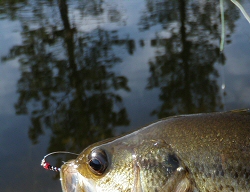
Bass from the Shadows

One small bass from the shadows of a small pond.

The same seemed to be true in our neck of the woods. A California DFG hatchery worker I’ve talked with over the years told of anglers grumbling that fish were nowhere to be found, despite the usual numbers being planted. (More interesting parts of that conversation will come in a future post.)

Not all went as we planned, but arriving in the Sierra foothills in the aftermath of Opening Day put Sean and me in a good position to fish and explore in relative solitude. Months of neglecting necessary fly fishing skills were soon forgotten and muscle memory was gradually regained.

Arriving before Sean and after opening the cabin for the season (thankful that pipes hadn’t burst during the long winter) it was time work out the kinks on the convenient Lyons Canal. Just behind town, it’s more accurately Section 4 of the Main Tuolumne Canal of the Lyons Reservoir Planning Unit. Built in the mid 1850s, it’s part of a network of canals — estimated to total 60 miles — that crisscross Tuolumne County. Though peppered with flumes and concrete in some sections, parts of it have been reclaimed by Mother Nature and now resemble a small stream carved into the rolling hills.

Like many moving waters, walking a short distance away from easily accessed sections is worth the little effort required. Stocked with rainbows, the canal is also home to a now wild population of brown trout.

Hopeful that the most important tool in my fly fishing arsenal — confidence — wasn’t lacking, I tested likely cut banks, boulders and shaded water.

Despite the lack of wildness of the surroundings — homes and a roadway are a short distance away — these brown trout are wild enough to scatter at the shadow of a rod or a less-than-light footfall. This requires casts well upstream of your position, with the best casts placing the fly no more than a few inches from the bank.

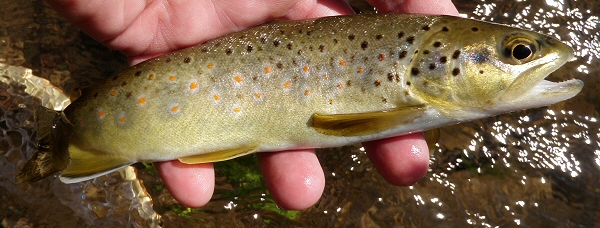
My first fish darted out from a surprisingly deep undercut four feet in front of me; eating a standard red Copper John nymph and barreling downstream into faster water. Nicer still, this was probably one of the biggest browns I’ve pulled out of the canal. It looked healthy, even happy.

Brown Trout from Lyons Canal

Another brown from the canal…they do like hugging those banks.

Six browns of various sizes came to the net that afternoon, all seeming to eye me with what might be described as familiarity bred by a near certainty that we’ve met before. Thankfully, most are small enough to be released by freezer-stocking folks hunting the bigger, stocked rainbows.

Perhaps it’s a reflection of the intervening off-season troutless months, but the brown trout this year seemed feistier and their spots brighter than I remember.

I finished up the day, with long shadows creeping between shafts of the setting sun, tossing streamers into a pond on long-fallow golf course. Decent sized bass cruised the banks, but in such small water quickly disappeared into the weeds. A few of their offspring were fooled with streamers and trailing nymphs; the biggest was about eleven inches.

As the sun fell behind the tips of the pines, it felt good to have worked the rustiness out of my cast and rediscover the confidence that had been in hibernation.


2 Comments

the water was high, but crazy luck abounded. fish caught, beer consumed and recon accomplished. more later.

Laughing Brown

Post Opening Day fishing so fun even the fish were laughing...


7 Comments

the challenge of a (personally) delayed trout season opener

It was the ride to the office yesterday that finally triggered that physical feeling that Opening Day is upon us. Despite the early hour — 0600 or so — the ride was comfortable, not too cold and not too warm. The sun was already burning away the coastal overcast, leaving behind clear skies.

Then it hit. Smack dab in the middle of my face shield. The first bug of the season. If I were to guess, I’d say something in the family Chironomidae. Trout food, particularly as pupae.

Until last year, it was imperative to depart Opening Day Saturday, immediately after assisting with a fly fishing class that I’ve been involved with for quite a while.

What changed? I’m certainly not self employed like the Unaccomplished Angler or retired like Mark (@Northern California Trout) and able to traipse off to fish whenever I’d like. I do, however, accrue a healthy number of vacation days at work and now consider it impolite to not use them.

[singlepic id=764 w=200 h=267 float=center]

Stream X

What’s truly changed is my attitude about the start of trout season. Perhaps a modicum of maturity can now be ascribed to my fly fishing. Rather than stand shoulder to shoulder with anglers from “the dark side,” there’s a certain challenge in arriving on the few fishable waters in the western slopes of the Sierra the Monday after the Saturday opener. (According to Mark, this year more anglers may be crowded on less available water due to snow and ice at higher elevations.)

The more accessible waters have been flogged and the fish traumatized by flashy spinners and DayGlo baits, making it all the more challenging and satisfying to hook and land the fish too smart for not caught by these other anglers.

I hope to also visit Stream X, where unmolested wild rainbows likely will attack anything that remotely looks like food. It’s a bonus that this is the time of year when much of the fishing crowd won’t be out during the work week.

So, Opening Day I’ll be helping folks learn how to play and land fish on a fly rod. Sunday I’ll spend time with The Wife. Monday through Friday I’ll be fishing.

See you on the water.


8 Comments

fishing for words turns five after fourteen years in the making

fishing for words (ffw) was born on April 19, 2006. However and without knowing it, my blogging started fourteen years prior to that.

During the mid ‘90s — the beginning of the end for most grunge bands — I joined the few civilians who could make sense of this thing called HTML to launch a website with the unoriginal title “My Little Corner of the Internet.” It was a kooky little site for which every new entry required incorporating text into hand-coded HTML.

The trend at the time was to post a relatively static website about one’s self, and looking back one can see that the early “posts” — stories about trips or family events — popped up once or twice a year from August 1997 through July 2003. There seemed to be more to write about starting in 2004. I don’t know if was the fact that the kids were growing up and it didn’t take a trunk full of diapers, bottles, food and a stroller to travel more than five miles, or the fact that my new wife actually encouraged me to enjoy some adventures on my own.

My writing was largely directed at family and a few friends. Though a student once thanked me for my page on Aloha shirts (apparently it aided him in writing a term paper), I suffered no delusion that anyone would take an interest in what I wrote if they didn’t know me personally.

The Future of Outdoor Blogging

Perhaps the future will bring a new immediacy to outdoor blogging. (That’s not me...it’s my son with a wild rainbow on Stream X.)

Things changed in 2006 with this stuff called CMS and easy-to-use blogging platforms — both of which coincided with my first experience brandishing a fly rod over a Sierra Nevada stream. It was all in place: a website/blog that could easily be fed and a hobby that could provide material.

Now, 139,512 words and 458 posts later, I still resist defining my blog. It remains a place for family and friends…with a loose definition of “friend.” Over the years, nearly everyone in my immediately family has made an appearance in my blog — whether they liked it or not. Friends run the gamut: fly fishing club members, fellow bloggers I’ve surprised by actually showing up on their doorstep met face to face; folks who thanked me for suggestions on where their kids might have a good first fishing experience; even a few buddies met online with whom I eventually shared a fishing trip or two. Every reader is a potential friend, just like the older gentleman and younger guy wearing waders that were too clean and waving barely used rods.

While ffw doesn’t subscribe to any specific definition, it’s definitely been about sharing a personal story. It’s about stepping out of my little universe to share encouragement, a laugh, an experience, a tip or a trick. And every once and a while I’m pleasantly surprised to learn that my words do encourage or earn a chuckle.

Some folks might lament about how much things have changed in five years. I’d say that it’s only our methods of our interaction that have changed; the folks behind it remain much the same. Take a look at the Outdoor Blogger Network, for example — a group of good folks coming together over common interests. They’ve got to be good folks; they let me and my little blog join in the fun. And fun it’s been, sharing my misadventures and adding a couple of new readers every year.

As for the fly fishing, the places I fish usually are not covered in the slick pages of magazines. These are places that can be reached with relatively modest means and without a 4×4. (I did learn last year that a 4×4 would be helpful on the roads to and from Yellow Creek.)

My hero shots find heroism in fooling small wild and skittish brook trout with a fly tied with my own hands. (This summer, hero shots may include a fly rod built with those same hands.) And though the “body count” isn’t so important to me anymore, it’s still about duping that first dozen fish and the story that comes with it.

I’m hoping that there will be many more fish to write about.


6 Comments

thanks to dad, we were lucky to simply survive experience the great outdoors

This post brought to you by a writing prompt from the Outdoor Blogger Network


I’ve been a dad for more years than you’d think and with that has come amazement that the number of candles on my birthday cakes made it to double digits.

Sure, everyone my age grew up without seat belts, car seats, and medications without child-proof lids. Many of my contemporaries rode bikes without helmets, ate sandwiches made with white bread and drank drinks made with real sugar.

Personally, I’m more amazed that I and my siblings survived family vacations in the great outdoors.

I can’t figure out if dad was fearless, just wasn’t being smart or placed such importance on exposing his kids to the outdoors that the risks outweighed the rewards. Maybe it was the fact that we didn’t have innumerable television documentaries underscoring man’s inability to win in a one-on-one battle with nature. Whatever the reason, we were lucky.

There are photos that I won’t share here of me in diapers, in the wilds of Yosemite Valley. That might have been where it all began, but the memories are foggy.

Tuolumne Meadows Campsite

Where we camped for many years, long ago...

What I do remember are the multiple summers we spent in Tuolumne Meadows. At 8,600 feet elevation the weather was changeable. This made day hikes, already an adventure thanks to steep elevation gains and decomposing granite, unpredictable.

While there’s debate among my family as to the name of the lake that was the destination on one ill-fated hike, it’s clear that dad had pushed the limits on that cold and overcast day. With the distance of the hike limited by the length of my youngest brother’s legs, I’m guessing the hike in took no more than a couple of hours. Much of the trail wound in and around trees before rising and emerging onto a wide meadow. Crossing the meadow put us on the shore of a lake nestled up against granite peaks. Back then we carried spin fishing gear, and it wasn’t more than a few casts before a trout made one of the most dramatic, leaping strikes to swallow dad’s Mepps Agila. Small as the fish was, dad stumbled back in his surprise at the strike.

Just about then or shortly thereafter (my memory was muddled by the excitement), the gray of the sky gave way to small granules of something best described as light hail or heavy snow. Not being as keen on fishing, my sister and brother were huddle with mom near what little shelter was offered by a wind-stunted tree. “Jerry,” my mom said, “I think it’s time to go.” Nearly 40 years later I can understand that when fishing, time flies by but those same minutes are painfully slow to pass when you’re shivering in the high country and miles from the remotest fingers of civilization. Grudgingly, dad decided it was better to leave the fish for the sake of his children and, perhaps, his marriage.

The first time we pitched a tent at the Tuolumne Meadows Campground, where, by the way, there are no public showers; my dad’s solution was to take advantage of what nature had to offer. He proudly explained to us that we’d be using biodegradable soap. (It was a novelty back in the 1970s.) Our water source would be the oh-so convenient Tuolumne River. A river that originates from two forks — the Dana Fork and the Lyell Fork — both of which originate from the huge snowpack in the high peaks of the Sierra Nevada. There’s something about bathing in water that only 24 hours ago was in its frozen form. Yet another time we dodged hypothermia.

Then there were the bears. We knew they were there. We saw them occasionally during the day. It’s the times we didn’t see them that still give me chills. There were mornings we’d wake up and dad would show us the bear tracks through our camp; tracks that weren’t there yesterday and must have been made during the night, when I stepped out of the tent for a trip to the bathroom and could have become a tasty midnight snack for one of Yogi’s cousins.

Sierra Cup

The fateful faithful Sierra cup.

Those mornings dad would tempt fate yet again by preparing breakfast on the flattop griddles that years ago were standard equipment in every national and state park campsite. These griddles were nothing more than flat plates of steel welded to a grill, on top of a three-sided steel box, and naturally were exposed to the elements all year long, accumulating sap, rust and the occasional animal or bird dropping. Dad’s ritual involved stoking the wood underneath the grill with the idea of sterilizing it, then throw on bacon to lube it up before tossing on eggs and toast. While it’s entirely possible he did manage to sterilize the griddle, I can help but wonder if some of the “seasoning” entailed small bits of rust and other things.

In that vein, I also remember being so proud of our Sierra cups. My brother and I would loop them under our belts, and like little men, dip them into the clear streams to quench our thirst. Try that nowadays without worrying.

These are only snapshots of my childhood adventures in the wilderness, and there are other, less dangerous memories of other hikes, more fishing and just being a kid in the great outdoors. Those I’ll save for another time.

I was lucky to spend so much time in the great outdoors. All of these adventures never fail to bring a smile to my face.


4 Comments

finding fish, but not fishing, close to home

[singlepic id=1011 w=300 h=452 float=center]

Fern Silhouette

Muir Woods National Monument in the hills just north of San Francisco could be like someplace near you. That place that’s relatively well-known and frequented by out-of-town visitors, one that you always mean to visit but never set aside the time to do so. The trees of Muir Woods quietly stand in a valley accessed by roads that progressively shrink from a highway to a local boulevard and, finally, a small two-lane country road that twists down the hillsides without the comfort of guard rails. It’s a drive that requires patience. It’s worth finding, however, because this 560-acre national monument encompasses one of last groves of old-growth coast redwoods on the planet, and the only one in the San Francisco Bay area.

It was a gray morning last week when The Wife and I left the rolling hills of home and headed west across the San Pablo Bay Tidal Wetlands and into the hills of the Coast Ranges. The air was cold, the sky hidden by fog, dense and unmoving. The kind of day that suggests you’d be better off nestled by the fireplace with a hot beverage.

Most of the drive was familiar and thus unremarkable, but soon enough we were rising into the hills and the fog. An all-encompassing grayness took the place of what otherwise would have been a sweeping view toward the coast. The fog, but not the chill it lent to the day, was left behind as we descended a number of switchbacks.

The getting there was easy; the parking was problematic. Even on a day like today, parked vehicles were overflowing onto the roadway. Maybe it was karma, or simply superior situational awareness, that opened our eyes to a slot unobserved by half a dozen other drivers at the end of one row.

On a short hike to the park the oak woodlands typical of California’s hills give way to a coniferous forest, dominated by towering Sequoia sempervirens. The paved trail parallels the babbling Redwood Creek, feeding guests toward the obligatory exhibits and gift shop, then the entrance.

Though there’s no escaping the noise of the crowds ignoring scattered signs asking “Quiet, Please,” the silent presence of these redwoods, many seedlings before World War II, can impress. Light filtered first though fog then the thick forest canopy lends a deep blue cast, deepening the greens of California bay laurel, Douglas firs, bigleaf maples, dogwoods, tanoaks, redwood sorrel and countless ferns; horsetail lady, sword, maiden hair, and gold back to name a few. It’s a wonder that such a place exists so close to San Francisco.

[singlepic id=1012 w=615 h=408 float=center]

Near Cathedral Grove

A quiet and easy walk took us deeper into the dense grove; wander first closer to then farther away from the creek. Soon I’m getting kink in my neck gazing at the massive trees in aptly named Cathedral Grove. These trees average 800 years old and taper from a thick base to a top that can’t be seen. They have survived fires, storms and man.

The trail leading back out of the grove crosses the clear waters of Redwood Creek, one of the southernmost streams in which coho salmon spawn. This time of year it’s the coho salmon (Oncorhynchus kisutch) that will make their way upstream, to be followed by steelhead (Oncorhynchus mykiss). It’d be dishonest to state that I wasn’t hoping we might be blessed to see fish in the creek.

We were blessed. The trail that would return us to our starting point crosses then parallels the creek four or five feet away from its bank. As we neared a small bend the bed of the creek moved. A coho, at least a good 18 or 20 inches, hovered in a couple feet of water. We watched, shushing the less courteous, as the salmon rested in a small eddy below fallen tree branches. Shortly, it was joined by another, similarly sized fish. After seemingly communicating via body language, the two cohos continued upstream. After a two-year absence, two more coho happened returned to Redwood Creek during our visit.

[singlepic id=1017 w=615 h=408 float=center]

Evidence that the Redwood Creek coho salmon may have a future...

Perhaps it was fell-good aspect of being outdoors and seeing nature at work (often despite humans), but lunch at the Muir Woods Trading Co. Café was particularly good. While Karen enjoyed a hot dog of grass-fed beef, I dove into a house special, the “Marin Melt,” which is built on a foundation of some of the most rustic bread I’ve ever met and two smooth locally produced cheeses. Add a bowl of fresh tomato soup, and it’s a lunch made for a cold morning near the coast.

Though there were no fishing rods involved in this trip, the fish were a welcome surprise.

[nggallery id=75]


2 Comments

anticipation: the early edition

For a few weeks now it’s either been raining like cats and dogs or bitter cold. At least for this neck of the woods, where anything below 40 degrees is uncommon. A day ago it was -18 degrees in the in the Sierra Nevada’s Long Valley Caldera, a little volcanic crater of roughly 200 square miles that I’m not likely to fish at such temperatures. If I do, it’ll be via snowmobile and with a supply of Glen Morangie.

It’s good weather to mark on the new year’s calendar the days that’ll be dedicated to fishing. They’re adding up nicely.

It’s not that I’ll be sitting on my hands until the general trout season reopens. There’s a fly rod to be built and flies to be tied. We’ll finish the rod by early February during a series of Saturday sessions. Fly tying will include giving guidance to a son who wants to learn. Then there are trips to plan.

I think it was about three years ago that the realization set in that there was pleasure to be found in the planning of fishing trips. Planning can be a pain in the arse, sometimes literally, because the Internet has opened the doors to a crushing abundance of information; then it took a while to learn to let go of the niggling worries about the actual outcome of a trip.

So, rather than wantonly throw out New Year’s resolutions that are likely to remain unachieved, my inclination is to etch things in wet cement as soon as possible. Things were set in motion this year by that preference and petitions for early planning from some of the folks who’ve participated in the club-sanctioned trip I lead in the Eastern Sierra.

Lest anyone think that there’s an inherent selflessness in these acts, the record should be set straight. Part of my willingness to teach Sean to tie flies is rooted in the self-serving belief it’s high time that he lose his own flies. It’s with as much resignation as can be mustered that I’ll inform The Wife that I must again act as ‘fishmaster’ for the club’s Eastern Sierra trip, quietly omitting the multitude of benefits it offers.

Most fly fishermen will ascribe good fishing and great scenery to favorite fishing venues. The Eastern Sierra excellently fits that bill and hopes are high that this year it will be even better. The snowpack is in great shape and water levels are good; both point to fantastic things in the fall. For those who’ve never been, the attraction of the Eastern Sierra can be modestly measured by the six folks who’ve already committed to a trip that doesn’t take place for another nine months. Those benefits that need not worry my wife: good food, home-brewed beer and great fishing far away from clocks and everyday concerns.

This year my volunteerism will extend to kindly offering to aid a fellow fly fisherman to get acquainted with Crowley Lake.  We’ll spend our first day on the lake with a guide I’ve employed a few times each of the last several years, as an introduction to Crowley for my friend and an opportunity to update my knowledge of current conditions. During the subsequent days there might just be an occasion or two to spend more time on the lake fishing from my friend’s boat. As you know by now, in no way did this influence my desire to help.


2 Comments

another perspective (…or just ask the person landing more fish than you)

…picking up where we left off last week

A new fly fisherman met the Zen Master after wading hundreds of yards. He was understandably pleased to learn at the great master’s feet.
      “Look at the fish swimming about,” said the Master, “They are really enjoying themselves.”
      “You are not a fish,” replied the fly fishing student. “You can’t truly know that they are enjoying themselves.”
      “You are not me,” replied the Master. “So how do you know that I do not know that the fish are enjoying themselves?”

The two men who taught me fly fishing basics were not Zen masters; but that first day they might just as well have been speaking in riddles. The mechanics of fly fishing aren’t incredibly complicated. If someone as ungraceful as myself can learn to decently cast fly, there’s hope for anyone interested in the sport. It’s the jargon, tactics and the eventual accumulation of the appropriate knowledge that require time, perhaps a lifetime to master, and much of that may only be learned through the act of fly fishing.

I learned the basics nearly five years ago through a class taught at the club of which I am now a member, only later realizing the value of those eight hours, which touched upon casting, gear, lines, leaders, tippets, entomology, flies, wading, venues and just about everything related to the sport. A club outing, specifically for the students, provided an opportunity to put classroom work into practice on the lower Stanislaus River. The “Stan” is one of the largest tributaries feeding into the San Joaquin River in California’s Central Valley, and offers a good, nearly year-round tailwater fishery, with topography common to moving water in the western Sierra foothills. It was on a smaller version of this type of water that I found myself trying in mid November to form an answer for the gentlemen who asked if I could tell him why Sean and I were catching fish while he and his buddy had yet to baptize their new nets.

It was in that moment that I learned something — call it “streamside enlightenment” — that could only be taught through the observation of another. I hope the bemusement I felt didn’t show on my face as it dawned on me that while I still identified myself as student of fly fishing, I’d been called upon to teach. I’ve done what I could to educate my older son in fly fishing, but that’s what a father does. The difference now was that someone, outside of family, thought that I might have wisdom to offer and that the countless trout I caught, some from spots already hit hard by other anglers, weren’t simply happy accidents.

I’ll admit that I had wondered about this gentlemen and his buddy. From my upstream position they came into view at the end of most of my drifts, and nearly every time they appeared motionless, pointing their rods at pools I knew contained fish.

My mind mulled over possible answers to the question that hung between us and, deciding that I had landed more than a fair share of fish, I secured my rod and waded toward shore and the gentleman. First, I needed to know that these two fishermen weren’t using fly rods inappropriately; after all, I have seen worm dunkers use long fly rods to extend their reach.

“Well, could you tell me what you’re using?” I asked. He held up a grasshopper imitation that would seem more at home as a model on a miniature science fiction movie set. To this was tied a Copper John wound with wire of an indescribably bright lime-green that in nature would only signal the poisonous nature of prey. Both files were at least three times too big, but these were the flies they were told to buy by the guys at a nearby big-box sporting goods store.

Silently, I selected from my fly box two size 18, beadhead Zebra Midges, flies that I tie with an extra tail of flash. The gentleman’s eyes had grown wide when I opened my fly box, then wider when I deposited the tiny flies into his waiting hand. He called to his buddy, “You should see all the flies in his box.” Then, staring at his hand, asked, “This is what you’re catching them on?”

The student frowned. At long last, the Zen Master asked, “Perhaps it would be better to begin with a simple question.”
      ZenFish“Please do.” implored the student.
      The Zen Master began again, “This is a much simpler puzzle. What is the sound of a trout laughing?”
      The student was perplexed to even think that a fish, even one enjoying itself, would laugh. Each of his answers was quickly dismissed. Finally, exasperated, the student exclaimed, “Master, I cannot solve even your simplest riddle. I am a complete idiot!”
      Then the student froze. Appreciation flashed across his face. He sat down, and said, “I am ready for my second lesson.”

I don’t remember my exact words, but my explanation touched upon the idea of trying to fool the trout, and to do so one should present what they think is food, not what we fisherman think might attract their attention. (It certainly wasn’t the time to discuss attractor flies versus imitative or realistic flies.) After much nodding of heads to acknowledge some understanding, the flies were tucked away and I asked the gentleman to join me downstream with his buddy, who all this time had stood still, rod perpendicular to the stream and just as stationary.

There’s an instinctive quality that seems to overcome fly fishermen after a few years of successful outings. One stops thinking, ‘cast, mend, watch the drift, mend again, slightly lift the rod tip at the end of the drift’ while watching for anything — any movement, however small — that triggers an almost instinctual jerk of the rod to set the hook. Sometimes referred to as muscle memory, it’s something most people don’t, or at least I didn’t, learn until everything is done properly and ends with a fish on and, hopefully, in the net.

I outlined how these two should cast and present flies, describing how a fly not moving with the current is a rather unnatural presentation, as evidenced by the lack of interest on the part of a number of trout in their vicinity. Since the huge gaudy grasshopper was, in essence, the indicator in their set up, I talked the one gentleman through the process of lobbing his flies upstream. It’s not the prettiest way to move flies, I explained, but it avoids leaving them in the overhanging tree branches common on this stream.

My on-stream lesson, abbreviated as it was, included a quick outline of setting the depth of nymphs, a reminder to watch the indicator fly for movement, and a quick account of what makes a decent hookset. It’s not that I didn’t expect either gentleman to hook a fish, but if figured they could easily enough learn how to land one after everything else came together.

I never did see either of these “students” attempt a hookset, much less land a fish. Hopefully, they will someday soon, and learn that the greatest lessons for a fly fisher are often taught without words, by the fish.