When I decided to step into the light and embrace fly fishing a few years ago, certain waters came to my attention. Many were governed by regulations limiting fishing to un-baited, single-hook, artificial lures. Others were specifically deemed zero-limit barbless hook fisheries. It was exciting.
A relatively short section of a certain Sierra Nevada creek was particularly alluring. Tales abounded of big browns and hefty rainbows. Most important to a novice fly fisher, only a few fly-eating trees follow its course. All this was gleaned from photos.
Then I read the associated article, and shuddered. It took only one word, an adjective often casually thrown around by old timers, to stop me in my tracks: ‘technical.’ I immediately visualized streamside judges waving numbers in the air, giving low-digit scores to my casting.
My discouragement mounted as the research piled up. There was no consolation to be found in other articles, books or discussions with more experienced fly fishermen. Much of the season this creek requires accurate sight casting, with presentation made difficult by heavy weeds that limited the ‘natural’ drift of your fly. In a nutshell, I was told, it was a creek only to be fished by those who had paid their dues.
But there I was, still in my first year of fly fishing, standing on its banks. I was asked by a more seasoned fly fishing club member to join him on this creek. He was one of the guys who had taken me under his wing, and it seemed to me that a refusal of the invite would have been rude at the very least, and would call into question my ability to absorb the knowledge he had thus far imparted.
The creek wasn’t as wide or as deep and I had envisioned. Most places one could cross in three or four strides without the water rising much above the knees. The water clarity fit that timeworn description ‘gin clear.’ We’d set out for his favorite spot, and I was upstream a few yards.
On the trail we had discussed flies. He told me he’d be using dries but that I’d be fine with a dry-dropper combination and lowering his voice, added that a lot of guys might have a fancier cast, but this fishery often rewarded the spirit and stick-to-itiveness of an angler, not the casting. Fish don’t judge casting.
It wasn’t until I landed that first brilliant rainbow that my fear fell away. Sure, it took more than a few casts to find the lane, but the abundance of trout ensured that any adequate presentation wouldn’t be ignored.
That first rainbow that rewarded this fly fisherman with a strong fight and great colors.
In the end, both my dry fly and nymph elicited strikes. I had taken on this Creek of Fear and won. Recently, one guide went so far as to say this creek is a good place for novices, a place that demands hard work but quickly rewards. I’ve since fished this creek half a dozen times. I netted nice brown and rainbow trout each time, but only after putting in the work, even if just sitting, watching and learning the day’s lesson before the first cast.
I’m still a bit intimidated when good casting or technical prowess is mentioned as necessary to success in any fishery. But perhaps I am not as unaccomplished ( [uhn-uh–kom-plisht] adj 1. not accomplished, incomplete; 2. certain angler of the Pacific Northwest*.) as I think, though there will be lot of learning before I too can “snicker at the new guys.”
* Kirk’s Kickstarter campaign is funded! He and Olive must feel so accomplished! Now the real work begins. To help Kirk feel less unaccomplished, join in the Kickstarter campaign that could launch his book character Olive, the Woolly Bugger and friends into the digital world with an iPad app. There’s only three days left. (In full disclosure, I’ve contributed in the hope of getting my complimentary copy of the app, so I’d also appreciate any contribution that would get me something out of this deal.)
A time comes in every fly fisherman’s career when it becomes clear that he (or she) has too much gear.
An outsider will recognize this long before the fly fisherman, but it seems that at some point, the vast majority of fly fisherman will eventually talk about simplifying. This may mean using a lanyard instead of a vest, carrying a single fly box instead of three, or taking up tenkara, which itself requires the purchase of more gear.
There’s an irony to the oft-told story of the boy who started fishing with cane rod, then grew into the fly fisherman who owns a small-brook rod, a small-river rod, a medium-river rod, a large-river rod, single- and double-handed salmon/steelhead rods, a stillwater rod and maybe a saltwater rod. And a few spare rods just in case. Each rod, of course, needs a matching reel. While there is legitimate need for a range of rods, this same fly fisherman will fondly recall the remarkable enjoyment, and simplicity, of chasing bluegill, bass, trout or some other fish with that cane rod of their childhood.
The first stage entails learning to cast with a rod that was passed down as a gift or was simply inexpensive enough to warrant an attempt at fly fishing. The first fish caught on this rod will likely be remembered forever. A fly box — probably a small, free one from the fly shop — and forceps fit into any available pocket. A broken branch serves as a wading staff.
Stage two entails replacement of that first rod and reel with counterparts that are shiny and new, both of which are more of a personal choice, and not a choice necessarily predicated on budget. Then there’s the vest; two, three or five more fly boxes and the flies to fill them; a decent mesh net; a wading staff; and maybe waders and felt-sole wading boots.
It all peaks in the third stage. A preference for a specific brand means new rods, new reels (with back ups for both) and new lines for every type of water fished or species chased. The vest may be replaced with a chest or sling pack. A rubber net is a must have, as is a lightweight, high-strength composite alloy collapsible wading staff. New rubber-soled wading boots include carbide cleats. A multitude of flies are purchased or tied, and if tied, enough materials to last three lifetimes must be bought.
The stage of simplification. It’s not so much about catching fish anymore, it’s the act — the gear is secondary. Maybe an attempt to recapture the pure joy of that first fly rod-caught fish, or perhaps avoiding hauling so much stuff around the river. Perhaps the rod is one built at home…not perfect but nice looking enough, and mated to a reel chosen for no other reason than it’s a favorite. The single fly box may not be filled, but it has every fly that’ll be needed.
If the level of a fly fisherman is measured by his gear, I’m still an amateur. Coming into the hobby later in life hasn’t afforded me the years that many spend accumulating equipment.
I did, however, purchase a new net at the club auction this week, for many reasons. Sure, it’s lighter than my current net and more “appropriately sized” for the trout I land. Crafted by a club member who’s also a skilled woodworker (so, made in America), it’s one of a limited set with the club logo (in enamel and metal) worked into the handle, and my winning bid will go into the pool of money the club donates to many conservation organizations.
Fly fishing is not stuff, it’s what you do. (And it really shouldn’t matter what you use to do it.)
While fishing in the Eastern Sierra last year, a buddy more spiritual than I commented that he had no worries about missing services that Sunday, figuring he was closer to God when casting a fly. I figured he was simply commenting on being outdoors and close to majestic and magical natural wonders, though he might have been thinking that we were closer to heaven at 9,000 feet in elevation.
A most romantic gesture by a fly fisherman: presenting a fly named after the woman who's caught his fancy.
At one time or another, those who fly fish have come across references or realize themselves that fly fishing can be a journey of faith. In some respects, this faith — call it unrestrained optimism if you wish — is reflected in the everyday of most fly fishermen. This is a central point in “Salmon Fishing in the Yemen,” with two of the main characters (Ewan McGregor as an English fisheries expert and Emily Blunt as a representative of the Yemeni sheikh played by Amr Waked) overcoming everyday problems such as loneliness, anxiety and lack of direction. Though tagging a movie as one with an uplifting story may be akin to damning with faint praise, it is; just as much as it offers a real view of fly fishing as a part of life, as I’d think it is for many of us.
I don’t think it’s a reach to call fly fishing a sport of faith, albeit with a side of skill involved.
Faith that the fish are where we think they are. Faith that the right fly is on the end of the line. Faith in our presentation. Faith that all those hours and all those casts will lead to something. And this year, in California, faith that already stressed trout will survive what’s shaping up to be a dry year.
Faith is quickly spelled out in “Salmon Fishing in the Yemen” as Sheikh Muhammad (Waked) equates his belief that salmon can be introduced to a country with no permanent rivers when asking reluctant fisheries expert and fly fisherman Alfred Jones (McGregor) how many casts he’s made before hooking a salmons. Jones’ answer of “hundreds” illustrates the faith held by the sheikh.
Even fly fishermen — part of a relatively conservative bunch in terms of techniques and fly patterns — who ‘break the rules’ do so on faith. Most fly fishermen start out utilizing the practical experience of others as a foundation, but it seems to me, that at some point, the confidence in the knowledge that one is doing everything properly gives way to a faith that allows departure from the norm and tradition. However outrageous this change might be, it may offer a crucial adjustment that will turnaround an otherwise fishless day. I’d go so far as to posit that the fly fishing of our grandfathers — a sport of rules mandating only upstream casts and high-riding dry flies — has shifted, for better or worse, to a more inclusive and adventurous pastime that only demands a little bit of faith.
Sure, “Salmon Fishing in the Yemen” is a soft love story about people brought together by a common interest, and while the fly fishing is peripheral, this story reminds me of the connections, relationships and little things that bring people together, as fly fishing so often does. (The book by Paul Torday offers more pointed satire.) The laughs are easy because the actors lend realness to the characters they portray. The film doesn’t have the same sharpness as the book, and a subplot disrupts the main storyline, but I walked out of the theater glad for the experience.
P.S. As for the fly fishing displayed in the movie, it’s okay and only tangential to the story. I’ve not fly fished for salmon, but one scene did leave me scratching my head.
While the youngsters flit about, expecting a burger delivered before they order, fly fisherman become one of the last bastions of stubbornness patience in a world moving at the breakneck pace of broadband.
People will visit a commerce or news website less often if it is slower than a close competitor by more than 250 milliseconds (a millisecond is a thousandth of a second).
‘Two hundred fifty milliseconds, either slower or faster, is close to the magic number now for competitive advantage on the Web,’ said Harry Shum, a computer scientist and speed specialist at Microsoft.
But speed matters in every context, research shows. Four out of five online users will click away if a video stalls while loading.”
As a youngster, I always assumed that those old fly fishing guys — a group to which I still feverishly claim not to belong — were slow because of age. Time’s revealed that I was a bit hasty in judging.
Sometimes it’s a method, sometimes superstition, and more often than we might care to admit, an unwillingness to think that it’s us that’s the problem…or a belief that any problem can be rectified with just one more cast.
It might be obvious that changing flies or moving up river is an answer to refusal after refusal after refusal. But obstinately I place faith in my ‘confidence flies.’ I don’t think I’m all alone; count the number of magazine articles, blog posts and forum discussions extolling anglers to swap flies after three refusals. And that same fisherman who knows the steelhead shuffle will sight cast to that single big brown while shadows grow longer.
Then there’s that one fish that’s the ‘fly in the ointment.’ The same fish that takes the fly on that last cast — the cast after which I was going to move up river; the cast after which I was going to change flies.
It’s that single fish that seems to have slowed me down; requiring the devotion of more time than appropriate thought to every move, every change, every cast.
Be honest. This is often the way we imagine it could have happened. Standing in a river in early May, maybe June, the fish are still eager and maybe still a bit stupid. The spot you’ve chosen offers a clear cast to riffles only half a dozen yards long. The weather is cool enough to encourage the wearing of that old, long-sleeve flannel shirt. The bright sun is blocked by a classic wool walking hat; the one that lends the wearer a certain swagger. The patches of aspen, peaking out between the Jeffery and piñon pines, are once again covered with bright green leaves.
It wouldn’t be too difficult to cast from here, and you consider it, but you are new to the sport and the desire to properly and softly present the fly requires a few more steps. The trout slowly and quietly slurp Baetis duns. You check your leader, eyeing its length and looking for any nicks or knots that would give away your fly as a fake.
You cast the fly into a seam you think will carry it past the closest edge of the feeding fish. The fly slips around one rock, then another. To keep the drift realistic, you lift your rod tip to keep as much line off the water as possible. Everything looks and feels right. The fly disappears, and without thinking, and an imperceptible pause, you set the hook. If time allowed, there’d be a debate as to who was more surprised, you or the fish.
All of this positioning and decision-making doesn’t take as long as it seems, except that it takes great effort to ensure that everything is perfect for the woman watching from the bank. She sits on a checkerboard blanket, the remnants of a picnic scattered about. Her classic beauty competes with the trout for your attention. She smiles, impressed, as the rainbow trout glistens in the sunlight, before you carefully return it to the water.
However, unless you’re luckier than the rest of us, reality is much different…even for better-looking people, particularly those who’ve just learned to cast a fly.
Ewan McGregor took Hollywood actress Emily Blunt fly fishing – and she ended up catching his dog.
The Crieff-born actor was in Scotland last year filming Salmon Fishing in the Yemen, about a fisheries scientist who tries to bring the sport to the Middle East.
Ewan was showing off his newly acquired casting skills to Emily…
He said: “All the actors stayed in this beautiful little house. They had a pond down at the bottom of the garden and some rods and both Amr Waked, who is also in the movie, and I had learnt to fly fish.
“We were showing off because we were trying to impress Emily with our fly fishing skills – ‘Look, you do it like this, don’t bendy our wrist, no, that’s right…’
“And she caught my dog who was running around behind. She hooked him. She didn’t catch any fish but she did catch my dog.”
From my perspective as someone who has made plenty of New Year’s resolutions to little affect on my life, this year I instead offer a public service in the form of resolutions for others, hoping that my 11 readers will pass them along under the presumption that adherence to any one of these resolutions by other outdoorsmen will make my fly fishing life a bit easier.
The Resolution for Fisherman Who May Be Too Friendly: If you’re not my guide or I don’t know you and haven’t asked, don’t net my fish. In my personal experience, it rarely ends well for anyone involved.
A Resolution for Those with (Untrained) Kids & Dogs: The water down around the bend is just as wet as the water I’m fishing.
The Shy Fly Fisherman Resolution (This comes from personal experience.): Don’t be afraid to ask a successful fly fisherman for help. If you ask while on the water, be courteous and remember what Andre Puyans was reputed to have said, “Move only close enough to communicate and observe, but never close enough to interfere.” Do so and you’ll likely start a new friendship, regardless of its duration; though you should expect that answers to any questions won’t always be totally truthful.
Resolve to Understand Fishing Doesn’t Always Mean One’s Fishing: Experienced fishermen often study a piece of water before fishing, and often before even entering the water. It’s only good manners to respect this and gently wake up a fellow angler quietly ask permission to fish the water being observed.
A Resolution for Those Filling Stringers: If you see me landing more fish than you, don’t ask if I’ll give you one for your stringer. Catch it on your own; only then have you earned the right to make a decision to let it go or keep it. (The fact that it may be a stocked fish doesn’t negate the premise of this resolution.)
Resolve to Look for Fish Elsewhere (Part 1): Even if I’m landing more fish than you, my spot is not where all the fish are. Respect the fact that I get up before the sun and fall over rocks in the dark to get a particular spot; or get up earlier than I do.
Resolve to Look for Fish Elsewhere (Part 2): Please, please don’t cast your lure, bait or even fly 15 or 20 feet to place it in the seam less than 5 feet in front of me. It’s also bad form to cross my line with yours. Be warned: I’ve been working on the accuracy of my retaliatory long-distance casting.
It didn’t take long after high winds brought an early end to our adventures on Crowley Lake to decide that it was the perfect afternoon to introduce Willy to the wonderfully willing brook trout in an upper section of Rock Creek, just below the lake.
Caddis on Rock Creek.
It was late when we arrived, but nearly magic hour on this wide spot. In a voice hushed for no other reason than wonderment at the beauty of where we were, I described what to expect. Every pool, tailout, rock and bend prompted a memory of a fish that rose to a fly in the seasons before. Colors grew more vivid as I described the 13-inch wild rainbow that surprised me and my 3 wt. rod during the spring a year ago. Willy headed downstream, I went up.
Fall in the eastern Sierras is a feast for the eyes; the low sun filters through the yellow and orange leaves of the quaking aspens, the evergreens seem to take on a darker hue, and through a bleak and gray winter may be nearing, for now the sky is a brilliant blue.
It’s that time of year when small brook trout flame with spawning colors. Willy, a striped bass fisherman of note who’s landed big fish of many species, broadly smiled while cradling one of these gems in his hand; reminded of how fun and beautiful these trout can be.
The numbers of fish we landed was lost in concentration as we targeted specific fish. I’d started with a dry/dropper combination, but soon opted for only a small humpy, for no other reason than the excitement of surface grabs. I’d end up climbing, literally, upstream, targeting small whirlpools tucked between the rocks. Nearly every one gave up a fish.
This time of year just as colorful as the trees…
With the tops of the tree shadows reaching the far side of the creek, we both ventured upstream, where Willy pulled a few fish out of a plunge pool that offers a small, but textbook example of the effect of currents on the drift of a fly, with almost intimate takes from fish less than three feet away.
Thinking we’d already had too much fun, we found our way back to the road, from which Willy could get a good look at the lake. The plunge pool we’d been fishing was the outlet for the lake, and as if an illustration from any good fly fishing book, signs of rising fish dotted what was in essence the tailout for the lake. This was feeding activity that couldn’t be passed up by any fly fisherman.
The wind, accelerating down the canyon, made casting difficult, at least for me, but we both got flies out far enough and every decent presentation earned at least a strike, and a few rainbows were landed.
It has been a textbook day, and the trout did everything they were supposed to do. It’s the best way to learn.
About a month ago, Willy and I loaded up at his house and left just before 7:00 a.m. and headed east, skipping from one highway to another, toward Toms Place, Calif., the annual fall destination for the club’s Eastern Sierra outing. It’d be my fourth. Along the way we’d be travelling through the Sierra foothills and Yosemite*, stopping at the Crowley Lake Marina for a quagga mussel inspection of Willy’s Bay Ranger.
Over the last eight-plus years I’ve had multiple opportunities to drive Hwy 120, up along scrubland bordering Priest Grade to where the highway becomes Big Oak Flat Road and winds through the sparse foothill woodland surrounding Groveland and much of the roadway, then finally rising into heavier stands of conifers — more correctly a lower montane forest — before the Yosemite entrance station at about 5,000 feet. My past trips encompassed ambitious one-day, 225-mile fishing trips with stops to cast a line at four or five different creeks or rivers as well as motorcycling over Sonora and Tioga passes shortly after opening, when snowdrifts 10-plus feet high line the high-country portions of the road.
It’s a fantastic road trip, to be sure, but on this drive I found that the view was very different from the passenger’s seat of Willy’s Cadillac Escalade.
The motley crew that would comprise the 2011 DVFF Eastern Sierra Trip.
The road welcomed us with limited traffic, and only a few miles of road construction slowed our progress. Anyone who’s driven through Tracy, Manteca and Oakdale — perhaps headed to Two Mile Bar or Goodwin Dam on the Stanislaus River — know that there’s plenty of nothing to look at. It’s here that the road seems to drone on between orchards and field crops, time seems to slow and I’m thankful that the highway is now three lanes through Tracy, once a bottleneck no matter the time of day.
It’s outside of the appropriately named Oakdale that the oak woodland takes hold. The oak trees and an occasional gray pine break up the monotony of the now golden grasses. Then there’s the always subtle shock of the “girls, girls, girls” sign that appears out of nowhere, perched above a rundown hotel and shadowy outbuilding truly in the middle of nowhere, all of which is enclosed by a substantial not-so-ornamental iron fence. That sign is also a landmark signaling the last mile or so before the right turn toward Yosemite.
The history of the Sierra foothills comes to life driving through Big Oak Flat and Groveland in the form of vacant stone buildings adorned with iron shutters and doors that recognize the danger of fire during the hot summers. Jeffery, Yellow and Ponderosa fight for space between buildings. The road here barely allows the passing of two motorhomes, forcing life to slow to a crawl. Not necessarily a bad thing.
As we approached the national park border the density of the forest was more imposing than my long held impression resulting from occasional glances from the driver’s seat. I’d seen these trees before, but details now stood out. A thick green canopy blocks any view of the sky and despite a distinct lack of branches from the ground to a few feet above the average man’s head, there were so many trees that the concentration of trunks cut the range of visibility to a couple hundred yards. As the miles slide by, the undergrowth grows lush.
More than just a stop to hit the restrooms, the Big Oak Flat entrance to Yosemite marks the start of a big change in vegetation and terrain. After another half hour and a left turn toward Tuolumne Meadows, Western Juniper, Red Fir and Lodgepole Pine dominate the view, indicators of the upper montane forest. Meadows of unreal green — in essence nature’s sponges for snowmelt — occasionally come in to view, edged by skunk cabbage and corn lily. In another hour, slabs of granite and collections of boulders begin to replace meadows.
Then, unexpectedly, the view opens up to vast expanses of what I’ve always known as granite and that, in all of my limited travels, seems to be the unique calling card of the Yosemite high country. A less brilliant white, I’d later learn that it’s actually a mix of granitoids and in many cases leans toward granodiorite, which is darker, almost moody and reflective of the changeable weather. It also marks the march into the subalpine forest as one nears 9,000 feet in elevation.
This day was clear and the only distraction was a fuel gauge needle too close to “E” for comfort. Since I tend to measure distance by time instead of mileage, I guessed that the gas station in Tuolumne Meadows would arrive at least a few comfortable miles before the needle was pegged. I grimaced a bit with each incline and hoped I was right.
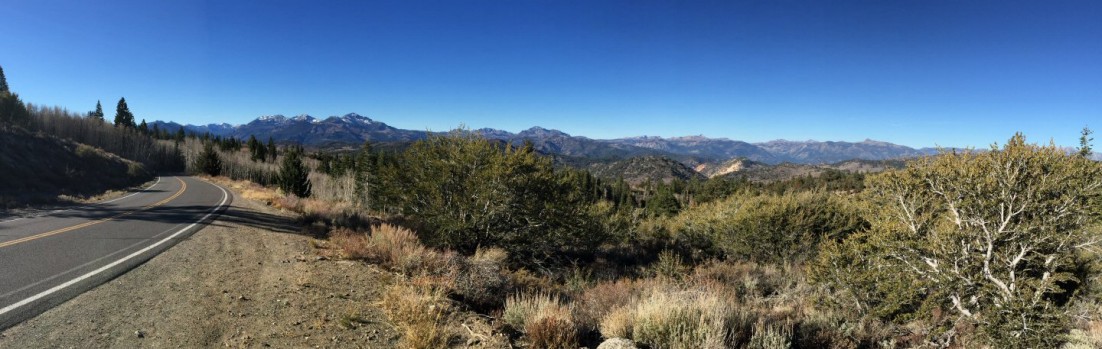
The East side of the Sierra Nevada mountains. (Photo courtesy Fed Glaser.)
My concerns were alleviated by the sight of the sapphire-blue waters of Tenaya Lake, probably one of the most photographed bodies of water within the borders of Yosemite National Park. The beauty of Tenaya belies the fact that it’s a barren, fishless lake. Thankfully, I knew it was less than 10 miles to the Tuolumne Meadows gas station, one of the few Chevron stations with a mini-store that offers rock climbing equipment for sale and rent. We’d done alright so far. It was 11:00 a.m., putting us on schedule to stop for lunch in Lee Vining.
This time the appearance of Tuolumne Meadows and its namesake river was a far cry from a visit in June with my brother and one son. The river was no longer near flood stage; the water had receded and the meadow was again grass. Lembert Dome loomed above us, sheer peaks watched from the southeast and the now fishable Dana Fork of the Tuolumne River teased us from alongside the road. Soon we reached Tioga Pass station and began a descent that would take us past Tioga and Ellery lakes, and into Lee Vining Canyon.
This 9-mile stretch of road harbors the majority of my childhood memories of family vacations. Scattered about are small meadows dotted with small stands of Lodgepole and other pines, and laced by small streams with small, willing wild brook and brown trout. Tioga Lake recalls a day of crazy fishing, when my sister, brother, dad and I stood on rocks a few feet above the lake casting spinners and watching the (stocked) rainbow trout chase our lures, only to strike at the last minute.
It all changes after Ellery Lake. Sheer rock is the predominate feature. Only small plants and hardy trees cling to crevices. Only on the canyon floor, the eventual destination of Lee Vining Creek after its exit from Ellery Lake, offers any great expanse of green. The Eastern Sierra high desert — a Pinyon pine-Juniper woodland — begins near the canyon floor, offering a stark contrast, beautiful in its own way, to the forest passed through to get there.
We had about 12 more miles to Lee Vining and sat down for lunch on the patio at Bodie Mike’s Barbeque just after noon. With the seasoning that comes with eating out-of-doors, we dug in, enjoying the view toward Mono Lake between bites. It was a quick drive to Crowley Lake Marina to surprise the marina attendant with a bone-dry boat. It took longer to affix the tag than conduct the inspection.
A few minutes later we tucked our stuff into the cabin to find ourselves with more time than expected on our hands. The afternoon sun was still well above the mountains to the west. We were there to fish, so took a short stroll to the nearby Rock Creek to cast a few flies.
Rock Creek isn’t too big, but usually heavily stocked and fished just as much. Willy and I split up. I would find a few rising fish willing to strike my offerings, but the kicker was Willy’s first fish — his first post retirement trout. A not-too-shabby brown trout of about 14 inches.
We spent a bit more time casting to rising fish, next to the opposite shore, of course. A few took our offerings, fewer were landed, but it was good to spend a few hours getting the “skunk” off before dinner.
Looking back, it was a good start to what would be a trip that was great for reasons I didn’t expect.
*Not through Yosemite Valley, however. The road to the valley dead ends near the Happy Isles Visitor Center. Hwy 120 passes the valley and heads through the high country and Tuolumne Meadows, then over Tioga Pass.
If you’re looking to build self-confidence and have taken up fly fishing, there is no shortage of instructional books, DVDs, websites and podcasts. Some folks will proclaim that things like more expensive better rods, a specific brand of fly line and the one killer fly will be the keys to a better fly fishing experience. But the best thing any angler can do is to just keep casting; confidence comes with learning to do things on your own.
Building this necessary confidence took me a while. Those who’ve seen my fishing — specifically my casting — might agree that blind confidence is a much bigger part of the equation than skill.
In casting, confidence requires first believing that you won’t piece a body part and, second, that you’ll get the fly where it needs to go.
When it comes to flies, there’s a prevalent theory that anglers gravitate toward certain flies — and hook most fish with them — because they have confidence in those flies. Confidence or lack thereof can also apply to the landing of or losing those hooked fish. My “confidence flies” are the Zebra Midge, AP Nymph and something like a Copper Chromie, but with red thread and silver wire.
Confidence in flies can be challenged again when you tie your own. The flies that work, the ones in which an angler has the most confidence, will be the ones tied most often. That certainly applies to my tying. (See the list above.)
My confidence was called into question this year, once again, when I hooked that first fish on the rod I built during the winter. My confidence grew with each fish coaxed to the net.
Soon I’ll be testing the limits of that confidence. I’ll be working with knotted leaders.
Yeah, old school stuff. There are folks who eschew modern loop-to-loop connections and extruded knotless leaders and swear by knotted leaders. In my case, I’ll be duplicating a time-tested formula used for stillwater nymphing (3 feet of 1X, 3 feet of 3X and 7 to 10-plus feet of 5X to the depth fished).
It’s my knot-tying ability that’ll be tested…in a lake where 18-inch rainbow, brown or cutthroat trout aren’t uncommon, and often one might get into a 24 incher. It doesn’t help that I have an inherent mistrust of tippet. The formula works; at least when tied by guides I’ve hired.
This time I’ll be me tying the knots, and I’d daresay that any fish I land will be well deserved.
Chalk it up to vanity or lack of maturity as a fly fisherman, but I felt the pressure on our second day to beat last year’s Eagle Lake record of 53 rainbows to the net.
We’d met our competition the guys in the other boat, a father who had gifted his son a guided trip for his birthday, and our guide reminded us that we’d fallen far short of our record the day before.
Things looked good. Scattered clouds, a bit of a breeze and the sun cresting the mountains.
Like nearly any water, the fishing on Eagle Lake can be changeable. That’s to be expected. Calm conditions will kill the bite. A weak breeze that morning put the burden on Don and I to make the most of every strike. We did, but it was a slow start. Atypically, the fish were smaller. It seems as if the big fish had moved off The Mesa during the night, to be replaced by youngsters. (Thankfully, the smallest fish of the day — an eight incher — was landed by Doug, our guide.)
Every time Don would hook a fish, I’d wait. I’ve learned to never recast if my partner just had a strike. More often than not, leaving flies in the water would lead to a double hook up. The proof’s in the video below, courtesy one of small cameras mounted on Don’s hat.
After noon, both guide boats were side by side. Our of the corner of our eyes, we’d all watch for the sudden jerk of a hookset and watch anxiously to see if a fish made it to the net. Don and I were one fish behind our competition.
It boiled down to making the hookset. And we did.
It wasn’t a day of huge fish. It also took some work — twitching the fly here and there, mending and casting to transitions — but the fish were passing by often enough to ensure regular hook ups. Our lead was extended, fish by fish.
In the end, we’d come within touching distance of our record, with 52 fish for the day.
By the end of that day, we were tired. Not tired of catching fish, but our hands and wrists and forearms ached. The sun had exacted its toll. I faced a long drive home. But all was good. It was a great time. It always is at Eagle.


 You cast the fly into a seam you think will carry it past the closest edge of the feeding fish. The fly slips around one rock, then another. To keep the drift realistic, you lift your rod tip to keep as much line off the water as possible. Everything looks and feels right. The fly disappears, and without thinking, and an imperceptible pause, you set the hook. If time allowed, there’d be a debate as to who was more surprised, you or the fish.


 fishing for words