fishing for words

(and tossing out random thoughts)


1 Comment

a return to Eagle Lake: the first day

It’s the kind of fishing that feels illegal, immoral and just plain wrong, but so good that you hope the semi-remote location will keep all but most motivated anglers from visiting.

For a second year, fishing buddy Don and I made the trek to Eagle Lake last weekend. Last year we had done so Father’s Day weekend, just as a huge caddis hatch was coming off. Arriving a week earlier this year, we saw only the beginning of the hatch. Regardless of our timing, it was certain that fishing would be good, the catching great, and, now it seems, that I’d pull an annual bonehead move.

For me the trip’s about 270 miles, really not too far, but the last 128 miles of a narrow two-lane state highway twists and turns through canyons. Whatever mapping application or GPS you use will indicate it’ll take roughly five hours driving time, but the nature of those last hundred miles will add just under an hour. The driving is so slow it’s common for folks to get a bit lost thinking they’ve passed the turnoff for Spalding when it’s still miles up the road.

Sierra Nevada Brewery Tastes

A little sample of Sierra Nevada Brewery's Ovila Dubbel and California Common. Both great.

Last year I drove straight through, which made for a tough haul. This year I heeded the adage of setting short, obtainable goals. Luckily enough, the Sierra Nevada brewery in Chico is about midway between home and the Eagle Lake, and without pushing it, I could arrive just in time for the tour at noon.

Whether or not you’re a fan of Sierra Nevada beers, the hour-long tour’s well worth a stop. Along the tour are offers to taste the toasted malted barley and wort, which tastes of Grape Nuts with a sweetness so strong it implies instant cavities, and a chance to rub and smell whole-cone hops. The history of the brewery is a large part of the tour, and it’s eco-friendliness is dumbfounding.

Good food and beer go hand in hand with fishing, there was no slouching on my part. The Sierra Nevada Brewery Restaurant has some great grub — steaks and burgers from the brewery’s spent-grain-fed 50 head of cattle — and flights of all beers on tap, many of which can’t be found elsewhere. Driving by myself, I asked for a couple of tastes: California Common and Ovila Dubbel. Both were tasty, and the California Common, a recipe created in last year’s beer camp with yeast native to the Golden State, seemed to have a little bit of that unique sourness found in San Francisco sourdough bread. (And personal kudos to Sierra Nevada as I wasn’t charged for the two small tastes.)

Eagle Lake is in the far northeastern corner of California, about 40 miles from the Nevada border and 90 miles from the Oregon border. The nearest town, Susanville, has been called “Prison Town, USA,” as about 40% of its 18,000 residents are housed at the High Desert State Prison and the California Correctional Facility, were actor Danny Trejo served time.

About 20 miles out of Chico, State Highway 32 winds through high desert and scrub to climb into a denser evergreen forest. The highway crosses Deer Creek numerous times and though the water was high, a few fly fishermen were wading in the slower sections. The town of Chester marks the beginning of the last, tortuously slow leg of the drive toward Spalding, which hugs the northeastern edge of Eagle Lake.

There’s not much cell phone coverage after leaving Chico, so it wasn’t until I pulled into Chester that a text message from Don popped up, letting me know he was in Susanville. I acknowledged his message with my location, to get a reply that he had just talked with our guide, Doug, who said the bite had been excellent. I trust Doug well enough that the thought didn’t even cross my mind that he might be setting us up for the big “you should’ve been here yesterday.”

Lunch was big, so dinner that night was a single grilled cheese sandwich and a beer, enjoyed in view of the lake, its water slowly darkening as the embers of a setting sun touched the tips of the surrounding mountains.

Never a Dull Moment

To be clear, I’m usually adequately prepared when it comes to fishing. But there’s something about the prospect of big Eagle Lake rainbows that seems to scramble my brain. Last year I lost track of my fishing license, something guides tend to require clients have in their possession.

[singlepic id=1136 w=300 h=225 float=center]

Don on the chilly morning ride to "The Mesa."

This year it was the same but different. As I hoisted my backpack to my shoulder, a pocket I had left that unzipped itself allowed my wallet to be flung to parts unknown. A quick scan of the ground revealed nothing. Thinking it might have fallen out back at camp I told Don and rushed off, thankful that I had arrived at the marina 20 minutes early. Not finding my wallet, I shoved any worries about it to the back of my mind. But confirming my choice in fishing buddies, Don was waiting in the boat with the first big catch of the day…my wallet. Finally I could enjoy a morning that hinted at good weather and gave rise to great expectations. The sky was peppered with white clouds that suggested changeable weather; good news if it brought a welcome breeze to the lake’s surface.

Anglers have been taking fish from the lake since Memorial Day, but as is the case with Eagle Lake, the trout population can make for stupid, silly catching much of the time. It’s a simple matter of being there on the bite with the right flies at the right depths in the right location. Doug has his favorite spots and our first stop was cryptically referred to as “The Mesa.” After positioning and anchoring the boat based on the wind, currents and structure, casts were made and indicators watched.

No matter one’s thoughts on stillwater nymphing, it demands decent casting as well as the mental stamina to discern the exact moment at which to set the hook. Casting two nymphs, split shot and an indicator isn’t elegant, but requires a certain skill to prevent incidental ear piercing.

Those who decry indicators often imply they make fly fishing too easy. But throw out 40 feet of fly line and put 10 feet of leader below an indicator, and it’s not that easy. One has to maintain constant vigilance, watching for the subtle difference between a “drive by” and an actual strike. A strike doesn’t always bury the indicator under water and often isn’t convenient. One learns to pause and pay close attention in those short moments after a twitch or line mends. It can be tough. I’ve heard of one experience fly fisher who went oh-for-eleven on solid strikes during the early morning bite.

[singlepic id=1140 w=300 h=225 float=center]

Don and his first-day big Eagle Lake Rainbow.

Don’s the kind of fishing buddy who will quietly sneak up on his partner when it comes to the “body count.” He’s also a great team player. We both bring experience to the lake, and guide Doug was impressed that Don and I as a team achieved an estimated successful hookset percentage north of 95% on Sunday. For our two days on the lake that figure was likely north of 90%.

As I’ve implied, great fishing can be anticipated on Eagle Lake. One guide is fond of saying that double hookups can be expected and triples are common. Even new fly fishers can often look back upon a day of 20-plus fish to the net. Many are in the 14- to 18-inch range; some edge above 18 inches. Given enough good hooksets, a few closer to 20 inches will make it to the boat. The larger fish will bulldog towards the bottom, while smaller fish will fool you with vicious head shakes and long runs, sometimes into the backing. If you’re lucky enough, as Don and I were, you’ll land a few native fish that are beautiful enough to compare favorably with Alaska’s famed leopard-spotted rainbows.

[singlepic id=1144 w=300 h=169 float=center]

My biggest Eagle Lake Rainbow – over 22 inches.

There are the Big Fish. During the morning of our first day, Don and I brought a couple in the 22-inch neighborhood to the net. It’s a different challenge to bring these big dogs in; they’re strong and tend to seek the darkness under the boat. Some will even clear the water after that first sting of the hook, as if to intimidate the funny-looking hairy beast on the other end of the line.

The fishing started off strong that first morning with the kind of rapid-fire hookups that give rise to concerns that the bite will taper into nothingness by noon. But this was Eagle Lake, and with some patience and dialing in the aforementioned flies, depth and location, one can expect steady action. Sometimes slower, sometimes not.

Forty-two fish made it to the boat that day. Eleven short of our record last year; but things looked promising for day two. Little did I know how tough it might be.

See the photo gallery here.

3 Comments

start of the 2011 trout season: working out the kinks

From what I hear and experienced, it might just be a good thing if you missed the Trout Opener this year. At least on the east and west slopes of the central Sierra Nevada mountains.

No one’s outright said as much, but reports from the Eastern Sierra suggest that crowds may have been there but the fish weren’t. One particularly likeable report: “Bait slingers and trollers failed miserably on Opening Day weekend and 100,000 lives were spared!”

Bass from the Shadows

One small bass from the shadows of a small pond.

The same seemed to be true in our neck of the woods. A California DFG hatchery worker I’ve talked with over the years told of anglers grumbling that fish were nowhere to be found, despite the usual numbers being planted. (More interesting parts of that conversation will come in a future post.)

Not all went as we planned, but arriving in the Sierra foothills in the aftermath of Opening Day put Sean and me in a good position to fish and explore in relative solitude. Months of neglecting necessary fly fishing skills were soon forgotten and muscle memory was gradually regained.

Arriving before Sean and after opening the cabin for the season (thankful that pipes hadn’t burst during the long winter) it was time work out the kinks on the convenient Lyons Canal. Just behind town, it’s more accurately Section 4 of the Main Tuolumne Canal of the Lyons Reservoir Planning Unit. Built in the mid 1850s, it’s part of a network of canals — estimated to total 60 miles — that crisscross Tuolumne County. Though peppered with flumes and concrete in some sections, parts of it have been reclaimed by Mother Nature and now resemble a small stream carved into the rolling hills.

Like many moving waters, walking a short distance away from easily accessed sections is worth the little effort required. Stocked with rainbows, the canal is also home to a now wild population of brown trout.

Hopeful that the most important tool in my fly fishing arsenal — confidence — wasn’t lacking, I tested likely cut banks, boulders and shaded water.

Despite the lack of wildness of the surroundings — homes and a roadway are a short distance away — these brown trout are wild enough to scatter at the shadow of a rod or a less-than-light footfall. This requires casts well upstream of your position, with the best casts placing the fly no more than a few inches from the bank.

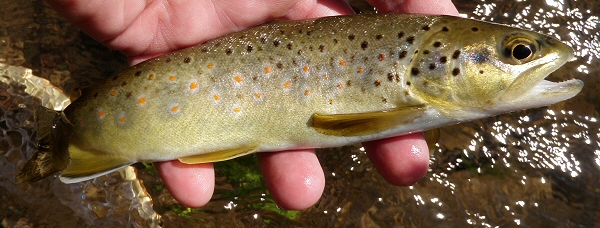
My first fish darted out from a surprisingly deep undercut four feet in front of me; eating a standard red Copper John nymph and barreling downstream into faster water. Nicer still, this was probably one of the biggest browns I’ve pulled out of the canal. It looked healthy, even happy.

Brown Trout from Lyons Canal

Another brown from the canal…they do like hugging those banks.

Six browns of various sizes came to the net that afternoon, all seeming to eye me with what might be described as familiarity bred by a near certainty that we’ve met before. Thankfully, most are small enough to be released by freezer-stocking folks hunting the bigger, stocked rainbows.

Perhaps it’s a reflection of the intervening off-season troutless months, but the brown trout this year seemed feistier and their spots brighter than I remember.

I finished up the day, with long shadows creeping between shafts of the setting sun, tossing streamers into a pond on long-fallow golf course. Decent sized bass cruised the banks, but in such small water quickly disappeared into the weeds. A few of their offspring were fooled with streamers and trailing nymphs; the biggest was about eleven inches.

As the sun fell behind the tips of the pines, it felt good to have worked the rustiness out of my cast and rediscover the confidence that had been in hibernation.


3 Comments

off-the-water rewards

I just finished counting the days until Opening Day in this neck of the woods, and realized that April will mark the fifth anniversary of my quick descent assimilation into the fly fishing community. The years have flown by as this hobby uniformly crept into the fabric my existence, without any warning of how rewarding and frustrating it could be, and how much richer it would make my life.

While I’ll likely forever argue with those who say fly fishing is about being on the water, in beautiful places, striving for the prefect cast (Would you really be there if the fish weren’t?), I was reminded last weekend that it can be similarly gratifying to pass along the joy of the sport.

When club casting instructor Willy called me and asked if I could fill in as an assistant at the Fly Fishing Show, I felt some relief that my father was on the other line, lending legitimacy to delaying my answer. Perhaps it’s a lack of confidence or a high level of self-criticism, but despite assisting with the club’s novice fly fishing seminar for these five years and acquitting myself well enough on the water to present flies in a manner suitable enough to fool fish, I’ve never thought of myself capable of offering worthwhile advice on casting. But I’d been kept onboard as the “hooking and landing” instructor for nine consecutive seminars over those five years. Besides, when a Federation of Fly Fishers-Certified Casting Instructor calls you, it suggests a level of faith.

The weather leading up to Sunday was cold and wet. The next system was predicted to lay a thin layer of snow on the local hills, but it moved quickly; the skies and sun would shine upon us all day.

Olive at the Fly Fishing Show

Kirk Werner's series of children's book showed up at the Fly Fishing Show.

I’d never been to the Fly Fishing Show for no other reason than lack of planning. Aisles were crowded with the requisite rod and reels in shiny colors that offered no additional functionality except to attract the eyes of anglers. One long row was inhabited by fly tiers doing what they do best. In between these booths, and others displaying gear, where thousands of flies for sale and lodges all touting trips of a lifetime.

Greeting me at the Federation booth were a few familiar faces, giving lessons in fly tying, offering casting lessons and talking up the Trout in the Classroom program. The job was simple. Meet and greet folks and offer free casting instruction. During the afternoon, Willy, Gary (who teaches the novice seminar with Willy) and I would do just that with a number of people. After all, free is a very good price.

I’ll admit to some trepidation at offering advice after a checkered short five-year career in fly fishing. Sticking to the basics seemed good enough, particularly for folks who’d never casted a fly rod. The results were surprising. The nearly adult boy who wanted to fly fish with his dad was soon able to cast well enough to place the yarn fly close to, if not in, the target ring. The girlfriend of the guy who wisely understood his attempts to teach her to cast might make him single again, learned that making a backcast as if she were picking up the phone* allowed for nice loops and a great presentation.

We kept offering and giving lessons. My confidence rose. While Gary instructed a wife, I worked with the husband to successfully relearn the casting of a smaller 5 wt trout rod after years of chasing Dorado with a 9 wt. We swapped stories and techniques all the while.

The kids were the best. My day ended spending time with a girl who was probably all of 11 years old, who wanted to learn to cast so that she and her dad could take advantage of an offer from an aunt in Montana to get them out on some of the local rivers. This little girl’s focus, willingness to learn and lack of bad habits allowed for fast learning, only delayed by a break now and then to rest. By the end of our time together, she was casting to a target with deadly accuracy.

At the end of the day, it was clear that I did something to help these folks learn fly casting or improve their casting. Perhaps it was as simple as standing outside on a sunny day and offering small words of encouragement. Perhaps there’s more to it than that. Regardless of what it was that I had to offer, the thank yous, appreciation and smiles after each lesson were genuine. Despite being a volunteer, I was paid well.


*Think of picking up the receiver of a wall-mounted phone and stopping at your ear.


Leave a comment

what we see… (03/02/2011)

  • Fly fishing folks can be pretty generous (Scroll down to “53. Fly Fishing Fantasy). (Of course, the winning $70,000 bid gets two days of fishing for you and seven friends at Brigadoon Lodge in the deal): http://bit.ly/hsPCyA
  • If we taught a club’s fly tying classes, we’d be on doorstep of Singlebarbed.com‘s shed headquarters: http://bit.ly/gvsGmx
  • While lucky enough to spend many a summer in Tuolumne Meadows, I’d had loved to earn college credit for traipsing around Yosemite’s high country oh-so-many-years-ago, in my youth: http://bit.ly/e2f8z6
  • From the All Too Personal Observation Department: While we thoroughly enjoyed our volunteer time with Northern California Council Federation of Fly Fishers at the Pleasanton Fly Fishing Show last weekend, the experience suggests that I am able to help people learn to cast better than my own ability to do so.