Be honest. This is often the way we imagine it could have happened. Standing in a river in early May, maybe June, the fish are still eager and maybe still a bit stupid. The spot you’ve chosen offers a clear cast to riffles only half a dozen yards long. The weather is cool enough to encourage the wearing of that old, long-sleeve flannel shirt. The bright sun is blocked by a classic wool walking hat; the one that lends the wearer a certain swagger. The patches of aspen, peaking out between the Jeffery and piñon pines, are once again covered with bright green leaves.
It wouldn’t be too difficult to cast from here, and you consider it, but you are new to the sport and the desire to properly and softly present the fly requires a few more steps. The trout slowly and quietly slurp Baetis duns. You check your leader, eyeing its length and looking for any nicks or knots that would give away your fly as a fake.
You cast the fly into a seam you think will carry it past the closest edge of the feeding fish. The fly slips around one rock, then another. To keep the drift realistic, you lift your rod tip to keep as much line off the water as possible. Everything looks and feels right. The fly disappears, and without thinking, and an imperceptible pause, you set the hook. If time allowed, there’d be a debate as to who was more surprised, you or the fish.
All of this positioning and decision-making doesn’t take as long as it seems, except that it takes great effort to ensure that everything is perfect for the woman watching from the bank. She sits on a checkerboard blanket, the remnants of a picnic scattered about. Her classic beauty competes with the trout for your attention. She smiles, impressed, as the rainbow trout glistens in the sunlight, before you carefully return it to the water.
However, unless you’re luckier than the rest of us, reality is much different…even for better-looking people, particularly those who’ve just learned to cast a fly.
Ewan McGregor took Hollywood actress Emily Blunt fly fishing – and she ended up catching his dog.
The Crieff-born actor was in Scotland last year filming Salmon Fishing in the Yemen, about a fisheries scientist who tries to bring the sport to the Middle East.
Ewan was showing off his newly acquired casting skills to Emily…
He said: “All the actors stayed in this beautiful little house. They had a pond down at the bottom of the garden and some rods and both Amr Waked, who is also in the movie, and I had learnt to fly fish.
“We were showing off because we were trying to impress Emily with our fly fishing skills – ‘Look, you do it like this, don’t bendy our wrist, no, that’s right…’
“And she caught my dog who was running around behind. She hooked him. She didn’t catch any fish but she did catch my dog.”
I’ll be on the road to the Sacramento edition of the International Sportsmen’s Exposition this morning and, according to forecasts, should be slogging through welcome but heavy rain. Don’t get too excited for me: it’s going to be a bit more like torture.
I’m leaving the checkbook and credit cards at home, carrying only enough cash for lunch.
I’m taking a cheaper simpler approach to the coming year that will be reflected in my fly fishing, though stopping short of tenkara. Last year didn’t go well, fishing wise, and changes on the job this year will bring incessant deadlines and blank pages in need of words. Anyone with a job today should be grateful, and I am, but it’s going to be tough to string together more than a few days off without risking some kind of pre- or post-vacation penalty. Big hopes for 2013 require planning. The fiscal reality is that dollars can stretch only so far. (Yes, I do feel some guilt that I won’t be helping a great deal to lift the fly fishing industry out of its apparent struggles, so it’ll be up to the rest of you this year.)
Much of the change this year can be blamed on my brother. Our conversations of late reminded me that what sticks with us most are the experiences of our life: riding our bikes as kids to the five ‘n dime or hiking the Sierra Nevada high country during family vacations. I don’t think we truly appreciated it at the time. The considerable value we now place on these experiences seemed to swell as our own children grew up.
So my visit to the ISE will be maddening, comprised of gear I won’t buy and guide trips I won’t take. There will be a visit with Derek Young, who I got to know as an unassuming and friendly guy before he was named 2011 Orvis Guide of the Year, some milling about various seminars, and likely encounters with other folks I’ve fished with.
My plans entail simplifying and diversifying. Much of my fishing will be refocused to waters near and not-too-far-from the family cabin in the Sierra foothills, something that’s long overdue. I’ll “make do” with gear I have and spend at least two long weekends there each month of the trout season. (My budget may allow for a very nice net handcrafted by a fly fishing club member and up for auction in April.)
It’ll be more about an exploration; a more mature approach in which satisfaction doesn’t hinge on numbers worth bragging about. There’s too much ground to cover in a single year, but the goal will be to cast flies to waters along the Highway 4 corridor, further up Highway 108, and on new stretches of the various forks of the Stanislaus River. All of those weekends should provide plenty of opportunity to spend more than a few days in the Walker River Basin; it’s only two hours away. There’s only one guide trip on the books (with Derek), and that may be the only one this year.
Dates have also been cleared on the cabin calendar for visits by my brother’s and sister’s families. And it’ll be darn nice if the wife — who recently rediscovered the detachment and contentment that can be found in the foothills — joins me more than a few times.
Diversification will mean revisiting diversions that aren’t enjoyed enough. Acting like tourists in our backyard, something started with our visit to Alcatraz last month. I’ll send the motorcycle seat out for a custom fitting more suited to longer rides. Rides that may or may not include fishing, and some that may include the wife.
You can chalk all of this up to wisdom gained with age, or — like me — simply decide to make the most with what you’ve got while you can.
I have a confession. I didn’t see “The River Why,” despite the claim that fly fishermen would flock to see Amber Heard’s décolletage the movie and that I can be a bit distracted by most things that entail fly fishing.
Sometimes it’s all about presentation. Doing everything, just so, being subtle, to sneak up on your quarry. Too many false casts or slapping the water will draw initial interest, but soon desensitize those who you most want interested in your offering. The same can be said of the latest and greatest fly fishing film; long before it’s screening in my neighborhood, I reach saturation through trailers and highlight reels, and articles and blog posts.
Obi-Wan Kenobi’s mentor Qui-Gon Jinn (Liam Neeson) fly fishes in real life; Ewan McGregor does so in “Salmon Fishing in The Yemen.”
Subtly is lost in the clamoring for attention. There a lack of attention to presentation; something done well will have the fish audience wanting what you have to offer. Regardless of the effort, it can all boil down to that presentation.
There’s the stumbling through the muddled, pre-dawn darkness and the tentative stride, the missteps on mossy rocks. Stooped in a half effort to conceal my profile, I’ll select a fly. The selection is a combination of a modest understanding of entomology and gut feeling. And not every cast, particularly that first cast of the day, will offer the perfect presentation of the fly du jour. It takes me some time to work up to even a decent cast.
My first cast, tinged with too much expectation, sets the fly down too far away. I judge subsequent casts unacceptable or unworkable long before my line falls to the water. Often, it’s too long since I last wet a fly; but slowly, and with effort, a rhythm is rediscovered and precision returns. (Admittedly, my version of “precision” is plus or minus eight or nine inches or so.) Once again, a renewed focus on my cast displaces all that comes with everyday life.
That (almost) perfect always seems to sneak up on me; perhaps the result of not thinking about what’s being attempted. Simply, it feels right. The fly settles on that one current seam suspected to be a conveyer belt delivering bugs to an as-yet unseen trout.
The fly slips downstream, held steady by hope. A nose emerges. The fly disappears. Often, I’m more surprised than the trout.
That’s a bit how I feel about the trailer for “Salmon Fishing in The Yemen,” a movie based on the book by Paul Torday. It snuck up and surprised me with its upbeat hopefulness. Unlike “The River Why,” it was bandied about as the next version of “A River Runs Through It.”
“Salmon Fishing in The Yemen” has some star power and apparently some respect on the independent film tour, and seemingly is without the focus-group formulation that sucks the soul out of anything. There’ll be no admission to somewhat of a man crush on Ewan McGregor. See “Long Way Round” and you’ll understand — he comes across as a guy who’d saddle up the adventure bike for a day of fly fishing, followed by a friendly evening at the local pub.
Though always risky, judging by the trailer, the plot of “Salmon Fishing in The Yemen” echoes the hopefulness that’s all too often required of fly fishing without directly being a film about fly fishing. It’s got Mr. McGregor (as the fisheries biologist hired by a fly fishing-obsessed Yemeni sheikh to bring salmon to the wadis of the Yemen), Emily Blunt (as the Sheikh’s representative), Kristin Scott Thomas (as a British government spokesperson promoting the project to draw attention away from the government’s latest blunder), salmon, English charm and wit, and fly fishing. While it might benefit from a more mainstream title, I like the title; it’s likely to keep the riffraff out of the showing you know I’ll attend.
It’s nice to have a fly fishing flick to look forward to while waiting for Ms. Olive (the Woolly Bugger) to make it to the big screen.
From my perspective as someone who has made plenty of New Year’s resolutions to little affect on my life, this year I instead offer a public service in the form of resolutions for others, hoping that my 11 readers will pass them along under the presumption that adherence to any one of these resolutions by other outdoorsmen will make my fly fishing life a bit easier.
The Resolution for Fisherman Who May Be Too Friendly: If you’re not my guide or I don’t know you and haven’t asked, don’t net my fish. In my personal experience, it rarely ends well for anyone involved.
A Resolution for Those with (Untrained) Kids & Dogs: The water down around the bend is just as wet as the water I’m fishing.
The Shy Fly Fisherman Resolution (This comes from personal experience.): Don’t be afraid to ask a successful fly fisherman for help. If you ask while on the water, be courteous and remember what Andre Puyans was reputed to have said, “Move only close enough to communicate and observe, but never close enough to interfere.” Do so and you’ll likely start a new friendship, regardless of its duration; though you should expect that answers to any questions won’t always be totally truthful.
Resolve to Understand Fishing Doesn’t Always Mean One’s Fishing: Experienced fishermen often study a piece of water before fishing, and often before even entering the water. It’s only good manners to respect this and gently wake up a fellow angler quietly ask permission to fish the water being observed.
A Resolution for Those Filling Stringers: If you see me landing more fish than you, don’t ask if I’ll give you one for your stringer. Catch it on your own; only then have you earned the right to make a decision to let it go or keep it. (The fact that it may be a stocked fish doesn’t negate the premise of this resolution.)
Resolve to Look for Fish Elsewhere (Part 1): Even if I’m landing more fish than you, my spot is not where all the fish are. Respect the fact that I get up before the sun and fall over rocks in the dark to get a particular spot; or get up earlier than I do.
Resolve to Look for Fish Elsewhere (Part 2): Please, please don’t cast your lure, bait or even fly 15 or 20 feet to place it in the seam less than 5 feet in front of me. It’s also bad form to cross my line with yours. Be warned: I’ve been working on the accuracy of my retaliatory long-distance casting.
In most cases, anything that can be bought is probably already in their possession, often without the spouse having a clue. Sometimes it’s a matter of simply being unable to wait to get the latest and greatest thing, other times it grows out of the search for that one thing that will make them look good regardless of the catching, or it was a shiny object necessary item that caught their eye at a fly shop visited during their travels.
Some of the stuff may never get used; the same fly fisherman who will cast to the same stretch of river time after time won’t necessarily have the patience to tie flies. The more practical among us will be content with what they have and will be content with only a dozen or so rods and reels. Consumable such as dry fly floatant, leader and tippet will always be appreciated, and used. Flies, however, can be tricky; many a fly fisherman will spend too much time sorting through choices, looking for that perfect fly. (The same one, broken and misshapen after fooling a few fish, won’t look like much of anything…but will still dupe the fish.)
If that person in your life is a steelhead fisherman, they’ll understand a joke gift of magnets. However, if the recipient does try to use this gift during fishing, seek professional help. There’s also the The Hungover Cookbook. Do you really thing that fly fishermen and their buddies only fish on longer, overnight outings?
Topping my list is an ever-present Sense of Humor, for those days when it’d be easier to say one was skunked instead of admitting to landing fish that were all less than 10 inches. Also very handy when skunked; it takes the sting out of the later realization that one was outsmarted by fish with brains the size of a pea. If you find it on Amazon.com, let my wife know.
My personal wish is that your holiday and the coming year are filled with the joy that comes from the many other gifts that can’t be purchased.
It didn’t take long after high winds brought an early end to our adventures on Crowley Lake to decide that it was the perfect afternoon to introduce Willy to the wonderfully willing brook trout in an upper section of Rock Creek, just below the lake.
Caddis on Rock Creek.
It was late when we arrived, but nearly magic hour on this wide spot. In a voice hushed for no other reason than wonderment at the beauty of where we were, I described what to expect. Every pool, tailout, rock and bend prompted a memory of a fish that rose to a fly in the seasons before. Colors grew more vivid as I described the 13-inch wild rainbow that surprised me and my 3 wt. rod during the spring a year ago. Willy headed downstream, I went up.
Fall in the eastern Sierras is a feast for the eyes; the low sun filters through the yellow and orange leaves of the quaking aspens, the evergreens seem to take on a darker hue, and through a bleak and gray winter may be nearing, for now the sky is a brilliant blue.
It’s that time of year when small brook trout flame with spawning colors. Willy, a striped bass fisherman of note who’s landed big fish of many species, broadly smiled while cradling one of these gems in his hand; reminded of how fun and beautiful these trout can be.
The numbers of fish we landed was lost in concentration as we targeted specific fish. I’d started with a dry/dropper combination, but soon opted for only a small humpy, for no other reason than the excitement of surface grabs. I’d end up climbing, literally, upstream, targeting small whirlpools tucked between the rocks. Nearly every one gave up a fish.
This time of year just as colorful as the trees…
With the tops of the tree shadows reaching the far side of the creek, we both ventured upstream, where Willy pulled a few fish out of a plunge pool that offers a small, but textbook example of the effect of currents on the drift of a fly, with almost intimate takes from fish less than three feet away.
Thinking we’d already had too much fun, we found our way back to the road, from which Willy could get a good look at the lake. The plunge pool we’d been fishing was the outlet for the lake, and as if an illustration from any good fly fishing book, signs of rising fish dotted what was in essence the tailout for the lake. This was feeding activity that couldn’t be passed up by any fly fisherman.
The wind, accelerating down the canyon, made casting difficult, at least for me, but we both got flies out far enough and every decent presentation earned at least a strike, and a few rainbows were landed.
It has been a textbook day, and the trout did everything they were supposed to do. It’s the best way to learn.
When you mention stillwater nymphing to a group of fly fishermen, you can’t expect more than a quarter of the group to stick around. Certainly, it’s not for everyone. It just happens that a lake offered my most productive fly fishing day ever entre into the sport.
After the drive over Tioga Pass last month, the plan was for Willy, Bill and me to spend that Wednesday with a guide, learning the specifics and generalities of Crowley Lake. Learn we did. Catching, not so much.
The high water this year had the Los Angeles Department of Water & Power monkeying around with the lake level, which, combined with warmer-than-usual fall weather, led to heavy weed growth. Not only were weeds growing up from the bottom, algae floated on top. We’d be parking the boat over a channel created by McGee Creek in search of a literal window through which we might present our flies.
Doug would be more than our guide that day. He would be teacher and cheerleader. Questions wafted through the air with the midges. Discussions centered around the fly(ies) of the day, casting, adjusting the depth of flies, and reading the fish finder to determine boat position.
Unlike most of my experiences on Crowley, conversations went on uninterrupted. The fish were there. Willy hooked a couple of decent rainbows early in the day, but strikes were few. Bill landed a nice brown later in the day, as did I. Violating the rule about moving away from fish, we did, wetting our lines at Green Banks, near Leighton Springs and Alligator Point, only to end up back at McGee.
That learning was put to the test Thursday, when Willy and I spent the day in his boat, searching for open channels and properly positioning the boat. Eight hook ups, with one beefy brown to the net and three rainbows lost — big fish that jumped and cleared the water by a body length or more — suggested we’d done well.
Willy on a fish…
Day two entailed my learning how to launch a boat on a rather shallow ramp, and soon enough we would be on the way. Unlike the previous morning, a nice breeze rippled the water; perhaps the same breeze that pushed the top-water algae to the opposite side of the lake. It was one of those clear, crisp high Sierra mornings when the mountains seem that much closer.
Willy and I had discussed strategy while slowly cruising through the marina with a probably misguided reliance upon my previous experience — five years worth — at Crowley. We’d end up agreeing to revisit the McGee Creek channel, but with my suggestion, which had no basis in any empirical evidence, that we’d push closer to shore and fish in about 10 feet of water.
A few boats and float tubers were already in the vicinity when we both began to carefully watch the depth finder for the edges of weeds and the telltale dip of the creek channel. We crossed it a few times and when we finally anchored, it had taken longer to get into position a few feet away from the channel (so we could cast to it) than it did to make the run from the marina to our destination. We were set to cast.
I felt a bit of a dorky tingle as I locked forceps to my bottom fly — I’d seen guides do this, but never myself — and lowered it over the gunwale to gauge the depth as which to set my indicator. I nervously cast out to where we hoped to intercept cruising fish; thinking that this was a test that would be graded by the fish we landed, or didn’t.
My big shouldered brown.
As often happens on this lake, it wasn’t too long before Willy’s indicator went subsurface. Once the hook was set (and the fish obviously felt it), a big, beautiful rainbow cleared the water by a body length of at least 18 inches, if not 20, and threw the hook. Willy and I gawked at each other in disbelief. For me it wasn’t so much because Willy didn’t land the fish, but for the simple reason that this fish clearly demonstrated that we, on our own, had done something right.
Willy would hook (and lose) another big rainbow later than morning, and we’d both elicit strikes when raising our rods (and flies) to cast, with one fish hitting Willy’s fly just a few feet from the boat. There were a few other fish for me, including one huge brown…not long, but linebacker big, with shoulders and a head big enough to give me pause before reaching into the net.
It wasn’t the wide-open fishing, or even the hot and heavy fishing, that I’ve previously seen on Crowley. It’s not always a numbers game and the difference this time — a huge difference in fact — was that we did it on our own and that the fish seemed to agree that we did something right.
About a month ago, Willy and I loaded up at his house and left just before 7:00 a.m. and headed east, skipping from one highway to another, toward Toms Place, Calif., the annual fall destination for the club’s Eastern Sierra outing. It’d be my fourth. Along the way we’d be travelling through the Sierra foothills and Yosemite*, stopping at the Crowley Lake Marina for a quagga mussel inspection of Willy’s Bay Ranger.
Over the last eight-plus years I’ve had multiple opportunities to drive Hwy 120, up along scrubland bordering Priest Grade to where the highway becomes Big Oak Flat Road and winds through the sparse foothill woodland surrounding Groveland and much of the roadway, then finally rising into heavier stands of conifers — more correctly a lower montane forest — before the Yosemite entrance station at about 5,000 feet. My past trips encompassed ambitious one-day, 225-mile fishing trips with stops to cast a line at four or five different creeks or rivers as well as motorcycling over Sonora and Tioga passes shortly after opening, when snowdrifts 10-plus feet high line the high-country portions of the road.
It’s a fantastic road trip, to be sure, but on this drive I found that the view was very different from the passenger’s seat of Willy’s Cadillac Escalade.
The motley crew that would comprise the 2011 DVFF Eastern Sierra Trip.
The road welcomed us with limited traffic, and only a few miles of road construction slowed our progress. Anyone who’s driven through Tracy, Manteca and Oakdale — perhaps headed to Two Mile Bar or Goodwin Dam on the Stanislaus River — know that there’s plenty of nothing to look at. It’s here that the road seems to drone on between orchards and field crops, time seems to slow and I’m thankful that the highway is now three lanes through Tracy, once a bottleneck no matter the time of day.
It’s outside of the appropriately named Oakdale that the oak woodland takes hold. The oak trees and an occasional gray pine break up the monotony of the now golden grasses. Then there’s the always subtle shock of the “girls, girls, girls” sign that appears out of nowhere, perched above a rundown hotel and shadowy outbuilding truly in the middle of nowhere, all of which is enclosed by a substantial not-so-ornamental iron fence. That sign is also a landmark signaling the last mile or so before the right turn toward Yosemite.
The history of the Sierra foothills comes to life driving through Big Oak Flat and Groveland in the form of vacant stone buildings adorned with iron shutters and doors that recognize the danger of fire during the hot summers. Jeffery, Yellow and Ponderosa fight for space between buildings. The road here barely allows the passing of two motorhomes, forcing life to slow to a crawl. Not necessarily a bad thing.
As we approached the national park border the density of the forest was more imposing than my long held impression resulting from occasional glances from the driver’s seat. I’d seen these trees before, but details now stood out. A thick green canopy blocks any view of the sky and despite a distinct lack of branches from the ground to a few feet above the average man’s head, there were so many trees that the concentration of trunks cut the range of visibility to a couple hundred yards. As the miles slide by, the undergrowth grows lush.
More than just a stop to hit the restrooms, the Big Oak Flat entrance to Yosemite marks the start of a big change in vegetation and terrain. After another half hour and a left turn toward Tuolumne Meadows, Western Juniper, Red Fir and Lodgepole Pine dominate the view, indicators of the upper montane forest. Meadows of unreal green — in essence nature’s sponges for snowmelt — occasionally come in to view, edged by skunk cabbage and corn lily. In another hour, slabs of granite and collections of boulders begin to replace meadows.
Then, unexpectedly, the view opens up to vast expanses of what I’ve always known as granite and that, in all of my limited travels, seems to be the unique calling card of the Yosemite high country. A less brilliant white, I’d later learn that it’s actually a mix of granitoids and in many cases leans toward granodiorite, which is darker, almost moody and reflective of the changeable weather. It also marks the march into the subalpine forest as one nears 9,000 feet in elevation.
This day was clear and the only distraction was a fuel gauge needle too close to “E” for comfort. Since I tend to measure distance by time instead of mileage, I guessed that the gas station in Tuolumne Meadows would arrive at least a few comfortable miles before the needle was pegged. I grimaced a bit with each incline and hoped I was right.
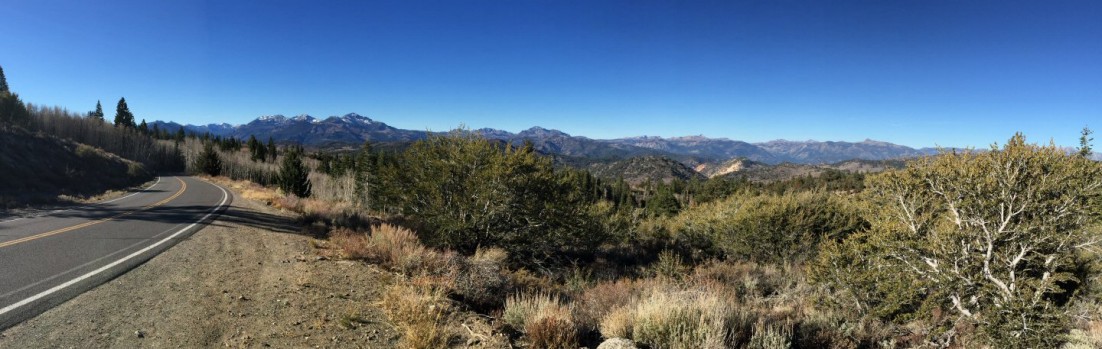
The East side of the Sierra Nevada mountains. (Photo courtesy Fed Glaser.)
My concerns were alleviated by the sight of the sapphire-blue waters of Tenaya Lake, probably one of the most photographed bodies of water within the borders of Yosemite National Park. The beauty of Tenaya belies the fact that it’s a barren, fishless lake. Thankfully, I knew it was less than 10 miles to the Tuolumne Meadows gas station, one of the few Chevron stations with a mini-store that offers rock climbing equipment for sale and rent. We’d done alright so far. It was 11:00 a.m., putting us on schedule to stop for lunch in Lee Vining.
This time the appearance of Tuolumne Meadows and its namesake river was a far cry from a visit in June with my brother and one son. The river was no longer near flood stage; the water had receded and the meadow was again grass. Lembert Dome loomed above us, sheer peaks watched from the southeast and the now fishable Dana Fork of the Tuolumne River teased us from alongside the road. Soon we reached Tioga Pass station and began a descent that would take us past Tioga and Ellery lakes, and into Lee Vining Canyon.
This 9-mile stretch of road harbors the majority of my childhood memories of family vacations. Scattered about are small meadows dotted with small stands of Lodgepole and other pines, and laced by small streams with small, willing wild brook and brown trout. Tioga Lake recalls a day of crazy fishing, when my sister, brother, dad and I stood on rocks a few feet above the lake casting spinners and watching the (stocked) rainbow trout chase our lures, only to strike at the last minute.
It all changes after Ellery Lake. Sheer rock is the predominate feature. Only small plants and hardy trees cling to crevices. Only on the canyon floor, the eventual destination of Lee Vining Creek after its exit from Ellery Lake, offers any great expanse of green. The Eastern Sierra high desert — a Pinyon pine-Juniper woodland — begins near the canyon floor, offering a stark contrast, beautiful in its own way, to the forest passed through to get there.
We had about 12 more miles to Lee Vining and sat down for lunch on the patio at Bodie Mike’s Barbeque just after noon. With the seasoning that comes with eating out-of-doors, we dug in, enjoying the view toward Mono Lake between bites. It was a quick drive to Crowley Lake Marina to surprise the marina attendant with a bone-dry boat. It took longer to affix the tag than conduct the inspection.
A few minutes later we tucked our stuff into the cabin to find ourselves with more time than expected on our hands. The afternoon sun was still well above the mountains to the west. We were there to fish, so took a short stroll to the nearby Rock Creek to cast a few flies.
Rock Creek isn’t too big, but usually heavily stocked and fished just as much. Willy and I split up. I would find a few rising fish willing to strike my offerings, but the kicker was Willy’s first fish — his first post retirement trout. A not-too-shabby brown trout of about 14 inches.
We spent a bit more time casting to rising fish, next to the opposite shore, of course. A few took our offerings, fewer were landed, but it was good to spend a few hours getting the “skunk” off before dinner.
Looking back, it was a good start to what would be a trip that was great for reasons I didn’t expect.
*Not through Yosemite Valley, however. The road to the valley dead ends near the Happy Isles Visitor Center. Hwy 120 passes the valley and heads through the high country and Tuolumne Meadows, then over Tioga Pass.
If you’re looking to build self-confidence and have taken up fly fishing, there is no shortage of instructional books, DVDs, websites and podcasts. Some folks will proclaim that things like more expensive better rods, a specific brand of fly line and the one killer fly will be the keys to a better fly fishing experience. But the best thing any angler can do is to just keep casting; confidence comes with learning to do things on your own.
Building this necessary confidence took me a while. Those who’ve seen my fishing — specifically my casting — might agree that blind confidence is a much bigger part of the equation than skill.
In casting, confidence requires first believing that you won’t piece a body part and, second, that you’ll get the fly where it needs to go.
When it comes to flies, there’s a prevalent theory that anglers gravitate toward certain flies — and hook most fish with them — because they have confidence in those flies. Confidence or lack thereof can also apply to the landing of or losing those hooked fish. My “confidence flies” are the Zebra Midge, AP Nymph and something like a Copper Chromie, but with red thread and silver wire.
Confidence in flies can be challenged again when you tie your own. The flies that work, the ones in which an angler has the most confidence, will be the ones tied most often. That certainly applies to my tying. (See the list above.)
My confidence was called into question this year, once again, when I hooked that first fish on the rod I built during the winter. My confidence grew with each fish coaxed to the net.
Soon I’ll be testing the limits of that confidence. I’ll be working with knotted leaders.
Yeah, old school stuff. There are folks who eschew modern loop-to-loop connections and extruded knotless leaders and swear by knotted leaders. In my case, I’ll be duplicating a time-tested formula used for stillwater nymphing (3 feet of 1X, 3 feet of 3X and 7 to 10-plus feet of 5X to the depth fished).
It’s my knot-tying ability that’ll be tested…in a lake where 18-inch rainbow, brown or cutthroat trout aren’t uncommon, and often one might get into a 24 incher. It doesn’t help that I have an inherent mistrust of tippet. The formula works; at least when tied by guides I’ve hired.
This time I’ll be me tying the knots, and I’d daresay that any fish I land will be well deserved.
 You cast the fly into a seam you think will carry it past the closest edge of the feeding fish. The fly slips around one rock, then another. To keep the drift realistic, you lift your rod tip to keep as much line off the water as possible. Everything looks and feels right. The fly disappears, and without thinking, and an imperceptible pause, you set the hook. If time allowed, there’d be a debate as to who was more surprised, you or the fish.


 fishing for words