fishing for words

(and tossing out random thoughts)


Leave a comment

trout season opening day 2007

What an adventurous weekend. Christopher and I headed to the cabin Friday afternoon, thankfully missing most traffic. We crawled into bed early with dreams of bent rods and tight lines. 

About 7:30 a.m. we were picked up by Chris H., a fellow fisherman I had corresponded with and who had provided me with good advice for off-season fishing. In his four-wheel-drive GMC pickup, we headed for the back roads and towards the South Fork of the Stanislaus River. Our goal was wild trout in the seemingly rarely fished section of the river. Unfortunately, our progress was quickly stopped by a gate that was closed after being open a few weeks ago. Diverted but not undeterred, Chris H. took the back way in. This was a stretch of the Stanislaus that I wouldn’t have expected to see as it definitely requires a trail-capable vehicle to get there.

Soon we were on the water. This part of the Stanislaus holds a lot of promising spots and has some beautiful sections. And rarely did we even see another vehicle go by. But I didn’t see a single trout. Chris H. apparently saw some fish, but couldn’t get them to bite. We moved upstream a bit, and tried again. No luck. We moved upstream again. Nothing. Late in the afternoon we finally moved up to an area where DFG supposedly plants trout…and you can see where I’m going by the use of the word “supposedly.” We were skunked again. Not the best opening day to be sure, but I asked Christopher if Sunday morning he’d want to head to Moccasin Creek and invited Chris H. to join us if inclined.

Christopher and I hit Moccasin Creek just before eight o’clock the next morning, only to find half a dozen folks already pounding the water and my favorite spot (our spot according to Christopher) occupied. Chris H. arrived as I was walking past the hatchery, and he joined us in trying a few spots. After a while, I slipped on my waders and we all proceeded downstream. Christopher turned back after a while, but Chris H. and I continued on. After a while, Chris H. found a couple of trout holding to a cluster of branches that were under water, but even after we both artfully cast lures and nearly hit the heads of these two fish, we hadn’t a single bite, much less any interest in our offerings.

After returning upstream, we found that Christopher had slipped into the “favorite spot,” and we joined him. Christopher had noticed the fish — about a dozen or so along this fifty-foot stretch — rising to the surface. Chris H. went back for his fly rod and I found my way through some blackberry bushes to get a better angle on the pool from the narrow bank. After a while, Christopher took a break from the frustration of limited interest in his flies and lures, so I moved upstream and started working a pool through which three to five fish would move in and out.

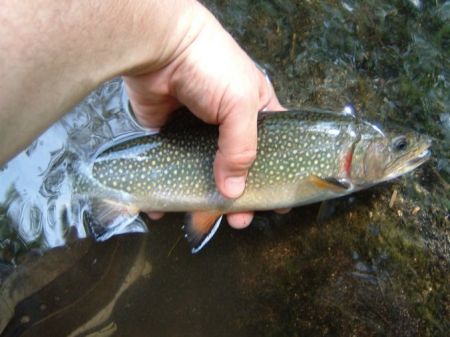
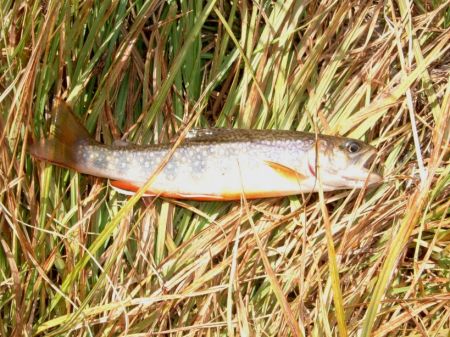
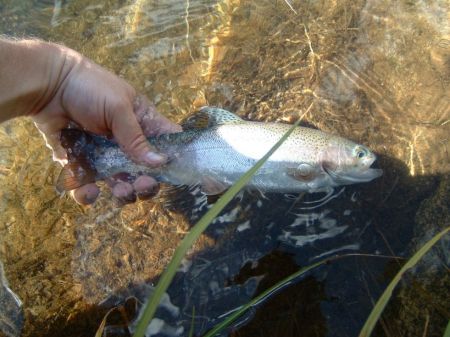
After all too many casts, one fish finally began to pay attention to my little gold on gold Panther Martin. A few more casts and he attacked. Line stripped from my ultra-light setup and I knew this wasn’t what I was used to catching in Moccasin Creek. This fish jump a few times and took off anytime he saw shoreline. I couldn’t so much as reel this fish into shore as guide it’s struggles so that I might get my hands on it — and release it — before it was too played out. It was about two minutes before I could get it to shore, to find it was the biggest brook trout I have landed. I would estimate 15 to 16 inches. What a fish and what a fight! 

Shortly after I landed my brookie, Chris H. got a hit on his fly rod and pulled in a decent brookie of his own, also the biggest he’s caught. This seemed to rekindle Christopher’s desire to get a line wet, so he rigged up his fly rod and tried casting into a pool just downstream from a boulder. I think he had a bit of interest in his San Juan worm fly, but not enough to hook up.

Nice surprise in this put-and-take creek.[/caption]I continued to work the more downstream pool, and just about when I was going to call it day, I felt my lure receive a gentle nudge. So I duplicated my cast and again felt a nudge, but as I continued to reel in, my pole began to bend and the fight was on. This fish apparently had gently mouthed my lure and neither he nor I realized he was hooked. This brook trout also put on a good fight, and seeing my little battle, Chris H. volunteer to net the fish. I guided it upstream, but it took about three attempts before he was in the net, and just after being netted, the lure “self released” — that’s how light the hook was set.

I know it was a very frustrating opening weekend for Christopher and I wish he could have lucky enough to have caught something. But it is called fishing and not “catching.”  I do feel blessed to have landing two awesome brook trout in the last hour before our fishing adventure ended. Time to start planning our next trip!

P.S. Found out later from Moccasin Creek Hatchery that

The brooks are used as a bio filter for rainbows in certain waters. They were reaching maturity and the decision was made to plant them out as a change of pace. Only moccasin, Lyons Canal, Powerhouse received brooks. Next week it will probably be rainbows again but brooks will be planted on occasion. This years egg numbers for brooks are about the same as last years about 1 percent of our total production. Glad you enjoyed them I was hoping someone would.


Leave a comment

first fish on my fly rod

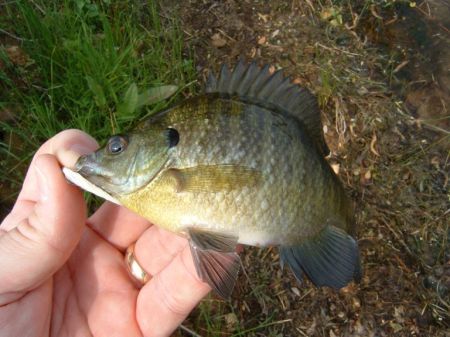
I was hoping that the first fish landed on my fly rod would be a might more glamorous, but sometimes one can’t be choosy. This weekend Christopher and I headed up to the cabin Friday night, and Saturday morning headed down to Kistler Ranch to join the Diablo Valley Fly Fisherman club to throw our lines in the three ponds there. The ponds are home to bluegill and bass, but we quickly found out that without waders and/or a floatation device, our options would be limited. I decided I would make the best of it, and use the opportunity to practice my casting. I worked my way around to the few spots on the first pond, then found a second of the back pond where I could cast from the shoreline, free of weeds, and place my fly — a white Clouser fly at this time — near some tree branches overhanging the bank and water. As my casts improved, I was able to land the fly closer to the branches, almost softly with a minimum of sound.

First fish on a fly rod...Kistler Ranch Bluegill.

First fish on a fly rod…Kistler Ranch Bluegill.

After one particularly good cast, I felt a tug, as if the hook was caught on a weed. Then the line moved towards deeper water. Fish on! It wasn’t much of a battle, and the fish didn’t jump. But bluegill don’t usually jump. Sure, I would have rather caught a decent trout, but a fish is a fish, and the fact that I fooled it with a fly gave me renewed confidence that perhaps I can get a handle on fly fishing. And it was a decent sized bluegill.  I spent the rest of my time on the edge of the largest pond, throwing a mouse “fly” into some weed beds. Again, I was practicing (it seems particularly hard to cast this fly) when suddenly my lure was literally attacked, probably by a bass. The fish immediately took to the bottom and wrapped my line around the weeds and somehow slipped off the hook. But it was an exciting 20 seconds, that’s for sure.

Sure hope I can get a trout on the end of my line next weekend, which just happens to be Opening Day.


Leave a comment

pre-season fishing on the Stanislaus

Left town Tuesday about 7:00 p.m. for my “spring break,” setting the GPS for the cabin and expecting to arrive in Twain Harte in about three hours with time for a quick dinner. My late departure paid off as I breezed past Tracy on I-205 (usually an awful bottleneck). Got to the cabin about when expected, laid out my fishing gear and hit the sack.

Thanks to a suggestion from member on one of the fishing forums I visit, Wednesday morning I headed off to the Two-Mile Bar area of the Stanislaus River, despite light rain and threatening clouds. I parked and headed down to the river, amazed at the greenness of everything around me, even the abundance of new growth on the poison oak.

I originally set out to use my fly rod, and started heading upstream about 11:30 a.m. But faced with very few locations from which I could suitably cast from shore (particularly with my limited experience and without waders), I turned to my new ultra-light spinning gear. Just about the time I made my first cast and despite it being spring, the heavens opened up like normally would happen on a dark winter day. Thankfully, I was sheltered by some overhanging branches and had the foresight to bring a weather-resistant outer shell, so remained relatively dry. So, I did what most any fisherman would, I began to work the pool, starting down stream of some big boulders and working my way up.

It took about five casts before I saw the first flash of a fish and felt a quick strike. Inspired to keep going, I began to notice what looked like little bubbles on the water…but freshwater usually doesn’t hang onto bubbles, like saltwater, I thought to myself… Then it dawned on me, or more accurately hit my hat…it was hailing! For maybe 10 minutes I simply marveled at being alone on a river while nature did what it does, all around me.

But I was also there to fish. Once the rain and hail abated and the sky began to clear, I again began to cast in earnest and was paid off with a few strikes. Keeping track of my casts, saw that my favorite little Panther Martin (red body/gold blade) was being bumped after a long upstream cast with a medium retrieval that allowed the current to pull the lure into a long pool near the center of a gentle bend. Duplicating that cast got me a few more strikes and finally a hookup. Gotta love that ultra-light gear…even though it was only an eight-incher, it was great fun getting it to shore. I cast a bit more and brought in another shorty, maybe nine inches or so.

Figuring I had worked that first pool enough and speculating that the strikes might have caused whatever fish were there to be a bit spooked, I headed downstream to another area accessed through berry bushes. (Mabye one of the spots you mentioned, StuckinLodi?) This spot is right near a big sweeping bend that ends with riffles split by a small island. I again began casting, starting upstream and working down stream to the shallow end, where I finally began to get some strikes. A few minutes later I was reeling in another small trout with remarkable parr marks.

Now, I’m not one to be so focused on trophy trout that I’ll forsake the opportunity to catch any number of small trout, but I thought maybe I’d increase my chances of pulling in a larger fish by turning to the all-purpose Kastmaster, gold of course. It gave me a bit more distance, which was a good thing as the most promising pool was nearer the other shore. (Ain’t that always the case?) Anyhow, maybe a dozen casts or so and a few strikes, I hooked into a decent fish, about 13 inches. And I decided to let that be the end of my fishing for the day.

I explored a bit of the river downstream from what one might call the main access point (where I saw the only other two fisherman I saw that day), but didn’t see much in the way of promising water unless one were on a float trip. Have to say, I couldn’t have asked for a better first experience on the Stanislaus or a better pre-season trip.

I took Thursday as a “lazy day,” getting up about nine, kicking around the cabin for a bit before heading to the Mother Load Fly Shop, where I chatting with owner Marvin for a bit about local rivers that can be fished during the “off season” and that offer decent shore access. He’s a good guy, willing to spend time to provide pointers. I bought a few more flies as well to help fill out my tackle box. By the time I left the fly shop, the clouds had retreated and the sun was out in full force.

Thanks to a reminder from Karen, I then headed off to the Diamondback Grill for an awesome mushroom and Swiss cheese hamburger. (If you like a good burger, you gotta stop there!) Have to say, I am getting a handle on the whole idea of slowing down and taking a break…I took my time with lunch, reading a couple of local papers and savoring my hamburger. Grabbing a few postcards off the shelf, I headed down the road to good ol’ Columbia for a stroll. This historic town was a bit more crowded than I expected (school groups off for spring break), but I found myself poking around and just enjoying the sunshine. I also spoke with a counterperson at the mine at the south end of town and found out that with gold prices being what they are, the mine owners have put the mine back into operation, so no tours for now.

Just for grins, since I was back at the cabin about three o’clock, I headed up to Lyons Canal for a hike to the water hazards on the abandoned and now-fallow golf course. Don’t know what happened, but both ponds seemed devoid of any bluegill. (Sure hope not as they were a great source of entertainment during a few summer visits.) For those who’ve seen Lyons Canal, it was higher than I’ve ever seen it, probably within a foot of the top edge of the canal. After hiking back to the car, I returned to the cabin, where I let the day slip away, listening to a concert in the park and watching the darkness creep over the trees.

Friday I again went to the Two Mile Bar Recreation Area. The sky was clear and the sun was strong. Arrived about the same time of day, and within the first five or six casts had a strike out of the upstream pool on an all-gold Panther Martin, and over the next hour and a half had numerous strikes. I found that the fish seemed to have gone a bit deeper, and eventually hooked and lost one fish and landed two smallish rainbows in the 10 inch range. Figuring I had enticed all of the willing fish from this pool, and after sitting for a while to munch on lunch and soak in the nature around me — turkey vultures and birds and sheer cliffs above, the music of the water — I headed downstream to the bend.

Got to the bend about 1:00 p.m. and switched over to small gold Kastmaster, threw it out and immediately had a fish on before I began my retrieve. It ended up being the most combative fish of the week, clearing the water four or five times and running away as soon as he eyed the bank. Kept getting strikes every half dozen casts or so over the next 45 minutes, with three hookups and one smaller fish landed.

But just as the sun neared its two o’clock position, those dog-gone trout seemed to be spy-hopping, trying to get a gander at this creature on riverbank. I swear they were laughing at me because the bite just fell off. Then I began to see at least a dozen or more fish holding in front of the riffles at the end of the bend and slurping up something just off the surface. I’m no expert, but I would guess that some sort of hatch was on. I set my pole aside and started “trout watching.” I could not make out what they were chasing, but this went on for about an hour before the fish shifted tactics and began to take some thing subsurface, with their dorsal fins and backs periodically breaking the water. Quite a show… This day I saw four other fisherman, all using fly rods, and at least one fish landed. I finally hiked out before the sun set as I had to get things packed for the trip home.

Have to say, I couldn’t have asked for a better first experience on the Stanislaus River. What a good pre-season trip!


Leave a comment

early pass opening?

Looks like it will be quite a different fishing season in the Eastern Sierra this summer and fall. According to California Department of Water Resources “the Sierra snowpack this spring is just 42 percent of normal, its lowest since 1990,” as reported on MammothLocal.com. Plowing for Tioga Pass will begin April 16 — a bit earlier than usual — and the pass could open two or more weeks earlier than “normal” (often around Memorial Day). While this will mean I should be able to get across Sonora Pass earlier this year, it may also mean that many of the smaller streams I like to fish will be only puddles by the end of August. Guess we can’t have it both ways…


2 Comments

another fishing tale

Guess I’m getting to know the fishing grounds of the Eastern Sierra. I’m no expert, but any means, but I passed what I know to a co-worker and he ended up enjoying a fishing trip to the “Eastside.” This tale is excerpted below:

…we released everything we caught. The Walker is very low at this point. There were a couple of sizeable pools right by the campground, but those two were the only ones we really found, at least at the West Walker. I caught four 10-12 inch rainbows at those pools with a small, black Panther Martin.

We tried a couple of other spots with no luck, but finally had some solid bites on powerbait at the lower Twin Lake. I caught three decent-size rainbows at the lake.

The most exciting, however, was the East Walker in Bridgeport. The East was very low as well, but I found a pool about four feet deep downtown. I saw a few small fish hovering at the surface, and on the first cast (a small gold spinner) I saw a ferocious 12-incher chasing the lure. It bit and, voila, I had my first Brown. I ended up catching five more fish, mostly browns and one bow.”

I’d said they had a good first experience in the Eastern Sierra…


1 Comment

quick fishing trip

Chris on the West Walker RiverPerhaps for the last time this trout season, Chris and I made a quick trip to the cabin, got some shuteye for about five hours, then headed over Sonora Pass to wind up to the Tioga Pass area about 8:30 a.m. Saturday, Sept. 23.
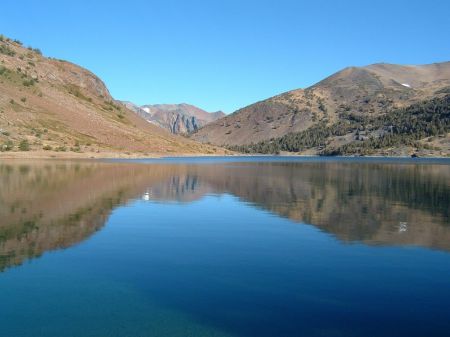
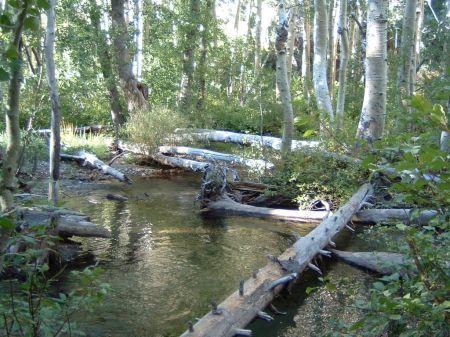
It’s amazing the difference three weeks can make. We first stopped at Saddlebag Lake, where the chill in the air and the cold breeze that would follow us all day bit into our fingers. Our visit earlier in the month wasn’t this cold! I don’t think the temperature rose much about 68°F. Generally, the water level seemed to be almost perfect. New pools to target, but still enough water to allow the fish to move up and down the streams.

We ignored the possibility of frostbite as we settled into the rhythm of fishing. At Saddlebag — which we have never fished before — we were teased by some bruisers cruising the shoreline near the dam but they paid little heed to our flies or spinners. A few rose to my son’s flies and a few chased my spinners, but none would commit to a strike. (Next time maybe we’ll head across the lake to the inlets or even hike up to some lakes behind Saddlebag.) Regardless of the lack of catching, it was beautiful…

After an hour and a half, we headed over to Lee Vining Creek (South), where we just knew we could find some trout. Sure ‘nuf, skittish brookies were skittering up and down the shallower reaches, where Chris was able to pull in five of the fish with flies (small, as to be expected in the high elevations), but fun nonetheless. I also convinced a brookie to grab a small Panther Martin. We wandered up and down the creek for about four fun hours. I eventually pulled in two wild rainbows and two stockers, as well as being surprised by another brookie in the bend of the creek just before it heads under the road. Just as important, it was great to be in one of my favorite places. Even my modest lunch seemed to taste better under the clear blue skies.

During our descent we stopped at the lower Lee Vining Creek, near Poole Power Plant, but didn’t stick to the more usually fished areas and instead headed upstream a bit. After fighting our way through some bushes, I was rewarded with a heck of a strike in a small pool and Chris got a fish on, but it didn’t want to be landed, and wasn’t.

There was just enough time at the end of our day to stop by Pickle Meadows. It was amazing the number of boulders and rocks that have appeared since June. We fished up and down a few spots with the only action being a smallish rainbow that snagged my lure in one of those pools I tend to think holds only water. Always a surprise to get a fish in one of those! In the end, Chris pulled in nine fish; I landed seven. Not bad for a beautiful day in the Sierras!

Here’s to hoping we’ll get in one more trip before mid November. After that, we’ll have to settle for planning for next year…


1 Comment

one more cast?

Got word that Christopher doesn’t have to work this weekend, so we geared up and “de-barbed” the hooks on any new lures in anticipation of hitting the road to Twain Harte Friday night and spending Saturday fishing. It’s going to be a very quick weekend, and may be our last fishing trip for the season.

We certainly shouldn’t have too much traffic Friday night, and it’ll be over Sonora Pass on Saturday. Word is that the bite is hot at Saddlebag Lake, so we’ll head there first to fish it for the first time. Then maybe off to Tioga Lake, from where good reports have recently filtered out, and maybe we’ll hit various fishing spots down the canyon as we head back in the afternoon.  Wish us luck!


Leave a comment

in search of a creek

Spent much of the first half of Saturday fruitlessly searching for wade-in access along Putah Creek, one of the few local waters that offer trout fishing and probably the only one that can be attacked with flies. Chris and I drove up to the Winters area, where the creek feeds into Lake Solano, a bend that is quite wide, and since the water gets warm, the trout are pushed to the deeper sections. We spend a bit of time there, but nothing. Since we were in the area, we continued on to Lake Berryessa, which feeds Putah Creek.

At Berryessa, we fished a bit from shore even through it is a large reservoir better approached with a boat and best trolled. We hit a few points, but only a few small fish followed our lures, with a few strikes, but our lure were bit too big for their mouths. We probably spend more time cleaning water weed off our lures than anything else. I was in the process of retrieving an obnoxious fluorescent orange Rooster Tail lure with the expectation of pulling water weed off it, when I found a smallmouth bass — maybe eight inches long — at the end of my line. Guess that was to be my only “catch of the day,” even if it didn’t give even an inkling of a fight!

berryessa_fish


Leave a comment

…it was a wild rainbow!

For those of you keeping up with my antics via this blog, you know that last weekend was an incredible fishing experience. Much of the discussion between Chris and I over the weekend was about catch some wild trout. But while we had targeted a specific stretch of the Little Walker River where wild trout were reputed to reside, and hoped that maybe we’d pull on out of other waters, I wasn’t certain that I could tell the difference between a wild and hatchery rainbow. Sure, I knew the brookies were wild because while they aren’t native, they are no longer stocked.

WILD rainbow from Molybdite Creek.

WILD rainbow from Molybdite Creek.

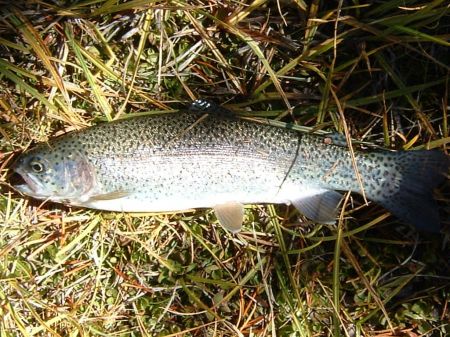
But with the help of a friend fellow fisherman who has some knowledge of the trout of the eastern Sierras, and a fortuitous photo, I can confirm that I caught at least one wild rainbow trout last Labor Day weekend. I had pointed out to Chris that some of the rainbow we were pulling in — roughly 5 of the 30 I caught — looked a tad different and noted a marked difference in the fish I caught in a small pool on the Little Walker. According to my source, wild trout normally have thin white tips or edges on their fins with extra par markings, with all fins intact, especially tails. Stocked rainbows usually have one of the back fins cut off and tails that are not be full. Sure enough, this rainbow had the extra parr marking, the thin white edge on the pelvic fins and the full tail (and all the requisite fins). Pretty neat!


Leave a comment

a fantastic fishing weekend

For me, and probably Chris, the Labor Day 2006 weekend ranks as one of our best “fishing weekends.” Ever.

We drove to the cabin Friday night and arrived about seven thirty. After quickly unpacking the car and settling in, it was off to bed at an early hour. Four-thirty came early the next day, as it usually does, but we were on the road about an hour later. With lunch in the cooler and fishing gear in the trunk, we crested Sonora Pass at just about sunrise.

Our plan was to try new fishing waters, and our first stop was the West Walker River, which lies less than twenty minutes east of Sonora Pass. During our descent we weren’t alone; at various locations along the road quite a few Marines, who were hard to see in their digital camo, seemed to be preparing for a day of field exercises. (These Marine’s home, the Marine Corp. Mountain Warfare Training Center is just north of the West Walker River.)

0609 Labor Day 04 Wolf Creek Chris

Chris’ catch on Wolf Creek.

We were on the West Walker about seven o’clock. While we have heard reports that this is an angler’s river, we were skunked. Our first pass, walking quite a distance down from the parking area, was with spinners and nary a bite. While I returned to the car to pick up my fly rod, Chris took his fly rod upstream to what is Little Wolf Creek, which empties into the West Walker. Unbeknownst to me, while I spent about an hour basically practicing my fly casting, Chris landed four decent-sized rainbow trout out of Little Wolf Creek. When I caught up with him, he pulled in two more. I, however, couldn’t hook a fish, though some did show interest in Mepps and Panther Martin spinners. I also tried casting some flies, but didn’t yet know that this wasn’t to be the weekend during which I would officially break in my new fly rod. Much to Chris’ chagrin, we departed Little Wolf Creek about noon, and headed towards the South Fork of Lee Vining Creek, where I wanted to hunt down some brook trout that snubbed me in July. (This is the section that starts at Tioga Lake and empties into Ellery Lake.)

We couldn’t have had better weather at 9,000+ feet. Blue skies dotted with puffy while clouds greeted us as we pulled to the side of the road just east of Tioga Lake. We started stalking the brookies in this very small and often shallow section of Lee Vining Creek with surface flies. These fish didn’t want to have anything to do with me, so I strolled back to the car for my spinning rod. Upon my return, I avoided casting a shadow on the water and kept a low profile just upstream from a group of brook trout and cast my favorite Panther Martin (gold blade/red body). On about the third cast I had a taker and landed a small, but very brilliant brook trout. Chris, who was bit more nonchalant about wading into the water with his boots, used a fly to land a brookie, also about eight-and-a-half inches in this area.

Lee Vining Creek Bend

A bend in Lee Vining Creek.

This section of Lee Vining Creek also meanders into a bend that one might call a very small lake or big pond, but whatever it’s called, it is deep. Chris spotted some fish that looked like more small brook trout hovering just under the surface near the creek outlet but with trees lining the shore, he couldn’t quite get a fly out far enough, though he did get a few strikes. Sizing up the situation, I knew there was only one lure to turn to: a Kastmaster. Rigged with a 3/8-ounce gold Kastmaster, I threw — not cast, not tossed — this lure more than halfway across this little lake. Almost every other cast was met with a strike, and it was probably no more than five casts between each hook up. These were some of the most aggressive and acrobatic rainbow trout I have seen. Who cares that they were probably planted! Picture in your mind casting a lure about 200 feet and having it attacked shortly after you begin your retrieve. Once hooked, the fish goes wild, jumping three or four times and sometimes clearing the water before you’ve pulled him even halfway to shore. In our case, these antics often led to an “unassisted release,” but such is the dilemma of the barbless hooks that come with practicing catch and release. But it’s always a great day when you loose tracks of the number of strikes or lost fish. In addition to their aggressiveness, these were some hefty trout.

After hammering one pocket of the lake, we moved ten or fifteen feet down the shore to another point. Chris eventually walked back to the car to get his spinning rod, but couldn’t seem to get many hook ups. After watching me, he figured out that he was going too deep, so with a lighter lure with a faster retrieve, he joined in the fun. Our little jaunt around this little lake netted about 15 rainbows ranging from about 12 to 14 inches for me, and five for Chris.

This little lake once again turns into a creek paralleling Tioga Pass Road, and in following it we hit likely pockets and pulled in a ‘bow here and there. At one deeper pool, we each pulled out a few more fish before heading back towards Little Wolf Creek for few casts before we had to head back over the pass. While my luck held true to form — a few strikes on lures and nothing on flies — Chris pulled about four fish from the same little pool we had targeted in the morning. But after watching the last rays of the sun fade, it was time to head home.

The plan was to stick around Twain Harte (where our cabin is located) on Sunday, but Saturdays’ fishing fever was still with us. Even though it was late in the morning, we again hit the road in search of finned fun. In the spirit of trying new waters, we headed up Hwy 108 towards the pass, without an inkling of where we might stop. We finally settled on the Clark Fork of the Stanislaus River. I started out with spinners, but soon found that it was near impossible to target many of the likely pools because of over-hanging bushes. I did eek out one strike in a deeper pool, but that was it. Chris, however, was able to entice about half a dozen strikes from the same pool by using various bead head flies, including a few hits from what appeared to be a “monster fish.” But we left the Stanislaus, without landing a fish, and headed over Sonora Pass yet again. Our intentions were to head back to the South Fork of the Lee Vining Creek, but since it was late in the day we set off for other unfamiliar waters.

We ended up on a section of the Molybdite Creek, near the Obsidian Campground. This is a little creek that branches off of the Little Walker River and requires some precision. It also should require Kevlar pants. I, however, was wearing shorts. But I’m not intimidated by “adventure fishing” and we headed upstream — Chris with his fly rod and me with my spin casting equipment. I moved ahead of Chris as there were fewer pools suitable for a spinner, while he moved a bit slower, throwing a fly at likely pools. I was probably 50 yards or so upstream from Chris, and wondering if I might not catch anything, when I was almost shocked out of my socks when my gold Panther Martin was attacked in a pool no more than five feet long, four feet wide and maybe three feet deep. Out of this small pool came a vibrant rainbow about 14 inches long.

Realizing that I had forgotten my forceps, and hoping that I might catch more fish, I headed downstream to find Chris attempting to free his line from a branch that was underwater. He had hooked a fish that then wrapped his line around the branch and employed a “self release” maneuver. After helping Chris free his line, I borrowed an extra pair of forceps and headed back upstream.

0609 Labor Day 18 Little Walker Rainbow

WILD rainbow from Molybdite Creek.

No longer questioning that trout might reside in almost any pool on this stream, I tossed my lure into almost any water deeper than six inches, making slow progress through the brambles and fallen trees while avoiding cow pies. About 100 feet further I found a wide and shallow bend. After slowly covering most of this section with half a dozen casts, a trout broke the surface, diving after my little bumble bee pattern Panther Martin with a silver blade. I placed the spinner in the same spot and he struck again. Apparently this rainbow wanted to be caught…with cast three the fight was on! Though this trout was “only” about 12 inches, it covered the entire width of the stream a few times before allowing me a close look and a quick release. While I only pulled in two fish and Chris had only one hook up during about 90 minutes on the Little Walker, this was a great introduction to a stream I may visit again.

But by now it was getting close to sundown. Since we had to head back over Sonora Pass, we stopped, of course, at Little Wolf Creek. Chris set off on a smaller branch of the creek while I headed upstream to a small bend where the water cascaded over boulders into a wide and deep pool. Picking a central position, I was able to cast both upstream and down stream. Within a dozen casts I had a decent rainbow on, ending up releasing an eleven incher. I was joined by Chris, and over about an hour we pulled in five more trout. Knowing it was almost time to go we slowly walked downstream, hitting various pools as we went. About 30 minutes later — with three more fish for me and a couple more for Chris — we ended our great fishing weekend.

But what a weekend to end the summer! When we finally departed Little Wolf Creek Sunday evening, we calculated that the two of us had landed about 57 rainbow trout, 1 brown and 2 brookies. Not bad for two days of intense fishing fun!