fishing for words

(and tossing out random thoughts)


Leave a comment

what would Yogi do?

Do we need pedestrian and wildlife lanes on our bridges? A bear jumped off the Old Donner Pass Highway to avoid two oncoming cars but amazingly and acrobatically saved his hide and ‘bout now might be regaling his bear buddies with the tale.
Bear in Net

Two cars converging on the Old Donner Pass Highway scared a bear who had wandered into the middle of a bridge causing it to jump over the side. The massive animal managed to arrest its fall and sat on a support for the 280-foot-high for a day until animal control darted it, pushed it into an army-surplus nylon net with a pole, and then lowered it to the ground.

This comes from Backcountry.com, with more pictures at Snopes.com.


1 Comment

a quick getaway

Two (unshaven) “mountain men.”  One spinning rod.  One fly rod.  One stream.  Fifty trout hooked and twenty-seven landed in five hours.  What a morning!

Sean and I made a quick weekend getaway to the cabin Friday afternoon and hit Moccasin Creek early Saturday morning. Before the sun was up we had parked the car and ambled down to the creek. The cloud cover kept the sunrise at bay a bit longer than usual, but we didn’t have any rain until later in the morning.

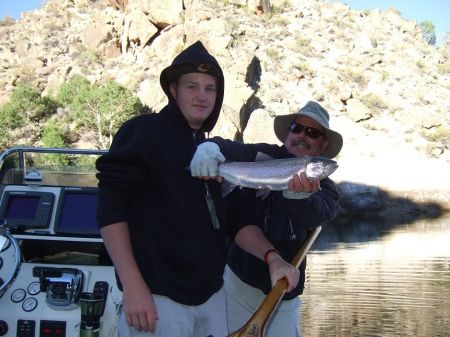
Sean's First Rainbow of the MorningWith a spinning rig, Sean began working a favorite pool with a gold-on-gold Panther Martin. I set up my fly pole with an indicator fly (Parachute Adams), with a Copper John nymph (small, a size 18) about 12 inches below. It couldn’t have been more than 20 minutes and we had both landed a decent stocker rainbow, in the 13- to 14-inch range. It was good to see Sean enjoying fishing as he sort of abandoned the sport a few years ago. See, I figure there are those who are lucky at fishing and those who aren’t, or maybe some are born with an intuitive skill. Sean, like me, has to work at catching fish. But that work can pay off, as it obviously did that Saturday.

Rain began to fall in earnest about mid morning, but thanks to the trees lining the stream banks, we were spared from getting too damp.  During the morning we switched up our lures. Me and my (bigger) fish.Sean went to my favorite gold-on-red Panther Martin while I opted for a Zebra Beadhead Nymph. I don’t think we went more than 30 minutes without one of us hooking a fish. In the end, Sean’s tally was sixteen trout hooked with nine landed; my record was thirty-four hooked and 16 landed. (Keep in mind that we only counted fish we touched or netted, meaning that we played some to shore, only to have them self release.)

After quick showers about noon, we headed to Columbia for some sarsaparilla and a gander at the town and a visit to the candy shop. We grabbed an early dinner of great hamburgers at the Diamondback Grill in Sonora. (I’m loving those buffalo burgers!) Driving back to the cabin we were entertained by a bit of lightning and thunder, and after watching a movie, it was early to bed.

It was a nice little break from everyday life, and maybe I can get Sean to go fishing again…


1 Comment

a boy becomes a fisherman

In our small group of family and friends, my son and I have emerged as the more avid anglers, a position that brings both responsibilities and rewards. Most of these responsibilities are self imposed. Others are unwritten but understood by most fishermen. And the rewards come in direct proportion to adherence to one’s understanding and practice of these responsibilities.

Thanks to my father, I can look to an example that serves me well. I can’t recall when a rod was first entrusted to my small hands, but this lack of recollection assures me I was quite young. So, it was only natural that I would humbly consent to take a family friend’s seven-year-old son, Connor, on his second adventure in fishing. This consent, however, put me in the unenviable position of living up to a reputation cemented when Connor was about two years old, when I was able to put him on a decent size fish during his first time fishing. Thankfully, I had a plan.

Over the last few years, as I have developed my rudimentary knowledge of fishing the 108 corridor of the Western Sierras, I have come to affectionately think of one particular stream as My Outdoor Classroom. A particular stretch of this stream originates from a reservoir, allowing for a consistent temperature all summer long, and is just as consistently stocked by California’s Department of Fish & Game.

I’ve taken my nephews to this stream, where they learned a bit about fishing and perhaps much more about its inhabitants, having chased various insects and crawdads on a warm afternoon. As a new fly fisher, I use this stream to build my skills, knowing that it is likely that I will be able to practice more than just casting and presentation if a trout – even if it is a hatchery rainbow or brook – obliges me with lessons in hooking, playing and landing. So it was decided that Connor would join me on this stream the morning of the Saturday before Labor Day.

As is the fashion of fishermen, before the sun was up I was driving through the golden Sierra foothills. Geared up and looking goofy as fly fisherman does, I headed into the small canyon where I would be guaranteed cool shade all day long. With history as my guide and no other fishermen in sight, I settled in a few feet downstream from a boulder and directly across from a seam (the edge between sections of water flowing at different speeds) that delineated the eddies of nearly still water behind the boulder and the faster flowing shallows closer to the opposite shore.

I would be casting my flies into the inky water without any hint that fish might be present. I had not seen any evidence of feeding. I also could not see beyond the stream’s still-black surface.

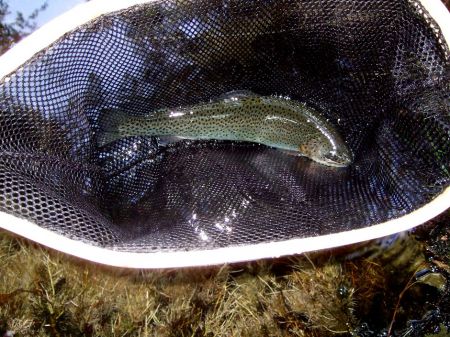
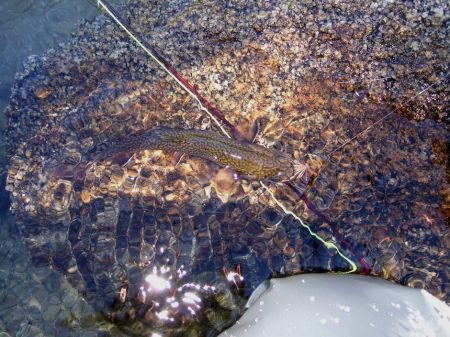
Six or seven casts later I was rewarded with a decent-sized rainbow that broke the surface chasing my Zebra midge. My reel sung as the fish first headed upstream before sounding for the bottom. I muscled him out from behind a rock only to apply pressure to keep him out the Trout Close Up (Labor Day ‘07)weed beds that lined the stream bank. What a great start to a day that was just dawning! During the next two hours before Connor would join me, this scene was replayed numerous times, and in the end, I could count sixteen fish hooked and fourteen landed.

With the arrival of my seven-year-old student, I set aside my fly rod and rigged up a spinning rod, then gave Connor a crash course in how to cast and retrieve the little Panther Martin at the end of the line. He caught on rather quickly and did a great job of listening to my direction. Within a few minutes he was casting a fair distance, though not always in the best direction, and was learning to retrieve the lure at a good pace.

[singlepic=249,150,,,right]
Wanting to show him the best location to land the lure, I made a cast myself, and wouldn’t you know it, it was “fish on!” after two cranks of the reel. Having learned many years ago that for a child the thrill of fishing lies in the catching not the watching, I suppressed the involuntary urge to bring the fish in and quickly handed the rod to Connor, offering guidance on playing this trout. Shortly, he was rewarded with a very fair-sized rainbow. I was rewarded with a big grin.

Since the casting in this section of the stream requires a healthy ability to target a small area, I next set Connor up with salmon eggs. (Yes, I’m typically a catch-and-release fisherman, but knowing that these were not wild trout, that there would be a limit to Connor’s take, and that they would be eaten, I was willing to allow for the use of bait.) It looked like a picture composed by Norman Rockwell: Connor in his striped shirt holding a pole out over the bank of the stream and anxiously watching his line.

In short order he was into another fish. Not as big as the first, but still plenty full of fight for young man. Connor’s mask of concentration dissolved into a smile as I netted this fish. Quickly he was ready to cast again. In between untangling line, Connor did get a few other strikes, but didn’t hook up. Setting the hook is another lesson for another time.

With Connor’s line once again in the water, I returned to fly fishing. My time on this water has taught me that about mid morning that the “catching” typically slows, particularly when it comes to bait or spinners. But for some reason, a fly seems to capture the attention of these trout for a bit longer.

Casting over the heads of Connor and a few other fishermen who had joined us, I again drifted my flies along the seam. I allowed for a longer drift, expecting the fish might be spread out a bit more after being flogged by spinners for a few hours. During the next hour or so I was into a rainbow every few minutes. Even after all the other fisherman had left, I was hooking fish. Eight more fish brought my total to twenty-four trout hooked and twenty landed. Not too shabby for three and a half hours.

The fishing was good this day. Best of all, my seven-year-old friend seems to have been inspired by his second time fishing (and catching). The morning we were preparing to leave the cabin he asked, “Are we going fish?” I hope the answer will be “Sometime soon.”

Leave a comment

back to the “westside”

Crowley Lake/Rock Creek Fishing Trip, Part 5 of 5

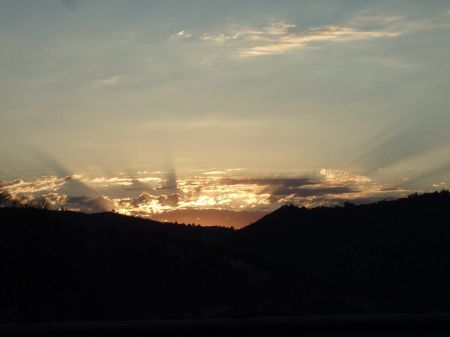
Sunrise over the Sierra Nevada.

Sunrise over the Sierra Nevada.

Sunday was a day of travel and the end of our adventure in Eastern Sierra fishing, probably for this summer. (Fall is coming up though!) We headed up Hwy 395 for Hwy 120, and made a quick stop on Lee Vining Creek just below Tioga Lake. The water was low and the fish were slow. A few bumps and some following lures, but no bites. Quickly moving along, we were over Sonora Pass and at the cabin by two thirty that afternoon. Soon after we were sitting on the sand at Twain Harte Lake with my sister and her boys.

In planning this trip I had given thought to taking a chance on a local put-and-take creek, figuring that any fish that weren’t caught over the weekend might be good targets Monday morning, when I hoped only a few folks would be fishing. Five thirty Monday morning came and I was up. I poked Christopher but he opted for extra sleep rather than extra fishing.

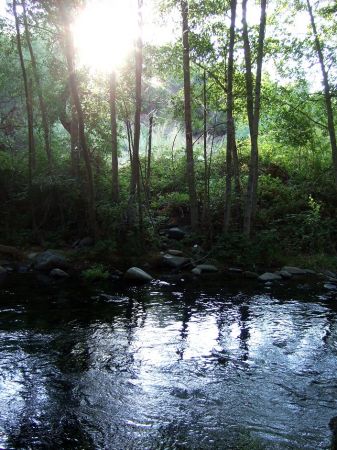
I was on the creek about six thirty, with the sun still behind the ridge. This creek is in a canyon of sorts with plenty of streamside trees keeping it cool. Without sunlight the water had an inky cast and I could not see beyond the surface of the water. Guess at likely holding locations for feeding trout, I cast a dropper/midge in position to float it (looking natural I hoped) through the pool.

On my fifth cast it was “fish on!” In fact, it surprised me so much that I involuntarily made a good hookset (in other words, I jerked my pole). Soon I had landed a decent thirteen-inch rainbow trout, my fist on my fly pole. For the next few hours it was constant action with a mix of fish to the net and a number of LDRs and missed strikes.

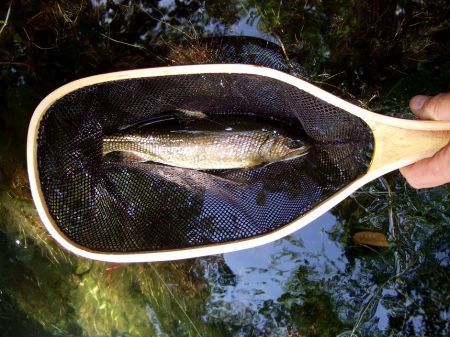
When the sun finally began to filter through the trees, I could make out quite a few trout schooling in two different locations. But off in the distance, about ten feet downstream, a single fish was watching a specific feeding lane. Based on the color difference in this trout’s profile, I figured it just might be one of the broodstock brook trout that were put into this creek weeks ago. Maybe one in ten of my casts were good enough to float down the feeding lane, but my dry fly did get some attention. I lost count of the number of casts and of the passing time, but on one particularly good cast he attacked the dry fly, breaking the surface and immediately turning downstream. A quick tug and he was hooked. These brook trout put on a good fight…a lot of head shaking, jumping and runs…so it took about three or four minutes before I had him in the net. It was a big fish. But I had misjudged how played out he might have been. With a mighty flop of his tail he was out of my net and back into the stream.

It was a heck of a morning that Monday. Eighteen rainbow trout and the single brook to the net with probably another ten LDRs and half a dozen missed strikes. I was finally off the water about eleven o’clock, when the bite died down. This little adventure surely falls under the adage “The early bird catches the worm.”

Monday afternoon and Tuesday were filled with typical fun cabin activities. We spent time at the lake, visited Columbia, played bingo, and ate well. I did, however, take time to clean off all of the cabin gear, so we could just store the equipment when we got home.

I will remember this trip fondly. I found out that I can indeed catch trout on a fly.


Leave a comment

great ending at rock creek

Crowley Lake/Rock Creek Fishing Trip, Part 4 of 5

Our last day at Rock Creek started with our packing for a high along Upper Rock Creek in pursuit of more wild trout. We struck out from the trailhead, which is at 10,255 feet, about nine o’clock. According to what I had learned, the Mosquito Flat Trail offered plenty of opportunities to fish along the creek and the numerous lakes it created while meandering out of the John Muir Wilderness. Unfortunately, the best way to gain access to these fish was to be wading. And we didn’t bring our waders. But we ventured on, leaving quite a few hikers and fisherfolks behind after cresting a steep grade. At Long Lake, about two miles down the trail, we found a few small brookies willing to look at our flies, but no takers. Near the far end of Long Lake, I offered Christopher the option of going on or turning around. After some discussion about golden trout being a possibility in Chickenfoot Lake, the next lake on the trail, and a comment from another fly fisher that it was just ahead, we struck out for Chickenfoot. It was a relatively strenuous climb, but the scenery was incredible…for good reason. I learned later that Chickenfoot is at about 11,000 feet!

The fish in Chickenfoot Lake must have been enjoying some underwater scenery as Christopher and I saw only a few rises to our dry flies, and I missed a single strike to my nymph. Funny thing about hiking, though, it’s the return trip that kicked my b**t. We made it back in relatively short order, getting back to the car about one o’clock. After leisurely cleaning up (including showers!), Christopher and I headed to Bishop for a break, including dinner out and lingered longer than usually in the welcome chill of air conditioning.

Being out last day at Rock Creek, I had formulated a plan for that evening based on my previous experiences. About five thirty I waded into the water at “the ponds.” With some cajoling, Christopher had joined me. Starting with a Copper John (a fly designed as a nymph with a reflective bright red body) underneath an Elk Hair Caddis, I cast into a likely pool below riffles. A fish hit on the second cast, and a six-inch brook trout was soon in my net. The rest of the evening was much the same, with Christopher and I picking up wild trout on both nymphs and dry flies. (The fly struck changed as the evening wore on and the food source changed from midges to mosquitoes and other unseen insects.) In the end, I caught and released another ten trout and LDR’d maybe another ten. I blame this mostly on the fact that these smallish trout were trying to strike my too-large Elk Hair Caddis fly. I also missed a few strikes as well. I don’t know how many fish Christopher pulled in, but I did have to convince him to get off the water. So I think he also had fun.

Go to Part 5…


Leave a comment

rock creek lake

Crowley Lake/Rock Creek Fishing Trip, Part 3 of 5

Friday morning Christopher wanted to pursue larger fish, hoping that Rock Creek Lake would give up some of the recently planted state hatchery and Alpers rainbows. There was little doubt that some fish were there. A few followed spinners in from deeper water just past a shelf, but only one struck my favorite gold Panther Martin, but that ended with an LDR. With frustration, Christopher opted to head down to Rock Creek, which also was supposedly stocked the day before.

We waded from our campground downstream, finding a few smaller trout, but little interest in our flies. The stream also offered few opportunities for this amateur fly fisherman to make good casts. We ended our time on the water a bit early to ensure time to enjoy our steak dinner. While we were waiting for the coals to heat up, we had a camp visitor.  (Shown to the right.)

After enjoying a good steak, we headed back out to “the ponds.” Something was a bit off this evening, as strikes were few and I ended up with only five fish – all small brook trout – to the net.

Go to Part 4…


1 Comment

first trout on my fly rod

Crowley Lake/Rock Creek Fishing Trip, Part 2 of 5

But our guided trip wasn’t the end of my fishing (or catching) for the day. During our day on Crowley Tom told me of some folks who had fished a section of Rock Creek called “the ponds.” It’s an area just below Rock Creek Lake where the creek widens and meanders through a marsh just opposite the Rock Creek Lodge store. This portion of the creek is populated small wild trout, typical of high elevations steams and lakes. (By the way, this is at an elevation of about 9,500 feet.) Anyhow, these folks had some fun the night before targeting these little trout with midges under a larger fly that is also used as an indicator. Out of my fly box I pulled a small tiger midge and a larger Elk Hair Caddis.

Chris fishing  Rock Creek.

Chris fishing Rock Creek.

Donning our waders, Christopher and I headed into the creek an hour or so before sunset. Christopher had hoped to try spinners, but with few results. I stuck with my fly rod, inspired by my Crowley experience to try nymphing in moving water. Soon I brought to my net my first trout, a brook trout, caught on my fly rod, albeit with a suggested fly section.

Rock Creek brook trout.

Rock Creek brook trout.

It wasn’t a trophy fish, maybe six inches, but it stunned me to think that I was able to cast a fly where it needed to go in such a manner as to fool a wild trout into taking it for a natural food source, in this case a midge. Encouraged, I edged down the creek, targeting areas upstream from the rises made by surfacing trout. I brought a few more brook trout to the net. I lost others to LDR (long-distance release).

Shortly after twilight began in the canyon, the feeding of these trout changed subtly. They were no longer slurping (a highly technical fly fishing term). They were jumping and breaking the surface of the water, typically at the edges of the marsh grasses. With mounting confidence, I cast closer and closer to the edges of the marshes. This time a fish struck my indicator on the surface. I was so surprised that I didn’t set the hook. Another cast, then another, within six inches of the grass. A strike and set and I soon had a juvenile brown trout in my net. By the time I left “the pond,” I brought a dozen fish “to the net,” lost about eight others to LDR and missed just about as many strikes. It was great!

Go to Part 3…


Leave a comment

changing fishlosophy

Crowley Lake/Rock Creek Fishing Trip, Part 1 of 5

This last trip across the Sonora Pass to the Eastern Sierra will go down in my books as one to remember. And one that brought about new understandings and new respect for my relatively recently adopted hobby, fly fishing.

It all began July 18 as Christopher and I leisurely left Benicia in the morning. With my car’s trunk and back seat stuffed with camping and fishing gear, we were off to an adventure that was in the making for nearly a year. Our destination was the East Fork Campground near Rock Creek Lake, but my imagination was already on Crowley Lake, where the next day was would enjoy our first day guided fly fishing, courtesy Tom Loe of Sierra Drifters.

Part of the Sierras, west of the lake.

Part of the Sierras, west of the lake.

For me, Crowley Lake was a place of mystery since I was wee lad. My family would drive by Crowley on the way to Tuolumne Meadows and I would marvel at this man-made, 650-acre body of water (part of Los Angeles’ water system) in the middle of the high desert of Mono County. But I wasn’t marveling at the size of the lake or the sheer audacity of its construction, but at the stories we read in the free local tourist papers about the huge trout caught out of Crowley. So when Christopher proposed the idea of a guided fishing trip, Crowley sprung to mind as the place to go.

After dropping some items off at the cabin in Twain Harte, we pushed over Sonora Pass; which was nearly devoid of snow. Shortly after four that afternoon, we had established our campsite and settled in. In many ways, Rock Creek resembles a miniature June Lake Loop. Rock Creek Lake sets near the head of the canyon, with Lower Rock Creek tumbling through pine and aspen forests towards Crowley Lake. Upper Rock Creek feeds into the lake, descending from its source in the high Sierras. Campgrounds dot the length of Rock Creek canyon and two lodges are found near the lake.

A quick call to Tom that evening gave us reason to bed down at an early hour. Fishing on Crowley was good in the morning hours, and our start time was to be sixty-thirty. It isn’t too hard to fall asleep early in the Rock Creek canyon. The ridges that form the canyon rise rather abruptly and just as abruptly bring an early sunset and prolonged twilight. We were in our sleeping bag soon after nine.

The sun comes up early in the Eastern Sierra! As we emerged from the bottom of Rock Creek Canyon about five forty-five the next morning, the sun was fully ablaze. The air temperature was still a bit chilly when we found Tom waiting on the dock and soon were in his flats-style boat headed to the Crooked Creek inlet on Crowley Lake. For much of the year Crowley Lake trout – mostly rainbow sprinkled with browns and cutthroats – seek out the cooler and more oxygenated water at the lake’s various inlets. Tom’s plan this morning was to be there waiting when the fish swam up the channel.

I had warned Tom that while we knew the theory and had some basic experience, that we were new to fly fishing. He did a great job to taking the time to explain how we should cast and how one goes about stillwater nymphing. (Nyphming is trying to imitate a particular nymph stage of a local insect. In this case, it was midges.) Our rigs consisted of a midge dropped from a Punk Perch (both of Mr. Loe’s design), which were both suspended underneath an indicator composed of a brightly colored yarn.

I will confess that our casting left a lot to be desired. With Tom’s advice were we able to place our flies in the suspected path of the trout we hoped to catch. Once our flies were in the water, we were told to keep our eye on the indicator, and if it started to submerge to set the hook. This is a concept counterintuitive to spin fishing, when fish tend to smack into a lure and hook themselves. Consider for a moment the small hooks around which these flies are tied, and one gains respect for setting the hook quickly and properly.

Chris and guide Tom Loe with a nice Crowley rainbow.

Chris and guide Tom Loe with a nice Crowley rainbow.

But Christopher did so, pulling in the first and biggest fish of the day – about 20 inches – within fifteen minutes of Tom setting out the anchors. Tom said he’d put us on the fish and he certainly did. Before ten o’clock Christopher and I together brought 19 rainbows to the net and probably missed a similar number of strikes.

I was surprised at the fight in all of the fish we hooked. I don’t think any were shorter than 14 inches and all required a bit of play before we could bring them to the boat. It was an incredible experience. To put together the theory learned in our fly fishing class with on-the-water experience and advice. Best of all, I gained confidence that I perhaps even I could grow into a halfway decent fly fisher.

The downside to Crowley is that during certain times of the year a mat of algae blooms, which is then pushed around by the winds. Unfortunately this day the wind was blowing up inlet, pushed an ever dense cloud of algae in our direction. This, in turn, reduces the trout’s’ ability to draw oxygen and pushes them back into the deeper recesses of the lake. As the algae grew denser, the number of strikes fell. It was amazing, however, that an occasional fish could still find our miniscule flies amid the pea soup of algae.

As we closed in on noontime, the wind began to tease us, shift direction and pushing the algae out of the channel. Alas, it didn’t push fast enough. For the next two hours strikes were few and my ability to set the hook properly seemed to be diminished…perhaps by over confidence? But as our time on Crowley Lake ended, the idea of a return trip was already firmly planted in my mind.

Go to Part 2…


Leave a comment

the adventure (soon) begins

The gear is getting lined up, the fishing tackle assembled and the gas tank is full. In less than 36 hours, the Great Fishing Adventure of 2007 will begin. Camping in the Rock Creek area, fishing Crowley Lake, McGee Creek and the Little Lakes Valley. Might squeeze in time at my favorite spot on Lee Vining Creek, then return to the cabin for a few more days of relaxation.

What am I looking forward to?

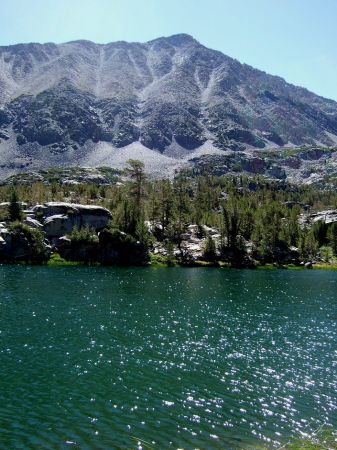
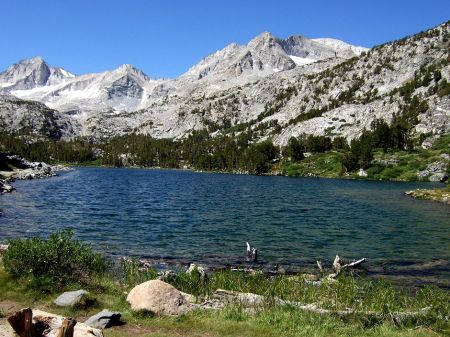
Eastern Brook Lake (Little Lakes Valley)

How’s that for an answer? (Just picture me in the foreground with a decent-sized rainbow, brook, brown or maybe even a golden trout.)

It is unknown if I will be able to post any real-time fishing reports from the Eastside, but I will report after the fact, with the obligatory photographic piscatorial proof.


Leave a comment

an orchid by any other smell

Yosemite Orchid

Platanthera yosemitensis

Amazing what one might find in the backyard, so to speak, if one looks long enough. Especially if you follow your nose.

An orchid that exists only in Yosemite National Park and first collected in 1923 has been found to be a distinct species. Apparently, it grows at only nine sites in the park and was rediscovered after a U.S. Geological Survey member tracked down a smell “…like a horse corral on a hot afternoon.”

Yosemite Valley’s meadows, which have never frozen under glaciers, are home to other endemic plants such as the Yosemite onion, Yosemite woolly sunflower and Bolander’s clover. The Yosemite bog-orchid (Platanthera yosemitensis) is the only known orchid species endemic to the Sierra Nevada range and grows in spring-fed areas at 6,000 to 9,000 feet. Its flowers are less than a quarter of an inch wide. An article in Madroño, a journal of the California Botanical Society announced the species’ discovery.

You can google news to find out more, or read more about Platanthera yosemitensis it at Discovery.com or the Fresno Bee.