fishing for words

(and tossing out random thoughts)


8 Comments

the slow lesson of fly fishing

Fly Fishing Trip Goals: Fish New Water(s), Fish for New Species/Strains of Trout,
Drink New Beer(s), Repeat. Note: Do so slowly, with great deliberation.

It’s not casting, presentation or fly selection; it’s a deliberate and slower pace that offers the best chance of success in fly fishing.

This isn’t a new or unfamiliar idea. My first appreciation of a slower approach was the pace at which I entered any water, familiar or unfamiliar. Slowing down to take the time to make a few observations. To watch the sun rise. To look for that one rising trout. To take time to fish that small seam a few feet out from the bank.

[singlepic id=1088 w=275 h=368 float=center]The decision to try my hand at tying flies required a slow, methodical approach as I learned techniques and how materials responded to the tying process. I’m not a production tyer, and probably think more what I’m doing when tying than I should. That’s okay; a lot of that thinking is about the fish I expect or hope to fool with that fly; or memories of already having done so.

Rod building again necessitates slowing down. Wrapping thread seems simple, and it is. Wrapping thread well isn’t. Five-minute epoxy is the fastest part of the process. Laying down multiple coats is not.

More experienced fly fisherman might wonder why it took so long for me to come to this conclusion. In my defense, there were trout to fool and success was measured by body count.

Two weeks ago, while setting aside the desire to get on higher-elevation trout water as soon as legally possible, it dawned on me that the fish would still be there even if my arrival was delayed a day or two. Like dominoes falling, decisions were then made to purposely plan a slower pace.

It’s a huge thing to slow down in today’s world. To take a slow, long look at that wild trout. And, when the sunlight’s too dim to fish, to slowly relish the day’s adventures, seasoned with good food and, if you’re lucky, a good beer.

It’s all worth savoring.

To be certain, we lugged along a few new brews to the cabin during our Opening Day trip, but didn’t pass up the opportunity to try something from the tap during dinner at The Rock.

Told by the waitress that customers had complained that New Belgium’s Ranger IPA was too hoppy, Sean naturally went ahead and ordered it. Apparently those customers have sensitive palates. I’m not a huge fan of too much hoppiness on the back end, but even I found the Ranger rather mild. So did Sean.

Though not an extreme beer snob, I favor trying local suds, and opted to try Snowshoe’s Grizzly Brown Ale. (And, honestly, I felt an obligation to try the Grizzly as research. The Snowshoe brewery is an hour away from the cabin and will be on the itinerary during my brother’s visit next month.) I’ve grown increasingly fond of a well-done brown ale. The Grizzly didn’t disappoint, and it seemed that Sean might have wished he’d chosen it. It’s certainly dark in color, but semi creamy and not heavy as might be expected. A nice toasty maltiness gives way to a light hop finish.

Certainly a great way to finish a day of fly fishing.

3 Comments

start of the 2011 trout season: working out the kinks

From what I hear and experienced, it might just be a good thing if you missed the Trout Opener this year. At least on the east and west slopes of the central Sierra Nevada mountains.

No one’s outright said as much, but reports from the Eastern Sierra suggest that crowds may have been there but the fish weren’t. One particularly likeable report: “Bait slingers and trollers failed miserably on Opening Day weekend and 100,000 lives were spared!”

Bass from the Shadows

One small bass from the shadows of a small pond.

The same seemed to be true in our neck of the woods. A California DFG hatchery worker I’ve talked with over the years told of anglers grumbling that fish were nowhere to be found, despite the usual numbers being planted. (More interesting parts of that conversation will come in a future post.)

Not all went as we planned, but arriving in the Sierra foothills in the aftermath of Opening Day put Sean and me in a good position to fish and explore in relative solitude. Months of neglecting necessary fly fishing skills were soon forgotten and muscle memory was gradually regained.

Arriving before Sean and after opening the cabin for the season (thankful that pipes hadn’t burst during the long winter) it was time work out the kinks on the convenient Lyons Canal. Just behind town, it’s more accurately Section 4 of the Main Tuolumne Canal of the Lyons Reservoir Planning Unit. Built in the mid 1850s, it’s part of a network of canals — estimated to total 60 miles — that crisscross Tuolumne County. Though peppered with flumes and concrete in some sections, parts of it have been reclaimed by Mother Nature and now resemble a small stream carved into the rolling hills.

Like many moving waters, walking a short distance away from easily accessed sections is worth the little effort required. Stocked with rainbows, the canal is also home to a now wild population of brown trout.

Hopeful that the most important tool in my fly fishing arsenal — confidence — wasn’t lacking, I tested likely cut banks, boulders and shaded water.

Despite the lack of wildness of the surroundings — homes and a roadway are a short distance away — these brown trout are wild enough to scatter at the shadow of a rod or a less-than-light footfall. This requires casts well upstream of your position, with the best casts placing the fly no more than a few inches from the bank.

My first fish darted out from a surprisingly deep undercut four feet in front of me; eating a standard red Copper John nymph and barreling downstream into faster water. Nicer still, this was probably one of the biggest browns I’ve pulled out of the canal. It looked healthy, even happy.

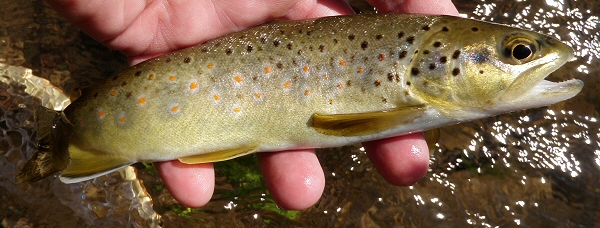
Brown Trout from Lyons Canal

Another brown from the canal…they do like hugging those banks.

Six browns of various sizes came to the net that afternoon, all seeming to eye me with what might be described as familiarity bred by a near certainty that we’ve met before. Thankfully, most are small enough to be released by freezer-stocking folks hunting the bigger, stocked rainbows.

Perhaps it’s a reflection of the intervening off-season troutless months, but the brown trout this year seemed feistier and their spots brighter than I remember.

I finished up the day, with long shadows creeping between shafts of the setting sun, tossing streamers into a pond on long-fallow golf course. Decent sized bass cruised the banks, but in such small water quickly disappeared into the weeds. A few of their offspring were fooled with streamers and trailing nymphs; the biggest was about eleven inches.

As the sun fell behind the tips of the pines, it felt good to have worked the rustiness out of my cast and rediscover the confidence that had been in hibernation.


Leave a comment

what we see this Wednesday… (05/11/2011)


2 Comments

the water was high, but crazy luck abounded. fish caught, beer consumed and recon accomplished. more later.

Laughing Brown

Post Opening Day fishing so fun even the fish were laughing...


Leave a comment

gone fishing

The Opening Day rush should be over by now, which means I’m heading out the door.

On the way will be obligatory stops for supplies and fast food. I’ll warm up with wild browns just outside town. Sean will join me later this evening. The next three days will be focused on fishing, with high water and lingering snow dictating where.

Fly fishing, friendly competition, man food and beer. The stuff vacations are made of.

[singlepic id=761 w=600 h=450 float=center]

Hoping to say hello again to a few of these wild guys...


7 Comments

the challenge of a (personally) delayed trout season opener

It was the ride to the office yesterday that finally triggered that physical feeling that Opening Day is upon us. Despite the early hour — 0600 or so — the ride was comfortable, not too cold and not too warm. The sun was already burning away the coastal overcast, leaving behind clear skies.

Then it hit. Smack dab in the middle of my face shield. The first bug of the season. If I were to guess, I’d say something in the family Chironomidae. Trout food, particularly as pupae.

Until last year, it was imperative to depart Opening Day Saturday, immediately after assisting with a fly fishing class that I’ve been involved with for quite a while.

What changed? I’m certainly not self employed like the Unaccomplished Angler or retired like Mark (@Northern California Trout) and able to traipse off to fish whenever I’d like. I do, however, accrue a healthy number of vacation days at work and now consider it impolite to not use them.

[singlepic id=764 w=200 h=267 float=center]

Stream X

What’s truly changed is my attitude about the start of trout season. Perhaps a modicum of maturity can now be ascribed to my fly fishing. Rather than stand shoulder to shoulder with anglers from “the dark side,” there’s a certain challenge in arriving on the few fishable waters in the western slopes of the Sierra the Monday after the Saturday opener. (According to Mark, this year more anglers may be crowded on less available water due to snow and ice at higher elevations.)

The more accessible waters have been flogged and the fish traumatized by flashy spinners and DayGlo baits, making it all the more challenging and satisfying to hook and land the fish too smart for not caught by these other anglers.

I hope to also visit Stream X, where unmolested wild rainbows likely will attack anything that remotely looks like food. It’s a bonus that this is the time of year when much of the fishing crowd won’t be out during the work week.

So, Opening Day I’ll be helping folks learn how to play and land fish on a fly rod. Sunday I’ll spend time with The Wife. Monday through Friday I’ll be fishing.

See you on the water.


2 Comments

I’m good enough, I’m smart enough, and doggone it, I’m a winner! (and an Opening Day tradition)

Things are looking up ‘round here.

The countdown to Opening Day stands at 67 hours and 5 minutes, and though I won’t be on the water, that’s fine. It’s become tradition the last few years for me to assist with our club’s fly fishing novice seminar every Opening Day Saturday. It offers an opportunity to pass along an education I received through the very same class and the off-the-water rewards are substantial. Many of the students continue on in the hobby, are involved with the club, and more than a handful have joined the outing I lead in the Eastern Sierra. The class also offers me a reminder of basics that I may have forgotten during a fishless winter. Also, the free lunch is a very good thing.

How Winning Requires New Skills

As ffw followers already know, I’m an unabashed nymph fly fisher. While other uptight purists fly fisherman would rather take a nap than fish with anything other than a dry fly, I go to where the fish usually are: well beneath the surface.

Oh, I’ll toss out dry flies when that’s where the action is, but it’s not too often.

Zudweg-Style Bunny Leech

But now I’ll be going subsurface with a slightly different tactic thanks to Jason over at Fontinalis Rising. According to Outdoor Blogger Network member Jason I should be expecting some awesome looking Zoo Cougars, bunny leeches, and lightweight shiner imitations.

So I’ll have to work on my casting of big flies a bit. These streamers will be good candidates this summer and fall for the East Walker, Upper Owens and West Walker rivers. Then there’s this midsized tributary I know in the Western Sierras, where brown trout spawn in the fall. Anyone have any other suggestions where these streamers might work well in the Central or Northern Sierras?

Thanks again to Jason!


As for what we see this week…


3 Comments

my favorite outdoor food really isn’t mine… (and breakfasts of legend)

This post brought to you by the writing prompt “Share Your Favorite Food
from the Outdoor Blogger Network (OBN)

I’m a food lover.

That’s why it’s difficult to narrow down my list of favorite outdoor foods to a single dish. Or snack cake. Or junk food.

When I’m in the Great Outdoors, usually fly fishing, it’s an opportunity always seized upon to graze freely. Though not out of doors, there’s always In-n-Out on the drive to or from the Family Cabin, the forward base of operations. A short few minutes away is Diamondback Grill. (Yes, we likes our hamburgers, though I favor the buffalo burger, medium rare.)

If I make it to the Eastern Sierras, there’s Bodie Mike’s Barbeque and the Whoa Nellie Deli for sandwiches in Lee Vining. And trips with the club to “The Eastside” come loaded with calories: pork posole stew, pasta, and barbecue beef sandwiches, all washed down with homemade beer.

While the above can be consumed out of doors, none are truly portable in the Great Outdoors.

That said, I’m not afraid of roughing it. I’ve spent time sleeping on rocks under a canvas roof or in the back of a questionable fly fishing vehicle (e.g. minvan). But age brings on a certain requirement desire for comfort. That limits much of my outdoor eating to the time I’m on the water.

Breakfasts of Legend*

Old-School Campsite Grill/Griddle

The source of Legendary Outdoor Breakfasts

I’d be remiss to not mention those breakfasts cooked by dear ol’ dad on the ancient heavy steel griddles that seemed to dot every campground we visited when I was a kid. You know the ones. They were made of ½-inch steel, attached to a matching steel fire ring or two “walls” made of cement and indigenous rocks.

Who knows how long the detritus of the forest — pine needles, sap, bird droppings, dead insects — accumulated on that griddle. But the first morning in camp dad would take a scrub brush to it and stoke up the fire to “sanitize” it. Once only coals were left, the cooking of one of the best outdoor breakfasts began.

There was a specific order to the cooking of this morning repast. Sausage or bacon came first, and a lot of it, to ensure a good layer of grease that was necessary in an era before Teflon®. Then the eggs, popping and sizzling like nothing you’ll see today in today’s non-stick skillets. Last, and certainly not least — and my favorite — bread slathered with real butter and “toasted” in the grease and any bits of eggs still stuck to the griddle. These were the breakfasts of legend.

These days another of my favorite foods is more of a meal: lunch on a guide boat. The phthalo blue of the open water, fresh air carried on a slight breeze, and the ribbing about the last missed hookset become condiments to whatever’s on the menu. Like that awesome pastrami sandwich from the local deli, piled with provolone, pickles and peperoncini on a rustic roll and slathered with spicy mustard. Sure, it tastes mighty good, but even better is that inevitably the “bite” will turn on with a vengeance as I chew that first mouthful.

As alluded to above, the Great Outdoors can lend a flavor to even the simplest of foods. Most of the lunches I toss together before heading to a stream or river are simple. Beef jerky, an apple, water and maybe a granola bar. (The less time taken to assemble lunch means more time on the water.) And every time, that apple carelessly thrown into my vest tastes so much better when eaten streamside — while a hatch starts, of course.

Nowadays, my favorite outdoor food is the one I never finish eating because I’m up on my feet again making that next hookset because the fish are the ones eating a favorite food.


* I believe my brother will whole-heartedly agree that there nothing that compares to our memory of these breakfasts, if not the reality. I think he’d also share my opinion that although there’ve been great breakfasts in the intervening years, there’s still nothing like breakfast cooked outdoors on these griddles, and eaten in the cool morning air of the Sierra Nevada high country.


8 Comments

fishing for words turns five after fourteen years in the making

fishing for words (ffw) was born on April 19, 2006. However and without knowing it, my blogging started fourteen years prior to that.

During the mid ‘90s — the beginning of the end for most grunge bands — I joined the few civilians who could make sense of this thing called HTML to launch a website with the unoriginal title “My Little Corner of the Internet.” It was a kooky little site for which every new entry required incorporating text into hand-coded HTML.

The trend at the time was to post a relatively static website about one’s self, and looking back one can see that the early “posts” — stories about trips or family events — popped up once or twice a year from August 1997 through July 2003. There seemed to be more to write about starting in 2004. I don’t know if was the fact that the kids were growing up and it didn’t take a trunk full of diapers, bottles, food and a stroller to travel more than five miles, or the fact that my new wife actually encouraged me to enjoy some adventures on my own.

My writing was largely directed at family and a few friends. Though a student once thanked me for my page on Aloha shirts (apparently it aided him in writing a term paper), I suffered no delusion that anyone would take an interest in what I wrote if they didn’t know me personally.

The Future of Outdoor Blogging

Perhaps the future will bring a new immediacy to outdoor blogging. (That’s not me...it’s my son with a wild rainbow on Stream X.)

Things changed in 2006 with this stuff called CMS and easy-to-use blogging platforms — both of which coincided with my first experience brandishing a fly rod over a Sierra Nevada stream. It was all in place: a website/blog that could easily be fed and a hobby that could provide material.

Now, 139,512 words and 458 posts later, I still resist defining my blog. It remains a place for family and friends…with a loose definition of “friend.” Over the years, nearly everyone in my immediately family has made an appearance in my blog — whether they liked it or not. Friends run the gamut: fly fishing club members, fellow bloggers I’ve surprised by actually showing up on their doorstep met face to face; folks who thanked me for suggestions on where their kids might have a good first fishing experience; even a few buddies met online with whom I eventually shared a fishing trip or two. Every reader is a potential friend, just like the older gentleman and younger guy wearing waders that were too clean and waving barely used rods.

While ffw doesn’t subscribe to any specific definition, it’s definitely been about sharing a personal story. It’s about stepping out of my little universe to share encouragement, a laugh, an experience, a tip or a trick. And every once and a while I’m pleasantly surprised to learn that my words do encourage or earn a chuckle.

Some folks might lament about how much things have changed in five years. I’d say that it’s only our methods of our interaction that have changed; the folks behind it remain much the same. Take a look at the Outdoor Blogger Network, for example — a group of good folks coming together over common interests. They’ve got to be good folks; they let me and my little blog join in the fun. And fun it’s been, sharing my misadventures and adding a couple of new readers every year.

As for the fly fishing, the places I fish usually are not covered in the slick pages of magazines. These are places that can be reached with relatively modest means and without a 4×4. (I did learn last year that a 4×4 would be helpful on the roads to and from Yellow Creek.)

My hero shots find heroism in fooling small wild and skittish brook trout with a fly tied with my own hands. (This summer, hero shots may include a fly rod built with those same hands.) And though the “body count” isn’t so important to me anymore, it’s still about duping that first dozen fish and the story that comes with it.

I’m hoping that there will be many more fish to write about.


1 Comment

modest proposal suggests concrete amusement parks for the catch-and-keep folks; good ideas for catch-and-release fans

At first it’ll likely prompt feigned outrage as the bait and hardware crowd wail and gnash teeth, claiming that the real goal is to enjoy the outdoors… That’ll die down once the realization sets in that it’ll mean easy access, flat surfaces for lawn chairs and coolers of beer and a near-guarantee the freezer can be filled without breaking a sweat.

Hatchery Fishing

Buried deep on the California Fish & Game Commission website is a little pdf titled “Trout Hatchery Production for Angling Opportunity” that suggests opening a raceway or two at one hatchery to recreational angling.

This is only one of a few proposals and changes at California Dept. of Fish & Game growing out of the Center for Biological Diversity’s 2006 lawsuit and subsequent proceedings. Now that I’ve moved up the ethical pecking order to become a catch-and-release fly fisherman and have washed away any lingering odor or memory of ever using bait, it’s easy to write with a straight face that perhaps this isn’t such a bad idea. (Not to worry, this modest proposal still allows for an outdoors experience with the stocking of mutant triploid trout in reservoirs.)

Most of us are guilty — at one time or another — of enjoying the rewards of a 100-plus-year-old stocking program but the commission may be on to something here. It’d be easier to outlaw deadly barbed treble hooks on streams and rivers when the option for Power Bait aficionados is a raceway brimming with stupid hungry trout.

Though the state is trimming the budget, there’ll be no need for access fees…lure in the crowds, and there’s new income to be found in raceway-side concessions.

Besides the reduction of streamside competition accumulation of empty Power Bait jars and Styrofoam worm containers, there just maybe a bigger upside for fans of catch and release.

In addition to increasing triploid production for future years, DFG is developing greater capability to successfully produce and stock heritage (native) trout species. Currently, four native species are being produced in DFG hatcheries. Kern River Hatchery is being modified with a water delivery back up system and other infrastructure upgrades for production of the native Kern River rainbow trout. Establishment of a broodstock is expected by fall of 2011. Five heritage species should be in production by January 1, 2012, with 25 percent of overall production to be comprised of heritage species. The feasibility of rearing Lahontan cutthroat trout for the Lake Tahoe basin restoration…

If it means an opportunity for me everyone to target more of our native species, that’s a sacrifice I’m we’re all willing to make.