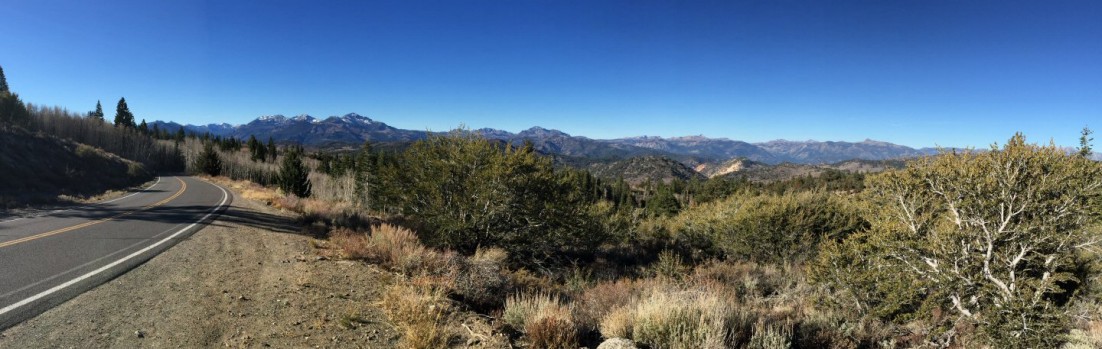
From what I hear and experienced, it might just be a good thing if you missed the Trout Opener this year. At least on the east and west slopes of the central Sierra Nevada mountains.
No one’s outright said as much, but reports from the Eastern Sierra suggest that crowds may have been there but the fish weren’t. One particularly likeable report: “Bait slingers and trollers failed miserably on Opening Day weekend and 100,000 lives were spared!”
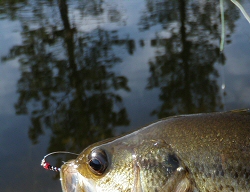
One small bass from the shadows of a small pond.
The same seemed to be true in our neck of the woods. A California DFG hatchery worker I’ve talked with over the years told of anglers grumbling that fish were nowhere to be found, despite the usual numbers being planted. (More interesting parts of that conversation will come in a future post.)
Not all went as we planned, but arriving in the Sierra foothills in the aftermath of Opening Day put Sean and me in a good position to fish and explore in relative solitude. Months of neglecting necessary fly fishing skills were soon forgotten and muscle memory was gradually regained.
Arriving before Sean and after opening the cabin for the season (thankful that pipes hadn’t burst during the long winter) it was time work out the kinks on the convenient Lyons Canal. Just behind town, it’s more accurately Section 4 of the Main Tuolumne Canal of the Lyons Reservoir Planning Unit. Built in the mid 1850s, it’s part of a network of canals — estimated to total 60 miles — that crisscross Tuolumne County. Though peppered with flumes and concrete in some sections, parts of it have been reclaimed by Mother Nature and now resemble a small stream carved into the rolling hills.
Like many moving waters, walking a short distance away from easily accessed sections is worth the little effort required. Stocked with rainbows, the canal is also home to a now wild population of brown trout.
Hopeful that the most important tool in my fly fishing arsenal — confidence — wasn’t lacking, I tested likely cut banks, boulders and shaded water.
Despite the lack of wildness of the surroundings — homes and a roadway are a short distance away — these brown trout are wild enough to scatter at the shadow of a rod or a less-than-light footfall. This requires casts well upstream of your position, with the best casts placing the fly no more than a few inches from the bank.
My first fish darted out from a surprisingly deep undercut four feet in front of me; eating a standard red Copper John nymph and barreling downstream into faster water. Nicer still, this was probably one of the biggest browns I’ve pulled out of the canal. It looked healthy, even happy.
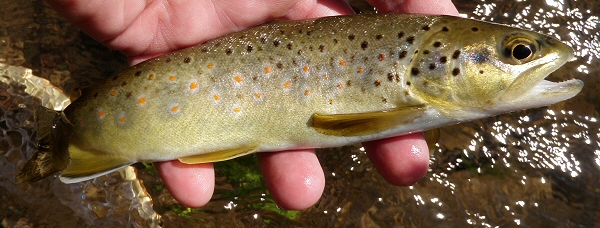
Another brown from the canal…they do like hugging those banks.
Six browns of various sizes came to the net that afternoon, all seeming to eye me with what might be described as familiarity bred by a near certainty that we’ve met before. Thankfully, most are small enough to be released by freezer-stocking folks hunting the bigger, stocked rainbows.
Perhaps it’s a reflection of the intervening off-season troutless months, but the brown trout this year seemed feistier and their spots brighter than I remember.
I finished up the day, with long shadows creeping between shafts of the setting sun, tossing streamers into a pond on long-fallow golf course. Decent sized bass cruised the banks, but in such small water quickly disappeared into the weeds. A few of their offspring were fooled with streamers and trailing nymphs; the biggest was about eleven inches.
As the sun fell behind the tips of the pines, it felt good to have worked the rustiness out of my cast and rediscover the confidence that had been in hibernation.

 fishing for words