fishing for words

(and tossing out random thoughts)


3 Comments

start of the 2011 trout season: working out the kinks

From what I hear and experienced, it might just be a good thing if you missed the Trout Opener this year. At least on the east and west slopes of the central Sierra Nevada mountains.

No one’s outright said as much, but reports from the Eastern Sierra suggest that crowds may have been there but the fish weren’t. One particularly likeable report: “Bait slingers and trollers failed miserably on Opening Day weekend and 100,000 lives were spared!”

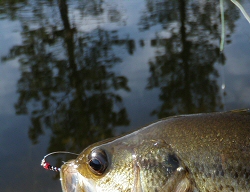
Bass from the Shadows

One small bass from the shadows of a small pond.

The same seemed to be true in our neck of the woods. A California DFG hatchery worker I’ve talked with over the years told of anglers grumbling that fish were nowhere to be found, despite the usual numbers being planted. (More interesting parts of that conversation will come in a future post.)

Not all went as we planned, but arriving in the Sierra foothills in the aftermath of Opening Day put Sean and me in a good position to fish and explore in relative solitude. Months of neglecting necessary fly fishing skills were soon forgotten and muscle memory was gradually regained.

Arriving before Sean and after opening the cabin for the season (thankful that pipes hadn’t burst during the long winter) it was time work out the kinks on the convenient Lyons Canal. Just behind town, it’s more accurately Section 4 of the Main Tuolumne Canal of the Lyons Reservoir Planning Unit. Built in the mid 1850s, it’s part of a network of canals — estimated to total 60 miles — that crisscross Tuolumne County. Though peppered with flumes and concrete in some sections, parts of it have been reclaimed by Mother Nature and now resemble a small stream carved into the rolling hills.

Like many moving waters, walking a short distance away from easily accessed sections is worth the little effort required. Stocked with rainbows, the canal is also home to a now wild population of brown trout.

Hopeful that the most important tool in my fly fishing arsenal — confidence — wasn’t lacking, I tested likely cut banks, boulders and shaded water.

Despite the lack of wildness of the surroundings — homes and a roadway are a short distance away — these brown trout are wild enough to scatter at the shadow of a rod or a less-than-light footfall. This requires casts well upstream of your position, with the best casts placing the fly no more than a few inches from the bank.

My first fish darted out from a surprisingly deep undercut four feet in front of me; eating a standard red Copper John nymph and barreling downstream into faster water. Nicer still, this was probably one of the biggest browns I’ve pulled out of the canal. It looked healthy, even happy.

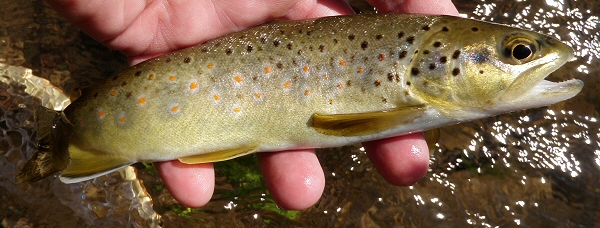
Brown Trout from Lyons Canal

Another brown from the canal…they do like hugging those banks.

Six browns of various sizes came to the net that afternoon, all seeming to eye me with what might be described as familiarity bred by a near certainty that we’ve met before. Thankfully, most are small enough to be released by freezer-stocking folks hunting the bigger, stocked rainbows.

Perhaps it’s a reflection of the intervening off-season troutless months, but the brown trout this year seemed feistier and their spots brighter than I remember.

I finished up the day, with long shadows creeping between shafts of the setting sun, tossing streamers into a pond on long-fallow golf course. Decent sized bass cruised the banks, but in such small water quickly disappeared into the weeds. A few of their offspring were fooled with streamers and trailing nymphs; the biggest was about eleven inches.

As the sun fell behind the tips of the pines, it felt good to have worked the rustiness out of my cast and rediscover the confidence that had been in hibernation.


Leave a comment

what we see this Wednesday… (05/11/2011)


2 Comments

the water was high, but crazy luck abounded. fish caught, beer consumed and recon accomplished. more later.

Laughing Brown

Post Opening Day fishing so fun even the fish were laughing...


Leave a comment

gone fishing

The Opening Day rush should be over by now, which means I’m heading out the door.

On the way will be obligatory stops for supplies and fast food. I’ll warm up with wild browns just outside town. Sean will join me later this evening. The next three days will be focused on fishing, with high water and lingering snow dictating where.

Fly fishing, friendly competition, man food and beer. The stuff vacations are made of.

[singlepic id=761 w=600 h=450 float=center]

Hoping to say hello again to a few of these wild guys...


7 Comments

the challenge of a (personally) delayed trout season opener

It was the ride to the office yesterday that finally triggered that physical feeling that Opening Day is upon us. Despite the early hour — 0600 or so — the ride was comfortable, not too cold and not too warm. The sun was already burning away the coastal overcast, leaving behind clear skies.

Then it hit. Smack dab in the middle of my face shield. The first bug of the season. If I were to guess, I’d say something in the family Chironomidae. Trout food, particularly as pupae.

Until last year, it was imperative to depart Opening Day Saturday, immediately after assisting with a fly fishing class that I’ve been involved with for quite a while.

What changed? I’m certainly not self employed like the Unaccomplished Angler or retired like Mark (@Northern California Trout) and able to traipse off to fish whenever I’d like. I do, however, accrue a healthy number of vacation days at work and now consider it impolite to not use them.

[singlepic id=764 w=200 h=267 float=center]

Stream X

What’s truly changed is my attitude about the start of trout season. Perhaps a modicum of maturity can now be ascribed to my fly fishing. Rather than stand shoulder to shoulder with anglers from “the dark side,” there’s a certain challenge in arriving on the few fishable waters in the western slopes of the Sierra the Monday after the Saturday opener. (According to Mark, this year more anglers may be crowded on less available water due to snow and ice at higher elevations.)

The more accessible waters have been flogged and the fish traumatized by flashy spinners and DayGlo baits, making it all the more challenging and satisfying to hook and land the fish too smart for not caught by these other anglers.

I hope to also visit Stream X, where unmolested wild rainbows likely will attack anything that remotely looks like food. It’s a bonus that this is the time of year when much of the fishing crowd won’t be out during the work week.

So, Opening Day I’ll be helping folks learn how to play and land fish on a fly rod. Sunday I’ll spend time with The Wife. Monday through Friday I’ll be fishing.

See you on the water.


2 Comments

I’m good enough, I’m smart enough, and doggone it, I’m a winner! (and an Opening Day tradition)

Things are looking up ‘round here.

The countdown to Opening Day stands at 67 hours and 5 minutes, and though I won’t be on the water, that’s fine. It’s become tradition the last few years for me to assist with our club’s fly fishing novice seminar every Opening Day Saturday. It offers an opportunity to pass along an education I received through the very same class and the off-the-water rewards are substantial. Many of the students continue on in the hobby, are involved with the club, and more than a handful have joined the outing I lead in the Eastern Sierra. The class also offers me a reminder of basics that I may have forgotten during a fishless winter. Also, the free lunch is a very good thing.

How Winning Requires New Skills

As ffw followers already know, I’m an unabashed nymph fly fisher. While other uptight purists fly fisherman would rather take a nap than fish with anything other than a dry fly, I go to where the fish usually are: well beneath the surface.

Oh, I’ll toss out dry flies when that’s where the action is, but it’s not too often.

Zudweg-Style Bunny Leech

But now I’ll be going subsurface with a slightly different tactic thanks to Jason over at Fontinalis Rising. According to Outdoor Blogger Network member Jason I should be expecting some awesome looking Zoo Cougars, bunny leeches, and lightweight shiner imitations.

So I’ll have to work on my casting of big flies a bit. These streamers will be good candidates this summer and fall for the East Walker, Upper Owens and West Walker rivers. Then there’s this midsized tributary I know in the Western Sierras, where brown trout spawn in the fall. Anyone have any other suggestions where these streamers might work well in the Central or Northern Sierras?

Thanks again to Jason!


As for what we see this week…


1 Comment

modest proposal suggests concrete amusement parks for the catch-and-keep folks; good ideas for catch-and-release fans

At first it’ll likely prompt feigned outrage as the bait and hardware crowd wail and gnash teeth, claiming that the real goal is to enjoy the outdoors… That’ll die down once the realization sets in that it’ll mean easy access, flat surfaces for lawn chairs and coolers of beer and a near-guarantee the freezer can be filled without breaking a sweat.

Hatchery Fishing

Buried deep on the California Fish & Game Commission website is a little pdf titled “Trout Hatchery Production for Angling Opportunity” that suggests opening a raceway or two at one hatchery to recreational angling.

This is only one of a few proposals and changes at California Dept. of Fish & Game growing out of the Center for Biological Diversity’s 2006 lawsuit and subsequent proceedings. Now that I’ve moved up the ethical pecking order to become a catch-and-release fly fisherman and have washed away any lingering odor or memory of ever using bait, it’s easy to write with a straight face that perhaps this isn’t such a bad idea. (Not to worry, this modest proposal still allows for an outdoors experience with the stocking of mutant triploid trout in reservoirs.)

Most of us are guilty — at one time or another — of enjoying the rewards of a 100-plus-year-old stocking program but the commission may be on to something here. It’d be easier to outlaw deadly barbed treble hooks on streams and rivers when the option for Power Bait aficionados is a raceway brimming with stupid hungry trout.

Though the state is trimming the budget, there’ll be no need for access fees…lure in the crowds, and there’s new income to be found in raceway-side concessions.

Besides the reduction of streamside competition accumulation of empty Power Bait jars and Styrofoam worm containers, there just maybe a bigger upside for fans of catch and release.

In addition to increasing triploid production for future years, DFG is developing greater capability to successfully produce and stock heritage (native) trout species. Currently, four native species are being produced in DFG hatcheries. Kern River Hatchery is being modified with a water delivery back up system and other infrastructure upgrades for production of the native Kern River rainbow trout. Establishment of a broodstock is expected by fall of 2011. Five heritage species should be in production by January 1, 2012, with 25 percent of overall production to be comprised of heritage species. The feasibility of rearing Lahontan cutthroat trout for the Lake Tahoe basin restoration…

If it means an opportunity for me everyone to target more of our native species, that’s a sacrifice I’m we’re all willing to make.


1 Comment

“I shall return”…with flies this time

Above 45 Degrees

Go North, young man.

This post brought to you by the photo prompt “Dream Destinations” from the Outdoor Blogger Network (OBN)

Being relatively new to fly fishing, it’s a bit difficult to answer the question of where I dream of fly fishing. There are so many places I haven’t been.

Generally being a Salmoninae guy, my first inclination was to narrow a dream destination to North American waters north of 45° latitude.

Canada is a blip on the radar — British Columbia for its renowned stillwaters filled with Kamloops rainbows and its coastal rivers and streams for salmon and steelhead, and Ontario for monster brook trout and grayling. Upper bits of Montana and Idaho would qualify as well, and we all know they offer plenty o’ places to fly fish.

But for me, it’s gotta be Alaska, a place I’ve fished, though not with flies.

Longing to Return

Brother and dad looking over the Kenai River

Alaska’s a no-brainer…there’s the entire Bristol Bay watershed — a place that may never be in budgetary reach — but perhaps just as intriguing and perhaps slightly more wallet friendly is Southeast Alaska. (Being a bit late to this post, The River Damsel beat me to choosing this destination, she’s also keen on fishing the 49th state. BTW, I would like to think it’s the compression of a telephoto lens that makes that bear in the third photo in her Dream Destination post only look so close…)

Kasilof River Moose

Where else can the morning traffic jam of drift boats be interrupted by a moose?...

Tractor Launch at Ninilchik

...or does a halibut trip begin with a beach launch?

And while it’s the fishing that’d be the main focus, there is the allure of that full-service, all-inclusive Alaskan lodge experience. There’s nothing like being responsible to only for dressing yourself and showing up for either food, fishing or sleep; it sorta removes any worries regarding the wanton consumption the occasional adult beverage.

Kenai King

Dad's first Kenai king...

Since I’m not retired or self-employed and don’t live within easy driving distance of nice trout water (and general trout season is closed here until the end of April), I’m left to only dream for now…though plans have been made and will be executed in the coming months.

I’d like to thank Rebecca over at OBN for this photo prompt and aggravating an already crazy itch to fish.


4 Comments

how bad do you want to meet mr. whitefish? — a few guides’ thoughts on clients bringing gps receivers along for the ride

Guides & GPS

One mid July day my guide both admonished me to maintain a straight line to the indicator and cheered good hook sets even though I missed more strikes than I should have. New to fly fishing then, I remember having a novice’s fascination with the almost magical wisdom guides showed and shared.

More important that day was my education. It’s a simple truism of fly fishing that one day on the water with a good guide can offer a learning experience equal to many trips alone.

But is there a limit to how much a guide might be willing to share beyond techniques, flies and presentation? This question bubbled up in my mind a few weeks ago, when an online poll conducted by Blood Knot Magazine asked fly fishermen for their opinion regarding bringing a handheld GPS receiver on a guided fishing trip. Of 100 random readers asked if it’s “okay” to do so, 41% answered “Hell yeah!” while 40% answered “Hell no!” The remaining 19% had no idea guides might care…

Flipping the question around in an admittedly unscientific and limited survey, I asked the same question of a few fly fishing guides, and the results offer interesting insight into what is a genuine desire among guides to share with clients. As a public service to both sides of the argument, I present in this space what I learned in informal conversations with a guides up and down the West Coast.

Fly fishing guides, of course, understand that they’re in a business that often requires catering to clients, but do so in a sport that’s long recognized as one of the more genteel pursuits. One can attribute the fact that half of the respondents with an opinion in the Blood Knot Magazine poll declared a GPS receiver verboten on a guided trip to this gentleman’s code. Guides’ expectations fall in line with this mind-set, hoping that clients will ask before slipping out a GPS receiver. And, if asked, most guides don’t have a problem with a client using a GPS receiver.

The Fly Shop Director of Outfitters Michael Caranci spent the time to carefully sum up his thoughts, many of which were echoed by other guides…

As a guide, I’ve never had a problem with people bringing a GPS along. As an outfitter, I know there are some guides who wouldn’t mind, and that there are surely some guides who would find it offensive. The way I see it, if you’re hiring a guide just to find out where to go, you’re missing the boat. A good guide has so much more to offer than that. And, at the same time, just knowing where to go isn’t all that much help sometime; the real knowledge and experience of guides is knowing how to approach a spot at the different times of year, times of day, flows, seasons, types of techniques, species, etc. One could GPS a spot they had great fishing one day with the guide, and return another time to the same spot and find it seemingly void of life.”

The reason behind the use of a GPS receiver also plays into a guide’s willingness to allow its use. Emerging Rivers Guide Services owner Derek Young shares that he’d be okay with a GPS receiver used for personal reasons, such as “…safety…or to better remember the experience.” But don’t pull out a GPS receiver if its use involves commercial or financial gain. “If a paying client is going to make a commercial financial gain off of my services, they can find someone else to do it with,” wrote Derek.

Mutual respect is a resounding theme with guides. Chris O’Donnell of River Runner Outfitters underscores this, expanding upon the idea by writing…

Personally, I feel that it is the client’s right to use a GPS to record fishing spots, just like gleaning other information about rigging, reading water, and catching fish. I do feel that using a GPS without asking displays a complete lack of respect for the guide. Just ask. I’ll tell you yes, and I will feel much better about it.”

These thoughts were shared by nearly every guide, though a few are less concerned about the use of GPS receivers, if for no other reason than they fish in plain sight on lakes. Tom Loe and Doug Rodricks of Sierra Drifters Fly Fishing Guide Service often ply the waters of Crowley Lake, Bridgeport Reseroir and Eagle Lake, and as Doug explains,

I wouldn’t mind if clients brought a GPS on their trips. Most people on the boats see us catching fish and will gravitate to that spot the following day. Conditions change and one day differs from the next so we don’t worry about it too much. There are always other spots on the lake to go catch fish.”

Tom gets down to brass tacks, clarifying his feeling that, “Trout migrate and conditions change so often in the areas I guide that it is foolish to get upset or worry about someone being on your numbers!”

Another guide fishing open water, and author of “Fly Fishing the California Delta,” Mike Costello, reiterates the idea of trust and discretion between guide and client, and how the development of a relationship opens the door…

I have had clients bring a GPS on my boat but they have asked me ahead of time and I trusted them that they would be discreet and not try to abuse the guide/client relationship. I am fortunate that the majority of my anglers have been fishing with me for a very long time and I am usually very open and helpful with my guiding information.”

For many guides, the idea and expectation of respect extends beyond the guided trip. Michael C. spells out this view on using knowledge gained with a guide…

…I think it’s important to realize that if you do learn some great spots by fishing with a guide, there should be a courtesy about it in the future. If you return to that place, and the guide is there working, it’s best to let them have it. If guides consistently find their favorite places taken up by past guests, they’ll quickly learn to be careful not to share those secret spots. Respect the information, and the countless hours and days of exploration that it often takes to discover those locations in the first place.”

Mountain Whitefish

If you see too many of these guys while targeting trout, you might have crossed the line with your guide...

Inversely, disrespect will get you nowhere; and maybe no fish. If you break out a GPS receiver without asking, let’s just say that a guide might be inclined to take you only to spots to which he/she wants you to return. Slide Inn owner and Fly Fish TV host Kelly Galloup succinctly spells it out:

We all learn water the same way. We go fish and then we watch other guides set up in the runs and see how they do. It is a time tested, earn-your-right-to-be-there system… If I found them using it [a GPS receiver] with out me having been told, I would instantly…either row out or start fishing in the more whitefishy water and see how few fish I could catch the rest of the day.”

In Chris O’Donnell’s view, a client’s use of a GPS receiver suggests the trip is a one-night stand…

I would not take action, other than possibly taking them to fishing spots that I want them to return to…busting out a GPS on a guided trip pretty much tells the guide it’s just a one time deal.”

Generally, these guides haven’t had too many bad experiences with clients using GPS receivers, perhaps because the majority of their fly fisherman clients subscribe to the same code of behavior and the idea of an “earn-your-right-to-be-there system.” Shasta Trout owner/operator Craig Nielsen has had several folks bring their GPS units but hasn’t had an issue with their use as he was asked beforehand in every case. Chris O’Donnell did have “…one client GPS my fishing spots…he didn’t ask, just started plugging away.” Using your imagination, you might guess as to the fish count on that trip.

At least one guide is considering employing GPS to enhance the guided experience. Derek Young mentions embracing the technology, considering the use of a GPS receiver to tag “…client photos so that they could revisit the experience with both a photo and location.”

With the above in mind and other tidbits I’ve left unshared for lack of room or other reasons, it’s a roll of the dice when you break out a GPS receiver on a guided trip.

But before you do, ask.

Or risk fishing that whitefishy water.

6 Comments

thanks to dad, we were lucky to simply survive experience the great outdoors

This post brought to you by a writing prompt from the Outdoor Blogger Network


I’ve been a dad for more years than you’d think and with that has come amazement that the number of candles on my birthday cakes made it to double digits.

Sure, everyone my age grew up without seat belts, car seats, and medications without child-proof lids. Many of my contemporaries rode bikes without helmets, ate sandwiches made with white bread and drank drinks made with real sugar.

Personally, I’m more amazed that I and my siblings survived family vacations in the great outdoors.

I can’t figure out if dad was fearless, just wasn’t being smart or placed such importance on exposing his kids to the outdoors that the risks outweighed the rewards. Maybe it was the fact that we didn’t have innumerable television documentaries underscoring man’s inability to win in a one-on-one battle with nature. Whatever the reason, we were lucky.

There are photos that I won’t share here of me in diapers, in the wilds of Yosemite Valley. That might have been where it all began, but the memories are foggy.

Tuolumne Meadows Campsite

Where we camped for many years, long ago...

What I do remember are the multiple summers we spent in Tuolumne Meadows. At 8,600 feet elevation the weather was changeable. This made day hikes, already an adventure thanks to steep elevation gains and decomposing granite, unpredictable.

While there’s debate among my family as to the name of the lake that was the destination on one ill-fated hike, it’s clear that dad had pushed the limits on that cold and overcast day. With the distance of the hike limited by the length of my youngest brother’s legs, I’m guessing the hike in took no more than a couple of hours. Much of the trail wound in and around trees before rising and emerging onto a wide meadow. Crossing the meadow put us on the shore of a lake nestled up against granite peaks. Back then we carried spin fishing gear, and it wasn’t more than a few casts before a trout made one of the most dramatic, leaping strikes to swallow dad’s Mepps Agila. Small as the fish was, dad stumbled back in his surprise at the strike.

Just about then or shortly thereafter (my memory was muddled by the excitement), the gray of the sky gave way to small granules of something best described as light hail or heavy snow. Not being as keen on fishing, my sister and brother were huddle with mom near what little shelter was offered by a wind-stunted tree. “Jerry,” my mom said, “I think it’s time to go.” Nearly 40 years later I can understand that when fishing, time flies by but those same minutes are painfully slow to pass when you’re shivering in the high country and miles from the remotest fingers of civilization. Grudgingly, dad decided it was better to leave the fish for the sake of his children and, perhaps, his marriage.

The first time we pitched a tent at the Tuolumne Meadows Campground, where, by the way, there are no public showers; my dad’s solution was to take advantage of what nature had to offer. He proudly explained to us that we’d be using biodegradable soap. (It was a novelty back in the 1970s.) Our water source would be the oh-so convenient Tuolumne River. A river that originates from two forks — the Dana Fork and the Lyell Fork — both of which originate from the huge snowpack in the high peaks of the Sierra Nevada. There’s something about bathing in water that only 24 hours ago was in its frozen form. Yet another time we dodged hypothermia.

Then there were the bears. We knew they were there. We saw them occasionally during the day. It’s the times we didn’t see them that still give me chills. There were mornings we’d wake up and dad would show us the bear tracks through our camp; tracks that weren’t there yesterday and must have been made during the night, when I stepped out of the tent for a trip to the bathroom and could have become a tasty midnight snack for one of Yogi’s cousins.

Sierra Cup

The fateful faithful Sierra cup.

Those mornings dad would tempt fate yet again by preparing breakfast on the flattop griddles that years ago were standard equipment in every national and state park campsite. These griddles were nothing more than flat plates of steel welded to a grill, on top of a three-sided steel box, and naturally were exposed to the elements all year long, accumulating sap, rust and the occasional animal or bird dropping. Dad’s ritual involved stoking the wood underneath the grill with the idea of sterilizing it, then throw on bacon to lube it up before tossing on eggs and toast. While it’s entirely possible he did manage to sterilize the griddle, I can help but wonder if some of the “seasoning” entailed small bits of rust and other things.

In that vein, I also remember being so proud of our Sierra cups. My brother and I would loop them under our belts, and like little men, dip them into the clear streams to quench our thirst. Try that nowadays without worrying.

These are only snapshots of my childhood adventures in the wilderness, and there are other, less dangerous memories of other hikes, more fishing and just being a kid in the great outdoors. Those I’ll save for another time.

I was lucky to spend so much time in the great outdoors. All of these adventures never fail to bring a smile to my face.