fishing for words

(and tossing out random thoughts)


1 Comment

a return to Eagle Lake: the first day

It’s the kind of fishing that feels illegal, immoral and just plain wrong, but so good that you hope the semi-remote location will keep all but most motivated anglers from visiting.

For a second year, fishing buddy Don and I made the trek to Eagle Lake last weekend. Last year we had done so Father’s Day weekend, just as a huge caddis hatch was coming off. Arriving a week earlier this year, we saw only the beginning of the hatch. Regardless of our timing, it was certain that fishing would be good, the catching great, and, now it seems, that I’d pull an annual bonehead move.

For me the trip’s about 270 miles, really not too far, but the last 128 miles of a narrow two-lane state highway twists and turns through canyons. Whatever mapping application or GPS you use will indicate it’ll take roughly five hours driving time, but the nature of those last hundred miles will add just under an hour. The driving is so slow it’s common for folks to get a bit lost thinking they’ve passed the turnoff for Spalding when it’s still miles up the road.

Sierra Nevada Brewery Tastes

A little sample of Sierra Nevada Brewery's Ovila Dubbel and California Common. Both great.

Last year I drove straight through, which made for a tough haul. This year I heeded the adage of setting short, obtainable goals. Luckily enough, the Sierra Nevada brewery in Chico is about midway between home and the Eagle Lake, and without pushing it, I could arrive just in time for the tour at noon.

Whether or not you’re a fan of Sierra Nevada beers, the hour-long tour’s well worth a stop. Along the tour are offers to taste the toasted malted barley and wort, which tastes of Grape Nuts with a sweetness so strong it implies instant cavities, and a chance to rub and smell whole-cone hops. The history of the brewery is a large part of the tour, and it’s eco-friendliness is dumbfounding.

Good food and beer go hand in hand with fishing, there was no slouching on my part. The Sierra Nevada Brewery Restaurant has some great grub — steaks and burgers from the brewery’s spent-grain-fed 50 head of cattle — and flights of all beers on tap, many of which can’t be found elsewhere. Driving by myself, I asked for a couple of tastes: California Common and Ovila Dubbel. Both were tasty, and the California Common, a recipe created in last year’s beer camp with yeast native to the Golden State, seemed to have a little bit of that unique sourness found in San Francisco sourdough bread. (And personal kudos to Sierra Nevada as I wasn’t charged for the two small tastes.)

Eagle Lake is in the far northeastern corner of California, about 40 miles from the Nevada border and 90 miles from the Oregon border. The nearest town, Susanville, has been called “Prison Town, USA,” as about 40% of its 18,000 residents are housed at the High Desert State Prison and the California Correctional Facility, were actor Danny Trejo served time.

About 20 miles out of Chico, State Highway 32 winds through high desert and scrub to climb into a denser evergreen forest. The highway crosses Deer Creek numerous times and though the water was high, a few fly fishermen were wading in the slower sections. The town of Chester marks the beginning of the last, tortuously slow leg of the drive toward Spalding, which hugs the northeastern edge of Eagle Lake.

There’s not much cell phone coverage after leaving Chico, so it wasn’t until I pulled into Chester that a text message from Don popped up, letting me know he was in Susanville. I acknowledged his message with my location, to get a reply that he had just talked with our guide, Doug, who said the bite had been excellent. I trust Doug well enough that the thought didn’t even cross my mind that he might be setting us up for the big “you should’ve been here yesterday.”

Lunch was big, so dinner that night was a single grilled cheese sandwich and a beer, enjoyed in view of the lake, its water slowly darkening as the embers of a setting sun touched the tips of the surrounding mountains.

Never a Dull Moment

To be clear, I’m usually adequately prepared when it comes to fishing. But there’s something about the prospect of big Eagle Lake rainbows that seems to scramble my brain. Last year I lost track of my fishing license, something guides tend to require clients have in their possession.

[singlepic id=1136 w=300 h=225 float=center]

Don on the chilly morning ride to "The Mesa."

This year it was the same but different. As I hoisted my backpack to my shoulder, a pocket I had left that unzipped itself allowed my wallet to be flung to parts unknown. A quick scan of the ground revealed nothing. Thinking it might have fallen out back at camp I told Don and rushed off, thankful that I had arrived at the marina 20 minutes early. Not finding my wallet, I shoved any worries about it to the back of my mind. But confirming my choice in fishing buddies, Don was waiting in the boat with the first big catch of the day…my wallet. Finally I could enjoy a morning that hinted at good weather and gave rise to great expectations. The sky was peppered with white clouds that suggested changeable weather; good news if it brought a welcome breeze to the lake’s surface.

Anglers have been taking fish from the lake since Memorial Day, but as is the case with Eagle Lake, the trout population can make for stupid, silly catching much of the time. It’s a simple matter of being there on the bite with the right flies at the right depths in the right location. Doug has his favorite spots and our first stop was cryptically referred to as “The Mesa.” After positioning and anchoring the boat based on the wind, currents and structure, casts were made and indicators watched.

No matter one’s thoughts on stillwater nymphing, it demands decent casting as well as the mental stamina to discern the exact moment at which to set the hook. Casting two nymphs, split shot and an indicator isn’t elegant, but requires a certain skill to prevent incidental ear piercing.

Those who decry indicators often imply they make fly fishing too easy. But throw out 40 feet of fly line and put 10 feet of leader below an indicator, and it’s not that easy. One has to maintain constant vigilance, watching for the subtle difference between a “drive by” and an actual strike. A strike doesn’t always bury the indicator under water and often isn’t convenient. One learns to pause and pay close attention in those short moments after a twitch or line mends. It can be tough. I’ve heard of one experience fly fisher who went oh-for-eleven on solid strikes during the early morning bite.

[singlepic id=1140 w=300 h=225 float=center]

Don and his first-day big Eagle Lake Rainbow.

Don’s the kind of fishing buddy who will quietly sneak up on his partner when it comes to the “body count.” He’s also a great team player. We both bring experience to the lake, and guide Doug was impressed that Don and I as a team achieved an estimated successful hookset percentage north of 95% on Sunday. For our two days on the lake that figure was likely north of 90%.

As I’ve implied, great fishing can be anticipated on Eagle Lake. One guide is fond of saying that double hookups can be expected and triples are common. Even new fly fishers can often look back upon a day of 20-plus fish to the net. Many are in the 14- to 18-inch range; some edge above 18 inches. Given enough good hooksets, a few closer to 20 inches will make it to the boat. The larger fish will bulldog towards the bottom, while smaller fish will fool you with vicious head shakes and long runs, sometimes into the backing. If you’re lucky enough, as Don and I were, you’ll land a few native fish that are beautiful enough to compare favorably with Alaska’s famed leopard-spotted rainbows.

[singlepic id=1144 w=300 h=169 float=center]

My biggest Eagle Lake Rainbow – over 22 inches.

There are the Big Fish. During the morning of our first day, Don and I brought a couple in the 22-inch neighborhood to the net. It’s a different challenge to bring these big dogs in; they’re strong and tend to seek the darkness under the boat. Some will even clear the water after that first sting of the hook, as if to intimidate the funny-looking hairy beast on the other end of the line.

The fishing started off strong that first morning with the kind of rapid-fire hookups that give rise to concerns that the bite will taper into nothingness by noon. But this was Eagle Lake, and with some patience and dialing in the aforementioned flies, depth and location, one can expect steady action. Sometimes slower, sometimes not.

Forty-two fish made it to the boat that day. Eleven short of our record last year; but things looked promising for day two. Little did I know how tough it might be.

See the photo gallery here.


1 Comment

post 460: IN WHICH we realize that technology provides proof today that “you should have been here yesterday”

A few years ago it was with a smirk and wink that the guide would tell you, knowing that you certainly weren’t there yesterday. In silent acknowledgement, you’d smirk back.

Impossibly white wisps of clouds break up that bluebird sky. The lake’s in great shape, the temperature just right and the surface rippling ever so slightly.

You’ve been fishing in this particular spot for just short of an hour, with only a few “drive bys” rewarding your efforts. This is the third spot this morning. Fishing’s been tough. And now it takes an honest effort to not set the hook with every dip of the indicator. A fear has set in that the moment you look away the next dip will end up being a missed fish.

A sly glance is the only indication that you’re ignoring a growling stomach, trying to outwait your companion, hoping that the moment he bites into his sandwich indicators will go down. You also overlook other bodily needs. You gather strength with the self admonition that a line not in the water isn’t fishing.

Then the guide says it. “You should have been here yesterday.”

This time you know he means it, and you curse the intertubes.

…in the coming days I’ll be on Eagle Lake — shown in the above only days-old video — hoping that those words are never even considered being spoken.


Leave a comment

what we see this Wednesday… (2011-05-08)

  • After climate change pushes trout to waters unreachable by those who love beer, the future of North American game fish: http://ow.ly/5d3g0 #
  • About time? RT @yosemitenps: Yosemite National Park Announces Changes to the Campground Reservation System http://1.usa.gov/iTIlaQ #
  • Sort of like attractor flies for fishermen? Colorful high-end Cheeky fly-fishing reels. http://ow.ly/5d1mB #
  • About 118 hours until we’ll be on Eagle Lake. Weather and fishing forecasts look great. Have to decide on beer to go with steaks at dinner. #


1 Comment

why the California trout you might catch will be different, though not to your naked eye

Chances are that in the sordid noble history of nearly all fly fishermen, trout were caught, cleaned and eaten. It’s just as likely that these fish were born in a hatchery, raised in concrete runways and trucked to that river, stream, or lake from which they were plucked.

Writing without the encumbrances of real journalism, I can can step out on a limb and offer definitive word that nearly all of the stocked rainbow trout in California soon could be triploids. Yup, them fish that should be asterisk’d in any claim of a record.

Hatchery Upwelling Jars

Hatchery Upwelling Jars

Shifting to triploids by 2014 is the goal, according to California Department of Fish & Game’s Dr. William T. Cox*, Program Manager: Fish Production and Distribution, thanks in part to the 2006 lawsuit filed by the Pacific Rivers Council and the Center for Biological Diversity claiming that CA DFG’s fish stocking did not comply with the California Environmental Quality Act. The nut of the lawsuit was the impact of stocked trout upon anadromous fish populations and other native aquatic species.

While the resulting hatchery environmental impact reports called for the protection of steelhead in anadromous waters below rim dams, CA DFG will expand rainbow triploid production to approximately 90% of the state’s stocking program. The few exceptions will include Eagle Lake, an understandably unnamed southern Sierra source of Kamloops Junction Rainbow broodstock, and hatchery broodstock that will be placed in certain waters when three to four years old.

Triploids aren’t new to California. They were first brought in from out-of-state suppliers, such as Sumner, Wash.-based Troutlodge, then reared in CA DFG hatcheries. The department later developed its own program, with a single apparatus and borrowing methodology from other states that have had success with trout triploidy. This single apparatus was trucked up and down the state, following the spawning of the different rainbow strains.

That will change near the end of this month when additional triploidy pressure shocking machines should arrive from Europe, allowing for the placement of two machines at the Mt. Shasta Hatchery and single machines at the San Joaquin Hatchery and Hot Creek Hatchery. (You can get a good, easy-to-understand outline of triploids and their production at Get Hooked.)

There Be No Monsters Here (and Good News for Natives?)

It seems you can set aside concerns that genetically engineered monster rainbows will be dumped into California waters. These triploid trout will be still be stocked when ½ to ¾ of a pound. (Trivia: The size of trout stocked by CA DFG rose to a target of ½ pound when the general daily limit on trout was reduced to five, from 10 fish. Before that, stocked trout often were smaller.)

Although mandated by 2005’s Assembly Bill 7 — now California Fish and Game Code §13007 — and not directly related to the PRC/CBD lawsuit, Dr. Cox expressed hope that up to 25% of CA DFG’s stocked fish will be heritage species (in terms of numbers) by 2012-13. State hatcheries currently raise Eagle Lake Rainbow (Oncorhynchus mykiss aquilarum), Lahonton Cutthroat (Oncorhynchus clarki henshawi), California (or Volcano Creek) Golden Trout (Oncorhynchus mykiss aguabonita) and Steelhead (Oncorhynchus mykiss).

A fifth heritage trout species should be in production by January 2012. Spelled out in the California Fish & Game Commission’s Current Issues Fall 2010 document are plans to upgrade the infrastructure at the Kern River Hatchery for the production of the native Kern River Rainbow Trout (Oncorhynchus mykiss gilberti). Dr. Cox said that Kern River rainbow broodstock should be collected this fall. Long-term plans include the possibility of rearing Lahontan cutthroat trout for the Lake Tahoe basin restoration.

Regardless of one’s opinion of stocked trout, it’s fair to say that those with boots on the ground in California’s hatcheries honestly aim to better the angling experience. Here’s to hoping.


* Yes, he’s a fisherman who spent much of last month fly fishing in Wyoming and Montana.


3 Comments

got kids? get out the crayons and promise that you won’t “bogart” the great fly fishing gear they might win

TKFF Logo

No Adults Allowed (for the contest, that is)

Shhhh…don’t tell anyone, but here’s your chance to give your kids an early start in Take Kids Fly Fishing’s kickoff contest. I happen to know that one force behind TKFF, Kirk Werner (aka Unaccomplished Angler and author of the Olive the Woolly Bugger books), has left the hen house unguarded.

Possibly because he’s heading out for an annual trip to Yellowstone, details and related materials for the contest I was told would begin in two days are already available here. This page has all the info and PDFs you need your kids need to get an unofficial head start on winning some pretty sweet gear.

It makes me wish I were a kid, knowing that there’s a chance to win some cool stuff, including:

While this is all great stuff and, sure, the contest will bring traffic to TKFF.com, it’s a simple statement within a TKFF blog post addressing why the site exists that brings my support: “We want kids to go fly fishing.”

Simple and clear — with TKFF providing the connection between the parents of those kids with suppliers of pint-sized gear.

The contest “officially” begins June 1st. Tell ‘em we sent you.

Just don’t tell them we sent you early.

Take Kids Fly Fishing Contest


Leave a comment

the fishing that led to appreciating that good beer

I didn’t know it then, but that confidence mentioned in words written about a week ago would be tested on the first full day of Trout Season 2011, even if high water narrowed our possible venue down to two or three choices where we knew the fish should be willing to play. At least that’s what we thought.

Sean's Angels Creek Rainbow

Sean's hands make this nicely colored rainbow from Angels Creek seem smaller than it actually is. At least that's what he says...

There’s a balance that comes with fishing the week after Opening Day. The fact that most of the water known to hold trout was given a rude awakening on Opening Day is offset by wide-open access. So, although I’m not one to linger long after opening my eyes in the morning, this morning there was no frantic rush to get out the door.

The night before we had decided to head to “Hatchery Creek.” While well stocked with rainbows (and occasionally brook trout), it also can offer kokanee in the spring and a few elusive browns in the fall. We had been warned, however, about the aforementioned grumbling on Opening Day from anglers who couldn’t find the fish maintained that DFG had cut back on its stocking.

The easy accessibility of this creek — as well as the everyday responsibilities of life — quickly fades as we descend the banks of this creek. No matter the origin of these trout, soon they would occupy all our thoughts and become our obsession for most of the day.

The creek, actually more a short tailwater before it dumps into a lake, is high. Maybe higher than I’ve ever seen it, and it takes more than a moment or two to identify familiar landmarks. Sean and I wonder out loud if high flows during the winter had scoured the creek. Together we remember a productive pool that two years ago was shaded by a now absent tree. A few of the old channels seem to have disappeared; new channels slowly reveal themselves. It’s hard to tell, but even a few boulders seem to occupy new positions.

With more of a series of grunts than conversation, it’s agreed that I’ll head slightly downstream to a long, fast, shallow run that’s always been good to me. The current here is too fast for dry flies. Nymphs work well, but most of the fun starts on the swing. It’s the first place I threw out a wet fly, and the first place that a trout took that soft hackle wet fly, one I had tied with a sparse blue-thread body and partridge hackle. After a few casts, the fish reveal themselves. It’s a cookie-cutter rainbow, but a welcome sign that all’s once again good with the world, at least in this brief moment in my part of the world.

Sean wandered upstream to another run, where water tumbled over rocks into a deeper run that ends in front of a boulder. It’s one of those hot spots favored by trout and deep enough to require at least one heavier fly.

After half an hour or so and three trout to the net and about the same for Sean, I ventured upstream, peering into pools and undercuts where I’d usually be able to sight fish. Seeing no fish sign, I checked in with Sean and headed downstream again. Going farther downstream requires care. Trees hug the banks and blackberry bushes are so prolific that thorny, tippet snatching blackberry vines hang overhead. There’s no overhead casting here. Line management is limited to side-arm casts, lobbing or simply dropping flies and letting the current take them to the fishy spots.

There’s one very fishy spot that requires that last tactic. Water bubbles over a creek-wide riffle before dropping into a wide area marked by granite boulders big enough to disrupt the current and create a pocket, a holding lie, for trout, yet small enough to allow the nearby current to flow fast enough, delivering bugs to waiting fish.

I dropped my flies — a size 18 AP Nymph and a size 22 glass bead chironomid pattern — just below the riffle. One drift, a second, then a third.

I’ve found that occasionally a subtle pause, perhaps no more than a second, perhaps a bit longer, can suggest that there’s a larger fish is at the end of the line. This was one of those times. I set the hook. My line paused. It vibrated faintly in the current. Then it was out of the pocket, through the riffles and around an upstream boulder faster than I could follow. But I would never see the fish. The same could be said for my home-tied fly.

The rest of the day, Sean and I would explore the lower reaches of this creek, finding a pool where, he’d been told, trout can often be found. We did find fish there.

This creek widens and gains speed closer to its mouth, reminding me more of a freestone river in the Eastern Sierra. Nice brown trout water, except it’s not home to many browns. There was fishing along the way but no more catching.

I can’t say whether it was the exertion of hiking, the full day of fishing or just plain thirst, but the dinner and the beer that came with it that night tasted awfully good.


Leave a comment

what we see this Wednesday… (2011-05-25)

Powered by Twitter Tools


8 Comments

the slow lesson of fly fishing

Fly Fishing Trip Goals: Fish New Water(s), Fish for New Species/Strains of Trout,
Drink New Beer(s), Repeat. Note: Do so slowly, with great deliberation.

It’s not casting, presentation or fly selection; it’s a deliberate and slower pace that offers the best chance of success in fly fishing.

This isn’t a new or unfamiliar idea. My first appreciation of a slower approach was the pace at which I entered any water, familiar or unfamiliar. Slowing down to take the time to make a few observations. To watch the sun rise. To look for that one rising trout. To take time to fish that small seam a few feet out from the bank.

[singlepic id=1088 w=275 h=368 float=center]The decision to try my hand at tying flies required a slow, methodical approach as I learned techniques and how materials responded to the tying process. I’m not a production tyer, and probably think more what I’m doing when tying than I should. That’s okay; a lot of that thinking is about the fish I expect or hope to fool with that fly; or memories of already having done so.

Rod building again necessitates slowing down. Wrapping thread seems simple, and it is. Wrapping thread well isn’t. Five-minute epoxy is the fastest part of the process. Laying down multiple coats is not.

More experienced fly fisherman might wonder why it took so long for me to come to this conclusion. In my defense, there were trout to fool and success was measured by body count.

Two weeks ago, while setting aside the desire to get on higher-elevation trout water as soon as legally possible, it dawned on me that the fish would still be there even if my arrival was delayed a day or two. Like dominoes falling, decisions were then made to purposely plan a slower pace.

It’s a huge thing to slow down in today’s world. To take a slow, long look at that wild trout. And, when the sunlight’s too dim to fish, to slowly relish the day’s adventures, seasoned with good food and, if you’re lucky, a good beer.

It’s all worth savoring.

To be certain, we lugged along a few new brews to the cabin during our Opening Day trip, but didn’t pass up the opportunity to try something from the tap during dinner at The Rock.

Told by the waitress that customers had complained that New Belgium’s Ranger IPA was too hoppy, Sean naturally went ahead and ordered it. Apparently those customers have sensitive palates. I’m not a huge fan of too much hoppiness on the back end, but even I found the Ranger rather mild. So did Sean.

Though not an extreme beer snob, I favor trying local suds, and opted to try Snowshoe’s Grizzly Brown Ale. (And, honestly, I felt an obligation to try the Grizzly as research. The Snowshoe brewery is an hour away from the cabin and will be on the itinerary during my brother’s visit next month.) I’ve grown increasingly fond of a well-done brown ale. The Grizzly didn’t disappoint, and it seemed that Sean might have wished he’d chosen it. It’s certainly dark in color, but semi creamy and not heavy as might be expected. A nice toasty maltiness gives way to a light hop finish.

Certainly a great way to finish a day of fly fishing.


Leave a comment

what we see this Wednesday… (05/18/2011)

  • Nice tale of getting away that takes you there: http://bit.ly/kae3j8
  • A student really learning from fly fishing (and fulfilling a class requirement): http://bit.ly/jKf7km
  • Tom Chandler of Trout Underground tweets: “One for the ebook; my “advance” copy of John Gierach’s latest book didn’t arrive prior to his interview, so I downloaded ebook. Reading now.” Follows up with post: http://bit.ly/lpBgnk


3 Comments

start of the 2011 trout season: working out the kinks

From what I hear and experienced, it might just be a good thing if you missed the Trout Opener this year. At least on the east and west slopes of the central Sierra Nevada mountains.

No one’s outright said as much, but reports from the Eastern Sierra suggest that crowds may have been there but the fish weren’t. One particularly likeable report: “Bait slingers and trollers failed miserably on Opening Day weekend and 100,000 lives were spared!”

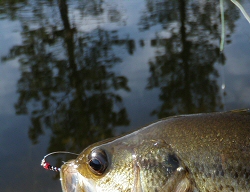
Bass from the Shadows

One small bass from the shadows of a small pond.

The same seemed to be true in our neck of the woods. A California DFG hatchery worker I’ve talked with over the years told of anglers grumbling that fish were nowhere to be found, despite the usual numbers being planted. (More interesting parts of that conversation will come in a future post.)

Not all went as we planned, but arriving in the Sierra foothills in the aftermath of Opening Day put Sean and me in a good position to fish and explore in relative solitude. Months of neglecting necessary fly fishing skills were soon forgotten and muscle memory was gradually regained.

Arriving before Sean and after opening the cabin for the season (thankful that pipes hadn’t burst during the long winter) it was time work out the kinks on the convenient Lyons Canal. Just behind town, it’s more accurately Section 4 of the Main Tuolumne Canal of the Lyons Reservoir Planning Unit. Built in the mid 1850s, it’s part of a network of canals — estimated to total 60 miles — that crisscross Tuolumne County. Though peppered with flumes and concrete in some sections, parts of it have been reclaimed by Mother Nature and now resemble a small stream carved into the rolling hills.

Like many moving waters, walking a short distance away from easily accessed sections is worth the little effort required. Stocked with rainbows, the canal is also home to a now wild population of brown trout.

Hopeful that the most important tool in my fly fishing arsenal — confidence — wasn’t lacking, I tested likely cut banks, boulders and shaded water.

Despite the lack of wildness of the surroundings — homes and a roadway are a short distance away — these brown trout are wild enough to scatter at the shadow of a rod or a less-than-light footfall. This requires casts well upstream of your position, with the best casts placing the fly no more than a few inches from the bank.

My first fish darted out from a surprisingly deep undercut four feet in front of me; eating a standard red Copper John nymph and barreling downstream into faster water. Nicer still, this was probably one of the biggest browns I’ve pulled out of the canal. It looked healthy, even happy.

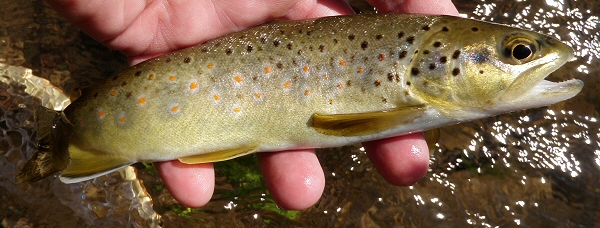
Brown Trout from Lyons Canal

Another brown from the canal…they do like hugging those banks.

Six browns of various sizes came to the net that afternoon, all seeming to eye me with what might be described as familiarity bred by a near certainty that we’ve met before. Thankfully, most are small enough to be released by freezer-stocking folks hunting the bigger, stocked rainbows.

Perhaps it’s a reflection of the intervening off-season troutless months, but the brown trout this year seemed feistier and their spots brighter than I remember.

I finished up the day, with long shadows creeping between shafts of the setting sun, tossing streamers into a pond on long-fallow golf course. Decent sized bass cruised the banks, but in such small water quickly disappeared into the weeds. A few of their offspring were fooled with streamers and trailing nymphs; the biggest was about eleven inches.

As the sun fell behind the tips of the pines, it felt good to have worked the rustiness out of my cast and rediscover the confidence that had been in hibernation.