fishing for words

(and tossing out random thoughts)


Leave a comment

a return to the high country with the folks who raised us, some thirty years later

It turns the tables a bit when it’s the kids introducing parents to new places and experiences and revisiting the familiar after three decades is icing on the cake, though there’s bound to be disagreement in our personal memories.

[singlepic id=1223 w=300 h=400 float=right]

Mom and Dad at the cabin, for their first visit.

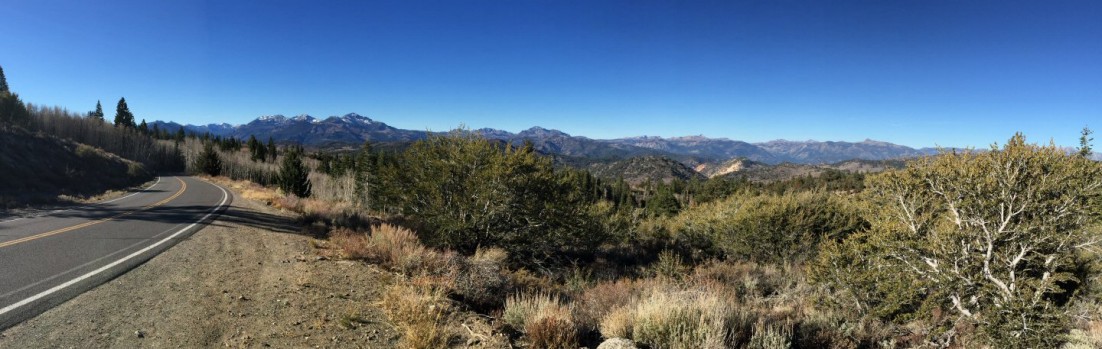
But easy agreement was found in the beauty of the scenery and shared remembrances during a long drive up and over Tioga Pass, along the shores of Mono Lake, before a return over Sonora Pass.

The parents arrived at the cabin late that Sunday afternoon, and after running an errand that took entirely too long for Dad, dinner was enjoyed and we settled in for the evening. Thankfully, the storm that had dumped snow on the passes had dissipated the day before and the warmth of the sunshine had cleared the roads.

Mom, Dad and I leisurely left Twain Harte with a route in mind but absent any planned stops or timetable. The hillsides leaned more toward gold, but were freckled by islands of still-green grass.

I’ve driven this road many mornings, but saw things a bit differently today since I wasn’t preoccupied with wetting my fly line. Miles rolled by, lubricated by conversation. Soon it was time for a stop to stretch our legs. Though there aren’t many hatcheries that will, in my mind, match the magnificence of the historic Mt. Whitney Fish Hatchery visited in my youth, there was something familiar about walking around the Moccasin Creek Hatchery with the folks.

After the excitement of gaining 1,500 feet in elevation over the two miles of the “new” Old Priest Grade, it was all new territory for Mom and Dad as we wound through Big Oak Flat, Groveland, and past Buck Meadows. Highway 120 took us from 2,838 feet at Big Oak Flat to Yosemite National Park’s Big Oak Flat Entrance Station at 4,900 feet. Dad was impressed by the tidiness of the towns and the number of old buildings alongside the roadway, many of which are still in use.

If it wasn’t enough to have fantastic weather, traffic was light. By mid morning we arrived at the entrance station, where the purchase of an annual pass got us across the park border. Words in many foreign languages hung in the cool air, reminding me of the many nature blessings that aren’t more than a day’s drive from home that attract visitors from around the world.

I’ve always throught that the changes in vegetation and terrain grow more dramatic once inside the formal boundaries of Yosemite. Heavy forest yielded to granite, which only seems to yield to water in the form of glaciers, ice and liquid. We pushed on to Olmsted Point, taking obligatory photos, then on to Tenaya Lake. Availing ourselves of the facilities near the lake, I made a mental note that I need to spend more time exploring Tenaya Lake and its surroundings.

There’s a drama that comes with finally emerging from the forest to be presented with the dramatic vista of Tuolumne Meadows, then dropping into the meadow itself. This time I was taken aback by the dramatic change in its appearance compared with that of last spring, when my brother, son and I were on our way to a challenging life-affirming hike to the top of nearby Lembert Dome. Last year the meadows were covered with water. This year, the grass was already the gray-brown of late August.

I had to explain to Dad that the Tuolumne Meadows campground wasn’t open yet when he asked why I was parking alongside the highway. He’d never been here so early in the season. (The campground would open two weeks later, rather early.) Though last June there was snow on the ground and big puddles filled with mosquito larvae, there was nothing of the sort this last week of May. A stroll toward the entrance was accompanied by a bit of debate about the differences between today’s visit and our memories of camping trips more than two decades ago. Regardless of the differences of opinion and any discrepancy in our memories, there was more than enough that was still the same to foster a feeling of familiarity.

[singlepic id=1218 w=600 h=407 float=center]

Mom and Dad’s triumphant return after 30-some years.

My worries about the water were confirmed during this walk through the campground when I stopped near the same spot from which I took a photo of Lembert Dome in 2011. Last year, there was no discernable difference between the channels of the Tuolumne River and the river itself, and the water was within two feet of the bottom of the Tuolumne Meadows (Hwy. 120) Bridge. This year, the channel nearest the campground was no more than a foot deep, and the river was barely touching the bridge abutments.

[singlepic id=1221 w=300 h=225 float=right]

The three of us at Leavitt Falls Overlook.

The reminiscing was further fueled by the sheer rock walls along the descent from Tioga Pass to Lee Vining. The thought of dropping in at Bodie Mike’s for a barbecue lunch was derailed by Dad’s sudden proposition of stopping at the Tioga Gas Mart — that he didn’t recall seeing before — to grab lunch at the Whoa Nellie Deli. A word of warning: Be careful what you order. It’s all big at Whoa Nellie. The Cowboy Steak Sandwich is not so much as sandwich as it is a steak slapped on a roll.

The easy drive north on Hwy. 395 from Lee Vining was a welcome change after such a big lunch. By the time we arrived to the intersection of Hwys. 395 and 108, the urge to nap had passed. A good thing considering the hairpin curves that would take us from 6,765 feet to 9,623 feet at Sonora Pass. Before our main ascent, the Leavitt Falls overlook offered a last opportunity to stretch our legs before the long trip over the pass. The reduced volume of water coming over the falls was another reminder that it’s going to be a dry year in the Sierra Nevada. We posed for photos, then began the long climb.

[singlepic id=1220 w=600 h=450 float=center]

Getting a roadside education at Sonora Pass.

This was undiscovered country for the parents, who never had a reason to travel this road. To my eye, Hwy. 108 over Sonora Pass offers much more dramatic transitions. The road rises faster and the changes in terrain and vegetation follow suit. Surprised to find it open, we stopped at the Donnell Reservoir scenic overlook, with a sweeping over the Stanislaus River canyon and the Central Valley. The road from there is bit less remarkable, winding through heavy forest and passing towns that only seem to be wide spots in road.

It was a long but worthwhile day; one that both revived and created memories.

[nggallery id=84]


2 Comments

a few days to fish (and learning that life will find a way)

There was exploration, fish caught, and the folks who raised us would revisit an old vacation spot at 9,000 feet — all despite weather last week that threatened to put the kibosh on all of it.

I started a mini-vacation two Fridays ago with a run up to the cabin, for once not battling traffic for any of the 142 miles. The plan was to get in a bit of fishing before the parents arrived Sunday afternoon and a drive over Tioga and Sonora passes on Monday. Besides an introduction to the cabin, history was the main reason for this tour. Our family typically spent vacation in one of the best possible venues, outdoors and many summers that meant Tuolumne Meadows.

But as of Friday, both passes were closed as late-season snow fell under dark gray clouds.

Brown Trout on a DryWilling to gamble only so much on the weather that afternoon, I set out for the ol’ irrigation canal, knowing it offers shelter and, if needed, a quick exit. During a few short hours the shifting weather offered sunshine, rain, hail and even a light flurry of snow. The fishing was as expected; my flies were hit mostly by wild browns and only the smartest stocked rainbows that hadn’t fall victim to salmon eggs or spinners. The stink of a possible skunking lifted, I retreated to a hot dinner and prepared for the next two days.

Instead of huddling inside, I was up before the sun on Saturday counting on the early hour and cold weather — about 48°F — working to my advantage. I choose wisely. Although I was on a well-fished creek, it was just me, the trout and couple of ducks for three hours. Fortitude and toughness won me solitude and a good number of fish that morning. Or, perhaps, it just proves that early bird adage.

By midday I was cleaned up and headed to the Moccasin Creek Hatchery for Trout Fest; the only time of the year that anyone is allowed to put a hook in its raceways. The grins of the kids were contagious; the K-9 demo of a quagga mussel search pretty amazing, and the general mood was generally festive. A local fly fishing club offered casting instruction in another raceway, allowing folks to cast an all-to-big fly to trout with appetites bigger than their four or five inches. I talked up a few of the hatchery personnel in hopes of lining up my plans for Sunday morning.

Those conversations suggested a return to the lower North Fork of the Tuolumne (near Basin Creek), a section of the river I had first visited about four years ago and enjoyed as an early season venue. This section is deep in a canyon and quite beautiful, despite its relative closeness to civilization. Most of the fish I caught back then there were stocked and in the intervening years that section of the Tuolumne had fallen off the stocking list as the result of an environmental lawsuit. But the word was that there were wild trout to be found.

Usually I’m up and out the door at the crack of dawn, but I’d reserved that Sunday morning for leisurely exploration of Forest Service roads outside of Long Barn. I was surprised to find much of my route paved with asphalt, and after marking a good-looking creek or two on the GPS, I headed to Tuolumne City and the four-mile descent to the lower North Fork of the Tuolumne.

Like so often happens, a small, nice looking wild rainbow slammed my dry fly on the first cast. (They always seem to do that when I’m least prepared.) I missed that first fish but managed to find almost dozen other little rainbows, scattered in the likely spots.

After a morning of rewards, I headed back to a hot shower before the arrival of the parents. But the folks’ visit will have to wait until next week.


5 Comments

a PSA that you’d better get up country to fish now

If you have any inclination to fish the high country in the central Sierra Nevada, now’s that time to get going.

The two pictures below of the a side channel of the Tuolumne River were taken from roughly the same position in the Tuolumne Meadows campground, looking toward Lembert Dome. The left-hand photo was taken last week (May 28, 2012). The right-hand photo was taken during late June 2011.

Tuolumne River 2012 vs 2011

You be the judge.


6 Comments

not catching fish is no excuse to toss your bobber/spinner/PowerBait in my direction

Remember last week’s more rhapsodic post about finding solitude and fooling fish with dry flies? And then my comment about the contentedness found on that new stretch of river?

Well, the next day was a little bit different.

I knew that there’d be little or no solitude that day. This was a creek well know among the locals and regular visitors alike. A place to fill the freezer with hatchery trout or simply have fun catching.

An early riser because of work by design rather than nature, I was on the water at sunup to find a husband and wife beat me to one of the better locations. I fished downstream a bit and after landing a few fish, ventured closer to the couple when the husband abandoned a favorite run. Pleasantries were exchanged and after asking if it would be okay, I moved upstream of the couple. They were fishing with spinners and bait but our conversation reveled them to be well-rounded fisherfolks. Today they hoped to take a limit of fish, while other days on other waters they’d favor catching and releasing with a fly rod. Fish were landed amid enjoyable conversation peppered with suggestions of other worthwhile fishing venues. Limits caught, they departed about mid morning.

During this time, I’d settled in perpendicular to a nice deep section while two older guys began to cast bait into a pool just downstream of where I was fishing. To paint a picture, I was making quartering casts about 15 feet upstream and the roughly 30-foot drift of my flies put them 15 feet below my position before I’d recast. Ten feet below that point, these guys perched on the opposite bank.

Combat FishingThe fishing and catching was good for everyone for about an hour, then slacked off, though the trout were still responding well to flies, both on the surface and subsurface. Like the day before, a well-presented dry would lure a fish from the depths with good deal of drama and splashing that, of course, caught the attention of the other fishermen.
Then it happened. Plop.

A white and red bobber landed less than 5 feet away from me, right in the seam I was working. This would happen half a dozen times more, but since I was still hooking a fish now and again and my ‘competition’ wasn’t, I ignored the uncouth behavior.

However, when another fisherman took up position about 15 feet upstream and let his sunken ball of fluorescent PowerBait float to within a yard and a half of my feet (certainly sneaky if this was intentional), it became clear that these rude manners deserved a response.  But I’m not a confrontational person.  So…

Downstream but within sight of every one of the other fishermen were various pods of trout holding in pockets and depressions and behind rocks. With a new dropper tied onto a stimulator dry fly, I targeted the fish swimming closest to me and, one by one hooked, each. Slowly, I worked my way across the creek until I was casting against the opposite bank. The other guys weren’t catching, so they were watching. Like the day before, I enjoyed watching the reactions of each fish, with the ‘turn‘ telling me how I might adjust my presentation and hinting at where the fish expected to see food.

My response may not have had an impact on these guys (and yes, I knew there’d be others on this water), but after landing more than a dozen fish — then releasing them — while everyone else stood idly by sure made me feel better.


4 Comments

consideration of a vehicle as fly fishing tackle, and finding there’s no mid-life crisis car for fly fishermen

In the year of my 49th birthday, I’m talking to myself a bit more than usual. Sure, people tend to carefully back away when this happens, but it’s not what you think.

Lamborghini LM 002 : A fly fishing vehicle?

The LM 002, probably the only Lamborghini suitable for fly fishing decals/stickers.

Most of this mumbling is in the car on the drive to work during the early morning darkness — courtesy the early hour, daylight savings and welcome rain — and its rooted in an all-too-common internal dialogue, this time debating the vehicle that might best replace my trusty and economical 2003 Honda Accord sedan in about two years.

By now, putting two and two together would suggest this is about a ‘midlife crisis car.’ I prefer to think that it’s more a reflection of a better financial position, and certainly not indicative of compensation for some perceived inadequacy.

Why the heck would I think about something so far in advance? I’m a big proponent of saving a few thousand bucks buying a certified pre-owned vehicle, which are often covered by a warranty as good as, or better, than those covering new cars.

Unlike those who are retired or freelance from home — with a commute fueled only by coffee — my decision-making process involves a bit more pragmatism. It boils down to a reliable conveyance to the place of work, hopefully with a modicum of comfort at minimal cost.

But all work and no play makes Jack a dull boy. Sporty would be nice.

When it comes to fishing, that better mileage certainly won’t be frowned upon during longer drives to trout waters. Maximization of fishing time requires space for a fully rigged 9-foot rod or three and all the associated fly fishing gear. Until a dedicated fly fishing vehicle joins the fleet, it’d be nice to have enough clearance for the occasional drive down a graded forest service road.  That eliminates sports cars.

Though the EPA ratings of many small SUVs/CUVs are in the 30 mpg range, my Accord regularly hits 32 to 34 mpg on many fishing trips, in the real world, even if that entails traversing both sides of the Sierras. And driving 250 miles a week to work adds up when gas is $4-plus a gallon. Wanting any replacement vehicle to do as well, or better, eliminates any truck and many crossovers. Sure, a Subaru is worthy of consideration, but only the revised 2013 Imprezza and its crossover version (the new XV) offer hope of better mileage, but seem to fail in the real world. The new Mazda CX-5 warrants some consideration, but it’s expected to earn an EPA rating about equal to the Accord. The Toyota’s RAV4 and Honda’s CR-V fall in the same range.

My conclusion is that I have no reason to impress the ladies there is no vehicle to satisfy all of the above requirements.   

Years ago I thought, as I took up fly fishing, that I’d get by with a single rod. While I’m not a rabid rod collector, in a few short years I’ve already accumulated half dozen rods, with each dedicated to specific types of flies, conditions or species. 

But as far as a vehicle goes, and for now being limited to one, it appears that practicality will win this round.

P.S. We’ve been through this before: an improving economy doesn’t lift all boats equally, but always lifts the price of gasoline. Maybe I’ve been desensitized to it, but the price of petrol here hovers near record levels, again, and will likely rise a few more nickels before California’s general trout opener. The journey, the food, and the companionship are all part of the experience. But how much money are you willing to spend on getting to that skunkin’?


8 Comments

the slow lesson of fly fishing

Fly Fishing Trip Goals: Fish New Water(s), Fish for New Species/Strains of Trout,
Drink New Beer(s), Repeat. Note: Do so slowly, with great deliberation.

It’s not casting, presentation or fly selection; it’s a deliberate and slower pace that offers the best chance of success in fly fishing.

This isn’t a new or unfamiliar idea. My first appreciation of a slower approach was the pace at which I entered any water, familiar or unfamiliar. Slowing down to take the time to make a few observations. To watch the sun rise. To look for that one rising trout. To take time to fish that small seam a few feet out from the bank.

[singlepic id=1088 w=275 h=368 float=center]The decision to try my hand at tying flies required a slow, methodical approach as I learned techniques and how materials responded to the tying process. I’m not a production tyer, and probably think more what I’m doing when tying than I should. That’s okay; a lot of that thinking is about the fish I expect or hope to fool with that fly; or memories of already having done so.

Rod building again necessitates slowing down. Wrapping thread seems simple, and it is. Wrapping thread well isn’t. Five-minute epoxy is the fastest part of the process. Laying down multiple coats is not.

More experienced fly fisherman might wonder why it took so long for me to come to this conclusion. In my defense, there were trout to fool and success was measured by body count.

Two weeks ago, while setting aside the desire to get on higher-elevation trout water as soon as legally possible, it dawned on me that the fish would still be there even if my arrival was delayed a day or two. Like dominoes falling, decisions were then made to purposely plan a slower pace.

It’s a huge thing to slow down in today’s world. To take a slow, long look at that wild trout. And, when the sunlight’s too dim to fish, to slowly relish the day’s adventures, seasoned with good food and, if you’re lucky, a good beer.

It’s all worth savoring.

To be certain, we lugged along a few new brews to the cabin during our Opening Day trip, but didn’t pass up the opportunity to try something from the tap during dinner at The Rock.

Told by the waitress that customers had complained that New Belgium’s Ranger IPA was too hoppy, Sean naturally went ahead and ordered it. Apparently those customers have sensitive palates. I’m not a huge fan of too much hoppiness on the back end, but even I found the Ranger rather mild. So did Sean.

Though not an extreme beer snob, I favor trying local suds, and opted to try Snowshoe’s Grizzly Brown Ale. (And, honestly, I felt an obligation to try the Grizzly as research. The Snowshoe brewery is an hour away from the cabin and will be on the itinerary during my brother’s visit next month.) I’ve grown increasingly fond of a well-done brown ale. The Grizzly didn’t disappoint, and it seemed that Sean might have wished he’d chosen it. It’s certainly dark in color, but semi creamy and not heavy as might be expected. A nice toasty maltiness gives way to a light hop finish.

Certainly a great way to finish a day of fly fishing.


3 Comments

start of the 2011 trout season: working out the kinks

From what I hear and experienced, it might just be a good thing if you missed the Trout Opener this year. At least on the east and west slopes of the central Sierra Nevada mountains.

No one’s outright said as much, but reports from the Eastern Sierra suggest that crowds may have been there but the fish weren’t. One particularly likeable report: “Bait slingers and trollers failed miserably on Opening Day weekend and 100,000 lives were spared!”

Bass from the Shadows

One small bass from the shadows of a small pond.

The same seemed to be true in our neck of the woods. A California DFG hatchery worker I’ve talked with over the years told of anglers grumbling that fish were nowhere to be found, despite the usual numbers being planted. (More interesting parts of that conversation will come in a future post.)

Not all went as we planned, but arriving in the Sierra foothills in the aftermath of Opening Day put Sean and me in a good position to fish and explore in relative solitude. Months of neglecting necessary fly fishing skills were soon forgotten and muscle memory was gradually regained.

Arriving before Sean and after opening the cabin for the season (thankful that pipes hadn’t burst during the long winter) it was time work out the kinks on the convenient Lyons Canal. Just behind town, it’s more accurately Section 4 of the Main Tuolumne Canal of the Lyons Reservoir Planning Unit. Built in the mid 1850s, it’s part of a network of canals — estimated to total 60 miles — that crisscross Tuolumne County. Though peppered with flumes and concrete in some sections, parts of it have been reclaimed by Mother Nature and now resemble a small stream carved into the rolling hills.

Like many moving waters, walking a short distance away from easily accessed sections is worth the little effort required. Stocked with rainbows, the canal is also home to a now wild population of brown trout.

Hopeful that the most important tool in my fly fishing arsenal — confidence — wasn’t lacking, I tested likely cut banks, boulders and shaded water.

Despite the lack of wildness of the surroundings — homes and a roadway are a short distance away — these brown trout are wild enough to scatter at the shadow of a rod or a less-than-light footfall. This requires casts well upstream of your position, with the best casts placing the fly no more than a few inches from the bank.

My first fish darted out from a surprisingly deep undercut four feet in front of me; eating a standard red Copper John nymph and barreling downstream into faster water. Nicer still, this was probably one of the biggest browns I’ve pulled out of the canal. It looked healthy, even happy.

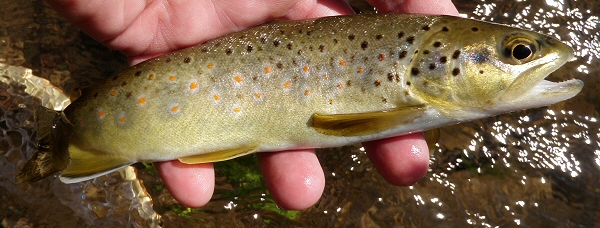
Brown Trout from Lyons Canal

Another brown from the canal…they do like hugging those banks.

Six browns of various sizes came to the net that afternoon, all seeming to eye me with what might be described as familiarity bred by a near certainty that we’ve met before. Thankfully, most are small enough to be released by freezer-stocking folks hunting the bigger, stocked rainbows.

Perhaps it’s a reflection of the intervening off-season troutless months, but the brown trout this year seemed feistier and their spots brighter than I remember.

I finished up the day, with long shadows creeping between shafts of the setting sun, tossing streamers into a pond on long-fallow golf course. Decent sized bass cruised the banks, but in such small water quickly disappeared into the weeds. A few of their offspring were fooled with streamers and trailing nymphs; the biggest was about eleven inches.

As the sun fell behind the tips of the pines, it felt good to have worked the rustiness out of my cast and rediscover the confidence that had been in hibernation.


2 Comments

the water was high, but crazy luck abounded. fish caught, beer consumed and recon accomplished. more later.

Laughing Brown

Post Opening Day fishing so fun even the fish were laughing...


Leave a comment

gone fishing

The Opening Day rush should be over by now, which means I’m heading out the door.

On the way will be obligatory stops for supplies and fast food. I’ll warm up with wild browns just outside town. Sean will join me later this evening. The next three days will be focused on fishing, with high water and lingering snow dictating where.

Fly fishing, friendly competition, man food and beer. The stuff vacations are made of.

[singlepic id=761 w=600 h=450 float=center]

Hoping to say hello again to a few of these wild guys...


7 Comments

the challenge of a (personally) delayed trout season opener

It was the ride to the office yesterday that finally triggered that physical feeling that Opening Day is upon us. Despite the early hour — 0600 or so — the ride was comfortable, not too cold and not too warm. The sun was already burning away the coastal overcast, leaving behind clear skies.

Then it hit. Smack dab in the middle of my face shield. The first bug of the season. If I were to guess, I’d say something in the family Chironomidae. Trout food, particularly as pupae.

Until last year, it was imperative to depart Opening Day Saturday, immediately after assisting with a fly fishing class that I’ve been involved with for quite a while.

What changed? I’m certainly not self employed like the Unaccomplished Angler or retired like Mark (@Northern California Trout) and able to traipse off to fish whenever I’d like. I do, however, accrue a healthy number of vacation days at work and now consider it impolite to not use them.

[singlepic id=764 w=200 h=267 float=center]

Stream X

What’s truly changed is my attitude about the start of trout season. Perhaps a modicum of maturity can now be ascribed to my fly fishing. Rather than stand shoulder to shoulder with anglers from “the dark side,” there’s a certain challenge in arriving on the few fishable waters in the western slopes of the Sierra the Monday after the Saturday opener. (According to Mark, this year more anglers may be crowded on less available water due to snow and ice at higher elevations.)

The more accessible waters have been flogged and the fish traumatized by flashy spinners and DayGlo baits, making it all the more challenging and satisfying to hook and land the fish too smart for not caught by these other anglers.

I hope to also visit Stream X, where unmolested wild rainbows likely will attack anything that remotely looks like food. It’s a bonus that this is the time of year when much of the fishing crowd won’t be out during the work week.

So, Opening Day I’ll be helping folks learn how to play and land fish on a fly rod. Sunday I’ll spend time with The Wife. Monday through Friday I’ll be fishing.

See you on the water.