At the start of the New Year, we resurrected plans to act like tourists when we could in any place that wasn’t more than about an hour’s drive away. With long-accumulated lists of points of interest and plenty of restaurants bookmarked in Yelp, it would be easy to head out with only a moment’s notice. From our home, depending on the direction, a one-hour drive can put us in San Francisco, Sacramento, the Sacramento River Delta, the wine country of Napa and Sonoma counties, stands of redwoods or on miles of coastline. This day, Karen and I found ourselves high over the city by the bay soaking in a 215-degree view stretching from the Presido to Diamond Heights.
Cooler weather is a certainty on any January Saturday in San Francisco, a reminder of the bay’s power over local weather. But winters in Northern California offer many sunny days in between storms, enough to remind one that spring and summer will return. Winter daytime highs can be in the 50-65°F range. Lower temperatures are relatively rare. The weather this winter was supposed to be impacted by the climate phenomena known as El Niño. While this implies that California will receive more rainfall, it’s generally not until February or March that we see big storms. That’s why, in January, a forecast of proper sunshine prompted a day trip to visit two of the “hidden” stairways in San Francisco.
The Destination
Making the most of any trip, whether long or short, always revolves around food we can’t get near home. This means no chain restaurants and usually an establishment that’s unique or notable. This morning it meant following cops to doughnuts. Literally.
As the biggest fan of bacon I know, Karen was keen on visiting Dynamo Donut+Coffee to sample the Maple Glazed Bacon Apple doughnut. Hearing that lines form early, we arrived before sunup. In the Mission District along the 2700 block of 24th Street, Dynamo Donut+Coffee sits in an urban canyon of buildings. Sunlight’s different here, and dawn is slow in coming.
Arriving in relative darkness and in need of cash, we missed the Dynamo sign, for obvious reasons explained below. We pulled into the first parking spot that appeared, a rarity in any city and more so in San Francisco. (Only downtown San Mateo seems to be more lacking in on-street parking.) We parked, made a quick run to an ATM and walked in what we thought was the right direction. I joked that we should follow the SFPD Ford Explorer driving parallel to us. Then we saw it.
Apparently, we’d arrived too early. The Dynamo Donut staff was only starting to open up for business when we walked up. Opening for business means pushing open a panel of wood that closes off a small coffee counter facing the sidwalk. We didn’t see the shop because, when closed, there’s nothing to see. Only on the awning are the words “Dynamo Donut + Coffee” in a stylized font too small and too difficult to read when driving by in the dark. The lack of a neon sign is strong evidence that this is a neighborhood joint – the kind of place we like.
Calling the Dynamo shop “minimalist” would be misuse of the word. The store is a simple affair, dominated by a midcentury color scheme of green and yellow, with exposed woods and small tables. There’s a hipster vibe just under the surface and an open kitchen on display. When first approached, it appears to be only a take-out counter stuck in a random wall. Dynamo is not selling atmosphere. It does, however, offer an edible adventure that starts with an unassuming doughnut that is flavored, dipped and coated with sweet or savory ingredients and sometimes both.
The Doughnut of Her Dreams
A conversation with the young guy at the counter reveals that we’ve arrived well before the line forms and that there is seating inside behind unassuming canvas drapes. With excuses – didn’t know if we’d be back, we’d be climbing multiple stairways that day – we ordered four doughnuts: Chocolate Rose, I’m Not a Gluten Chocolate with Raspberry Black Pepper Glaze, Maple Glazed Bacon Apple and Spiced Chocolate. Drinks were fresh-squeezed orange juice for me and jasmine tea for Karen.
The choice of the Chocolate Rose doughnut was in the spirit of adventure; the Spiced Chocolate doughnut just because. Both were good, but we agreed that if we returned to Dynamo, we wouldn’t order them again.
The “I’m Not a Gluten Chocolate with Raspberry Black Pepper Glaze” is a shining example of deftly balancing incongruity. By now we’ve all become blasé about chocolate and chili, so chocolate and pepper isn’t too much of a stretch. Throw in raspberry and wheat-free dough and it becomes interesting. Amazing isn’t too strong a word for this torus of gooey goodness.
We try to eat better nowadays but without outright deprivation. Yes, food is fuel most of the time. But now and then food is part of the experience, the adventure and the reason. Savoring every bite, tranquility overruns my mind as a wave of intense flavors pushes away distractions and muffles noises. There’s nothing but the sweet and the savory, my wife’s voice and the soft comfort of a day without deadlines.
Days like this are too few; when awareness of the now is stark and bright. A promising beginning to a splendid day.
Soon read about the real walking (winter walkabout, part two – finding secret places); coming April 4th.
It’s been raining here in California; something much appreciated after three years of so little. Watching the drops dance on our patio, admiring our revamped back yard, I know it’s not yet the habitat we’d like it to be but a huge improvement over water-thirsty lawns. About a year ago we decided to tear out our lawns, front and back, and being cheap decided to tackle the job ourselves.
Removing a lawn is one of those jobs for which the thinking about it is more intimidating than just jumping into the work. Jump in we did. Sprinkler heads were capped, a sod cutter rented to make quick work of cutting up the turf, which was then flipped, eventually turning the grass into compost. The bare dirt was shaped and graded with a shovel and rake and a lot of pondering during the process. Hummocks were formed and drip irrigation installed. With only an image of a favorite stream in my head, a faux creek bed was dug and rocks, stones and pebbles placed appropriately.
Although I find it a bit distressing to remove one living plant in favor of another, the over-arching motivation was curbing water used for landscaping. Any new plants, trees or bushes would have to be California drought-tolerant natives. Research led us to the Bay Native Nursery; where a bounty of native plants is inauspiciously tucked between a mix of industrial buildings, open space and recreational shoreline in San Francisco’s India Basin.
Faux creek bed and faux fish.
We spent more money than planned but headed home with a few varieties of salvia, a single California currant bush, a low-growing coyote brush, Ceanothus thyrsiflorus (aka white-flowered mountain lilac), soap grass, manzanita (shrub and groundcover), yarrow, checkerbloom and blue-eyed grass. The good part of a day was spent planning and planting. Another few days to spread bark. Neither yard looked like much then. (A big upside: We made money doing it ourselves since both the county and city offered turf removal rebates.)
During the first six months the currant grew from about a foot high to over five feet tall with a diameter nearly the same dimension. The salvias and blue-eyed grass blossomed. Since they were newly planted and the winter of 2015 was dry, the drip irrigation system was put to use, but only sparingly.
Like it does for many California natives, the heat of late summer left the blooms withered and leaves brown. Except the currant; that plant is a juggernaut. Much of the plants’ growth came to a standstill from October through February and a stillness settled on the yard.
Almost a year later, with enough rain to thoroughly soak the soil, the back yard is showing potential of becoming a habitat. The runners sent out by the salvias have emerged with stacks of gray-green leaves. Blue-eyed grass is blooming. Seedlings descended from the few poppies planted last spring have appeared. Their parents are forming flowers.
It’ll be some time before our all-California native drought-resistant landscaping is finished but, for now, they blossom with hope.
Don’t misconstrue the lack of new words here during the last few months as an indication that there’s been an excess of fly fishing in my life. As often happens, new priorities displace what was previously most important.
During the last few months, fly fishing, feeding this space, even a favorite pastime of seeing movies as intended – on the big screen – fell by the wayside. The lack of fishing through all of last year is a bit alarming. The fact that I spent more time fishing waters in Washington state, where I don’t live, is telling.
Instead, we have been working on the house, purging the unnecessary accumulation of clothing unlikely to ever fit again as well as renovating and rearranging. There are on-going efforts to simplify and economize; a re-thinking of what we do, how we do it and why we do it. A personal challenge to learn new, foreign and perhaps extraneous subject matter, but through this rediscovering that the process of learning remains as attractive as ever.
Occasionally, there was the welcome interruption of long drives from home in Northern California to visit family near Seattle and in Portland. I last wrote about our short holiday that took us to Los Angeles, Mexico and Disneyland.
I’ve missed writing for fun, for myself. While widespread rumors suggest blogging is dying at the hands of social media, I don’t write for “likes.” A single writer can’t compete with the sheer scale of Facebook. I write without expectation my words will be read, except perhaps by a few family members. I don’t write because it’s easy; sometimes self-doubt can even make it painful. It’s an exercise as much as it is a digital memory for those few who may be interested.
So here I am. A new host, a new layout, a new start for the stuff I will write.
I can’t promise what’s to come will be good, funny, thought provoking or simply interesting, or even if it will appear with regular frequency. Rest assured, it will be me.
I stopped at Costco on the way home last Friday to pick up a few items, as if anyone can pick up just a few items and not walk out of Costco with a kayak or some such thing.
It was Good Friday. The line to the gas station was long, the parking lot nearly full and the crowd of shoppers thick. But I wasn’t in a hurry; it was one of those clear, sunny spring days with a blanket of astonishingly blue sky that can’t be appreciated if you don’t slow down and look around. The shopping list wasn’t long and soon I was loading more than expected into the car. And while it’s not unusual for other shoppers to wander by, an uncomfortably close, slow-moving shopping cart caught my eye.
Do you recognize this guy? Circa 1950s, photo by Russ Warner.
Pushing it was an elderly gentleman, appropriately grizzly for his age but dressed in pressed khakis, a button-down shirt and sweater, as you might imagine would have been the standard about 50 years ago, when publicly wearing pajamas would attract attention and perhaps include a visit to the funny farm. He walked slowly but without shuffling, slowly looking left, then right. The corners of his green sweater flapped in the breeze while the set of his face showed he was expending more than a little effort on thinking.
There’s no telling whether it was my Boy Scout mindset or overly hopeful belief in karma, but I slipped out of the car. As I stepped toward the man, he eyed me through thick glasses with a level of caution that’s unfortunately appropriate these days. His posture relaxed after I asked if he might need some assistance.
His eyes were clear and sharp under tussled salt-and-pepper hair as he described a growing distrust of his memory, a worry reinforced today by his inability to find his car. His habit was to fill up at the Costco gas station and park near the gas station exit. Today, because he couldn’t find an open spot in that section, he cruised around the lot to find a spot.
Knowing cars a little bit more than the average person and figuring I might help, I asked what type of car he was driving. It was Honda, that he was sure of; but of the model he wasn’t. The color was gray, but maybe lighter. Perhaps silver. It had four doors and was more than five years old. Rubbing the whiskers on his chin, he told me that it was bigger than a Civic. The easiest solution, pressing a button on his key fob, wasn’t an option; the remote integrated with the key was held together by masking tape and hadn’t worked for years.
My offer of assistance accepted, I began walking the 15 or so aisles of the parking lot, scanning for a four-door, gray or silver, Honda sedan. I was hunting for an Accord, but didn’t dismiss the possibility it could be a Civic. As might be expected in any parking lot in America, there was no scarcity of matching vehicles. (Silver – the color of indecision – and gray, were two of the top five most popular car colors during the last decade.) Wandering the closest three aisles, I took cell phone photos of a few suspect cars and returned to my lost friend. No, the car didn’t have a sun roof. The color was more of a light gray. The tail lights were different.
I searched a few more aisles, then returned to find the gentleman in conversation with the gas station attendant. This Costco gas station attendant is a good ol’ boy, always wearing a cowboy hat and quick to tell seemingly deaf patrons to turn down their stereos. He told me that he knew the older gentlemen I was assisting. His name is Clay. The attendant radioed the store’s cart crew for help, but no one was available. I tried to get a better description of the car but only got confirmation that it was indeed silver and had four doors. Clay wondered out loud if his car was on the far side of the lot.
Knowing I could cover ground about three times faster, I walked the rest of the parking lot, ending up as far away as possible from my starting point. Clay, who had walked in a straight line rather than up and down each aisle, caught up with me.
Not wanting to leave Clay on his own, I again prodded him for any identifying features of his car. Was it dirty? Was anything hanging from the mirror? Did it have special wheels? A light seemed to flicker behind his eyes; yes, there was something. The number five and “UES” had come to mind, though Clay was uncertain why. Hoping the number suggested the beginning of a license place – sequential 5-series plates were issued in California about five to seven years ago, fitting the possible age of a vehicle that had so far eluded us.
I began scanning plates and less than ten steps away, there is was; on a silver CR-V. Not quite the sedan I was looking for. Clay’s key fit the front door. An offer to help load his groceries was declined, so I wished Clay good luck and we parted company.
I was a few steps away when Clay called out to offer fruit snacks and thanks. I declined, again began to walk away, Clay drew me back with another comment about how he appreciated the help. My acknowledgement ended with an observation that we’d both gotten in some exercise by walking, never a bad thing. Clay replied, “You know, that was part of my training.”
I’m sure that I cocked my head to one side, wondering what that might mean. Bewilderment got the best of me and I asked, “What do you mean?” His story began with being stationed at Naval Air Station Alameda as a young man. (A quick calculation told me that this was likely in the mid 1930s.)
Then Clay asked, “Have you ever heard of Jack LaLanne?”
A response that I did seemed to release a flood of memories. Clay hung out with Jack, performing feats of strength. Occasionally he stepped in to watch over Jack’s exercise studio in Oakland*. He and Jack would impress the “girls” with their muscles, and eventually shared a lifelong friendship.
The photo strip that Clay gave me.
Clay illustrated his story with a strip of glossy photo paper upon which were printed digitized photos showing Jack and Clay through the years. One photo shows Clay lying on the ground, with his hands skyward while Jack uses Clay’s hands as a foundation for a handstand. Others show Clay, Jack and their wives at dinner. In one photo they are celebrating Jack’s 90th birthday.
Clay shared that he had to take care of himself for at least five more years. Jack LaLanne died in 2011 at age 96, and Jack wouldn’t like it if Clay didn’t live to the same age or longer.
I only spent about an hour helping Clay. His memory may be fading, but I hope his enthusiasm for life and appreciation of his past allows him to reach that goal.
♫♫Oh, who are the people in your neighborhood?
In your neighborhood?
In your neighborhood?
Say, who are the people in your neighborhood?
The people that you meet each day.♫♫
*For those who don’t know, Bally Total Fitness grew out of licensing LaLanne’s European Health Spas, which numbered more than 200 by the 1980s.
It was a dark and stormy night…more accurately, a morning.
Remember a few weeks ago when California was drier than a cork leg? That ain’t so true anymore, though The Drought is not over by a long stretch.
My drive to work at 0545 yesterday was dark and slow, musically accompanied by pounding rain. Traffic moved at about 40 mph in a 65 mph stretch of highway. Lakes and ponds formed where none had existed for 10 or more years. Later, flooding closed my route home by early afternoon. Flooding also removed the option of a more northerly alternate route.
Arizmendi Bakery’s fruitcake, called the drunk uncle of fruitcakes. (Definitely made with a bounty of brandy.)
I instead decided to play chauffeur for the afternoon, heading to San Francisco to pick up Karen and meet our son. It took a bit longer than expected as half the signalized intersections along my route were dark, a result of storm-induced flooding. An underground PG&E substation at Post and Stockton streets exploded that morning as a result. Union Square and surrounding neighborhoods were without power well into the evening. Those dark signalized intersections offered abundant evidence that too many of today’s drivers don’t know how to react to a flashing red signal or in-operational traffic signals.
We snacked leisurely, watching waves of rain wash the streets. We also found the Christmas fruitcake I was looking for, then dropped the son at his place and picked up some casual carpoolers. These people had been waiting in the dark, in pouring rain, for 50 minutes. We picked ’em up thinking that it would make for a more rapid trip home in the HOV lane. Based on the lack of traffic — some folks had left work early and others didn’t go to work at all — it was unnecessary. Call it a mitzvah
This morning wasn’t bad except that Hwy 37 WB was closed and the detour through Novato added 20 minutes to my commute. The rain has let up so far today, but we clearly got enough rain to soak the ground and the temporary lakes and ponds are only slowly disappearing.
Through all this, my attention is on the weather radar, hoping to see snow accumulating in the Sierra Nevadas. It’s said we need at least five more storms of this magnitude to remove the specter of another drought year.
As if it hasn’t been a figuratively dry trout season for me, a long trip last weekend over three passes, along rivers and over two reservoirs showed that things are literally drying up…
This was my last and only second trip to the Sierras during the general trout season. It was happenstance that kept me off the water and only sheer determination — and a desperate desire for a break from every-day life — that crammed a 400-plus mile drive and not enough fishing into a single day.
Firsthand reports dashed any hope of great fishing. Small streams were trickles, meaning wild fish were off limits. State-stocked waters that normally received a few buckets of fish before the end of the season didn’t.
Another view of the sunrise from Sonora Pass.
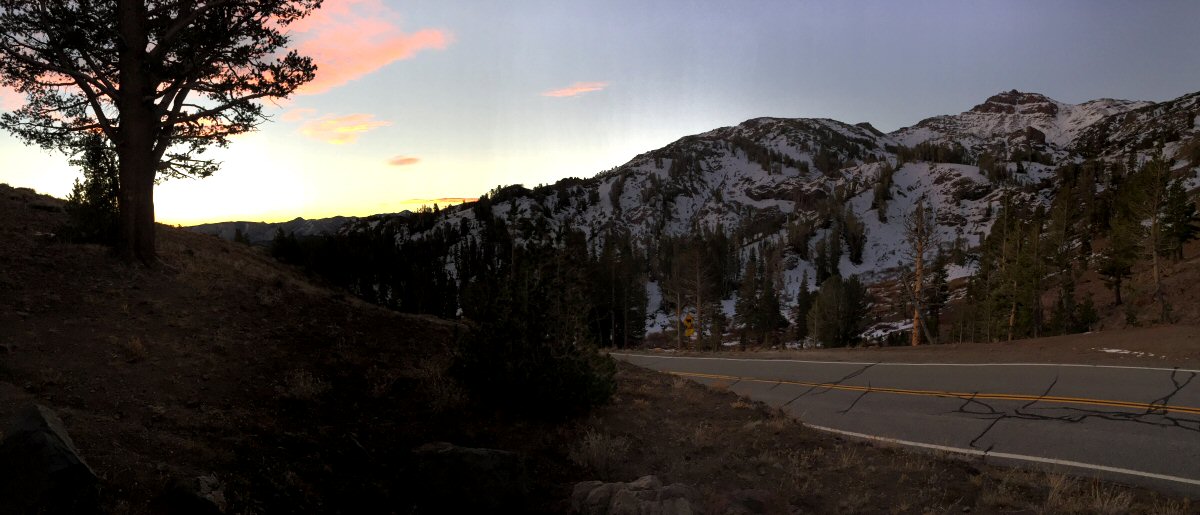
Optimism being the most overused tool in a fly fisherman’s arsenal, I still hit the road over Sonora Pass before sunup. If there were few fish to be had, at least a sunrise at 9,000 feet doesn’t disappoint. This late in the year, a sunrise seems to last longer.
Looking a bit southwest from Sonora Pass.
There was unexpected company on the West Walker River, a couple planning to soak bait. They went their way, I went mine. I’d have pocket water all to myself, whitefish on the mind, and the sound of reveille arising (a bit too late in the morning this time?) from the Marine Corps Mountain Warfare Training Center.
My “office” for the morning. (West Walker River)
Just like that “confidence fly” most fly fishermen keep tucked away, there are pieces of water one comes to expect to hold fish. My expectation held true this morning. It didn’t take long before a fish was fooled with my favorite red-butt zebra midge pattern. While not large, white tips on smooth fins suggested it was a more educated trout. Even if was a hatchery fish, it had spent enough time in the wild to learn a few things while it’s pectoral and caudal fins healed. There would be no whitefish this year and nothing big, but all of the trout I found were feisty.
This isn’t the time of year that these trout rise to dry flies, but the water level requires stealth, a dry-dropper setup, light casts to small seams and short drifts. It’s hard to disagree that this type of rig might be a reflection of my middle-of-the-road nature, mixing the oft-look’d-down-upon tactic of nymphing with the loftier technique of dry fly fishing. Deep down I hoped for a rise to the dry fly, but ice crunching underfoot suggested it was not to be.
My plans called for crossing Monitor Pass on the way to the East Carson River, then over Ebbetts Pass, and finally completing a twisting and oblong course over the man-made New Melones Lake. Unfamiliar with the route and wary of unpredictable delays, I was on the road again before noon.
Many times I’ve enjoyed driving — whether a car or motorcycle — over Tioga and Sonora passes many times, during the spring, summer and fall. Any threat of snow brings about closures, but during this trip Tioga and Sonora pass, as well as Ebbetts and Monitor pass had reopened after brief snow closures earlier in the week.
Looking west from near Monitor Pass.
The landscape and vegetation of each pass is unique, with stark changes as one gains elevation. Over Monitor Pass, Highway 89 twists between and over numerous peaks, alternating between barren high desert to east and the fir and pine forests on the western slopes. Once over the summit, the road quickly descends to meet Highway 4, then crosses the East Carson River.
This was first visit to the East Carson River. The wild trout section was low and slow, and out of the shadows of the high canyon walls. Sunlight reflected off nearly every eddy, riffle and pool, and, as might be expected, the fishing was great but the catching not. It was suggested after the fact that I should have fished upstream, where a summer of stocking might mean a few stupid willing fish would remain. I chalked this visit up to exploration. Since it wasn’t too far away, I drove to Markleeville. I had to drive through town a second time; I blinked and missed it the first time through.
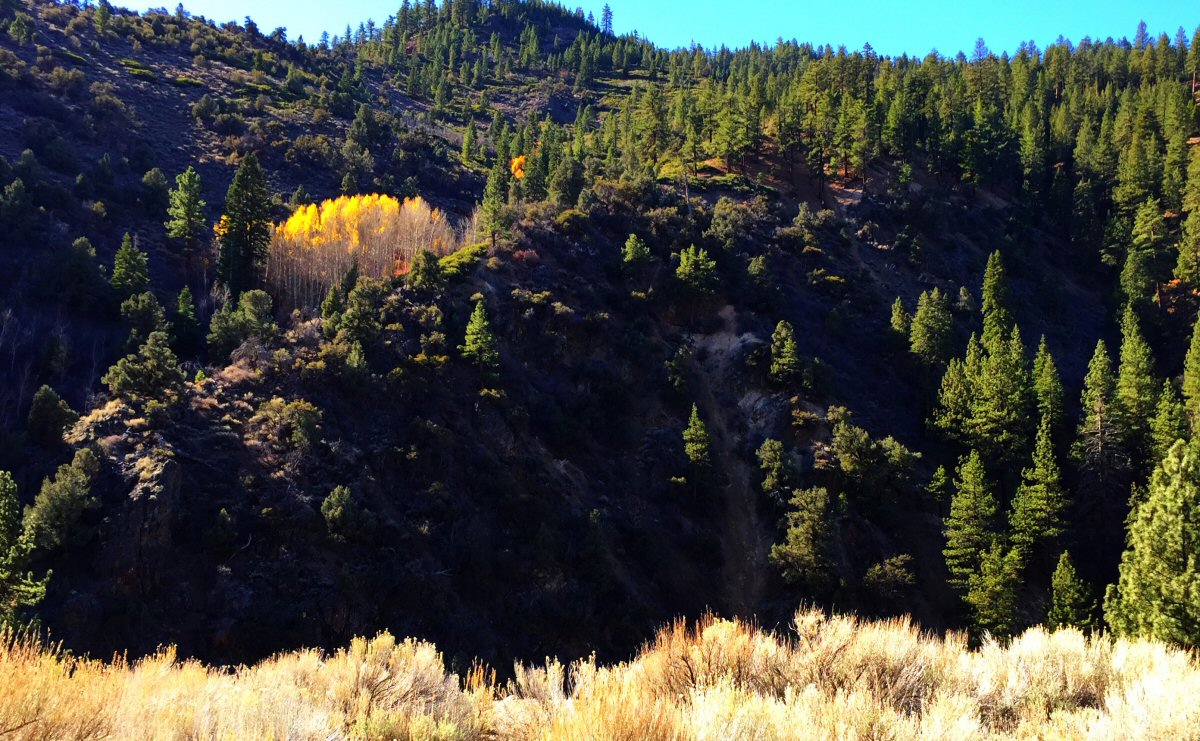
Colors along Highway 89, just south of the East Carson River.
The route over Ebbetts Pass is more adventurous than the comparatively high-speed Highway 108 over Sonora Pass and Highway 120, which winds through Yosemite and over Tioga Pass.
Driving over Ebbetts Pass is not for the faint of heart. Sandwiched between a full-width, two-lane state highway is a section reminiscent of the descriptions our parents and grandparents might offer of roads built only wide enough that two Model Ts could squeeze by each other. This middle section, from Lake Alpine to Silver Creek, is a barely two-lane road. There is no center line or fog lines. Shoulders are a rarity. Steep curvy portions, precipitous drop-offs and vistas of pristine landscapes are plentiful. If the narrowness of this road isn’t enough to reduce one’s speed, the beauty was. Lack of planning meant I couldn’t linger. Plans are already afoot to return with a greater abundance of time.
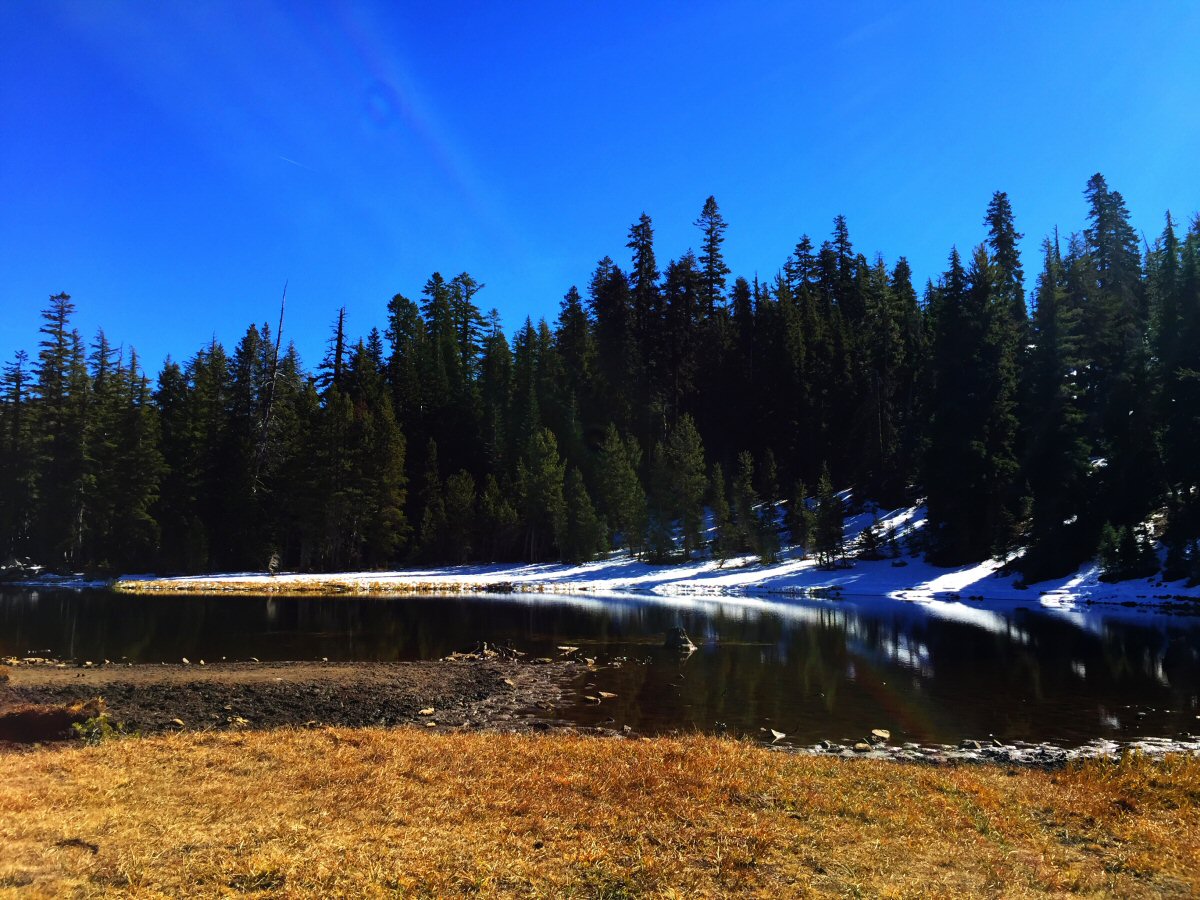
Ebbetts Pass tarn.
The rest of my drive was in relatively civilized areas. I’d pick up apple cider outside of Arnold, then wine and special spices in Murphys. I crossed New Melones Lake, which looked more a river at flood stage (it was formed by the damming of the Stanislaus River). Back in Twain Harte early, I cleaned up and planned to attend to a few items on the to-do list, figuring I’d walk to the local Ace store for a halogen bulb and any other necessary item. During the walk I began an exploration of a different variety. More on that next time my fingers are willing to dance on the keyboard…
Leavitt Falls, late in the fall.
All of the photos, and some more:
Sunrise from Emigrant Gap on Highway 108.
Sunrise from Sonora Pass on Highway 108.
Another view of the sunrise from Sonora Pass.
Looking a bit southwest from Sonora Pass.
Looking back toward Sonora Pass.
Over the West Walker River from the Leavitt Falls Vista Point.
Leavitt Falls, late in the fall.
Sun appears over the West Walker River.
My “office” for the morning. (West Walker River)
Looking west from near Monitor Pass.
Colors along Highway 89, just south of the East Carson River.
Summer’s gone and dribbles of rain have wet the ground a few times. It’s been an almost fish-less year for me. That may change with an end-of-the-season trip after the first of November, but in the meantime I’ll remain a bit cranky.
That’s not to say I haven’t been busy with tangential fishing endeavors. By the end of this month the move of two fly fishing club websites to new online platforms should be finished, and my involvement will taper off from full-time developer/designer to part-time consultant. I’ve also busied myself with experiments in online learning, recreational shooting and a personal goal of walking 5 miles daily. It’s become difficult to remember how fishing could fit into my schedule.
Last weekend it was creepy neighborly curiosity that had Karen and me traipsing through a home across the street and a houses up. The residents weren’t people with whom we had wanted to acquaint ourselves. The house was now vacant and an estate sale planned for Saturday.
In the world of estate and garage sales, every minute counts; but we had things to do and arrived about an hour late. There weren’t too many items of interest, though a nice rolling tool cabinet and couple decent pieces of furniture were tagged as sold.
I’m not a picker by any stretch of the imagination and generally won’t dig through a pile of junk hoping for a gem. But walking through the garage my attention was drawn to a few rods tucked into a corner.
It was the usual collection of rods bought on the spur of the moment: a mix of spinning and bait casting rods and nothing remarkable. The same could be said of the reels, with one exception tucked behind the others. A fly reel attached to a medium saltwater spinning rod.
Two years ago I purchased an unbranded bamboo rod at the club auction for minimal money and since had been looking for a reel that might match the rod’s patina and pedigree. At first glance, this reel would fit the bill. I offered $5, mumbling that it was the reel I was interested in, but that I’d do them a favor by taking the rod off their hands as well. The deal was sealed and money changed hands.
The Catch
The rod cleaned up well enough to keep for the occasional misstep outside of fly fishing. The reel was in decent shape and only required wiping some dust and cobwebs away, which revealed it was a Pflueger Medalist 1495, a solid reel that I suspected might work well enough on the so-far-unused bamboo rod. But it was set up for left-hand retrieve, and I don’t do left-hand retrieve.
The Internets quickly offered up enough knowledge to indicate that I could set it up for right-hand retrieve. With a few tools and decent instructions the reel was soon in pieces. Maybe it’s nostalgia, but I admired its construction and relatively simple design — a more elegant reel from a more civilized age.
After a simple inversion of the drag plate was all it should take, but the right-hand retrieve side of the drag plate was missing a bezel that would allow the drag bearing, which fits inside the drag plate, to nestle into the drag plate. Test fitting revealed that would prevent the spool from seating properly. I scratched my head for a bit then sent off a few emails to guys who know better than I.
Apparently I had found a left-hand retrieve only Medalist 1495, likely manufactured in the late 1950s or 1960s before Pflueger changed the drag plate to allow folks to reel with the “wrong hand,” apparently a “quite collectible” version of the Medalist.
You’ll find me looking for another $5 reel for that no-name bamboo rod.
There’s something wonderfully satisfying about the surprising fight-per-ounce ratio of a wild trout that is followed by a revelation of coloration more vivid than man might create. That’s doubly true when the wild fish is native.
There are purists who would dismiss the progeny of planted parents, but earlier this week, Mark Kautz raised an interesting thought about a possible decline of opportunities to catch wild trout on his Northern California Trout blog as the California Department of Fish & Wildlife’s stocking program shifts to triploid trout.
Shelving the wild vs. native fish discussion for a bit, if I can’t chase native trouts, I’m just as happy stalking their wild brethren. Wild trout are the reason I took up fly fishing. There comes a point in every fishing career that you develop an affinity for a style of fishing, or a species, and often both. It can happen unexpectedly and unconsciously.
With me it began on a little creek in the Walker River watershed, with a spinning rod and a size one spotted Panther Martin teardrop. The cookie-cutter planter rainbows are the standard fare downstream, but my recent rediscovery of the benefits of hiking a bit farther than most weekend warriors had convinced me that whacking through dense stands of cottonwood could be worth the effort.
Trout are one species that adhere to the adage that “life will find a way,” and there’s no better example that the wild fish that often can be found upstream of the ruts created by the DFW’s live-haul stocking trucks. That day it was a cast to riffles in the shade of streamside willows that introduced me to a sizeable wild trout, at least by my standards. Until then, my familiarity of trout with parr marks had been limited to fish measuring less than six inches; this one was about twelve inches long. That wild trout was my gateway fish to appreciation of native populations.
As Mark observed, it’s likely that many folks expect to stock their freezers with trout poundage with a value equal to the cost of a fishing license; perhaps by any means necessary and without knowledge of or concern about the toll on wild and/or native trout. Perhaps it’s fed by the illusion of self-sustenance, even if for only a few days each year. It’s just as likely those fish won’t be replaced as the DFW’s triploid trout — chosen in response to a legal action challenging its hatchery and stocking operations — can’t reproduce. In the long-run, this should be a good thing for California’s native fishes. (It should be noted that the California DFW hatchery system has been gearing up production of native fish for selected waters.)
Still, it’s hard not to wonder if meat fishing, especially in a state as populous as California, would decimate populations of wild fish that have gained a foothold where native fish don’t exist. Also, with California’s now minimal sustainable populations of native fish, it could eventually impact native fish without stronger enforcement of regulations. That, or we have to hope, as Mark alluded, that meat fisherman will be more inclined to drive a few miles to grab some steaks than clamber over rocks, descend into a canyon or even walk a few thousand feet upstream.
Thank you, Mark, for the thought-provoking discourse.
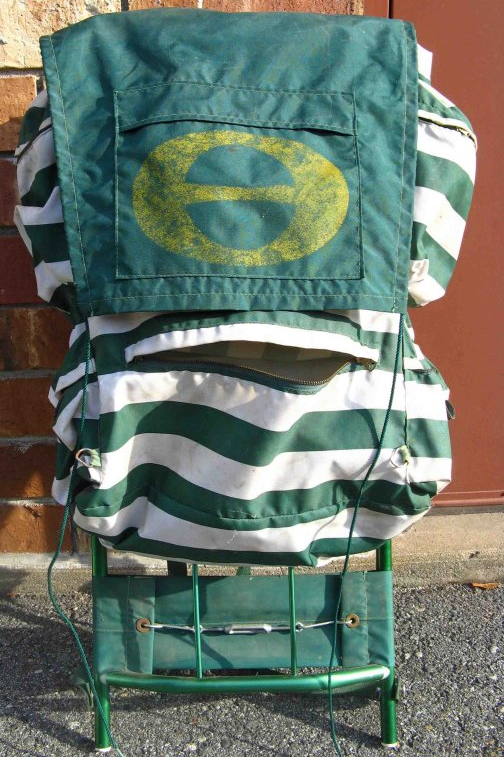
While the most radical statement I made during the ‘70s was the purchase of a white and green-striped backpack emblazoned with the ecology symbol, I’ve always been pretty certain that Styrofoam isn’t environmentally friendly. Yet there it is; big blocks of the stuff being used in the restoration of the wetlands north of my commute on Hwy 37.
Used one like this in Boy Scouts.
Restoration of this area, in the Napa River delta and known as Cullinan Ranch, began three years ago. According to the website, long-term farming led to subsidence — up to six feet — as the marsh dried out. This puts the area below mean sea level. The hope is to restore 1,500-plus acres of tidal wetlands in the San Pablo Bay National Wildlife Refuge. But it’s estimated it would take Mother Nature about six decades to rebuild the site with sediment deposited in by the Napa and Sacramento-San Joaquin rivers.
It seems that’s where Styrofoam geofoam plays a part.
About two weeks ago, semi loads of big blocks of geofoam were offloaded while tractors of all sorts and sizes carved out a building-sized ditch paralleling Hwy 37 for about four miles. Now that ditch is being filling with geofoam. The geofoam website lists various applications of the stuff and touts its benefits.
I just can’t get my mind around it. I can understand stabilizing the embankment along the highway, but stuffing what in essence is Styrofoam into the earth as part of restoring a site to its natural composition seems contradictory.
Of course, once covered with dirt and after vegetation takes hold, no one will know.
My family spent many summer vacations in Tuolumne Meadows. These trips were a family affair and in the interest of keeping everyone engaged, it was more than fishing. We’d spend the days hiking to higher elevations — the campground was at 8,600 feet — and sometimes we’d end up at nearly 10,000 feet. Mepps spinners would be cast into water along the trail and sometimes the destination was a lake where fishing was rumored to be amazing. Mom would keep the troops focused by wondering out loud about what might be around the next bend. My brother and sister and I would spend countless hours exploring the banks of the Tuolumne River, watching the occasional bear that wandered into the campground, and waiting for the rare treat of visiting the campground store, where we’d get to pick one comic book and maybe enjoy an ice cream.
Idealization taints memories but, for me, the Sierra Nevada high country has always lived up to my recollection. That’s what fueled the rest of my plan for Memorial Day Weekend 2014.
The view from where I started.
First-hand reports made it clear that water would be high in the Walker River Basin. But I had a plan that tied into two keywords in my last post: “maturity” and “adventure.” Not to get too personal, but I’m no spring chicken rooster, and for more than five years I’ve worn a compression brace on my right knee. Years ago, while carrying a bag of cement on my shoulder, I stepped into an unseen depression, twisted my knee and fell to the ground. I was young then, so shook it off. It was only years later that I began to feel a bit of pain after long walks. This year I finally got out of my rocker to walk every day. Not Forrest Gump style, but about five miles a day. That, in combination with weight loss, has eliminated the need for the brace.
Cautiously optimistic, in planning for this trip I had decided to walk up the Little Walker River, hoping this would rekindle my enjoyment of high country hikes. I enjoy fishing this creek’s small water, though most of my experience had been limited to the stretch through and downstream of the campground. Sticking to my plan, I ignored warnings of high and muddy water. The drive over Sonora Pass would take about two hours, but it’s one drive that’s always enjoyable as the terrain changes with the elevation and, particularly this time of year, snow still dusts the pass. This day the drive was even more pleasant; being a weekday I saw only four cars at lower elevations, and no one above 6,000 feet.
The section of Hwy 108 between Twain Harte and the junction with Hwy 395 rarely runs straight. It’s a good road and relatively fast considering the twists and turns. On the eastside, after beginning a descent into the high desert, there are at least four severe hairpin turns. It seems that every year I either run into a cattle drive on the highway or a semi-trailer truck stuck at a hairpin. This year it was another truck. I waited about 10 minutes as the driver unsuccessfully tried to free the drive wheels, which had sunk in the loose dirt on the inside of the turn, before walking up to ask if it would be okay to try to drive around on the shoulder. He helped me move a few big rocks. After getting past, I was talking with the driver, emphasizing that this hairpin was only the first, when assistance arrived in the form of a Ford Police Interceptor Utility in California Highway Patrol colors.
The longest part of this drive always seems to be the three or so miles down a washboard dirt road to the Obsidian Campground in the Humboldt-Toiyabe National Forest. It’s not a bad drive, and was made nicer this year by a late-season storm that dropped enough rain to keep the dust down. Best of all: I was the only person there.
One of many fallen trees…
I began hiking where a bridge crosses the Little Walker. Topographical maps showed a nearby trail, but that trail would only appear intermittently during my hike. This part of the river flows through a narrow canyon, and since my preferred tactic is to hike as far up as possible and return by slowly fish downstream, I headed for high ground. This is terrain marked by small and rounded granite cobbles, perhaps glacial debris, sandy loams and decomposed granite. Willow and quaking aspen grow along the creek, replaced by conifers and mountain hemlock, which tolerate a drier environment. Hiking was relatively easy. There’s not much underbrush and the only hurdles — literally — were the many downed trees.
After about an hour I emerged from the canyon to find the wide-open expanse of Burt Canyon. Here the Little Walker meanders through stands of willows. The mountains that looked so far away when I started at about 7,400 feet seemed to be within reach. That was clearly an optical illusion as I was at about 8,600 feet and those mountains scraped the sky. The hiking was easy here and I continued on for about another hour.
I find solitude to be refreshing, so I pulled up a boulder and sat. Handfuls of raisins fed my body. The silence of the mountains, the sound of birds and gurgling water, and the unfathomable history of this place, fed my mind and soul. It was as if I was one of only few humans to pass this way.
The view in Burt Canyon, where I turned around.
Shaking off such romanticism, I rigged up the 3 wt. rod. This is the type of water that begs for a dry fly, with the usual small dropper. I fished suspect water, sneaking through willows as best I could, but apparently not well enough. I re-entered the narrow canyon of the Little Walker River with only a single rise so far.
It took a combination of hiking, climbing and crawling to follow the course of the creek, which wound around boulders, under fallen trees, sometimes cascading ten feet. The water was indeed high. Side arm casting, parallel to the creek was the best option. The fish were there, and a few rose to my fly, but none with enough an appetite to bite. If you fish, you know that there are those special spots that you know must hold fish. During high water flows, those locations change, and observation is the name of the game.
I had taken to hiking above the narrowest sections of the canyon and noticed one such spot. A large boulder was forcing the creek to bend almost ninety degrees, so that even at high flows, a pool was created. A large pine offered shade and security.
Hugging the conifer to hide my profile, my first cast fell into place and the fly slipped along a seam. I let it flow around the boulder until out of sight but before my fly line could spook any fish higher up in the pool. On the third or fourth cast a fish slammed the dry. This wasn’t a long pool, so the fish was resigned to head shaking and circling, but it did stress my little rod. I hadn’t expected to find a thirteen-inch holdover rainbow, but that’s what I was looking at in the net. That pool gave up a few more small fish, wild rainbow and brook trout of no more than eight inches, before I moved on.
Confident these fish could be fooled, it was time to stop for lunch in a small meadow passed on the hike upstream. The entrée was a jelly sandwich — I forgot to buy peanut butter at Twain Harte Market — accompanied by pretzels and raisins for dessert. During this repast, telltale rises in a slow bend caught my attention.
Lunch finished, I crept up to the edge of the creek. I made my first casts while still a few feet away; the high water had fish hugging the banks. The fish landed was a bright wild rainbow. A cast to the far bank brought up a couple of brilliantly colored brook trout. Feeling accomplished, I started to hike back to the car.
Panorama from a stop along the Little Walker.
The bridge where I had parked came into sight, and below another fly fisherman, dappling a small pool. In short order he had hooked a big hatchery rainbow. His problem was getting it in the net. The pool was at the limit of the reach of his 5 wt., maybe nine feet, and the skinny water in this wide spot of the creek meant the rod often had to manage the full weight of the struggling fish. It wasn’t until I was on the bridge and ready to render aid, that he had the fish in the net. We chatted briefly before he headed off to clean his lunch.
That morning, in my focus on the adventure ahead, I hadn’t taken a good look at the water around this bridge. Now I could see that, directly underneath, it offered some interesting water. I clambered down. Fish hit my flies cast after cast. The hatchery rainbows were numerous and hooking one was a non-event. It was the occasional brook trout that made it fun. The challenge was getting my flies past the rainbows at the top of the run so the brookies at the bottom could get a look. I’m not complaining about having a chance at numerous fish, but I had come here for the wild ones.
On my way to the Little Walker, a quick look at the West Walker revealed it was running high, but clear. Knowing that time was limited if I was to get back over the pass before dark, I packed up and headed to Pickel Meadow. During the regular season the Pickel Meadow dirt parking lot would have half a dozen cars in it. This early in the season there were only two cars and three fly fisherman.
They had been fishing all morning and had found fish stacked up in a few bends. High-stick nymphing had worked best. And clearly, these guys have a more class than I; they were setting up a table and chairs for lunch, with all the fixin’s for Dagwood sandwiches. They also gave me explicit directions on how to get to the best spots (walk to the second willow and cast downstream) and told me to have at ‘em.
Perhaps it was laziness, but I decided to stick with a dry dropper. The fish were easy to spot, and I’m sure I was from their point of view, so I tried to hide behind a third willow while casting upstream. Helped by a twelve-foot leader, good drifts prompted rises to the dry fly. Proving that hatchery fish tend to be dumber, I had landed almost a dozen in less than an hour.
About then, one of the gentlemen from the parking lot walked up and asked what I was doing to hook so many fish. He was new to fly fishing, but enjoying it so far. We talked tactics and I again found myself in the role of teacher. I shared some flies with him and recommended other nearby waters. Then it was time to head back to the cabin.
It’s taken me seven-plus years to take “catching” out of the equation of fishing. Now I’m able to hike, if not with the energy of my teenage self, at least without getting (too) winded or an aching knee.












 fishing for words