Opening day of the general trout season in California is this Saturday.
But I won’t be on the water. I will instead sacrifice the first opportunity to be skunked on my favorite stream for the greater good. (Very Vulcan of me, right?)
The first two years after I picked up a fly rod — some seven years ago — I would start preparing for the new trout opener a few weeks after the closing of the previous season.
I do still care about the trout opener. It opens wading access on the west slope of the Sierra usually long before the passes to the eastside are cleared. Being on the water at the earliest legal minute had become tradition. Even back when I was throwing hardware, it wasn’t about filling the freezer; it was simply about being out there, working the rust out of skills unused during the winter. Four seasons ago I accepted the invite of a fellow forum contributor to join him opening day in chasing down backcountry trout. He would provide the four-wheel drive truck, I provided flies. It was a day filled with good friendship, great weather and beautiful country unseen by most. Unfortunately, any trout that may have been in the half dozen streams we visited remained unseen.
The biggest influence in my changed opening day perspective is also one of the bigger rewards that have come with fly fishing. Notwithstanding the excitement of a big Eagle Lake rainbow taking me into my backing, I’ve find an unquantifiable pleasure in helping bring others into the sport. My contributions to the club’s novice fly fishing class aren’t huge, but the enthusiasm imparted by the instructors, including myself visibly, sparks something in the students. The payoff often comes a few weeks or months later, when one of those students, all smiles, presents a photo of the fish caught because of something learned in class.
So, while I’m not retired, but I’ve become one of those guys for whom the trout opener only marks the point in time that most trout water is wide open to fishing. I’m lucky enough to have a place in the Sierra foothills available to me most any time, and I have grown content to head up the week after the opener, often to find welcome solitude on most rivers and streams. I have also taken to the challenge of finding the ‘smarter’ fish left behind after the crowds of opening day.
When I finally do make that first cast for trout this year, it’ll be later, but for good reason.
If the headline got you here, great. But let’s first clear the air…
I’m not the master; I’m more of a jack of all trades and master of none.
My last trip of this trout season to the foothills of the Sierra Nevada was like many before it. It offered solitude and a stillness that can only be found in the fall.
It is possible to spend time on most moving waters here — even those that are well stocked — without any company, and my usual arrival at sunup ensures that it’s just me and the fish for a few hours.
Such was the case on one of those streams, one that also sees a small fall run of spawning browns. I hooked only one of those browns this year, a big one that, after we eyeballed each other, promptly snapped my tippet and headed back downstream. Before and after I lost him, there were plenty of raceway rainbows that were willing to play.
When the sun finally warmed up the landscape enough, four gentlemen waded into the stream downstream from me, and slowly began to work their way upstream. I gave them a welcoming wave. Eventually, they were close enough that I could hear their conversation. Phrases drifted over the water…
“They biting?”
“Some, but that guy up there is getting five for every one of mine.” (‘That guy’ was me.)
“Wonder what he’s using?”
“It’s gotta be a nymph or something ‘cause I’m getting nothing on my Adams.”
During my few years of fly fishing I’ve learned to discern the experienced fly fisherman from those new to the sport. It was clear that despite their apparent age, two of the gentlemen had probably cast a fly rod only once before.
I can’t say whether it was the ego boost that comes with someone’s admiration of my catch rate or a more altruistic pay-it-forward attitude, but since I had long lost count of how many fish had wet my net, I offered my spot to the group. After assurances that I had caught plenty of fish, they gratefully accepted. I mentioned that black nymphs of almost any style might work, offered a bit of advice on depth, and the two more experienced guys helped the other two rig up. I think between the four of them they used four different types of indicators.
One of the gentlemen broke away to chat with me. All four gentlemen were over 70 years old. While two of them were more experienced, that experience was with bass or in Alaska, not so much in the Central Sierras. There was no bragging between us, a simple sharing of information and stories. One of their group was from South Africa and had never caught a trout. He did that morning and gave me one of the biggest smiles you might imagine.
I’d end up showing these guys where to find the fish on this stretch, explaining then showing that during a limited window — when the sun is at the proper angle on this stream — during which dry flies will get some attention.
All of us accepted each other in the common bond of fly fishing. While most fish were caught and released, there was a stringer produced and a few fish taken by one guy who was recently retired, but only after asking if we thought it okay. (He somewhat sheepishly explained that he wife had complained that through all his years of fly fishing, and all the money spent, that not once had he brought home trout for dinner.) There was no dissention, knowing that these were stocked fish that might not last through the winter.
When I left, there were smiles all around. We were friends that might have never met were it not for our shared hobby. It was a good way to end my season.
There are times when the catching is good, but the fishing still unsatisfying. I was felt this way on Hot Creek, just a bit, during this last club trip to the Eastern Sierra.
I may not eagerly jump out of bed on a work day, but by nature — likely because I’m in tune with nature on most fishing trips — I’m an early morning fly fisher.
It’s a strategy that works for me. It puts me on the water long before almost anyone else. Nymphs work well for me in the twilight of the morning. The darkness lends the fish in my net a a mysterious, ghostly quality.
That’s what put me on Hot Creek about mid afternoon on a Thursday.
It was nicer than I expected, with a mid week crowd comprised of a single fisherman and myself, and the normally frustrating winds almost nonexistent. Caddis coated the bushes. An errant mayfly dipped up and down in the air.
I’d been told that a certain crane fly imitation would work well. I didn’t have one. The hoppers that were suggested didn’t get even a glance from fish clearly seen to be eating. For a time I watched the graceful and economical movements of a pod of trout, rising to feed and falling back to the bottom. Obviously, there was something that I couldn’t see bringing them to the surface.
Like most any water, Hot Creek comes with its own piece of counseling: go small. And in the afternoon, dry flies.
Normally I’d head upstream and work my way down, but after a friendly conversation with older gent already fishing (and giving him a size 20 caddis for use as an indicator above a trailing something about size 22-24), I decided to stick and move as I worked my way up the creek.
I rigged up in similar fashion, with a black caddis trailing a size 24 parachute Adams. This time of year, tactics at Hot Creek are often dictated by the abundant weed growth. A soft footfall serves one well, and I carefully picked my way around bushes while watching the “lanes.” In the past, I bypassed these areas under the pretext of one excuse or another. (My casting isn’t good enough, I won’t get a long enough drift, too many people, etc.)
It wasn’t too long before I saw that first nose, more of a bump in the water, a tell-tale sign of a feeding trout.
I cast well upstream. It took a few more casts, but with some skill luck, a good drift put the fly where it needed to be.
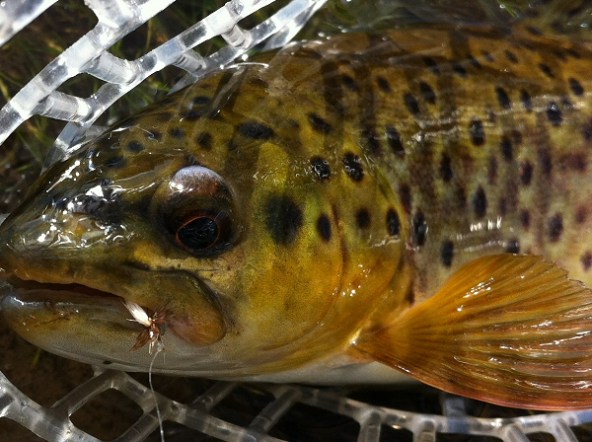
It still amazes me that a nice Hot Creek brown like this can be landed on so small a fly.
I’d repeat this more times than I care to recall but was rewarded with eight beautiful trout, mostly browns, all of which were no less than 13”. The biggest and prettiest crowded about 24” of beauty into 15” of fish.
Next year, I think this place will deserve an entire day of my attention.
This year’s annual club trip to the Eastern Sierras — organized by yours truly — came a tad bit later this year, but its planning nearly nine months ago couldn’t anticipate the snowfall that wouldn’t arrive last winter. From afar I watched the guide reports and river flows, but all of that was forgotten two Sundays ago, once an amazingly fat brook trout slammed the first dry fly cast into a suspect pool.
This is a good time of year to be in the Eastern Sierras. Fewer people, perhaps only the hardier (and those without kids), remain to fish, hike and camp. Being a bit more mature, our group rents a couple of rustic cabins, though we do cook dinner ourselves (clam linguine one night). The days are often cloudless and, at an elevation of 7,000 feet, this expanse of high desert warms up fast. Temperatures swing the other direction just as fast, dropping to the mid-to-low 30s in the evening. Startlingly brilliant stars illuminate the clear nights.
Once over Sonora Pass, my first stop was on the Little Walker River. This small water is often overshadowed by its bigger brethren, the East Walker and West Walker rivers, which offer bigger and more fish. A year after discovering the charm of the Little Walker, and during my first turn as “fishmaster” for this trip, I fished this creek with the club’s outings chairman. We had a wonderful time finding wild brook, brown and rainbow trout exactly where they should be. Jim has since passed away, but the Little Walker reminds me of his broad smile.
It surprised me to see a brookie so big in the Little Walker.
It was with Jim that I first explored Hot Creek, one of the waters that would be frequented during the week. Since I’d have six full days to fish, and in light of Hot Creek’s popularity, the plan was to fish it during midweek. It was a sound philosophy; avoiding as many other fly fishermen as possible and hoping that reduced fishing pressure over a day or two would improve my chances.
Hot Creek Morning.
Hot Creek has been the marlin to my Santiago. It’s a spring creek with a high fish population, estimated to be 8,000 to 10,000 trout per mile. But these are highly educated trout that have probably seen every fly in the catalog. Throw in clear, low water and weeds that limit opportunities to small lanes and the chance of a drag-free drift, and this fly fishing heaven can become hellish, particularly late in the year. Most descriptions of Hot Creek include words that tend to scare me: “technical,” “attentive mends,” “drag-free drifts,” “multiple hatches.” That first visit with Jim five years ago didn’t dispel any of my trepidation, despite my landing two decent fish.
Although I was on the road Tuesday morning later than intended, I descended into the canyon well before the sun was fully on the water. A single fly fisherman had arrived before me. Reminding myself that there was no need to rush, I slowly and softly walked upstream, taking time to stop and watch the water. In the absence of light, the water was dark and unyielding.
Trusting to my experience that fish would be in a familiar spot, I finally stopped to cast a size 16 dark brown-bodied caddis trailing a smaller dropper (maybe size 22, or 24); a red-butt zebra midge type of fly made up during a fit of madness inspiration at the fly-tying vise. This was truly blind casting. There was a lane big enough to allow for a decent drift of about two feet. I kept my false casts short and out of view of the trout I hoped were there, and used a single-haul cast to finally lay the flies on target. The caddis dipped on my third cast and a good-looking 11 inches of brown trout went airborne. I don’t know if it’s the lack of depth in the creek, but I don’t think I’ve seen brown trout as acrobatic as those in Hot Creek.
Hot Creek Brown. Love that pectoral fin!
With the first fish to the net, my pulse finally began to slow and my body relaxed. My casting settled down. Two more fish made it to my net during the next hour, one a dark-hued rainbow of about 14 inches. There are bigger fish in Hot Creek, but any decent fish hooked, played through the mass of weeds, and landed, is still a pretty big deal in my book.
Soon the first few caddisflies and mayflies appeared in the air as sunlight began to warm the water. The sunlight also revealed pods of fish, some hovering between weeds, others just on the edge.
Yes it was dark, but this wild fish also has a dark cast to it.
I downsized my caddis fly to a size 22, hoping that it might get a look or two. It did, but only in passing. I would land a total of six fish that morning and walk out of the canyon feeling pretty good about it. But it was a conversation — with a friendly guy who toughs out his year splitting time between fly fishing the Eastern Sierra and running a scuba shop in Cabo San Lucas — that had me pondering a return in the evening.
As alluded to in my last Friday post, the excellent fishing just over a week ago was often centered on a certain little red humpy. Accompanying the good fishing was good weather. I couldn’t have asked for any better; it was in the mid 80°s those four days. The following week the average daily highs climbed above 100°.
When it comes to fishing unfamiliar waters, I’m a big fan of hedging my bets. While specific locations and tactics will be obfuscated in conversations with just-met fly fisherman, and stops at local shops often require filtering out hyperbole, it’s usually fellow fly fishing club members that will usually — with a caveat that certain tidbits never be shared — give the most accurate information.
That’s what led me to Calaveras Big Trees State Park to check out Beaver Creek and the North Fork of the Stanislaus River.
I’ll get the North Fork of the Stan out of the way first. I fished it later in the day and did land a few fish. It’s not my favorite type of river. It’s certainly scenic, shadowed by groves of ponderosa and sugar pines, incense cedars, white firs, mountain dogwood and, of course, giant sequoia redwoods. It looks to offer a great opportunity for rafting and I probably should reserve final judgment until there’s a chance to visit when the water is lower. But it’ not the easiest stretch of water to fish as it tumbles through truck-size boulders that mean edging a few yards downstream might entail a half-mile hike just to get around those boulders.
[singlepic id=1228 w=300 h=225 float=right]
Missed hatch on Beaver Creek.
Beaver Creek, however, was a reminder of why I enjoy fly fishing smaller waters; they require a more personal involvement with nature. Though it took bushwhacking to move upstream, Beaver Creek offers the intimate style of water I favor, and that certainly made any difficult terrain less of a burden. My hope was to find the wild fish I had been told about, but if they were there, they weren’t as aggressive as the stocked rainbows. I was pleasantly surprised, however, by a wild brown that nailed the humpy only seconds after it landed near a likely seam.
I fished a few other less remarkable sections of the Stanislaus, revisited Herring Creek, and wet a line in some of the ol’ regular spots. It was a good few days. And when the humpy didn’t work, one of my “confidence” flies, a stimulator of nearly any color, did.
I’m glad I went exploring when I did; it’s likely that within a month some of these creeks will be a bit too skinny.
Hopefully, today will be a second day of exploration of waters somewhere on the map below. The best outcome will include fishable water, wild fish and solitude.
There was exploration, fish caught, and the folks who raised us would revisit an old vacation spot at 9,000 feet — all despite weather last week that threatened to put the kibosh on all of it.
I started a mini-vacation two Fridays ago with a run up to the cabin, for once not battling traffic for any of the 142 miles. The plan was to get in a bit of fishing before the parents arrived Sunday afternoon and a drive over Tioga and Sonora passes on Monday. Besides an introduction to the cabin, history was the main reason for this tour. Our family typically spent vacation in one of the best possible venues, outdoors and many summers that meant Tuolumne Meadows.
But as of Friday, both passes were closed as late-season snow fell under dark gray clouds.
Willing to gamble only so much on the weather that afternoon, I set out for the ol’ irrigation canal, knowing it offers shelter and, if needed, a quick exit. During a few short hours the shifting weather offered sunshine, rain, hail and even a light flurry of snow. The fishing was as expected; my flies were hit mostly by wild browns and only the smartest stocked rainbows that hadn’t fall victim to salmon eggs or spinners. The stink of a possible skunking lifted, I retreated to a hot dinner and prepared for the next two days.
Instead of huddling inside, I was up before the sun on Saturday counting on the early hour and cold weather — about 48°F — working to my advantage. I choose wisely. Although I was on a well-fished creek, it was just me, the trout and couple of ducks for three hours. Fortitude and toughness won me solitude and a good number of fish that morning. Or, perhaps, it just proves that early bird adage.
By midday I was cleaned up and headed to the Moccasin Creek Hatchery for Trout Fest; the only time of the year that anyone is allowed to put a hook in its raceways. The grins of the kids were contagious; the K-9 demo of a quagga mussel search pretty amazing, and the general mood was generally festive. A local fly fishing club offered casting instruction in another raceway, allowing folks to cast an all-to-big fly to trout with appetites bigger than their four or five inches. I talked up a few of the hatchery personnel in hopes of lining up my plans for Sunday morning.
Those conversations suggested a return to the lower North Fork of the Tuolumne (near Basin Creek), a section of the river I had first visited about four years ago and enjoyed as an early season venue. This section is deep in a canyon and quite beautiful, despite its relative closeness to civilization. Most of the fish I caught back then there were stocked and in the intervening years that section of the Tuolumne had fallen off the stocking list as the result of an environmental lawsuit. But the word was that there were wild trout to be found.
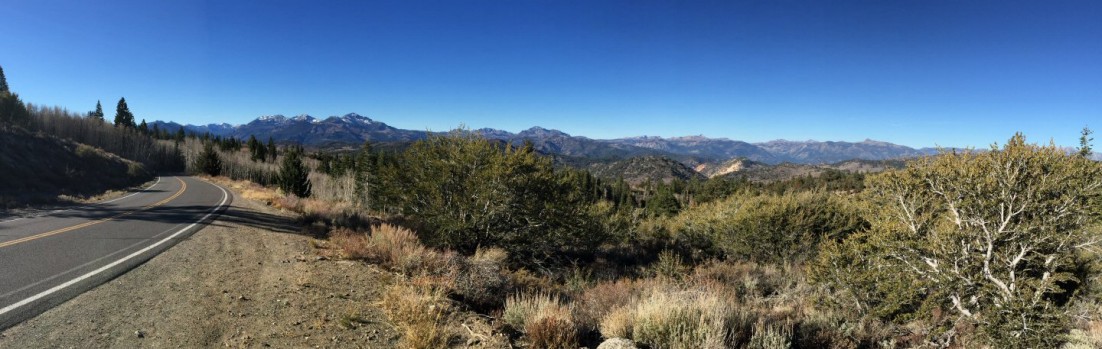
Usually I’m up and out the door at the crack of dawn, but I’d reserved that Sunday morning for leisurely exploration of Forest Service roads outside of Long Barn. I was surprised to find much of my route paved with asphalt, and after marking a good-looking creek or two on the GPS, I headed to Tuolumne City and the four-mile descent to the lower North Fork of the Tuolumne.
Like so often happens, a small, nice looking wild rainbow slammed my dry fly on the first cast. (They always seem to do that when I’m least prepared.) I missed that first fish but managed to find almost dozen other little rainbows, scattered in the likely spots.
After a morning of rewards, I headed back to a hot shower before the arrival of the parents. But the folks’ visit will have to wait until next week.
The general trout season opens tomorrow here in California and though I’ll likely be awake before sunup, it won’t be to beat the freezer-filling crowd to streamside.
Work’s got to get done if there’s any hope of having time to wet the line on any unfamiliar waters, and I’ll be helping a new group of students learn some of the ins and outs of fly fishing before heading for the hills in the afternoon. Perhaps more accurately, my casting will be an example of what not to do for these novice fly fishermen.
This is the fourth year that Opening Day has been more of a casual affair. Admittedly, I am itching to get out there with the fly rod; but it’s become a ritual not to be rushed, knowing that my son and I will likely be the only people on a small stream just far enough out a Forest Service road that most folks will give up and turn around about a mile short. Google Maps shows another creek a couple of miles further that just might be worth a try.
The maximization of our fishing time will include a few roadside spots as well, and on Monday, after the weekend warriors have left, we’ll slink down to some stocked waters trusting that we’ll be able to hook the dumb smart fish that didn’t fall victim to power bait or shiny objects.
If you’re out in the Sierra foothills this weekend, look for the guy with the funny cast. That’ll be me.
When I decided to step into the light and embrace fly fishing a few years ago, certain waters came to my attention. Many were governed by regulations limiting fishing to un-baited, single-hook, artificial lures. Others were specifically deemed zero-limit barbless hook fisheries. It was exciting.
A relatively short section of a certain Sierra Nevada creek was particularly alluring. Tales abounded of big browns and hefty rainbows. Most important to a novice fly fisher, only a few fly-eating trees follow its course. All this was gleaned from photos.
Then I read the associated article, and shuddered. It took only one word, an adjective often casually thrown around by old timers, to stop me in my tracks: ‘technical.’ I immediately visualized streamside judges waving numbers in the air, giving low-digit scores to my casting.
My discouragement mounted as the research piled up. There was no consolation to be found in other articles, books or discussions with more experienced fly fishermen. Much of the season this creek requires accurate sight casting, with presentation made difficult by heavy weeds that limited the ‘natural’ drift of your fly. In a nutshell, I was told, it was a creek only to be fished by those who had paid their dues.
But there I was, still in my first year of fly fishing, standing on its banks. I was asked by a more seasoned fly fishing club member to join him on this creek. He was one of the guys who had taken me under his wing, and it seemed to me that a refusal of the invite would have been rude at the very least, and would call into question my ability to absorb the knowledge he had thus far imparted.
The creek wasn’t as wide or as deep and I had envisioned. Most places one could cross in three or four strides without the water rising much above the knees. The water clarity fit that timeworn description ‘gin clear.’ We’d set out for his favorite spot, and I was upstream a few yards.
On the trail we had discussed flies. He told me he’d be using dries but that I’d be fine with a dry-dropper combination and lowering his voice, added that a lot of guys might have a fancier cast, but this fishery often rewarded the spirit and stick-to-itiveness of an angler, not the casting. Fish don’t judge casting.
It wasn’t until I landed that first brilliant rainbow that my fear fell away. Sure, it took more than a few casts to find the lane, but the abundance of trout ensured that any adequate presentation wouldn’t be ignored.
That first rainbow that rewarded this fly fisherman with a strong fight and great colors.
In the end, both my dry fly and nymph elicited strikes. I had taken on this Creek of Fear and won. Recently, one guide went so far as to say this creek is a good place for novices, a place that demands hard work but quickly rewards. I’ve since fished this creek half a dozen times. I netted nice brown and rainbow trout each time, but only after putting in the work, even if just sitting, watching and learning the day’s lesson before the first cast.
I’m still a bit intimidated when good casting or technical prowess is mentioned as necessary to success in any fishery. But perhaps I am not as unaccomplished ( [uhn-uh–kom-plisht] adj 1. not accomplished, incomplete; 2. certain angler of the Pacific Northwest*.) as I think, though there will be lot of learning before I too can “snicker at the new guys.”
* Kirk’s Kickstarter campaign is funded! He and Olive must feel so accomplished! Now the real work begins. To help Kirk feel less unaccomplished, join in the Kickstarter campaign that could launch his book character Olive, the Woolly Bugger and friends into the digital world with an iPad app. There’s only three days left. (In full disclosure, I’ve contributed in the hope of getting my complimentary copy of the app, so I’d also appreciate any contribution that would get me something out of this deal.)


 Willing to gamble only so much on the weather that afternoon, I set out for the ol’ irrigation canal, knowing it offers shelter and, if needed, a quick exit. During a few short hours the shifting weather offered sunshine, rain, hail and even a light flurry of snow. The fishing was as expected; my flies were hit mostly by wild browns and only the smartest stocked rainbows that hadn’t fall victim to salmon eggs or spinners. The stink of a possible skunking lifted, I retreated to a hot dinner and prepared for the next two days.
 fishing for words