When you mention stillwater nymphing to a group of fly fishermen, you can’t expect more than a quarter of the group to stick around. Certainly, it’s not for everyone. It just happens that a lake offered my most productive fly fishing day ever entre into the sport.
After the drive over Tioga Pass last month, the plan was for Willy, Bill and me to spend that Wednesday with a guide, learning the specifics and generalities of Crowley Lake. Learn we did. Catching, not so much.
The high water this year had the Los Angeles Department of Water & Power monkeying around with the lake level, which, combined with warmer-than-usual fall weather, led to heavy weed growth. Not only were weeds growing up from the bottom, algae floated on top. We’d be parking the boat over a channel created by McGee Creek in search of a literal window through which we might present our flies.
Doug would be more than our guide that day. He would be teacher and cheerleader. Questions wafted through the air with the midges. Discussions centered around the fly(ies) of the day, casting, adjusting the depth of flies, and reading the fish finder to determine boat position.
Unlike most of my experiences on Crowley, conversations went on uninterrupted. The fish were there. Willy hooked a couple of decent rainbows early in the day, but strikes were few. Bill landed a nice brown later in the day, as did I. Violating the rule about moving away from fish, we did, wetting our lines at Green Banks, near Leighton Springs and Alligator Point, only to end up back at McGee.
That learning was put to the test Thursday, when Willy and I spent the day in his boat, searching for open channels and properly positioning the boat. Eight hook ups, with one beefy brown to the net and three rainbows lost — big fish that jumped and cleared the water by a body length or more — suggested we’d done well.
Willy on a fish…
Day two entailed my learning how to launch a boat on a rather shallow ramp, and soon enough we would be on the way. Unlike the previous morning, a nice breeze rippled the water; perhaps the same breeze that pushed the top-water algae to the opposite side of the lake. It was one of those clear, crisp high Sierra mornings when the mountains seem that much closer.
Willy and I had discussed strategy while slowly cruising through the marina with a probably misguided reliance upon my previous experience — five years worth — at Crowley. We’d end up agreeing to revisit the McGee Creek channel, but with my suggestion, which had no basis in any empirical evidence, that we’d push closer to shore and fish in about 10 feet of water.
A few boats and float tubers were already in the vicinity when we both began to carefully watch the depth finder for the edges of weeds and the telltale dip of the creek channel. We crossed it a few times and when we finally anchored, it had taken longer to get into position a few feet away from the channel (so we could cast to it) than it did to make the run from the marina to our destination. We were set to cast.
I felt a bit of a dorky tingle as I locked forceps to my bottom fly — I’d seen guides do this, but never myself — and lowered it over the gunwale to gauge the depth as which to set my indicator. I nervously cast out to where we hoped to intercept cruising fish; thinking that this was a test that would be graded by the fish we landed, or didn’t.
My big shouldered brown.
As often happens on this lake, it wasn’t too long before Willy’s indicator went subsurface. Once the hook was set (and the fish obviously felt it), a big, beautiful rainbow cleared the water by a body length of at least 18 inches, if not 20, and threw the hook. Willy and I gawked at each other in disbelief. For me it wasn’t so much because Willy didn’t land the fish, but for the simple reason that this fish clearly demonstrated that we, on our own, had done something right.
Willy would hook (and lose) another big rainbow later than morning, and we’d both elicit strikes when raising our rods (and flies) to cast, with one fish hitting Willy’s fly just a few feet from the boat. There were a few other fish for me, including one huge brown…not long, but linebacker big, with shoulders and a head big enough to give me pause before reaching into the net.
It wasn’t the wide-open fishing, or even the hot and heavy fishing, that I’ve previously seen on Crowley. It’s not always a numbers game and the difference this time — a huge difference in fact — was that we did it on our own and that the fish seemed to agree that we did something right.
About a month ago, Willy and I loaded up at his house and left just before 7:00 a.m. and headed east, skipping from one highway to another, toward Toms Place, Calif., the annual fall destination for the club’s Eastern Sierra outing. It’d be my fourth. Along the way we’d be travelling through the Sierra foothills and Yosemite*, stopping at the Crowley Lake Marina for a quagga mussel inspection of Willy’s Bay Ranger.
Over the last eight-plus years I’ve had multiple opportunities to drive Hwy 120, up along scrubland bordering Priest Grade to where the highway becomes Big Oak Flat Road and winds through the sparse foothill woodland surrounding Groveland and much of the roadway, then finally rising into heavier stands of conifers — more correctly a lower montane forest — before the Yosemite entrance station at about 5,000 feet. My past trips encompassed ambitious one-day, 225-mile fishing trips with stops to cast a line at four or five different creeks or rivers as well as motorcycling over Sonora and Tioga passes shortly after opening, when snowdrifts 10-plus feet high line the high-country portions of the road.
It’s a fantastic road trip, to be sure, but on this drive I found that the view was very different from the passenger’s seat of Willy’s Cadillac Escalade.
The motley crew that would comprise the 2011 DVFF Eastern Sierra Trip.
The road welcomed us with limited traffic, and only a few miles of road construction slowed our progress. Anyone who’s driven through Tracy, Manteca and Oakdale — perhaps headed to Two Mile Bar or Goodwin Dam on the Stanislaus River — know that there’s plenty of nothing to look at. It’s here that the road seems to drone on between orchards and field crops, time seems to slow and I’m thankful that the highway is now three lanes through Tracy, once a bottleneck no matter the time of day.
It’s outside of the appropriately named Oakdale that the oak woodland takes hold. The oak trees and an occasional gray pine break up the monotony of the now golden grasses. Then there’s the always subtle shock of the “girls, girls, girls” sign that appears out of nowhere, perched above a rundown hotel and shadowy outbuilding truly in the middle of nowhere, all of which is enclosed by a substantial not-so-ornamental iron fence. That sign is also a landmark signaling the last mile or so before the right turn toward Yosemite.
The history of the Sierra foothills comes to life driving through Big Oak Flat and Groveland in the form of vacant stone buildings adorned with iron shutters and doors that recognize the danger of fire during the hot summers. Jeffery, Yellow and Ponderosa fight for space between buildings. The road here barely allows the passing of two motorhomes, forcing life to slow to a crawl. Not necessarily a bad thing.
As we approached the national park border the density of the forest was more imposing than my long held impression resulting from occasional glances from the driver’s seat. I’d seen these trees before, but details now stood out. A thick green canopy blocks any view of the sky and despite a distinct lack of branches from the ground to a few feet above the average man’s head, there were so many trees that the concentration of trunks cut the range of visibility to a couple hundred yards. As the miles slide by, the undergrowth grows lush.
More than just a stop to hit the restrooms, the Big Oak Flat entrance to Yosemite marks the start of a big change in vegetation and terrain. After another half hour and a left turn toward Tuolumne Meadows, Western Juniper, Red Fir and Lodgepole Pine dominate the view, indicators of the upper montane forest. Meadows of unreal green — in essence nature’s sponges for snowmelt — occasionally come in to view, edged by skunk cabbage and corn lily. In another hour, slabs of granite and collections of boulders begin to replace meadows.
Then, unexpectedly, the view opens up to vast expanses of what I’ve always known as granite and that, in all of my limited travels, seems to be the unique calling card of the Yosemite high country. A less brilliant white, I’d later learn that it’s actually a mix of granitoids and in many cases leans toward granodiorite, which is darker, almost moody and reflective of the changeable weather. It also marks the march into the subalpine forest as one nears 9,000 feet in elevation.
This day was clear and the only distraction was a fuel gauge needle too close to “E” for comfort. Since I tend to measure distance by time instead of mileage, I guessed that the gas station in Tuolumne Meadows would arrive at least a few comfortable miles before the needle was pegged. I grimaced a bit with each incline and hoped I was right.
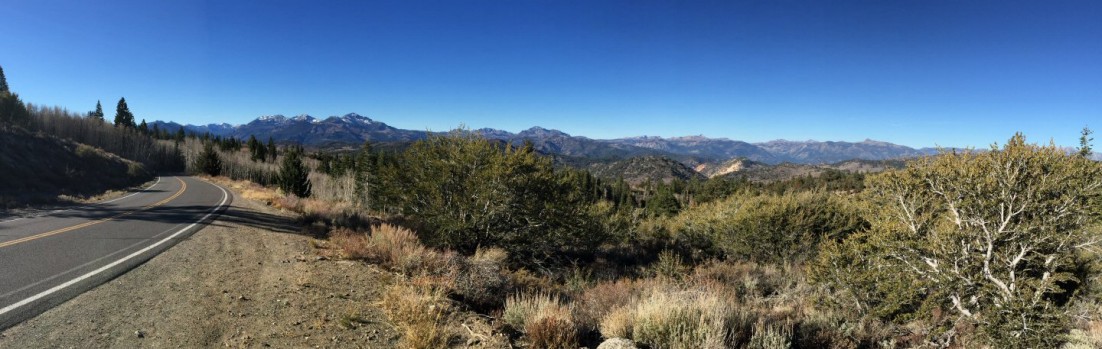
The East side of the Sierra Nevada mountains. (Photo courtesy Fed Glaser.)
My concerns were alleviated by the sight of the sapphire-blue waters of Tenaya Lake, probably one of the most photographed bodies of water within the borders of Yosemite National Park. The beauty of Tenaya belies the fact that it’s a barren, fishless lake. Thankfully, I knew it was less than 10 miles to the Tuolumne Meadows gas station, one of the few Chevron stations with a mini-store that offers rock climbing equipment for sale and rent. We’d done alright so far. It was 11:00 a.m., putting us on schedule to stop for lunch in Lee Vining.
This time the appearance of Tuolumne Meadows and its namesake river was a far cry from a visit in June with my brother and one son. The river was no longer near flood stage; the water had receded and the meadow was again grass. Lembert Dome loomed above us, sheer peaks watched from the southeast and the now fishable Dana Fork of the Tuolumne River teased us from alongside the road. Soon we reached Tioga Pass station and began a descent that would take us past Tioga and Ellery lakes, and into Lee Vining Canyon.
This 9-mile stretch of road harbors the majority of my childhood memories of family vacations. Scattered about are small meadows dotted with small stands of Lodgepole and other pines, and laced by small streams with small, willing wild brook and brown trout. Tioga Lake recalls a day of crazy fishing, when my sister, brother, dad and I stood on rocks a few feet above the lake casting spinners and watching the (stocked) rainbow trout chase our lures, only to strike at the last minute.
It all changes after Ellery Lake. Sheer rock is the predominate feature. Only small plants and hardy trees cling to crevices. Only on the canyon floor, the eventual destination of Lee Vining Creek after its exit from Ellery Lake, offers any great expanse of green. The Eastern Sierra high desert — a Pinyon pine-Juniper woodland — begins near the canyon floor, offering a stark contrast, beautiful in its own way, to the forest passed through to get there.
We had about 12 more miles to Lee Vining and sat down for lunch on the patio at Bodie Mike’s Barbeque just after noon. With the seasoning that comes with eating out-of-doors, we dug in, enjoying the view toward Mono Lake between bites. It was a quick drive to Crowley Lake Marina to surprise the marina attendant with a bone-dry boat. It took longer to affix the tag than conduct the inspection.
A few minutes later we tucked our stuff into the cabin to find ourselves with more time than expected on our hands. The afternoon sun was still well above the mountains to the west. We were there to fish, so took a short stroll to the nearby Rock Creek to cast a few flies.
Rock Creek isn’t too big, but usually heavily stocked and fished just as much. Willy and I split up. I would find a few rising fish willing to strike my offerings, but the kicker was Willy’s first fish — his first post retirement trout. A not-too-shabby brown trout of about 14 inches.
We spent a bit more time casting to rising fish, next to the opposite shore, of course. A few took our offerings, fewer were landed, but it was good to spend a few hours getting the “skunk” off before dinner.
Looking back, it was a good start to what would be a trip that was great for reasons I didn’t expect.
*Not through Yosemite Valley, however. The road to the valley dead ends near the Happy Isles Visitor Center. Hwy 120 passes the valley and heads through the high country and Tuolumne Meadows, then over Tioga Pass.
If you’re looking to build self-confidence and have taken up fly fishing, there is no shortage of instructional books, DVDs, websites and podcasts. Some folks will proclaim that things like more expensive better rods, a specific brand of fly line and the one killer fly will be the keys to a better fly fishing experience. But the best thing any angler can do is to just keep casting; confidence comes with learning to do things on your own.
Building this necessary confidence took me a while. Those who’ve seen my fishing — specifically my casting — might agree that blind confidence is a much bigger part of the equation than skill.
In casting, confidence requires first believing that you won’t piece a body part and, second, that you’ll get the fly where it needs to go.
When it comes to flies, there’s a prevalent theory that anglers gravitate toward certain flies — and hook most fish with them — because they have confidence in those flies. Confidence or lack thereof can also apply to the landing of or losing those hooked fish. My “confidence flies” are the Zebra Midge, AP Nymph and something like a Copper Chromie, but with red thread and silver wire.
Confidence in flies can be challenged again when you tie your own. The flies that work, the ones in which an angler has the most confidence, will be the ones tied most often. That certainly applies to my tying. (See the list above.)
My confidence was called into question this year, once again, when I hooked that first fish on the rod I built during the winter. My confidence grew with each fish coaxed to the net.
Soon I’ll be testing the limits of that confidence. I’ll be working with knotted leaders.
Yeah, old school stuff. There are folks who eschew modern loop-to-loop connections and extruded knotless leaders and swear by knotted leaders. In my case, I’ll be duplicating a time-tested formula used for stillwater nymphing (3 feet of 1X, 3 feet of 3X and 7 to 10-plus feet of 5X to the depth fished).
It’s my knot-tying ability that’ll be tested…in a lake where 18-inch rainbow, brown or cutthroat trout aren’t uncommon, and often one might get into a 24 incher. It doesn’t help that I have an inherent mistrust of tippet. The formula works; at least when tied by guides I’ve hired.
This time I’ll be me tying the knots, and I’d daresay that any fish I land will be well deserved.
From what I hear and experienced, it might just be a good thing if you missed the Trout Opener this year. At least on the east and west slopes of the central Sierra Nevada mountains.
No one’s outright said as much, but reports from the Eastern Sierra suggest that crowds may have been there but the fish weren’t. One particularly likeable report: “Bait slingers and trollers failed miserably on Opening Day weekend and 100,000 lives were spared!”
One small bass from the shadows of a small pond.
The same seemed to be true in our neck of the woods. A California DFG hatchery worker I’ve talked with over the years told of anglers grumbling that fish were nowhere to be found, despite the usual numbers being planted. (More interesting parts of that conversation will come in a future post.)
Not all went as we planned, but arriving in the Sierra foothills in the aftermath of Opening Day put Sean and me in a good position to fish and explore in relative solitude. Months of neglecting necessary fly fishing skills were soon forgotten and muscle memory was gradually regained.
Arriving before Sean and after opening the cabin for the season (thankful that pipes hadn’t burst during the long winter) it was time work out the kinks on the convenient Lyons Canal. Just behind town, it’s more accurately Section 4 of the Main Tuolumne Canal of the Lyons Reservoir Planning Unit. Built in the mid 1850s, it’s part of a network of canals — estimated to total 60 miles — that crisscross Tuolumne County. Though peppered with flumes and concrete in some sections, parts of it have been reclaimed by Mother Nature and now resemble a small stream carved into the rolling hills.
Like many moving waters, walking a short distance away from easily accessed sections is worth the little effort required. Stocked with rainbows, the canal is also home to a now wild population of brown trout.
Hopeful that the most important tool in my fly fishing arsenal — confidence — wasn’t lacking, I tested likely cut banks, boulders and shaded water.
Despite the lack of wildness of the surroundings — homes and a roadway are a short distance away — these brown trout are wild enough to scatter at the shadow of a rod or a less-than-light footfall. This requires casts well upstream of your position, with the best casts placing the fly no more than a few inches from the bank.
My first fish darted out from a surprisingly deep undercut four feet in front of me; eating a standard red Copper John nymph and barreling downstream into faster water. Nicer still, this was probably one of the biggest browns I’ve pulled out of the canal. It looked healthy, even happy.
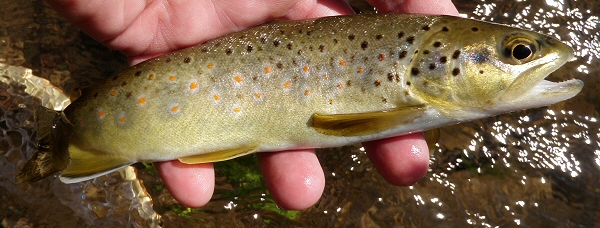
Another brown from the canal…they do like hugging those banks.
Six browns of various sizes came to the net that afternoon, all seeming to eye me with what might be described as familiarity bred by a near certainty that we’ve met before. Thankfully, most are small enough to be released by freezer-stocking folks hunting the bigger, stocked rainbows.
Perhaps it’s a reflection of the intervening off-season troutless months, but the brown trout this year seemed feistier and their spots brighter than I remember.
I finished up the day, with long shadows creeping between shafts of the setting sun, tossing streamers into a pond on long-fallow golf course. Decent sized bass cruised the banks, but in such small water quickly disappeared into the weeds. A few of their offspring were fooled with streamers and trailing nymphs; the biggest was about eleven inches.
As the sun fell behind the tips of the pines, it felt good to have worked the rustiness out of my cast and rediscover the confidence that had been in hibernation.


 fishing for words