fishing for words

(and tossing out random thoughts)


2 Comments

with the proper attitude fly fishing keeps one young (or, once I was but the learner; now I am the master.)

If the headline got you here, great. But let’s first clear the air…
I’m not the master; I’m more of a jack of all trades and master of none.

My last trip of this trout season to the foothills of the Sierra Nevada was like many before it. It offered solitude and a stillness that can only be found in the fall.

It is possible to spend time on most moving waters here — even those that are well stocked — without any company, and my usual arrival at sunup ensures that it’s just me and the fish for a few hours.

Such was the case on one of those streams, one that also sees a small fall run of spawning browns. I hooked only one of those browns this year, a big one that, after we eyeballed each other, promptly snapped my tippet and headed back downstream. Before and after I lost him, there were plenty of raceway rainbows that were willing to play.

When the sun finally warmed up the landscape enough, four gentlemen waded into the stream downstream from me, and slowly began to work their way upstream. I gave them a welcoming wave. Eventually, they were close enough that I could hear their conversation. Phrases drifted over the water…

“They biting?”
“Some, but that guy up there is getting five for every one of mine.” (‘That guy’ was me.)
“Wonder what he’s using?”
“It’s gotta be a nymph or something ‘cause I’m getting nothing on my Adams.”

During my few years of fly fishing I’ve learned to discern the experienced fly fisherman from those new to the sport. It was clear that despite their apparent age, two of the gentlemen had probably cast a fly rod only once before.

I can’t say whether it was the ego boost that comes with someone’s admiration of my catch rate or a more altruistic pay-it-forward attitude, but since I had long lost count of how many fish had wet my net, I offered my spot to the group. After assurances that I had caught plenty of fish, they gratefully accepted. I mentioned that black nymphs of almost any style might work, offered a bit of advice on depth, and the two more experienced guys helped the other two rig up. I think between the four of them they used four different types of indicators.

One of the gentlemen broke away to chat with me. All four gentlemen were over 70 years old. While two of them were more experienced, that experience was with bass or in Alaska, not so much in the Central Sierras. There was no bragging between us, a simple sharing of information and stories. One of their group was from South Africa and had never caught a trout. He did that morning and gave me one of the biggest smiles you might imagine.

I’d end up showing these guys where to find the fish on this stretch, explaining then showing that during a limited window — when the sun is at the proper angle on this stream — during which dry flies will get some attention.

All of us accepted each other in the common bond of fly fishing. While most fish were caught and released, there was a stringer produced and a few fish taken by one guy who was recently retired, but only after asking if we thought it okay. (He somewhat sheepishly explained that he wife had complained that through all his years of fly fishing, and all the money spent, that not once had he brought home trout for dinner.) There was no dissention, knowing that these were stocked fish that might not last through the winter.

When I left, there were smiles all around. We were friends that might have never met were it not for our shared hobby. It was a good way to end my season.


1 Comment

the conundrum of working-class guy’s fly fishing vehicle

Ask around, do a little research and you’ll likely find that the question “what’s the best vehicle for fly fishing” is often answered “truck.”

But I’m still paying into social security so others can fly fish when they want a working stiff. I need transportation that is, first and foremost, reliable, and just as important, economical. I have to spend money on gas to make money, and the less I spend upfront the better.

During better weather, the Honda CB750 and its 45+ miles per gallon is a fine option. But it’s difficult to load the necessary fly fishing gear, and the cooler of post-fishing beer, on a motorcycle. I’ve tried.

Being a bit obsessive about conducting research on anything that will cost more than $50, I’ve been thinking — probably too much according to those around me — about the vehicle that, in about 1½ to 2 years, will replace my current 2003 Honda Accord. Since I’ll likely buy a certified pre-owned car, it’s going to be something currently on the market. My current car gets 30 to 32 mpg most of the time, and on long trips to fishing venues, I’ve seen 34+ mpg. But over 80% of my driving is commuting to and from work.

I’ve debated the merits of various models, including sport utility vehicles and all-wheel-drive cars. A hybrid is out of the question; too heavy and not enough clearance for the occasional Forest Service road. Subaru is a commonly offered up make as an all-encompassing solution. But I’ve noticed two things: most Subaru owners talk about the sportiness of the ride, the go-almost-anywhere capability, but rarely praise their cars’ mpg, and it seems to be a roll of the dice when it comes to build quality. That might be said about any make, but that’s my experience.

Despite the fact that I’ve been a Honda owner for well over 20 years, I opened up my consideration to other options, particularly now that the mpg on midsize sedans is edging up.

But, and a bit ironically, it’s fly fishing that helped firmed up my decision. At least for now.

I’ve driven my Honda on a good many, only slightly improved, Forest Service roads. Sometimes for miles, over the relatively soft dirt along the Upper Owens River, for example, or over rocks on my way to the Little Walker River, and on washboard roads in the hills behind the cabin.

Still, the doggone car doesn’t squeak or rattle.

I’m hoping this will still hold true for my next car, until that someday when I can justify a dedicated fishing truck.


2 Comments

(relatively) word-free Friday

Since pictures are worth a thousand words, and it would take many thousands to tell of the adventure and fun enjoyed last week with my brother’s family, below is a gallery of photos that tell the story than I could. The days were filled with swimming at the local lake, visiting a historic gold rush town and panning for gold, more fun — swimming, sliding, diving, building sand castles — at the lake, hiking, mini golf and a trip to Yosemite. Enjoy!

Due to loading issues, the gallery has been moved here.


4 Comments

my very best Goldilocks impersonation and the chance encounters of fly fishing

Last week in a nutshell: Trout weren’t caught where expected; a good many others landed where only a few were caught before. One river was frustrating; another too low; one just right. Fellow fly fishermen were met and their company enjoyed on the water.

Some folks won’t understand the almost 200 miles traveled to catch and release the trout I finally found. But a quiet sense of urgency seems to settles in after the summer solstice, an urgency that leads to miles of driving before sunup.

With water in many Sierra rivers, creeks and streams low this year, this urgency demanded a trip, however quick, to the Walker River Basin. It’s a watershed I’ve visited less than I should, considering the beauty of the country traveled distracts from the time it takes to get there. Breakfast is light and handy, the air cold and crisp as I crest the Sonora Pass. Horizon-to-horizon cloud cover dulls the day.

Morning commute traffic means something entirely different here. Before reaching the high desert of the Eastern Sierras, the two lanes of Hwy 108 winds through forests of pines and aspens near the Leavitt Meadow Campground, and though its twists and turns demand slower speeds, both lanes are usually vacant. But not this morning.

Thanks were muttered to the mechanic who last worked on my brakes as a cowboy sidled alongside to suggest it best that I pull to the side of the road and wait. I did and prayed just a little as a herd of cattle gave me the close up and personal experience I never wished to have, as well as one of those encounters that makes a journey all the more memorable.

A few miles more and two hours after my departure, an internal debate of where to fish the East Walker River was quickly settled by the absence of vehicles near the “miracle mile.” After a few wrong turns (caution is warranted driving a sedan on these dirt turnoffs), it was time to gear up. A lack of competition other fishermen tends to eliminate a subconscious desire to rush this process, and I stood there looking like a sausage standing on end while wishing another angler “Good morning.”

East Walker Brown

The single East Walker brown that came out to play…and on a red-butt zebra midge tied by yours truly.

His accented response was explained in the resulting conversation. He was visiting from France, working his way up the Sierras, and with admiration in his voice told me he enjoyed a quite a time on Hot Creek the day before. We talked techniques, and in a bit of name dropping I mentioned that three-time French Fly Fishing World Champion Pascal Cognard had recently spoken at a club meeting. (The French team has been ranked #1 by the International Fly-Fishing Federation for a number of recent years.) I mangled Pascal’s last name but once it was clear I was talking about competitive fly fishing and who I talking about, my new friend told me that he had competed against Pascal. Small world.

We spent a bit of time within sight of each other and I spent time watching his strategy. That French nymphing brought the first fish to the net within half an hour before I wandered downstream.

The East Walker has become my nemesis. It’s never not given up a fish and admittedly I haven’t spent much time fishing it. This day I poked and prodded likely pools, riffles and runs, with only one small brown to show for four hours of effort. Hungry and a bit frustrated, it was time to retrace my route, with stops at the Little Walker and West Walker rivers.

Though “little” is in its name, the Little Walker was too low for my tastes since I was hoping to fish stretches holding the wild trout that live there. It was back down another dirt road to the highway.

Bank on West Walker River

Rewarded will be a nice cast to within a foot or so of this bank on the West Walker…

The idea of unknown possibilities kept at bay a creeping despondency that was nourished by the still overcast sky, an unwetted net and the aches that come with age exertion. The West Walker is typical of the rivers in the Eastern Sierra…you might miss it if you didn’t know it was there. It winds through high desert terrain, below banks that conceal its course. Parking the car alongside the handful of trucks emblazoned with one military insignia/motto or another, I loaded up and headed out the half mile to a bend that seemed to interest a handful of anglers.

The number of fishermen made it a less than optimal situation, but my eye was drawn to flashes on the surface, near the tail of the bend and just below a lone fly fisherman. I walked quietly to a position downstream and behind him. Our conversation began when he stopped to replace a lost fly. He’d arrived at the nearby U.S. Marine Corps Mountain Warfare Training Center only two days ago, heard that the fishing was “on” and now stood on the shore of the West Walker in his fatigues.

He was enjoying himself. Though stocked rainbows, a long pod of fish had stacked up against the opposite bank, next to reeds and in deeper channels, and were earnestly feeding on the surface. Every other cast was welcomed with a bump, slash and, best of all, a solid strike. I was invited to join in and set up on a small point just downstream.

West Walker Rainbow on a Dry Fly

The reward.

The next three hours were filled will double hook ups and an inevitable comparison of our fish, talk of flies and home, and rain, wind and sun. Good fishing makes triumph seem easier in the face of a challenge, and despite powerful wind gusts — gusts that didn’t help casting but allowed the sun to shine — we continued fishing. Sidearm casts two feet off the water got flies close enough to feeding lanes. We never exchanged names but were fast friends in fly fishing that day.

Breaking my rule of never leaving willing fish, I headed back over the pass. My sister and her family were joining me for a three-day weekend, and though fishing is a big part of my time in those mountains, it had been a while since they’d been to the cabin and there was family fun to be had; fun that would be a bonus on top of that day on the three Walkers.


2 Comments

time well spent on new water

The bad news is that work this year dictates quick trips pretty much limited to the family cabin. The good news is that this allows for frequent trips that engender exploration.

Last week I decided that the two full days available for fishing would be dedicated to moving waters with familiar names but until now remained unfished. And no one told me it was humpy week. Red and yellow to be exact.

Road work meant the last five miles of my trip took half an hour. Luckily, a month ago I found a small section of the North Fork of the Tuolumne River not more than 20 minutes from the cabin, a convenient place to get the skunk off after a midafternoon arrival in the Sierra foothills. It’s not remote and often occupied, with a limited number of wild trout, but it’s a place that offers room to practice casting to specific seams and shelter.

Like much of the moving water in the Sierras, this section of the Tuolumne was already low. The early season spoiled me, so the fisherman in me was also initially disheartened to find two kids frolicking in the main pool. As a dad, I appreciated that these kids were having a good time outdoors. However, despite the splashing and noise, a trout would periodically and enticingly slash at the surface.

Though a short drive, I hate wasting an opportunity to fool a fish with a dry/dropper combination. A red humpy and a self-tied small, go-to bead-head nymph.

It took a few casts to warm up.

Then the fish warmed up to my presentation.

[singlepic id=1226 w=600 h=450 float=right]

Darn fish wouldn't stay in focus. (But was caught near the rock, in focus, in the background.)

So it went for a few hours. The humpy dried off many times after being battered and half swallowed. These fish were hungry and made me look good.

That’d be the theme this trip, and though I didn’t find as many wild trout as hoped, I did well enough to consider it time well spent.

The next three days I’d fish four unfamiliar waters, landing fish from each, often amid relative solitude (we’ll get to that next week). When not alone, I was lucky enough to enjoy conversation with fishermen more knowledge about the area than I, fly fishermen who were happy to offer friendly advice and recommend additional venues. One gentleman, with a long history of fishing the foothills, related bit of history that suggests in high-water years there’s a very real possibility of brook trout being washed out of a reservoir into a nearby steam.

Yes, it was time very well spent.

[singlepic id=1225 w=600 h=228 float=right]

Big-tailed rainbow...surprising for a stocked fish.


3 Comments

we’re chasing fish today

Hopefully, today will be a second day of exploration of waters somewhere on the map below. The best outcome will include fishable water, wild fish and solitude.

Where We Will Be

Where we’ll be, fishing or otherwise.


Leave a comment

a return to the high country with the folks who raised us, some thirty years later

It turns the tables a bit when it’s the kids introducing parents to new places and experiences and revisiting the familiar after three decades is icing on the cake, though there’s bound to be disagreement in our personal memories.

[singlepic id=1223 w=300 h=400 float=right]

Mom and Dad at the cabin, for their first visit.

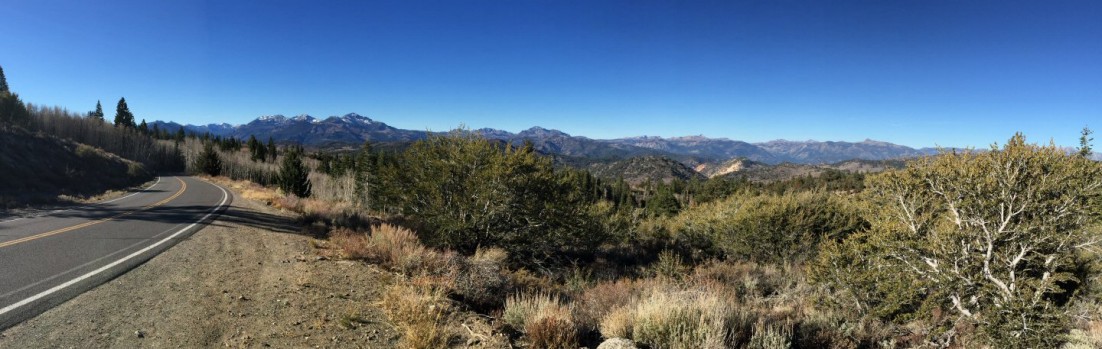
But easy agreement was found in the beauty of the scenery and shared remembrances during a long drive up and over Tioga Pass, along the shores of Mono Lake, before a return over Sonora Pass.

The parents arrived at the cabin late that Sunday afternoon, and after running an errand that took entirely too long for Dad, dinner was enjoyed and we settled in for the evening. Thankfully, the storm that had dumped snow on the passes had dissipated the day before and the warmth of the sunshine had cleared the roads.

Mom, Dad and I leisurely left Twain Harte with a route in mind but absent any planned stops or timetable. The hillsides leaned more toward gold, but were freckled by islands of still-green grass.

I’ve driven this road many mornings, but saw things a bit differently today since I wasn’t preoccupied with wetting my fly line. Miles rolled by, lubricated by conversation. Soon it was time for a stop to stretch our legs. Though there aren’t many hatcheries that will, in my mind, match the magnificence of the historic Mt. Whitney Fish Hatchery visited in my youth, there was something familiar about walking around the Moccasin Creek Hatchery with the folks.

After the excitement of gaining 1,500 feet in elevation over the two miles of the “new” Old Priest Grade, it was all new territory for Mom and Dad as we wound through Big Oak Flat, Groveland, and past Buck Meadows. Highway 120 took us from 2,838 feet at Big Oak Flat to Yosemite National Park’s Big Oak Flat Entrance Station at 4,900 feet. Dad was impressed by the tidiness of the towns and the number of old buildings alongside the roadway, many of which are still in use.

If it wasn’t enough to have fantastic weather, traffic was light. By mid morning we arrived at the entrance station, where the purchase of an annual pass got us across the park border. Words in many foreign languages hung in the cool air, reminding me of the many nature blessings that aren’t more than a day’s drive from home that attract visitors from around the world.

I’ve always throught that the changes in vegetation and terrain grow more dramatic once inside the formal boundaries of Yosemite. Heavy forest yielded to granite, which only seems to yield to water in the form of glaciers, ice and liquid. We pushed on to Olmsted Point, taking obligatory photos, then on to Tenaya Lake. Availing ourselves of the facilities near the lake, I made a mental note that I need to spend more time exploring Tenaya Lake and its surroundings.

There’s a drama that comes with finally emerging from the forest to be presented with the dramatic vista of Tuolumne Meadows, then dropping into the meadow itself. This time I was taken aback by the dramatic change in its appearance compared with that of last spring, when my brother, son and I were on our way to a challenging life-affirming hike to the top of nearby Lembert Dome. Last year the meadows were covered with water. This year, the grass was already the gray-brown of late August.

I had to explain to Dad that the Tuolumne Meadows campground wasn’t open yet when he asked why I was parking alongside the highway. He’d never been here so early in the season. (The campground would open two weeks later, rather early.) Though last June there was snow on the ground and big puddles filled with mosquito larvae, there was nothing of the sort this last week of May. A stroll toward the entrance was accompanied by a bit of debate about the differences between today’s visit and our memories of camping trips more than two decades ago. Regardless of the differences of opinion and any discrepancy in our memories, there was more than enough that was still the same to foster a feeling of familiarity.

[singlepic id=1218 w=600 h=407 float=center]

Mom and Dad’s triumphant return after 30-some years.

My worries about the water were confirmed during this walk through the campground when I stopped near the same spot from which I took a photo of Lembert Dome in 2011. Last year, there was no discernable difference between the channels of the Tuolumne River and the river itself, and the water was within two feet of the bottom of the Tuolumne Meadows (Hwy. 120) Bridge. This year, the channel nearest the campground was no more than a foot deep, and the river was barely touching the bridge abutments.

[singlepic id=1221 w=300 h=225 float=right]

The three of us at Leavitt Falls Overlook.

The reminiscing was further fueled by the sheer rock walls along the descent from Tioga Pass to Lee Vining. The thought of dropping in at Bodie Mike’s for a barbecue lunch was derailed by Dad’s sudden proposition of stopping at the Tioga Gas Mart — that he didn’t recall seeing before — to grab lunch at the Whoa Nellie Deli. A word of warning: Be careful what you order. It’s all big at Whoa Nellie. The Cowboy Steak Sandwich is not so much as sandwich as it is a steak slapped on a roll.

The easy drive north on Hwy. 395 from Lee Vining was a welcome change after such a big lunch. By the time we arrived to the intersection of Hwys. 395 and 108, the urge to nap had passed. A good thing considering the hairpin curves that would take us from 6,765 feet to 9,623 feet at Sonora Pass. Before our main ascent, the Leavitt Falls overlook offered a last opportunity to stretch our legs before the long trip over the pass. The reduced volume of water coming over the falls was another reminder that it’s going to be a dry year in the Sierra Nevada. We posed for photos, then began the long climb.

[singlepic id=1220 w=600 h=450 float=center]

Getting a roadside education at Sonora Pass.

This was undiscovered country for the parents, who never had a reason to travel this road. To my eye, Hwy. 108 over Sonora Pass offers much more dramatic transitions. The road rises faster and the changes in terrain and vegetation follow suit. Surprised to find it open, we stopped at the Donnell Reservoir scenic overlook, with a sweeping over the Stanislaus River canyon and the Central Valley. The road from there is bit less remarkable, winding through heavy forest and passing towns that only seem to be wide spots in road.

It was a long but worthwhile day; one that both revived and created memories.

[nggallery id=84]


2 Comments

a few days to fish (and learning that life will find a way)

There was exploration, fish caught, and the folks who raised us would revisit an old vacation spot at 9,000 feet — all despite weather last week that threatened to put the kibosh on all of it.

I started a mini-vacation two Fridays ago with a run up to the cabin, for once not battling traffic for any of the 142 miles. The plan was to get in a bit of fishing before the parents arrived Sunday afternoon and a drive over Tioga and Sonora passes on Monday. Besides an introduction to the cabin, history was the main reason for this tour. Our family typically spent vacation in one of the best possible venues, outdoors and many summers that meant Tuolumne Meadows.

But as of Friday, both passes were closed as late-season snow fell under dark gray clouds.

Brown Trout on a DryWilling to gamble only so much on the weather that afternoon, I set out for the ol’ irrigation canal, knowing it offers shelter and, if needed, a quick exit. During a few short hours the shifting weather offered sunshine, rain, hail and even a light flurry of snow. The fishing was as expected; my flies were hit mostly by wild browns and only the smartest stocked rainbows that hadn’t fall victim to salmon eggs or spinners. The stink of a possible skunking lifted, I retreated to a hot dinner and prepared for the next two days.

Instead of huddling inside, I was up before the sun on Saturday counting on the early hour and cold weather — about 48°F — working to my advantage. I choose wisely. Although I was on a well-fished creek, it was just me, the trout and couple of ducks for three hours. Fortitude and toughness won me solitude and a good number of fish that morning. Or, perhaps, it just proves that early bird adage.

By midday I was cleaned up and headed to the Moccasin Creek Hatchery for Trout Fest; the only time of the year that anyone is allowed to put a hook in its raceways. The grins of the kids were contagious; the K-9 demo of a quagga mussel search pretty amazing, and the general mood was generally festive. A local fly fishing club offered casting instruction in another raceway, allowing folks to cast an all-to-big fly to trout with appetites bigger than their four or five inches. I talked up a few of the hatchery personnel in hopes of lining up my plans for Sunday morning.

Those conversations suggested a return to the lower North Fork of the Tuolumne (near Basin Creek), a section of the river I had first visited about four years ago and enjoyed as an early season venue. This section is deep in a canyon and quite beautiful, despite its relative closeness to civilization. Most of the fish I caught back then there were stocked and in the intervening years that section of the Tuolumne had fallen off the stocking list as the result of an environmental lawsuit. But the word was that there were wild trout to be found.

Usually I’m up and out the door at the crack of dawn, but I’d reserved that Sunday morning for leisurely exploration of Forest Service roads outside of Long Barn. I was surprised to find much of my route paved with asphalt, and after marking a good-looking creek or two on the GPS, I headed to Tuolumne City and the four-mile descent to the lower North Fork of the Tuolumne.

Like so often happens, a small, nice looking wild rainbow slammed my dry fly on the first cast. (They always seem to do that when I’m least prepared.) I missed that first fish but managed to find almost dozen other little rainbows, scattered in the likely spots.

After a morning of rewards, I headed back to a hot shower before the arrival of the parents. But the folks’ visit will have to wait until next week.


2 Comments

it is best in the springtime, when the good Trout looks up

The dogwoods’ stark white blooms peeked out from behind pines as unfamiliar water teased with promise. A slight breeze carried mayflies upstream. Spring was winding its way higher and higher up the Sierra Nevada range, bringing renewal. It arrived with a beautiful recklessness.

Wildflowers popped up randomly, seeking purchase in the cracks of granite boulders. The river, though somewhat tamed by a mild winter, flowed high with snowmelt. If the warmth of the day suggested that this trout season would peak early, it was the mayflies that served notice that the spring runoff had already begun to recede.

Spring Runoff

Spring Runoff

A decision to devote this year to exploration of the many streams and rivers surrounding The Cabin led me to this upper stretch of the Tuolumne River; a widely known section, until now, unvisited. Upstream, pocket water was edged by sedges, willows and horsetails, while downstream plunge pools hugged outcroppings of granite. It’s just shy of a month since the start of the season yet it was only my eyes that scanned the water that morning for any hint of fish.

It would be disingenuous to suggest that all of the time spent and distance traveled to this and similar waters is devoted to casting practice, or perfecting my presentation. It’s the fish that I’m after. Thus far this season, however, I’ve fallen under the spell of ‘the turn.’ Fly fishermen more commonly will speak fervently about ‘the take,’ and it can be exciting, but for me it’s the anticipation that builds with that telltale flash, or if sight fishing, the shift of an eye or opening of the mouth that comes before the strike or refusal. It’s the amount of this turn, lack thereof, or ultimately the take that offers the most accurate appraisal of a fly’s presentation.

It was upstream that I half kneeled behind a boulder, tossing more than casting a dry/dropper combination into a likely pocket. Almost imperceptibly the dry fly, a yellow humpy this time, skipped a beat and the hook was set. The reward was eight inches of a brilliantly painted wild rainbow trout. The fish had struck a small, size 18 red-butt Zebra midge I tied on a whim last fall, not knowing or caring if it was an actual pattern. After a quick look at the little fish, I slipped it back into the water.

My casting went unanswered for a while and I headed downstream, purposely ignoring the pool just below where I had parked the car. With the new trout season came the stocking of fish, and it really wasn’t speculation to think they’d still be there later.

It was more bushwhacking than fishing on the way downstream. Any fish that might have been there remained unseen. The same gradient that allowed for a stairway of likely pools also funneled this part of the river into a canyon. With the passing of years I have come to understand a need to balance the distance traveled in the search for fish with the consideration that an equivalent distance must be retraced to my starting point. I turned around when venturing further downstream meant following a trail too far away from the water. Less attractive was the slippery bed of pine needles and the leaves of California black oaks.

On a piece of lichen-dotted granite — not a boulder, more of an exposed part of the mountain — I sat, watched and listened. Thought not silent, there was peace in the sounds of the river washing over rocks, the breeze rocking the tip tops of the trees and chirping birds unmindful of my presence. Heading upstream meant hiking uphill and arriving at the pool previously disregarded, my excuse was taking time to watch the water while the truth was I needed to catch my breath.

This was one of those long, wide pools that suggest fish and are often quickly fished out. Grabbing my attention on the opposite bank, however, was what looked to be the tip top of a pine tree, out of which sprung gnarled branches extending into the water and above its surface. It was prime shelter just off the fastest seam. Not fishing means not catching, but in my few short years of fly fishing I’ve learned from my quarry to maximize reward with efficiency, so I waited and watched. First it was only a nose prodding the water’s surface inches away from the branch, then a small splash. A fish finally crashed through the surface. Though its prey was unseen, I tied on a black-bodied caddis and stripped line for a cast.

A simple quartering upstream cast put my flies just out of sight of the fish but in a current that would pull them just past the ripples of another rise form. The first look at the dry fly was only a tentative bump. Readjusting and allowing my back cast to go high over the willows behind me, I would cast a few more times before appetite overwhelmed caution, and a decent rainbow came to the net.

When appetite overcomes caution...

When appetite overcomes caution...

This was the game played over the next hour or so. I’d periodically examine my knots and flies, taking my time and only casting again when the trout’s feeding fell back into a natural rhythm. Half a dozen more fish were fooled and more than a few of those netted.

I’m not a great caster, and often label my casting skill as ‘simply adequate.’ Normally a difficult-to-reach fish would be ignored. That wouldn’t be the case today.

What caught my attention was a couple of regular rises, slightly downstream and on the other side of the tree, underneath a branch extending about three feet above the surface. The tree top seemed to end somewhere below that branch, allowing for another couple of feet of clear water before a boulder diverted the river back into the main part of the pool. In hindsight it’s hard to tell why I tried the cast, though in the moment there wasn’t much thinking involved, only action. The fly fell right where intended and travelled no more than six inches before it was inhaled.

This was one of those rare moments, and a sense of wonderment washed over me. A decent rainbow trout and I exchanged looks. I released it, but it lingered between my boots before slowly disappearing upstream. More casts were made, most on target. Hook sets were missed, but some connected and I would be eyeball-to-eyeball with three more fish.

There was an unusual contentedness within when I left about noon, happy to have found fish, and happy they were willing.

Twas an imployment for his idle time, which was not idly spent; for angling was after tedious study, a rest to his mind, a cheerer of his spirits, a divertion of sadness, a calmer of unquiet thoughts, a Moderator of passions, a procurer of contentedness, and that it begot habits of peace and patience in those that professed and practice’d it.”
— Izaac Walton, The Complete Angler, or Contemplative Man’s Recreation: Being a Discourse on Rivers, Fish-Ponds, Fish and Fishing (1653, 8th ed.)


3 Comments

how to know you’ve taught a son well (and he’s thinking, “When I left you I was but the learner. Now I am the master.”)

We knew the weekend warriors were gone. We also knew they’d have hit hard a creek that’s always fun in terms of catching. Our plan was to find all the fish too smart for everyone else.

As we geared up that morning, the count favored Sean, and I trailed by a considerable margin but refused to bring up the excuse that I had relied on a dry fly for much of the previous day while he took the easy way out used nymphs.

We go to this creek when we want to catch something, enjoying our tax (and licensing) dollars at work. The rainbow trout stocked here are generally of the Eagle Lake strain, a hard fighting fish that often entertains with acrobatics. Fishing here stacks the deck if you’re measuring success by the number of fish caught. I’ll admit to also enjoying the look of astonishment on the faces of other fishermen, the ones not using flies, when in 15 minutes Sean or I pull out three fish to their one. So, please, shelve any debate about “missing the point,” this is a place of pure fun.

As we walked down to the creek, it was clear that we’d have it to ourselves. Sean headed upstream. We’d both be nymphing — I’ve not known stocked trout to look up much — and this section offered plenty of deeper runs and pools. It didn’t take long for either of us to hook up.

With the intensive fishing over Opening Day weekend, I expected the catching to be a bit slower. I wasn’t disappointed. With a bit of work and a change to a favorite red chironomid, I regularly elicited strikes, particularly with a slow lift at the end of a drift. Catching had slowed for Sean, so he headed downstream to a fast run.

[singlepic id=1199 w=300 h=225 float=right]

Sean's first big Opening Day trout.

Though a bit later I saw Sean’s rod go “bendo,” I knew the water he was fishing was fast and a fish of nearly any size would have an advantage in the current. I had no worries. Over the years during the too infrequent trips with me, Sean has become a better fly fisherman, enough to venture out on his own last year to find success on some streams in Yosemite’s high country. (There’s some fondness in my memory of a Reno telephone number showing up on my caller ID, only to find it was Sean resorting to a pay phone to call me with the news that he had landed his first wild brown on a fly.) After I saw him bend down with the net, I refocused on my fishing.

In the meantime, Sean had started upstream, and when I finally looked up, even at a distance I could see that the fish on his stringer wasn’t a cookie cutter stocker. With a grin to match, he held up a rainbow that measured an honest 18 inches. After the obligatory photo, he headed back downstream.

As often happens, I became lost in the fishing. Testing every edge and riffle, rewarded with strikes where expected and others that came as a total surprise. A bait fisherman took a seat on the opposite bank, asked about the fishing, then, after telling him it had slowed down, I landed three decent fish in less than ten casts.

Sean had returned while I was distracted. Suspiciously happy, he announced that he decided that first fish wasn’t big enough and hoisted up a 20-incher that had been added to the stringer.

[singlepic id=1200 w=600 h=800 float=left]

Sean with a fine mess o' trout.

If our little father-son competition was to be measured by inches, those last two fish would put Sean over the top.

However, we weren’t measuring in inches, and my count had long ago surpassed Sean’s. Nevertheless, this was probably Sean’s best Opening Day. Ever.


[nggallery id=83]