If we were counting — and my son and I certainly don’t — we were both winners this delayed Opening Day weekend.
Mostly, it was great just to get outdoors and chase trout once again. And get out we did, and away from any crowds.
Eleven miles out, to be exact. R. Creek is a tiny thing, a small stream I am sure is barely given any notice by the few folks crossing the small stone bridge. We’d certainly have never taken note of it, much less visited, were it not for two older fishermen who took a liking to our catch-and-release ethic and, in a quiet whisper, described this crick full of small wild and willing rainbows.
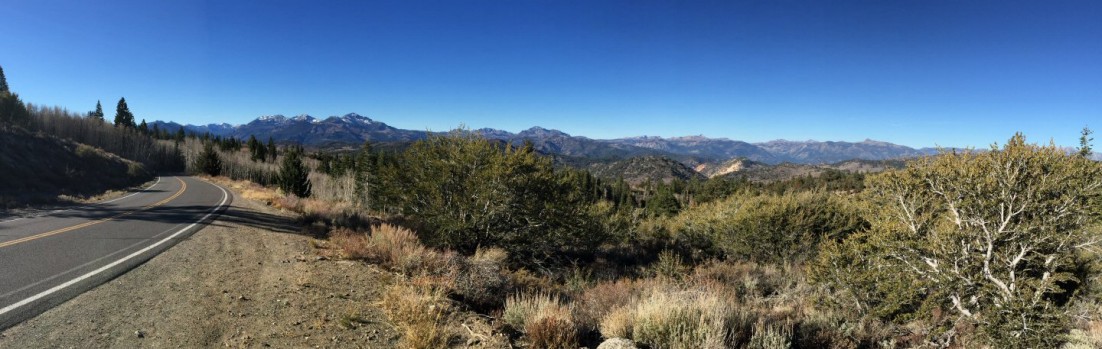
We made to R. Creek sometime after eight o’clock. It was one of those so-called ‘bluebird days’ of a California spring, when everything is still green. Just as expected and hoped, we were the only ones on the creek.
The water was running a bit high, but it still looked about as inviting as a small creek can be. A few casts in the usual spots suggested that like the fish, we’d have to adjust to the higher flow if there was to be any catching.
We headed upstream, testing each pocket, pool and riffle. Sean was nymphing. It was a dry/dropper combination for me; a size 20 Parachute Adams trailing a similarly sized Flashback Pheasant Tail.
A bit of strategic thinking is required when it comes to accessing this creek through thick stands of pine, oaks and streamside blackberry bushes. Felt-soled wading boots don’t help and my elbow can attest to the lack of traction afforded on a mat of pine needles and oak leaves.
Then I found it. That picture perfect bend, with a half sunken log offering shade and shelter to a small pod of trout. It was a deeper pool than usual on this creek, about three feet deep. My first cast revealed that depth wasn’t an issue when a six-inch rainbow rocketed from the depths to grab the Parachute Adams.
[singlepic id=1196 w=600 h=450 float=left]
R. Creek rainbow on a dry. Beauty!
Now, I’m still very much in touch with my inner caveman when it comes to fishing — I like to catch — and will use what works. But when a dry fly works, there truly is nothing like an aggressive take on the surface, regardless of the size of fish.
I had landed a beautiful ten incher and missed a few more strikes by the time Sean found me. We let the pool rest and ventured upstream. We would return later and we both hooked a couple of fish.
As happens with days during which the fishing and catching are good, time lost meaning and any argument to leave quickly fell away amid furtive glances to promising water. We decided to venture downstream into unexplored territory. Dismissed two years ago as a fool’s errand, it was clear we were mistaken. The shallow braided water soon regained the manner of a proper stream offering countless possibilities.
Sticking with the dry/dropper combo — it was too much fun to not try a dry — I found a long run of riffles that again offered the shelter of a fallen log. Shadows darted after my fly as it rushed downstream. There was no false casting here, just a quick whip to get the fly back upstream.
Sean and I would leapfrog one another as we explored further downstream. Sean would end up landing more fish, but I daresay that I was one who had the most fun. R. Creek is becoming a favorite place.
The general trout season opens tomorrow here in California and though I’ll likely be awake before sunup, it won’t be to beat the freezer-filling crowd to streamside.
Work’s got to get done if there’s any hope of having time to wet the line on any unfamiliar waters, and I’ll be helping a new group of students learn some of the ins and outs of fly fishing before heading for the hills in the afternoon. Perhaps more accurately, my casting will be an example of what not to do for these novice fly fishermen.
This is the fourth year that Opening Day has been more of a casual affair. Admittedly, I am itching to get out there with the fly rod; but it’s become a ritual not to be rushed, knowing that my son and I will likely be the only people on a small stream just far enough out a Forest Service road that most folks will give up and turn around about a mile short. Google Maps shows another creek a couple of miles further that just might be worth a try.
The maximization of our fishing time will include a few roadside spots as well, and on Monday, after the weekend warriors have left, we’ll slink down to some stocked waters trusting that we’ll be able to hook the dumb smart fish that didn’t fall victim to power bait or shiny objects.
If you’re out in the Sierra foothills this weekend, look for the guy with the funny cast. That’ll be me.
I’ll be on the road to the Sacramento edition of the International Sportsmen’s Exposition this morning and, according to forecasts, should be slogging through welcome but heavy rain. Don’t get too excited for me: it’s going to be a bit more like torture.
I’m leaving the checkbook and credit cards at home, carrying only enough cash for lunch.
I’m taking a cheaper simpler approach to the coming year that will be reflected in my fly fishing, though stopping short of tenkara. Last year didn’t go well, fishing wise, and changes on the job this year will bring incessant deadlines and blank pages in need of words. Anyone with a job today should be grateful, and I am, but it’s going to be tough to string together more than a few days off without risking some kind of pre- or post-vacation penalty. Big hopes for 2013 require planning. The fiscal reality is that dollars can stretch only so far. (Yes, I do feel some guilt that I won’t be helping a great deal to lift the fly fishing industry out of its apparent struggles, so it’ll be up to the rest of you this year.)
Much of the change this year can be blamed on my brother. Our conversations of late reminded me that what sticks with us most are the experiences of our life: riding our bikes as kids to the five ‘n dime or hiking the Sierra Nevada high country during family vacations. I don’t think we truly appreciated it at the time. The considerable value we now place on these experiences seemed to swell as our own children grew up.
So my visit to the ISE will be maddening, comprised of gear I won’t buy and guide trips I won’t take. There will be a visit with Derek Young, who I got to know as an unassuming and friendly guy before he was named 2011 Orvis Guide of the Year, some milling about various seminars, and likely encounters with other folks I’ve fished with.
My plans entail simplifying and diversifying. Much of my fishing will be refocused to waters near and not-too-far-from the family cabin in the Sierra foothills, something that’s long overdue. I’ll “make do” with gear I have and spend at least two long weekends there each month of the trout season. (My budget may allow for a very nice net handcrafted by a fly fishing club member and up for auction in April.)
It’ll be more about an exploration; a more mature approach in which satisfaction doesn’t hinge on numbers worth bragging about. There’s too much ground to cover in a single year, but the goal will be to cast flies to waters along the Highway 4 corridor, further up Highway 108, and on new stretches of the various forks of the Stanislaus River. All of those weekends should provide plenty of opportunity to spend more than a few days in the Walker River Basin; it’s only two hours away. There’s only one guide trip on the books (with Derek), and that may be the only one this year.
Dates have also been cleared on the cabin calendar for visits by my brother’s and sister’s families. And it’ll be darn nice if the wife — who recently rediscovered the detachment and contentment that can be found in the foothills — joins me more than a few times.
Diversification will mean revisiting diversions that aren’t enjoyed enough. Acting like tourists in our backyard, something started with our visit to Alcatraz last month. I’ll send the motorcycle seat out for a custom fitting more suited to longer rides. Rides that may or may not include fishing, and some that may include the wife.
You can chalk all of this up to wisdom gained with age, or — like me — simply decide to make the most with what you’ve got while you can.
By the time you read this it’ll be official. I’ll have ridden 10,000 miles on two wheels.
There are those who’ll say I was getting in front of a possible midlife crisis with the purchase of my first motorcycle just about four and a half years ago. I’d disagree. The idea of riding has bounced around my brain since riding a friend’s off-road bike, so long ago as a kid.
Like fly fishing, riding was one of those things that looked fun, but something I never truly could envision myself doing. And like fly fishing, choosing to ride any particular day influences planning, gear and even the pace.
To be clear, in both cases I favor a slower pace.
This pace was reflected in the process that led me to motorcycling, starting with a Motorcycle Safety Foundation class, just to see if I might possess the skills to ride and to determine — taking into account the possibility of dropping someone else’s motorcycle — whether it still offered the enjoyment I remembered from years ago.
I’d be remiss to not give credit to my wife, who works in the healthcare field and often used the term “donor-cycle,” for supporting my desire to at least try motorcycling. Even knowing that my dad had a decidedly unpleasant motorcycling accident that led to his not riding, I went ahead with registration for the class — with my oldest son joining me — with no particular plan to purchase a motorcycle. That’s not to say I didn’t have thoughts about something in the Honda CB series… Sean and I both passed the class with flying colors and by early December 2007 our driver’s licenses carried an M1 endorsement.
[singlepic id=297 w=368 h=275 float=center]
The first bike.
Though I had no immediate plan buy a motorcycle, the universe had something else in mind. Only four weeks after getting my M1 endorsement I became the owner of a venerable 1982 Honda CB650SC with about 8,000 miles on it. Now owned by my son, this vintage Nighthawk gently taught me the basics. It was a great starter bike; easy and fun to ride. It also taught me that two-wheeled transportation, while giving one a true appreciation for highway speeds, can make one feel more connected to the world. Maybe it’s the safety-conscious swiveling of my head, but I seem to see more when riding.
I definitely feel more when riding. My commute is about 30 miles one way on a state highway that passes through reclaimed marshland of the San Pablo Bay National Wildlife Refuge, farmland and by a cattle ranch, all the time skirting the upper edge of San Francisco Bay. (Technically it’s San Pablo Bay.) Despite protective riding gear, the microclimates are readily apparent. When the weather’s warmer, the water of the marshes retain enough heat to create a “banana belt” that makes my early morning ride more comfortable. But once I drop over a small ridge, heading closer to the coast, the air temperature invariably drops 5 to 10 degrees.
Two bikes, two fly rods, two reels and an extra gallon of gas.
It was sad to see that first bike go, but nice to know it’d still be in the family. Even more exciting was the fact that on July 24, 2009, I took possession of a motorcycle that through its production years (1992-2003) had been my favorite: the Honda CB750F/Nighthawk 750. Mine’s from ’97 and had less than 4,000 miles on it when purchased. It’s now fitted with a windscreen, luggage and risers. I like it and its average of nearly 50 mpg.
So here I am, 10,000 miles later. Yes, there have been two close calls, both due to inattentive drivers. (And yes, my wife knows about them.) I’m thankful that whomever is watching over me is doing so and I’ve learned to ride within my limits. I’ve come to grudgingly accept that the buffer I put between myself and the car in front of me is often instead seen by “cagers” (car drivers) as an opportunity.
Those who know me know I take care of my vehicles. But the motorcycle is unlike the cars. Once and a while I find myself simply staring at the motorcycle, an old-school symbol of freedom, still not fully believing I own and regularly ride one.
Teaching fly fishing requires enthusiasm. Teaching it well requires a bit more. A little curiosity helps.
It was my brother who provided the curiosity. Not openly, but in that tone of voice we’ve all heard before.
We were discussing ideas for his first visit to California in eight years and our trip to, up and over the Sierra Nevadas. “I’d be willing to try fly fishing if you have some gear I could use,” he said over the phone.
I’d thought plenty about offering such an opportunity but hadn’t mentioned it. Everyone has a story about how they were introduced to the sport. Mine surely isn’t unique, but it did imbue me with a belief that a curious mind opens the door to the best first fly fishing experience.
Along with the gear, I’d bring considerable enthusiasm. (It’d help to understand that my sister’s family has given me the nickname of “The Herring Merchant.”*)
That’s how Mark, Sean and I found ourselves on “Hatchery Creek,” not too far away from the cabin, just as sunlight touched the top of the hills. With borrowed waders, boots and a wading staff but minus an overloaded vest, Mark looked just about as silly as I. (It’s a tenant of fly fishing that fish don’t care how one looks.)
[singlepic id=1188 w=325 h=244 float=center]
Mark on a fish.
This creek tucks against a hillside and, controlled by a powerhouse, is nearly always fishable regardless of spring runoff. Though near a main highway, it’s sheltered by heavily treed banks, and — except for the occasional burps of a Jake brake — the outside world is easily left behind. Though the outcome of our day had yet to be determined, the absence of other fisherman was a welcome sign.
After gearing up and giving a primer on the creek, I led Mark toward one of my favorite runs. It’s the same piece of water on which I educated both sons as to the nuances of hydrology. On the surface it looks fast, and most would call it too fast for fish. The most obvious (and dependable) spot for trout here is near the far bank, where the water’s velocity is slowed by friction. Perhaps because of constant shadows and the lack of light, it’s difficult to see the nearer telltale seams that suggest hidden trout. As both sons learned years ago, a little bit of patience and a passable drift in the proper location will surprise you. It’s also a great spot to swing a fly at the end of the drift.
We were rigged up with nymphs under an indicator. It was too early for dry flies, and to my knowledge this creek is devoid of any real insect hatches, with only occasional dry fly takes in the afternoon.
There’s nothing more conducive to learning than doing, and my strategy was simple: talk, walk, fish and hope that Mark would get into at least one fish while doing so. I would take on the role of guide. I’d assemble leaders, tie knots and select flies. It would be Mark’s “job” to focus on hooking and landing a fish.
It Ain’t Pretty, But Works
For those who haven’t fly fished, casting nymphs (often heavier, underwater flies) with an indicator (yeah, like a bobber) is an inelegant affair. In this case it was more of a lobbing action. After a bit of discussion about this technique and a quick demonstration, Mark made his first casts. Occasionally I’d offer a bit of advice. The suggestion of a casting target that’d offer a better drift into a good trout lie. A recommendation to keep a tight line between the rod to the indicator, then a gentle admonishment to keep an eye on the indictor for any movement that didn’t seem “normal.” A description of the slight lift the rod should be given at the end of every drift.
It was that last piece of advice that gave Mark his first surprise. He’d made a good drift with no takers. Toward the end of the run, the rod tip was raised, the movement of the indicator slowed, and the flies below rose toward the water’s surface, as an emerging insect might do.
That’s how Mark hooked his first trout on a fly rod. Just as quickly as it was on, it was off.
It didn’t matter that we didn’t land that fish. It’s the confidence and faith that washed over Mark’s face that mattered. His big brother wasn’t just blowing smoke. An unseen fish had risen to take a fly presented just as he had advised. Without any encouragement from me, the training wheels were off.
Heading upstream, Mark stopped at a suspect pool while I ventured toward a stretch where riffles tumbled into a long, deep run that abutted a boulder, which in turn created a pool that offered a long tailout. Sean had fished the area earlier, but had since headed downstream.
When Mark moved to the pool behind that boulder, just below me, I futilely tried to keep an eye on my indicator as well as Mark’s. I needn’t have. Before I knew it Mark had set the hook. Encouraging him to keep the rod tip up, a bend in the rod and to allow the fish to tired ever so slightly, I dropped set aside my rod, grabbed my net, and headed downstream.
Mark was broadly smiling as the rod tipped danced. Not an acrobatic fish, it splashed enough to put on a bit of a show. Soon Mark turned its head and we had a decent trout in the net.
[singlepic id=1189 w=480 h=640 float=center]
Mark and his first fly rod fish.
Mark waded over for the obligatory fish photo. Excitement shifted to quiet contemplation. We talked of wetting hands before handing trout, the ease of removing a barbless hook, and keeping the fish in the water until all were ready for the photo. Photo taken, we let it rest in the net. It was a remarkably clean, deep bellied and heavily dotted hatchery rainbow trout measuring an honest 13 inches; a admirable first fly rod fish.
It quickly recovered and, as discussed, Mark softly cradled the trout as I lowered the lip of the net. Often, it seems to me that time slows in the minute or so before a trout finally swings its tail and darts for the familiar safety of deeper water. I never asked Mark if he felt that same sensation, but the look on his face confirmed that he had discovered the magic of catch and release fishing.
The Lesson Learned
At that moment I got it. A curtain parted ever so slightly, giving me privileged insight into why fly fishing guides, those who truly enjoy what they do, do what they do.
More could be written about that day. About the other fish that Mark stalked, hooked and landed, and his amazement that he could do so while hardware and bait fishermen struggled for even a single fish. About Mark’s discovery of trout in places he previously might have dismissed as holding fish. About a simple enjoyment in finding that sharing of one’s love of fly fishing can spark the beginnings of such a passion in another.
But looking above, there’s not much else to worth writing about Mark’s first fly fishing experience and how it rekindled in me renewed appreciation for the little things, beyond the fishing, that bring such joy to the sport.
[In the movie “Love and Death”] Boris is in love with Sonja, but she is unhappily married to Voskovec the Herring Merchant (“his mentality,” she complains, “has reduced all the beauty of the world to a small pickled fish“). She takes lovers. (“She takes uppers?” Boris repeats, incredulous, when he hears this news). Voskovec, preparing his pistols to fight a duel in defence of his wife’s honour, accidentally shoots himself. Sonja goes to his deathbed in the company of a couple of doctors. In what is, I think, my favourite exchange in all film, Sonja talks to the expiring man…Here’s the tender deathbed scene:
SONJA: You were a kind and loving husband. Generous and always considerate. (To doctors) What’s he got? About eight minutes?
DOCTOR: (consulting his watch) I think I’m slow. He’s got about three.
VOSKOVEC: Swimming out! Swimming out to the open sea like the great … wild … herring! [Dies]
(You can find more photos here under “The Brother’s Visit – Tuolumne Meadows, Eastern Sierra, First Time Fly Fishing”.)
I’ve no way of checking, but I’m pretty sure hell’s frozen over.
After eight years since his last appearance in the Golden State, my brother showed up with no specific plans. That’s where I stepped in as travel agent, outfitter and guide; apparently a role that suits me better than might be expected.
Lembert Dome viewed from the Tuolumne Meadows Campground, and where we'd be going.
A visit to the cabin is akin to establishing a base camp. In our case, a base camp stocked with beef jerky, beer and an XBox. One might be inclined to think it was something like a “man cave,” but there’s an irony to my brother and I spending quality man time together. Those who’ve been in the proximity when we get together know that we quickly prove the adage that you can’t take the boy out of the man.
Mark lives in the Evergraygreen state and while he said he’d enjoy seeing California family members, it became clear that he perhaps more happy to see the sun. I swung by the airport to him pick up Wednesday evening and we met up with my oldest son, Sean, at the Bass Pro Shop in Manteca. We secured a two-day nonresident fishing license, grabbed dinner and headed up the hill.
Weather-wise, we’d hit it right. Temperatures had peaked that day and would be still warm but slightly lower the next few days, meaning it would cool off at night; something important for a good night’s sleep in a cabin that has no insulation and no air conditioning.
Before Mark or Sean posts a comment below, I will admit that I was adamant that I would I had expected to wake up and hit the road for Tuolumne Meadows early the next morning. I did wake up at 5:00 a.m. But I rolled over and caught a few more winks.
Mark had asked if we might be able to hike up Lembert Dome. He and I had done so back when we were boys, with my sister and dad. It’s a pretty easy drive from the cabin to Tuolumne Meadows, just about 2½ hours. Since Tioga Pass had opened the week before, we would circle our way back over Sonora Pass.
Mark's friend, the Marmot, at Olmstead Point.
It’s been said many times before, but the blue of the sky is remarkable at higher altitudes, and we weren’t disappointed. With only a few clouds in the sky, we passed through the entrance station and soon arrived at Olmstead Point. Reinforcing that he boy stills lives within the man, Mark was all about seeing and getting photos of the marmots of our childhood at Olmstead. A few marmots obliged.
We next stopped at the Tuolumne Meadows Campground, where we spent many a family vacation camping. Sure, some things have changed — mostly manmade things — but nearly everything was recognizable and Mark and I soon agreed upon the location of “our” campsite, partially based on its position relative to the Tuolumne River, which itself was nearly unrecognizably high. I’m sure Sean was somewhat amused by our reminiscing.
Just down the road we pulled into the parking lot at the Lembert Dome trailhead and loaded up. The trail begins with a modest incline, but starting at about 8,600 feet and rising another 800 feet to the dome’s summit, it was soon clear that our lungs would get the kind of workout not seen in years. The gradient seemed to increase every 100 feet, and even if we were on the trail (we weren’t), it would be covered by extensive snow fields that made the hiking more difficult. At one point, Mark fell through the snow into a waist-high air pocket. Undaunted but pausing more often that we’d care to admit to catch our breath, we pressed on. I’m sure it took a lot of patience for Sean to not charge ahead. (I don’t think he broke a sweat or even breathed hard.)
It’s said that the memory grows hazy over time and Mark and I didn’t remember the last stretch up the back of Lembert Dome being so steep or requiring so much climbing. But climb we did, reaching the top. The view was made a tad more incredible by the fact that we had it to ourselves.
Me, Mark & Sean a the top of Lembert Dome. (After Mark and I rested for half an hour just a few minutes.)
It was hoped that we’d also find some water to fish. Without much browbeating Mark had asked if he might get a chance to try fly fishing, and I had plenty of gear he could use. We rigged up and flogged the no-so-high-but-higher-than-usual Lee Vining Creek. It was tough going. I was the only one to get two strikes, but missed both fish.
We refueled our egos with some good barbecue at Bodie Mike’s, then headed north to Bridgeport, and I pointed out all of the water that we might have fished. Every single river was the color Yoo-Hoo.
Traveling creates memories, and traversing the Sierra Nevada Mountains can make for some of the most vivid memories. Then there are other things that one doesn’t soon forget.
Our return to the cabin meant a few preparations for the next day, when we’d get out on “Hatchery Creek,” hoping to get Mark into his first trout on a fly rod. Mark looked to verify that his fish license was in his wallet. It was. His driver’s license wasn’t. He searched through my car. Sean looked through his car. I looked around the cabin. Mark began to go through his suitcase. After thinking about it a bit, I called Bass Pro Shop. The customer service rep went through the lost and found, looking for a Washington license with the appropriate name and a goofy looking photo.
Soon we were making the 1½-hour drive back to Manteca. Only a few miles went by without Sean or I reminding Mark of his snafu.
There was an upside to this. We enjoyed a manly dinner at the House of Beef.
Back at the cabin, assurances were made that I’d not linger in bed the next morning as there’d be fish to catch. And I did not.
But Mark’s First Fly Fishing Experience is a story unto itself, and for next week.
(You can find more photos here under “The Brother’s Visit – Tuolumne Meadows, Eastern Sierra, First Time Fly Fishing”.)
A marmot at Olmstead Point, a stop on our way to Tuolumne Meadows, and a hike that would require the full use of our lungs.
Looking at our Target - Lembert Dome - from Tuolumne Meadows Campground, over the very swollen Tuolumne River. The hike is 1.5 miles with an 800-foot elevation gain.
Mark and Sean on the last stretch up the back of Lembert Dome.
The view from Lembert Dome, looking out over Tuolumne Meadows.
Mark's first experience fly fishing...obviously it went well.
I didn’t know it then, but that confidence mentioned in words written about a week ago would be tested on the first full day of Trout Season 2011, even if high water narrowed our possible venue down to two or three choices where we knew the fish should be willing to play. At least that’s what we thought.
Sean's hands make this nicely colored rainbow from Angels Creek seem smaller than it actually is. At least that's what he says...
There’s a balance that comes with fishing the week after Opening Day. The fact that most of the water known to hold trout was given a rude awakening on Opening Day is offset by wide-open access. So, although I’m not one to linger long after opening my eyes in the morning, this morning there was no frantic rush to get out the door.
The night before we had decided to head to “Hatchery Creek.” While well stocked with rainbows (and occasionally brook trout), it also can offer kokanee in the spring and a few elusive browns in the fall. We had been warned, however, about the aforementioned grumbling on Opening Day from anglers who couldn’t find the fish maintained that DFG had cut back on its stocking.
The easy accessibility of this creek — as well as the everyday responsibilities of life — quickly fades as we descend the banks of this creek. No matter the origin of these trout, soon they would occupy all our thoughts and become our obsession for most of the day.
The creek, actually more a short tailwater before it dumps into a lake, is high. Maybe higher than I’ve ever seen it, and it takes more than a moment or two to identify familiar landmarks. Sean and I wonder out loud if high flows during the winter had scoured the creek. Together we remember a productive pool that two years ago was shaded by a now absent tree. A few of the old channels seem to have disappeared; new channels slowly reveal themselves. It’s hard to tell, but even a few boulders seem to occupy new positions.
With more of a series of grunts than conversation, it’s agreed that I’ll head slightly downstream to a long, fast, shallow run that’s always been good to me. The current here is too fast for dry flies. Nymphs work well, but most of the fun starts on the swing. It’s the first place I threw out a wet fly, and the first place that a trout took that soft hackle wet fly, one I had tied with a sparse blue-thread body and partridge hackle. After a few casts, the fish reveal themselves. It’s a cookie-cutter rainbow, but a welcome sign that all’s once again good with the world, at least in this brief moment in my part of the world.
Sean wandered upstream to another run, where water tumbled over rocks into a deeper run that ends in front of a boulder. It’s one of those hot spots favored by trout and deep enough to require at least one heavier fly.
After half an hour or so and three trout to the net and about the same for Sean, I ventured upstream, peering into pools and undercuts where I’d usually be able to sight fish. Seeing no fish sign, I checked in with Sean and headed downstream again. Going farther downstream requires care. Trees hug the banks and blackberry bushes are so prolific that thorny, tippet snatching blackberry vines hang overhead. There’s no overhead casting here. Line management is limited to side-arm casts, lobbing or simply dropping flies and letting the current take them to the fishy spots.
There’s one very fishy spot that requires that last tactic. Water bubbles over a creek-wide riffle before dropping into a wide area marked by granite boulders big enough to disrupt the current and create a pocket, a holding lie, for trout, yet small enough to allow the nearby current to flow fast enough, delivering bugs to waiting fish.
I dropped my flies — a size 18 AP Nymph and a size 22 glass bead chironomid pattern — just below the riffle. One drift, a second, then a third.
I’ve found that occasionally a subtle pause, perhaps no more than a second, perhaps a bit longer, can suggest that there’s a larger fish is at the end of the line. This was one of those times. I set the hook. My line paused. It vibrated faintly in the current. Then it was out of the pocket, through the riffles and around an upstream boulder faster than I could follow. But I would never see the fish. The same could be said for my home-tied fly.
The rest of the day, Sean and I would explore the lower reaches of this creek, finding a pool where, he’d been told, trout can often be found. We did find fish there.
This creek widens and gains speed closer to its mouth, reminding me more of a freestone river in the Eastern Sierra. Nice brown trout water, except it’s not home to many browns. There was fishing along the way but no more catching.
I can’t say whether it was the exertion of hiking, the full day of fishing or just plain thirst, but the dinner and the beer that came with it that night tasted awfully good.
Met with a lack of success in finding frog balls during my Opening Day fly fishing trip, I was back at the cabin this past weekend, this time with The Wife, hoping to track down the elusive and delectable pickled morsels.
[singlepic id=1098 w=300 h=452 float=center]
Who said frogs have no style?
We first found these little globes of goodness a couple of years ago at a wine tasting room in the Sierra Nevada foothills. That’s how we found ourselves near the little town of Angels Camp. Perhaps you know it better as “…the ancient mining camp of Angel’s,” or as the setting for “The Celebrated Jumping Frog of Calaveras County.”
What better place or time to find frog balls than at the Calaveras County Fair & Jumping Frog Jubilee?
The Calaveras County Fair is a relatively small affair, condensed into a few buildings, with the obligatory display of hit-and-miss engines powering pumps. One powered an old wash tub. Filling space in one of the buildings was the regular complement of vendors hawking their goods, some unique, some tasty and a few suspiciously smacking of snake oil. Other buildings housed the winning entries in horticulture, art and photography, as well as a display of locally produced wines. Our visit was flavored by the requisite fair food: corn dogs and cotton candy.
Most surprising was the entertainment value of the jumping frog competition. Since 1928, and inspired by Mark Twain’s story, frog jumping is a serious sport in Angels Camp. After all, there are rules:
Frog Requirements
1. Must be at least four inches (4”) from nose to tail.
2. Must begin jump with all four (4) feet, including toes, on the eight inch (8”) launch pad.
3. No substitutions.
4. Evidence of jumping the same frog twice will result in disqualification and forfeiture of prizes.
Jump Measuring
1. The distance will be measured on the third jump in a straight line from the center of the pad to the tail of the frog. A walk or skip is counted as a jump.
2. If a frog jumps into the Jockey or the Jockey’s equipment, the frog will be disqualified.
3. If a frog jumps into other people or other people’s equipment on the stage, the Jockey may allow a re-jump or take the mark.
4. During the jump only the person jockeying the frog may move ahead of the launching pad.
5. Frog catchers shall be on the right– or left-hand corners of the stage and cannot move until the frog has finished jumping.
6. The jump must occur within one (1) minute from start to finish. A one-minute clock will start when the Announcer announces the Jockey’s name. If the jump is not completed within one (1) minute the horn will sound and the frog will be disqualified.
7. Touching the frog after it leaves the pad is cause for immediate disqualification.
8. All marks are final. Any interference by a participant or team member may be cause for disqualification.”
[singlepic id=1089 w=300 h=199 float=center]
Fun with frogs.
An amusing kids’ competition is held to the side of the main stage, with all kids encouraged to kiss their frogs for good luck. Most precious was the look on the younger kids’ faces when their frogs took flight.
On the main stage, however, the competition was serious. Veteran “frog jockeys” competed alongside youngsters. Organized teams competed for top honors, including a trophy at least three feet tall and cash prize of $750. A frog that beats the world record of 21’ 5¾” can earn $5,000 worth of greenbacks for the jockey.
We ended up spending more time than expected watching folks flail their arms, hoot, holler and jump in an effort to motive their amphibian friends. (Not to worry, these athlete frogs, after just about 30 seconds of competitive effort, are pampered at a frog spa under the main stage.)
This year’s winner was a frog named “4Peat,” jockeyed by Michael Wright of Team Bozos. 4Peat’s three jumps totaled 19′ 1”.
With his impression of the the "running man," this frog gained inches fast.
[singlepic id=1097 w=600 h=399 float=center]
This frog showed style...or just showed off...with a mid-air pirouette.
Alas, we were not to find frog balls. Not at the fair, not in local stores. It seems that the purveyor of these spherical snacks pushed prices a bit too high for the retailers we talked with. It was still a good time.
[nggallery id=79]
*No, they’re not real frog balls. They’re pickled Brussels sprouts. The story goes that the man who would make these delicious orbs needed a name for his product. His little sister, when served the vegetable at about six years old, decided that the odd green things on her dinner plate were green like a frog and round like a meatball, thus “frog balls.”


 fishing for words