
Recent picture of the plowing efforts to open Tioga Pass Road, near Summit Meadow, on the Yosemite Valley side. Counting the days until I can take a weekend Sonora Pass/Tioga Pass Fishing drive, or ride.
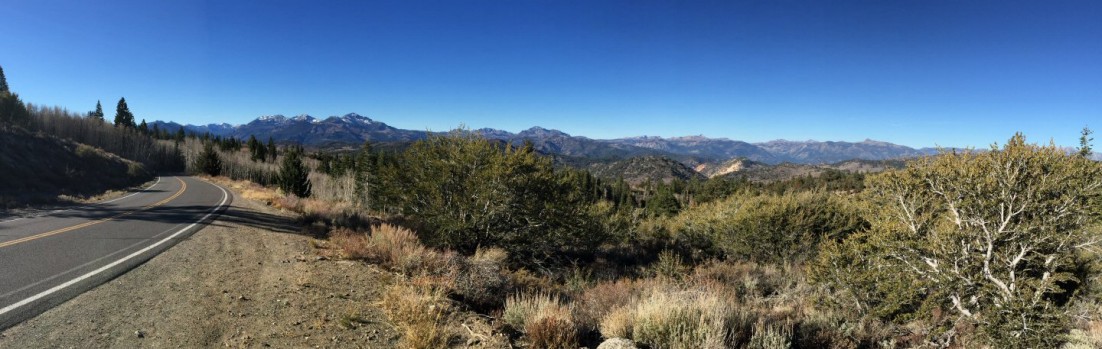
Recent picture of the plowing efforts to open Tioga Pass Road, near Summit Meadow, on the Yosemite Valley side. Counting the days until I can take a weekend Sonora Pass/Tioga Pass Fishing drive, or ride.
Each Opening Day Weekend — with or without company — I charge into the Sierra Foothills in pursuit of the first trout of the season. This year Older Son Sean accompanied me.
Sean left earlier than I could Opening Day — I had a commitment — and he had some luck flogging a few spots before my arrival. We met up at The Cabin late in the afternoon. Sean brimmed with confidence that this would be the year he outfishes dad. The refrigerator was stocked with beer and the pantry with basic staples and, with daylight waning, we opted to warm up on the surprisingly trout-friendly irrigation canal behind town.
Opening Day brings nearly half the town to the canal, knowing that sometime during the prior week, days or hours, that the state DFG hatchery truck will have dropped a load of pan-sized rainbows into the water. I’ve seen everything brought to bear on the canal — the ubiquitous baits of questionable manmade formulations, bass lures, even 10 foot saltwater rods — with the results being full stringers, as well as the seemingly inevitable string of injured, dead, or dying stocked rainbows. (Wild or not, wasteful in my book.)
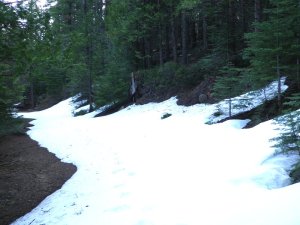
Snow along the way, in late April.
The first full day began with a five a.m. departure. This year it meant driving east on Hwy 108 during at dawn. Not surprisingly, remnants of dirty snow appeared at approximately 4,500 feet and drifts defined the snowplow’s reach after 5,000 feet. Most summers I will end up driving this route at least six times. Sometimes to destinations before the summit; other times to traverse Sonora Pass as I make tracks for the East Slope of the Sierras. So, knowing full well (and happily) that Old Man Winter laid down a healthy snowpack, we set out Sunday morning to reach the Promised Water, the Clarks Fork of the Stanislaus River, which is littered with boulders and sprinkled with wild trout and their domesticated brethren.
Outside the car windows the air was crisp and cold, and snow began to dominate the landscape. That should have been our warning. Apparently the road to Clarks Fork doesn’t warrant the same attention as the highway when it comes to snow removal. Disappointment was tamed somewhat by the acknowledgement that we were taking risk this time around by checking on waters never before visited this early in the season.
The next attempt to reach unvisited water— Sand Bar Flat and Spring Gap on the Middle Fork of the Stanislaus River — was prevented by (1) lack of signage and (2) lack of a Stanislaus National Forest map. Fishing near Spring Gap can legitimately be called epic: a few years ago Christopher and I stumbled upon it late in the afternoon; late enough that we had about two hours of fishing, but those two hours yielded some beautiful wild rainbows. But Sean and I weren’t getting there this year.
Apparently gluttons for the punishment doled out by Forest Service roads, we threw caution to the wind to set the GPS for Wild Trout Stream X. It’s been mentioned here before as a location revealed in confidence by two old and grizzled fishermen who appreciated the fact that Sean and I were fly fishing and practicing catch and release. We had visited the stream in the off season, when flows were about half of what we’d find, and saw a good number of dark shadows that presaged good times. It’s about ten miles from pavement, on roads littered with potholes (and mud at this time of year) winding through dry pine forests, by meadows and over one river and a few creeks. Sean claims that no matter which direction we were headed that the potholes seems to line up on his side. It certainly wasn’t my driving.
Was the long, 20-miles-per-hour drive worth it? You betchya.
Smaller streams are always a great excuse to get out my smaller 3 wt. rod, so while I was getting that ready Sean nearly ran to a pool downstream of an old-school stone bridge. You’d have to ask him, but I would swear that it wasn’t more than one drift before I heard an exclamation affirming a hook up. Sure enough, a small wild rainbow was the first of many rewards for the torturous ride in.
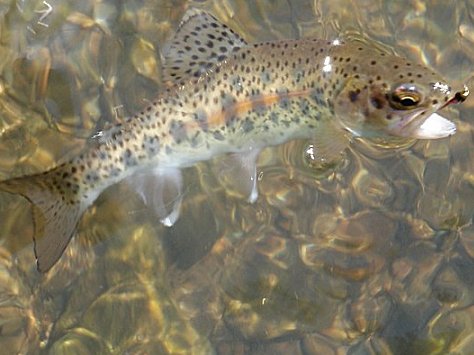
What I call a Trophy – a wild rainbow in Stream X.
I’m always amazed to find trout in streams like this one. It was rarely more than six feet across and more than two feet deep. Its crystal-clear water danced over the rocks, creating riffles and small plunge pools. Short stretches offered a riffle-pool-tailout configuration in miniature.
This small stream made the day. There’s nothing like wild fish. Particularly in light of The Unaccomplished Angler‘s “Adages as Pertaining to Smallish (Wild) Fish”:
While I hear that Mr. Unaccomplished is good in the small hands department, it’s not so true for me. We’re in agreement on everything else.
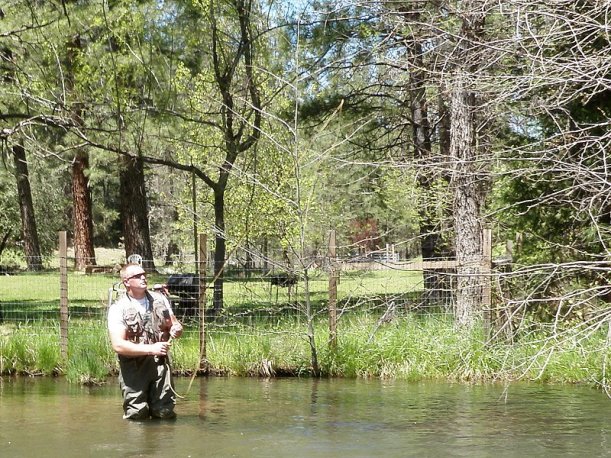
Sean on a fish.
And the wild fish at Stream X were h-u-n-g-r-y. We were casting a dry/dropper rig (a dry fly with a dropper, i.e. a subsurface nymph imitation) and these little guys chased both flies with abandon. Even the dry fly, despite it being a size 12 stimulator in my case. (The dropper was a size 18/20 Copper John.) As a relatively new fly fisherman who cut his teeth on nymphing as a nearly surefire way to dredge up trout, the last two years I’ve gained a greater understanding for the pure joy of presenting a dry fly in a manner adequate enough to elicit a strike.
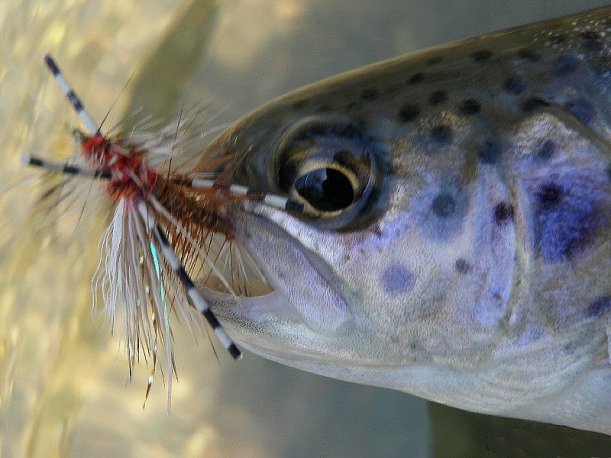
Rubber-legged stimulatior doing the job.
Steam X also offered plenty of dry fly fun. Sean spent much of his time at the downstream pool, while employed my shorter rod in dappling various riffles and plunge pools as I made my way upstream. Disappointment was rare. Fish would rise out of bubbles of plunging water to inhale the rubber-legged stimulator. Others in riffles would pounce on the dropper at the last minute, just as it began to drift toward the water’s surface on the swing. Nearly four hours flew by. We capped the day with a great buffalo burger at the well-known Diamondback Grill in downtown Sonora.
Monday would mark Sean’s last day of the trip and a responsible but unfortunate decision to leave a bit early to make it to class. His original plan was to skip class to spend a bit more time on what I’ll call Hatchery Creek. (More on why later.) We were on the water just after sunrise, but with the water temperature at 50°F, there was no love that morning. Two hours or so later, Sean made his fateful decision. As for me, perhaps I’m too stubborn. Sometimes stubbornness pays off.
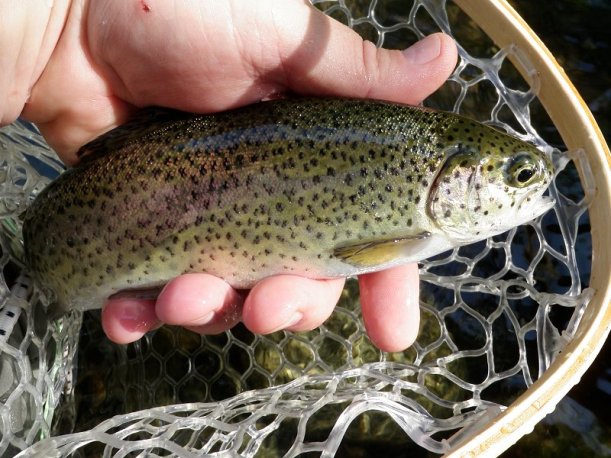
Hatchery fish, Opening Day 2010.
Mid morning, with sun dappling the water and the air temperature rising enough so that I could no longer see my breath, bugs began to hatch. A few small mayflies darted here and there. Then the bite was on. During the next two hours I would hook fourteen fish and bring ten to the net. (I’ll attribute the hooked/landed ratio to the fact that size matter that morning…nothing larger than size 18 got their attention.) Every fish was a cookie cutter stocker, ranging from ten to twelve inches. I’ll give ‘em credit, every single one of these fish put on a good show, either jumping multiple times or offering me a challenge by sounding for the bottom. I stuck around through the afternoon, trying to land that last fish. It never came. The evening entailed cleaning The Cabin and packing most of the gear.
The last bit of fishing for this trip came when the last load of laundry was in the dryer. I made the short drive to The Canal and casually walked upstream with drifting a couple of nymphs through likely locations, particularly the undercut bank just underfoot. Things looked good after the second case, when a colorful, ten-inch brown absolutely nailed the lower fly, a Copper John. During the 30-minute walk up to flume I picked up two more trout, both brownies. Below the flume, where the force of the water create a pool full of eddies, another five fish came to hand. (I missed two hooksets as well.)
Overall it was a great Opening Day trip. The catching wasn’t red hot as it’s been during previous Opening Days. Stream X, however, offered the highlight of the trip, the kind of fishing memory that will grow grander with each telling. But don’t ask for the GPS coordinates. You’ll only get there if I take you there. Blindfolded. Probably in the trunk.


By now you know that the Older Son and I are likely having a heck of a time. We’re headquartered at the cabin, fishing a few rivers and small streams for trout. Maybe even tainting our lines to chase bluegill and bass in a nearby pond.
During the fishing there will be manly bonding that can only come over fierce friendly competition; competition that likely will be won by guile and cunning rather than youth and strength. In between fishing there will be a visit to our favorite hamburger place. Thankfully, forecasts portend fantastic spring weather. Yeah, a heck of a time.
I can feel your sympathy.
Without a decent laptop, much less a reliable connection to the interwebs, any updates will erratic or nonexistent. In the debate of fishing vs. blogging, well, you can guess the loser.
More words — and taunting — to come. Just can’t say when.
Stepping up to the plate to help educate novice fly fishers tomorrow morning in the basic skills needed to play and land a fish means shoving aside the desire to fling a fly at oh-dark-thirty on Opening Day of Trout Season 2010. (The offer of a free lunch had something nothing to do with volunteering.)
Unfortunately, there’s 125 miles between the classroom and suitable trout water, which means — without too much traffic — I won’t put a fly in or on the water until sometime after 4:00 p.m. That’s not necessarily a bad thing. That magical twilight hour can mean good times on a few of the rivers and streams on my list.
The plan’s a bit in flux until Saturday morning, when older son Sean will decide on his departure hour and whether he’ll stop at the Bass Pro Shops store in Manteca…and how much time and money he might spend there. (Thankfully, he doesn’t have to worry about a wife discovering that Bass Pro offers something for everyone.) His timing will determine on which water will begin his annual attempt to out fish the old man.

A portion of our arsenal.
It’s certain that we’ll mix it up a bit this year. Water flows will dictate whether of not we visit the Clark Fork of the Stanislaus River. The regular, local spots are also on our list. So is Brook Trout Stream X, a small trickle of a creek discovered last year thanks to two local retiree/fishermen, who gave specific instructions to ‘…go down that there road ten miles and you’ll find it.’ No mention that nine of the ten miles would be Forest Service road. We’re hoping that after a long winter that these wild brookies might be a tad hungry enough to be fooled by adequately presented dry flies.
We’ll have the new waterproof camera with us, hoping it’ll be baptized photographing some decent fish.
Our days are about to flash by at a more frenzied pace, but there are fish in our future and more than a few waters — a well-known lake in Northern California, a Washington river, and untold Sierra rivers and streams — in which we’ll wet our fly lines for the first time. We’ll reacquaint ourselves with familiar waters along the way. Then there’s the long-planned Tioga-to-Sonora Pass Motorcycle Fly Fishing Tour.
We’re packed and ready to go.
An ASVAB score pointing to Army MOS Field 92 foretold of our penchant for long-range planning. That same long-range planning fuels fly tying and anticipation of the coming trout fishing season. What’s slowly becoming an annual effort of logistics planning and matériel acquisition is underway.
We’re warming up. Figuratively and literally. Spring’s officially around the corner.
Mid-March marks the beginning of the end of winter and sounds the four-week warning bell for The Club’s annual auction, where we’ll donate cold hard cash in exchange for not necessarily warm or soft flies.
And fishing plans are being hatched.
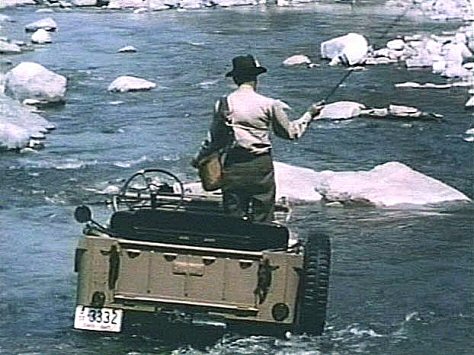
Long before the felt vs. rubber-soled wading shoe debate.
Heck, long before any environmental concerns.
It all begins the last weekend of April.
We’ll be out the gates Opening Weekend with a quick three days of fishing Sierra west-slope streams and rivers in the hope that they’ve suitably recuperated over the winter. The oldest son might join me, though it’s hard to tell if it’s the fishing he’s after or a buffalo burger at Diamondback Grill. Regardless, we’ll be going where the fish are and cell phones hopefully don’t work. And once the trout season opens, the rush will be on to squeeze in fishing weekends as we can.
Next stop: the Upper Sacramento. This late June trip with The Club will incorporate “bugology” and on-the-water education. This’ll be yours truly’s first visit to this much talked-about far nothern stretch of the “Nile of the West,” fulfilling the self-made promise to try at least one new trout water each year.
But wait. There’s more.
The visit to the Upper Sac will be immediately followed by two days of guided fishing on Eagle Lake. The excuse is that we’ll be in the neighborhood. Mostly. The truth is that Eagle Lake is on the all-too-long bucket list. Best to start early whittling down that list.
The midsummer plan is to hit up the folks who raised us for lodging and grub, then chase Puget Sound salmon with the bro’, pa and few of their friends. It’ll be a quick trip…one of a length that now appears too short since dad’s stepped up to join us for a float on the Yakima and there’s a possibility of getting onto some local water, backed by the local knowledge of fellow fly fisher who’s offered whatever tidbits he might grudgingly share in exchange for a pint or a lunch or a dinner.
The year’s shaping up to be a windfall of new waters. Four new venues in just as many months. The months that follow will offer the comfort of the familiar.
Nothing’s set in stone for the dog days of summer, but history hints at a few weekend stays at The Cabin, punctuated by high-speed runs leisurely drives over Sonora Pass to wet the line in one or more waters: the rivers Walker (East, West and Little), Lee Vining Creek, Saddlebag Creek, and the Lyell and/or Dana forks of the Tuolumne.
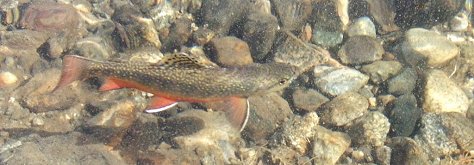
Favorite late fall target: High Sierra brook trout.
We’ll officially mark the start of fall with a three-day stay at Tom’s Place Resort with perhaps a dozen club members spreading out to their favorite (lower) Eastern Sierra Waters. From sunrise to sunset we’ll be educating trout and testing home-tied flies on Rock Creek and Crowley Lake, with stops at Hot Creek and the Upper Owens and East Walker rivers. Dusk to dawn will mean home-cooked meals, homemade beer and sleep, in that order.
That’s where specific plans end. Rest assured, the looming closure of the season will bring renewed and somewhat frenetic energy. Energy for quick weekend trips, again headquartered at The Cabin, with day trips here and there.
Trying to live the life of a gentleman fly fisherman is tough. But I’m trying my best.
The hard times faces by many rural California communities
might just get harder if the Pacific Rivers Council and Center for Biological Diversity (CBD) deem Homo sapiens, like trout, to be an introduced species in high Sierra watersheds.
Four years after filing a lawsuit centered on the idea that stocked hatchery trout and salmon have ‘deeply hurt’ native trout, salmon and amphibians, in a press release issued today the CBD unsurprisingly judges the California Department of Fish & Game’s final environmental impact report (EIR) to be a failure. But reading the naturally strongly worded press release — and without wading through the legalese of the original lawsuit filing — it seems that the CBD’s goals seems nigh unreachable.
In response to lawsuits brought by the Center for Biological Diversity and Pacific Rivers Council, the California Department of Fish and Game has released a final environmental impact report analyzing the impacts of stocking of hatchery trout and salmon on native species, including native trout and salmon and amphibians deeply hurt by a century of planting of millions of hatchery fish.
An EIR going back 100 years? We’re all for protecting the environment, but isn’t that reaching a bit much?
The CBD’s approach as perpetuates the piecemeal attempts to save salmon citing a federal study then blowing past the comment about habit quality to focus on hatchery fish.
One federal study concluded that the “longstanding and ongoing degradation of freshwater and estuarine habitats and the subsequent heavy reliance on hatchery production were also likely contributors to the collapse” of salmon stocks. The state’s new report does not propose any specific mitigations to address the impacts of hatchery fish on native salmon stocks.
For catch and release fisherman, the original concept of the lawsuit could have been interpreted as a way to protect wild trout populations from their hatchery cousins. And while the yellow legged treefrog was the poster amphibian for the CBD lawsuit, the lawsuit encompasses 36 ‘imperiled’ species in 47 streams, rivers and lakes. It’s not hard to remember the last time a fisherman bragged about that unarmored threespine stickleback or hard head minnow. It didn’t.
The pullback in DFG stocking could easily amplify the current economic slump in communities that have benefited from stocking. It’s ironic that on the same day of the CBD published its press release that Alpine County’s Markleeville was used as an example in the aforementioned San Francisco Chronicle article regarding the economic reality in rural California communities.
Markleeville is a jumping off point for a good many fishable streams, rivers and lakes, some stocked and some not. The Chronicle covered the community’s hardship from an economic standpoint. Back in November, the Sacramento Bee reported on Markleeville’s response to the elimination of Alpine County lakes and streams from the DFG stocking list:
So when the state Department of Fish and Game this week released a list of lakes and streams that won’t be stocked with fish until at least 2010, it landed in Alpine County with a thud. “These waters are our economy,” said Skip Veatch, an Alpine County supervisor and its former sheriff. “If they are not populated our economy is going to go down the drain.”
And a blogger for Bakersfield.com reported on the dramatic and immediate impact of the Dec. 30, 2008, compromise on stocking that prevented stocking of fish in water that held certain “species of concern.” That meant no fish for a section of the Kern River.
So stocking in the Kern ended a year ago this month.
There was no notice, nothing,” Donna James, who with her husband runs Camp James on the Kern River near Kernville, said. Almost overnight, she said, fishing dried up — and then so did her business.
Some businesses in the Kern River Valley saw as much as a 40 percent decline, said Jim Hunt, former president of the Friends of the Hatchery, the Kern River hatchery that farms the rainbow trout Fish and Game uses to stock the river.
I’ll admit to periodically enjoying some waters that regularly used to receive hatchery trout, particularly when snow blocks routes to high Sierra streams. I’m also all for easing pressure on existing wild and native trout populations. However, in my opinion, Noah Greenwald, endangered species program director at the Center, misses the mark himself when it comes to the recreational aspects of fishing.
Fish and Game has missed the mark with this review, which fails to consider alternatives that better meet their mission to conserve native wildlife,” said Greenwald. “On top of that, it’s questionable whether the current fish-stocking program effectively provides fish for recreation or commercial purposes.”
In my small world there are two types of fishermen: those who catch and release, and those who don’t. For the latter, hatchery trout tend satisfy their ‘recreational purposes.’ So, without an ‘appropriate’ level of stocking, am I wrong to worry that fishermen who want to keep their catch might horn in on waters previously left to the eccentric and lone fly fisherman?
Where’s wise Solomon when you need him?
Occasionally, I’ve been know to get a bit deep into this little hobby called fishing.
It ties well into the touch of Obsessive-Compulsive Disorder.
The shorter and darker days signal that it’s time to do one of the things you can do when you can’t really go fly fishing: plan. Then let the anticipation set in.
No sooner had I cleaned the gear and started to tie flies for future offerings to fishing gods via streamside branches and brambles, I began planning. To be sure, there will be plenty of weekend fishing trips to the cabin, but since I’m a late bloomer in so far as fly fishing goes, my plan is to orchestrate opportunities for at least one remarkable-than-most outing every year. This year just might have more than most, and at least one is in the books.
Research was conducted. Emails sent back and forth. Phone calls made. The first trip to be set in wet cement won’t be the first of the year, but it will be the first to take me to foreign fly fishing waters.
Mid summer we’ll be on Washingotn’s Puget Sound, not fly fishing, but fishing just the same for salmon with Dad, The Funny Looking Brother, and a group of guys who think they’re brave enough to put up with us.
Then, and this is not to say the salmon charter is an excuse, I was able to fit a guided fly fishing drift trip on the Yakima River into my visit. One if not the only blue ribbon trout waters in the Evergreen State. And maybe, thanks to a fellow fly fisherman’s generosity (a trait not uncommon to the fellowship of fly fishing), I’ll get time in on some water not so far away from the parents’ little bread and breakfast.
The anticipation is almost as exciting as that brought on by expectations surrounding the trip to Alaska almost two years ago.
Time to go. The wife would like a word…something about a credit card statement or something.

Enjoyed the ride this morning in the cool, clear, crisp air of autumn. The pale orange sun cresting the hills over my left shoulder. Then through a tunnel of fog alongside alfalfa fields already asleep for the winter.
[singlepic id=746 w=200 h=267 float=right]We’re back. The second annual End of Trout Season Trip is history. And we caught more browns, brookies and rainbows than could rightfully be expected.
It all started late and slow as less adept drivers transformed former automobiles into too many ready-to-be-recycled bits strewn along Hwy 680. We picked up speed through Livermore, grabbed a sandwich dinner in Dublin, then came to a stop in Manteca. Younger son Christopher needed his first look at a Bass Pro Shops store and a few pieces of gear. Eyes suitably glazed over, it was a quick 70 miles to the cabin and an early bed time.
There’s a benefit to regularly falling getting out of bed during the five o’clock hour. It’s that much easier to hit road early when fishing. On the road in the dark, with Christopher asleep and few episodes of “Ask About Fly Fishing” queued up on the iPhone, the 93 miles to the upper East Walker River quickly slipped away.
Mother Nature was nice enough to cooperate, and the weather was exactly as if I had ordered it up…cool, crisp and high-desert clear. I don’t think it was much above 40° and never rose much above 50° on the EW. The nicest surprise is that this would be the first time I would been alone on the East Walker, if for just the first hour.
[singlepic id=745 w=200 h=150 float=left]Once we were bugged up and on the river, the rest of life drifted away. Cast, mend, watch. Repeat. That went on for a total of, oh, maybe ten minutes before the confidence inspiring first strike. That’s the way it was to be all morning. Grand total: twelve browns in three hours. Not a one less than twelve inches long and some stretching to fourteen. Nice fish. All fat, sassy and seemingly ready for winter. There we’re bigger fish around to be sure. In a slower moving, slick surfaced stretch we caught sight of a wake that would do the Lock Ness Monster proud. Big fish to the net or not, it was a great start to the weekend.
Eating lunch on the go, it was south to Tioga Pass Road. We tried a familiar lower stretch of Lee Vining Creek, but most of those fish were holdover stockers that had earned an education over the summer and weren’t having any of what we were selling. So it was onwards and steeply upwards to the upper sections of Lee Vining Creek and other high-mountain creeks, where I know of a few wild populations of brook trout just right for the 3 wt. rod.
It had become a mandate that I visit these little trout. I did so during May, only to find a few fish, and those few fish unwilling to fall for any of my offerings. This time it was to be different.
[singlepic id=747 w=200 h=267 float=right]The air temperature was, at best, in the high thirties, and a stiff wind whipped down off the snow fields. I mentally marked the time: one thirty. ‘Cause I had just walked into what seemed to be one heck of a hatch. Or at least a feeding frenzy. Pods of brook trout, dazzling in their spawning colors, slashed at the surface. Others breached like freshwater whales in miniature. And I could do no wrong with a size 14 Royal Wulff, off which I hung a size 22 “Ghost Midge” of my own design. (Simply tie a tiger midge with gray thread instead of black, with a small flash tail if you’d like.)
I stopped counting at twenty. A number of ten-inch trophies made up for lack of length with brilliant colors. Yes, that’s a trophy fish at 9,990-something feet in the Sierra Nevada mountain range. There’s something amazing about fishing a small, crystal clear mountain creek, no deeper than 12 inches and landing fish after fish. I would have liked to have spent the entire afternoon there. But we had older son Sean to meet and some one hundred-plus miles to go.
Sunday dawned cold and clear again. Soon we were packed up and ready to return to reality home, but not without one last cast or twenty. On the road home there are a few small West Slope streams that feed into Don Pedro Lake; good places to delay our reentry into the world by a few hours. The morning started off slow and Sean wandered downstream. I should have seen the signs. No witnesses. No one to man the net.
It could have been predicted. It was a soft take. Subtle in fact. Muscle memory set the hook. Then all hell broke loose. Apparently a torpedo had attached itself to my line. It accelerated upstream. Three leaps later the fish made the mistake of almost grounding itself in shallow water. Then I could see its back – a big back – break the surface. A short second of indecision preceeded a downstream charge; a charge powerful enough to take me with it. In the end, fifteen minutes later, and 100 feet down stream, a slab of a fish was in the net. Barely. Twenty four inches of rainbow. The biggest trout I’ve landed in moving water. And no witnesses. Only the camera to trust to tell the story.
[singlepic id=752 w=470 h=352]
The rest of the morning was filled with multiple double hook ups as Sean and fished favorite spots side by side. We landed a number of DFG-raised rainbows, with just enough casts required between strikes to keep it interesting. Sean was lucked enough to bring an eighteen incher to hand. I got another good fish of twenty two inches. I also had a repeat of last year. I’d heard years ago that in the fall some wild Don Pedro Lake browns occasionally find their way upstream thanks to spawning urges. This was proven to me to be fact last fall went I landed an eighteen-inch brownie. Got one again this year. Even if it was only ten inches, I’ll count it.
My last hurrah for Trout 2009.
The slideshow:
The gallery:
[nggallery id=65]
On Moccasin Creek, Nov. 8, 2009
 fishing for words