I don’t remember how it was learned. There has been a lot of trail and error, fishing trips and advice from guides and fly fishing friends. It certainly wasn’t during my first year of fly fishing, when it was all new and mysterious — and happiness was fooling a single wild trout. Mistakenly filled with a dream of never being skunked again, all virgin water held promise, particularly without the knowledge that is only gathered with time on the water. Maybe, at first, this knowledge is founded upon a dog-eared book authored by Whitlock, Humphreys, Cutter or Rosenbauer. But over time, those written words merge with experiences to become more instinct than reason.
Only lately did it become clear — while reflecting on fishing an Eastern Sierra river a bit more than a few weeks ago — that my approach to water, at least assessment of it, was without conscious thought that day. A first trout that came to the net early that morning would be the only fish for a period of time longer than I liked. But there was a lot of water to fish. It wasn’t too long before the burble of the river, the lowing of cattle and the rhythm of casting encouraged giving in to just being there and trusting in my strategy.
I no longer feel frustration (I’ll admit to a bit of irritation) when the net remains dry and the fish don’t respond to sound tactics. Digging a bit deeper often reveals a smidgen of an idea that I may be employing the appropriate tactics, just not in the right place. If asked, I usually can’t describe the right place, but I’ll know it when I see it.
I saw that right place that morning on the Upper Owens River, but it wasn’t until long after the fact did I recognize my knowing that it was the right place. At the moment, it simply felt right. It was a small bend where the water tumbled over and through a few polished rocks, with enough speed to carve underneath the bank a small undercut. Above this bend, a confluence of two braids would funnel any food to where fish should be waiting.
What those books don’t tell you, and can’t if they hope to find new readers, is that as insight is accumulated, at sometime it’ll be a gut feeling telling you that you’re in the right place, at the right time, casting the right fly with the right technique. With a lot of luck, you may even feel that a drift is so right that a hook up is almost — almost — guaranteed. That day half a dozen trout from that bend would end up in my net.
It took some thinking about that day before I realized that it was following a feeling, a learned intuition perhaps, and that not overthinking worked out pretty well.
This year’s annual club trip to the Eastern Sierras — organized by yours truly — came a tad bit later this year, but its planning nearly nine months ago couldn’t anticipate the snowfall that wouldn’t arrive last winter. From afar I watched the guide reports and river flows, but all of that was forgotten two Sundays ago, once an amazingly fat brook trout slammed the first dry fly cast into a suspect pool.
This is a good time of year to be in the Eastern Sierras. Fewer people, perhaps only the hardier (and those without kids), remain to fish, hike and camp. Being a bit more mature, our group rents a couple of rustic cabins, though we do cook dinner ourselves (clam linguine one night). The days are often cloudless and, at an elevation of 7,000 feet, this expanse of high desert warms up fast. Temperatures swing the other direction just as fast, dropping to the mid-to-low 30s in the evening. Startlingly brilliant stars illuminate the clear nights.
Once over Sonora Pass, my first stop was on the Little Walker River. This small water is often overshadowed by its bigger brethren, the East Walker and West Walker rivers, which offer bigger and more fish. A year after discovering the charm of the Little Walker, and during my first turn as “fishmaster” for this trip, I fished this creek with the club’s outings chairman. We had a wonderful time finding wild brook, brown and rainbow trout exactly where they should be. Jim has since passed away, but the Little Walker reminds me of his broad smile.
It surprised me to see a brookie so big in the Little Walker.
It was with Jim that I first explored Hot Creek, one of the waters that would be frequented during the week. Since I’d have six full days to fish, and in light of Hot Creek’s popularity, the plan was to fish it during midweek. It was a sound philosophy; avoiding as many other fly fishermen as possible and hoping that reduced fishing pressure over a day or two would improve my chances.
Hot Creek Morning.
Hot Creek has been the marlin to my Santiago. It’s a spring creek with a high fish population, estimated to be 8,000 to 10,000 trout per mile. But these are highly educated trout that have probably seen every fly in the catalog. Throw in clear, low water and weeds that limit opportunities to small lanes and the chance of a drag-free drift, and this fly fishing heaven can become hellish, particularly late in the year. Most descriptions of Hot Creek include words that tend to scare me: “technical,” “attentive mends,” “drag-free drifts,” “multiple hatches.” That first visit with Jim five years ago didn’t dispel any of my trepidation, despite my landing two decent fish.
Although I was on the road Tuesday morning later than intended, I descended into the canyon well before the sun was fully on the water. A single fly fisherman had arrived before me. Reminding myself that there was no need to rush, I slowly and softly walked upstream, taking time to stop and watch the water. In the absence of light, the water was dark and unyielding.
Trusting to my experience that fish would be in a familiar spot, I finally stopped to cast a size 16 dark brown-bodied caddis trailing a smaller dropper (maybe size 22, or 24); a red-butt zebra midge type of fly made up during a fit of madness inspiration at the fly-tying vise. This was truly blind casting. There was a lane big enough to allow for a decent drift of about two feet. I kept my false casts short and out of view of the trout I hoped were there, and used a single-haul cast to finally lay the flies on target. The caddis dipped on my third cast and a good-looking 11 inches of brown trout went airborne. I don’t know if it’s the lack of depth in the creek, but I don’t think I’ve seen brown trout as acrobatic as those in Hot Creek.
Hot Creek Brown. Love that pectoral fin!
With the first fish to the net, my pulse finally began to slow and my body relaxed. My casting settled down. Two more fish made it to my net during the next hour, one a dark-hued rainbow of about 14 inches. There are bigger fish in Hot Creek, but any decent fish hooked, played through the mass of weeds, and landed, is still a pretty big deal in my book.
Soon the first few caddisflies and mayflies appeared in the air as sunlight began to warm the water. The sunlight also revealed pods of fish, some hovering between weeds, others just on the edge.
Yes it was dark, but this wild fish also has a dark cast to it.
I downsized my caddis fly to a size 22, hoping that it might get a look or two. It did, but only in passing. I would land a total of six fish that morning and walk out of the canyon feeling pretty good about it. But it was a conversation — with a friendly guy who toughs out his year splitting time between fly fishing the Eastern Sierra and running a scuba shop in Cabo San Lucas — that had me pondering a return in the evening.
It didn’t take long after high winds brought an early end to our adventures on Crowley Lake to decide that it was the perfect afternoon to introduce Willy to the wonderfully willing brook trout in an upper section of Rock Creek, just below the lake.
Caddis on Rock Creek.
It was late when we arrived, but nearly magic hour on this wide spot. In a voice hushed for no other reason than wonderment at the beauty of where we were, I described what to expect. Every pool, tailout, rock and bend prompted a memory of a fish that rose to a fly in the seasons before. Colors grew more vivid as I described the 13-inch wild rainbow that surprised me and my 3 wt. rod during the spring a year ago. Willy headed downstream, I went up.
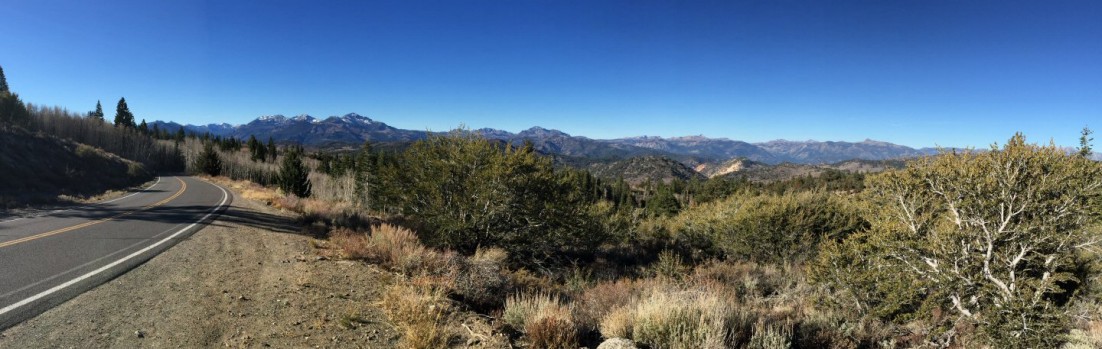
Fall in the eastern Sierras is a feast for the eyes; the low sun filters through the yellow and orange leaves of the quaking aspens, the evergreens seem to take on a darker hue, and through a bleak and gray winter may be nearing, for now the sky is a brilliant blue.
It’s that time of year when small brook trout flame with spawning colors. Willy, a striped bass fisherman of note who’s landed big fish of many species, broadly smiled while cradling one of these gems in his hand; reminded of how fun and beautiful these trout can be.
The numbers of fish we landed was lost in concentration as we targeted specific fish. I’d started with a dry/dropper combination, but soon opted for only a small humpy, for no other reason than the excitement of surface grabs. I’d end up climbing, literally, upstream, targeting small whirlpools tucked between the rocks. Nearly every one gave up a fish.
This time of year just as colorful as the trees…
With the tops of the tree shadows reaching the far side of the creek, we both ventured upstream, where Willy pulled a few fish out of a plunge pool that offers a small, but textbook example of the effect of currents on the drift of a fly, with almost intimate takes from fish less than three feet away.
Thinking we’d already had too much fun, we found our way back to the road, from which Willy could get a good look at the lake. The plunge pool we’d been fishing was the outlet for the lake, and as if an illustration from any good fly fishing book, signs of rising fish dotted what was in essence the tailout for the lake. This was feeding activity that couldn’t be passed up by any fly fisherman.
The wind, accelerating down the canyon, made casting difficult, at least for me, but we both got flies out far enough and every decent presentation earned at least a strike, and a few rainbows were landed.
It has been a textbook day, and the trout did everything they were supposed to do. It’s the best way to learn.


 fishing for words