fishing for words

(and tossing out random thoughts)


Leave a comment

a return to the high country with the folks who raised us, some thirty years later

It turns the tables a bit when it’s the kids introducing parents to new places and experiences and revisiting the familiar after three decades is icing on the cake, though there’s bound to be disagreement in our personal memories.

[singlepic id=1223 w=300 h=400 float=right]

Mom and Dad at the cabin, for their first visit.

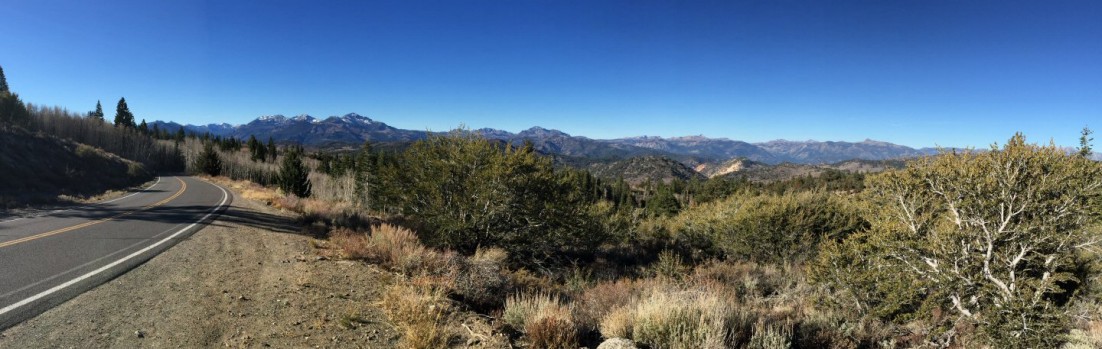
But easy agreement was found in the beauty of the scenery and shared remembrances during a long drive up and over Tioga Pass, along the shores of Mono Lake, before a return over Sonora Pass.

The parents arrived at the cabin late that Sunday afternoon, and after running an errand that took entirely too long for Dad, dinner was enjoyed and we settled in for the evening. Thankfully, the storm that had dumped snow on the passes had dissipated the day before and the warmth of the sunshine had cleared the roads.

Mom, Dad and I leisurely left Twain Harte with a route in mind but absent any planned stops or timetable. The hillsides leaned more toward gold, but were freckled by islands of still-green grass.

I’ve driven this road many mornings, but saw things a bit differently today since I wasn’t preoccupied with wetting my fly line. Miles rolled by, lubricated by conversation. Soon it was time for a stop to stretch our legs. Though there aren’t many hatcheries that will, in my mind, match the magnificence of the historic Mt. Whitney Fish Hatchery visited in my youth, there was something familiar about walking around the Moccasin Creek Hatchery with the folks.

After the excitement of gaining 1,500 feet in elevation over the two miles of the “new” Old Priest Grade, it was all new territory for Mom and Dad as we wound through Big Oak Flat, Groveland, and past Buck Meadows. Highway 120 took us from 2,838 feet at Big Oak Flat to Yosemite National Park’s Big Oak Flat Entrance Station at 4,900 feet. Dad was impressed by the tidiness of the towns and the number of old buildings alongside the roadway, many of which are still in use.

If it wasn’t enough to have fantastic weather, traffic was light. By mid morning we arrived at the entrance station, where the purchase of an annual pass got us across the park border. Words in many foreign languages hung in the cool air, reminding me of the many nature blessings that aren’t more than a day’s drive from home that attract visitors from around the world.

I’ve always throught that the changes in vegetation and terrain grow more dramatic once inside the formal boundaries of Yosemite. Heavy forest yielded to granite, which only seems to yield to water in the form of glaciers, ice and liquid. We pushed on to Olmsted Point, taking obligatory photos, then on to Tenaya Lake. Availing ourselves of the facilities near the lake, I made a mental note that I need to spend more time exploring Tenaya Lake and its surroundings.

There’s a drama that comes with finally emerging from the forest to be presented with the dramatic vista of Tuolumne Meadows, then dropping into the meadow itself. This time I was taken aback by the dramatic change in its appearance compared with that of last spring, when my brother, son and I were on our way to a challenging life-affirming hike to the top of nearby Lembert Dome. Last year the meadows were covered with water. This year, the grass was already the gray-brown of late August.

I had to explain to Dad that the Tuolumne Meadows campground wasn’t open yet when he asked why I was parking alongside the highway. He’d never been here so early in the season. (The campground would open two weeks later, rather early.) Though last June there was snow on the ground and big puddles filled with mosquito larvae, there was nothing of the sort this last week of May. A stroll toward the entrance was accompanied by a bit of debate about the differences between today’s visit and our memories of camping trips more than two decades ago. Regardless of the differences of opinion and any discrepancy in our memories, there was more than enough that was still the same to foster a feeling of familiarity.

[singlepic id=1218 w=600 h=407 float=center]

Mom and Dad’s triumphant return after 30-some years.

My worries about the water were confirmed during this walk through the campground when I stopped near the same spot from which I took a photo of Lembert Dome in 2011. Last year, there was no discernable difference between the channels of the Tuolumne River and the river itself, and the water was within two feet of the bottom of the Tuolumne Meadows (Hwy. 120) Bridge. This year, the channel nearest the campground was no more than a foot deep, and the river was barely touching the bridge abutments.

[singlepic id=1221 w=300 h=225 float=right]

The three of us at Leavitt Falls Overlook.

The reminiscing was further fueled by the sheer rock walls along the descent from Tioga Pass to Lee Vining. The thought of dropping in at Bodie Mike’s for a barbecue lunch was derailed by Dad’s sudden proposition of stopping at the Tioga Gas Mart — that he didn’t recall seeing before — to grab lunch at the Whoa Nellie Deli. A word of warning: Be careful what you order. It’s all big at Whoa Nellie. The Cowboy Steak Sandwich is not so much as sandwich as it is a steak slapped on a roll.

The easy drive north on Hwy. 395 from Lee Vining was a welcome change after such a big lunch. By the time we arrived to the intersection of Hwys. 395 and 108, the urge to nap had passed. A good thing considering the hairpin curves that would take us from 6,765 feet to 9,623 feet at Sonora Pass. Before our main ascent, the Leavitt Falls overlook offered a last opportunity to stretch our legs before the long trip over the pass. The reduced volume of water coming over the falls was another reminder that it’s going to be a dry year in the Sierra Nevada. We posed for photos, then began the long climb.

[singlepic id=1220 w=600 h=450 float=center]

Getting a roadside education at Sonora Pass.

This was undiscovered country for the parents, who never had a reason to travel this road. To my eye, Hwy. 108 over Sonora Pass offers much more dramatic transitions. The road rises faster and the changes in terrain and vegetation follow suit. Surprised to find it open, we stopped at the Donnell Reservoir scenic overlook, with a sweeping over the Stanislaus River canyon and the Central Valley. The road from there is bit less remarkable, winding through heavy forest and passing towns that only seem to be wide spots in road.

It was a long but worthwhile day; one that both revived and created memories.

[nggallery id=84]


Leave a comment

textbook fly fishing (when the fish do everything they should)

It didn’t take long after high winds brought an early end to our adventures on Crowley Lake to decide that it was the perfect afternoon to introduce Willy to the wonderfully willing brook trout in an upper section of Rock Creek, just below the lake.

Caddis on Rock Creek.

It was late when we arrived, but nearly magic hour on this wide spot. In a voice hushed for no other reason than wonderment at the beauty of where we were, I described what to expect. Every pool, tailout, rock and bend prompted a memory of a fish that rose to a fly in the seasons before. Colors grew more vivid as I described the 13-inch wild rainbow that surprised me and my 3 wt. rod during the spring a year ago. Willy headed downstream, I went up.

Fall in the eastern Sierras is a feast for the eyes; the low sun filters through the yellow and orange leaves of the quaking aspens, the evergreens seem to take on a darker hue, and through a bleak and gray winter may be nearing, for now the sky is a brilliant blue.

It’s that time of year when small brook trout flame with spawning colors. Willy, a striped bass fisherman of note who’s landed big fish of many species, broadly smiled while cradling one of these gems in his hand; reminded of how fun and beautiful these trout can be.

The numbers of fish we landed was lost in concentration as we targeted specific fish. I’d started with a dry/dropper combination, but soon opted for only a small humpy, for no other reason than the excitement of surface grabs. I’d end up climbing, literally, upstream, targeting small whirlpools tucked between the rocks. Nearly every one gave up a fish.

This time of year just as colorful as the trees…

With the tops of the tree shadows reaching the far side of the creek, we both ventured upstream, where Willy pulled a few fish out of a plunge pool that offers a small, but textbook example of the effect of currents on the drift of a fly, with almost intimate takes from fish less than three feet away.

Thinking we’d already had too much fun, we found our way back to the road, from which Willy could get a good look at the lake. The plunge pool we’d been fishing was the outlet for the lake, and as if an illustration from any good fly fishing book, signs of rising fish dotted what was in essence the tailout for the lake. This was feeding activity that couldn’t be passed up by any fly fisherman.

The wind, accelerating down the canyon, made casting difficult, at least for me, but we both got flies out far enough and every decent presentation earned at least a strike, and a few rainbows were landed.

It has been a textbook day, and the trout did everything they were supposed to do. It’s the best way to learn.

As I figure it, I have a lot more learning to do.


7 Comments

a blog exclusive you won’t find on my wall

This post brought to you by the photo prompt
Most Un-Frame Worthy Outdoor Photo You Got
from the Outdoor Blogger Network (OBN)

Let’s be clear. Fishing small high-country streams means the trophies taken home are usually limited to skinned knees, a sore back or scratches inflicted by any one or multiple species of vegetation.

Those who ask how the fishing was probably won’t understand that the trip is more than just fishing. It’s fishing that entails a walk that, longer than expected, become a hike; the stalking of trout so skittish its remarkable they aren’t afraid of the bugs they eat; and the creation of memories that draw a fisherman back time after time.

Where I fish, at elevations of 6,000-plus feet in the Sierra Nevadas and often above 8,000 feet, there are incredible opportunities to sink back into forests most notable for the lack of human visitation. In the small creeks and rivers found under lodgepole and western white pines, red firs, mountain hemlock and aspens, wild trout live a hardscrabble life during a summer that rarely lasts more then eight weeks. The small size of these trout truly belies their spirit.

But that’s not why they don’t end up in a framed photo on my wall. These trout are so darn small that holding a fish in one handle while using the other to fiddle with camera’s macro setting invariably results in a photo that’s too fuzzy to be called “arty” of a fish that would be a snack for what’s traditionally deemed a trophy trout.

But since so many of these high-country trout to obligingly rise to any of the customary trout flies, seemingly regardless of size, the outcome of a photo op can be a bit unpredictable.

Unframeable Fish Photo

the photo that shall not be framed

However, the one photo that will never be framed I also hesitate to share in the blogosphere. Because the fish is so small? Because the photo is so blurry? Yes to both questions.

…but mostly because I don’t know what the heck it might be it’s not a trout.

Pikeminnow.Squawfish.Hardhead

From the South Fork of the Tuolumne River: Pikeminnow? Squawfish? Hardhead? Your guess?


P.S. I’ve since upgraded to a better and waterproof camera to compensate for my lack of photographic skill.


4 Comments

finding fish, but not fishing, close to home

[singlepic id=1011 w=300 h=452 float=center]

Fern Silhouette

Muir Woods National Monument in the hills just north of San Francisco could be like someplace near you. That place that’s relatively well-known and frequented by out-of-town visitors, one that you always mean to visit but never set aside the time to do so. The trees of Muir Woods quietly stand in a valley accessed by roads that progressively shrink from a highway to a local boulevard and, finally, a small two-lane country road that twists down the hillsides without the comfort of guard rails. It’s a drive that requires patience. It’s worth finding, however, because this 560-acre national monument encompasses one of last groves of old-growth coast redwoods on the planet, and the only one in the San Francisco Bay area.

It was a gray morning last week when The Wife and I left the rolling hills of home and headed west across the San Pablo Bay Tidal Wetlands and into the hills of the Coast Ranges. The air was cold, the sky hidden by fog, dense and unmoving. The kind of day that suggests you’d be better off nestled by the fireplace with a hot beverage.

Most of the drive was familiar and thus unremarkable, but soon enough we were rising into the hills and the fog. An all-encompassing grayness took the place of what otherwise would have been a sweeping view toward the coast. The fog, but not the chill it lent to the day, was left behind as we descended a number of switchbacks.

The getting there was easy; the parking was problematic. Even on a day like today, parked vehicles were overflowing onto the roadway. Maybe it was karma, or simply superior situational awareness, that opened our eyes to a slot unobserved by half a dozen other drivers at the end of one row.

On a short hike to the park the oak woodlands typical of California’s hills give way to a coniferous forest, dominated by towering Sequoia sempervirens. The paved trail parallels the babbling Redwood Creek, feeding guests toward the obligatory exhibits and gift shop, then the entrance.

Though there’s no escaping the noise of the crowds ignoring scattered signs asking “Quiet, Please,” the silent presence of these redwoods, many seedlings before World War II, can impress. Light filtered first though fog then the thick forest canopy lends a deep blue cast, deepening the greens of California bay laurel, Douglas firs, bigleaf maples, dogwoods, tanoaks, redwood sorrel and countless ferns; horsetail lady, sword, maiden hair, and gold back to name a few. It’s a wonder that such a place exists so close to San Francisco.

[singlepic id=1012 w=615 h=408 float=center]

Near Cathedral Grove

A quiet and easy walk took us deeper into the dense grove; wander first closer to then farther away from the creek. Soon I’m getting kink in my neck gazing at the massive trees in aptly named Cathedral Grove. These trees average 800 years old and taper from a thick base to a top that can’t be seen. They have survived fires, storms and man.

The trail leading back out of the grove crosses the clear waters of Redwood Creek, one of the southernmost streams in which coho salmon spawn. This time of year it’s the coho salmon (Oncorhynchus kisutch) that will make their way upstream, to be followed by steelhead (Oncorhynchus mykiss). It’d be dishonest to state that I wasn’t hoping we might be blessed to see fish in the creek.

We were blessed. The trail that would return us to our starting point crosses then parallels the creek four or five feet away from its bank. As we neared a small bend the bed of the creek moved. A coho, at least a good 18 or 20 inches, hovered in a couple feet of water. We watched, shushing the less courteous, as the salmon rested in a small eddy below fallen tree branches. Shortly, it was joined by another, similarly sized fish. After seemingly communicating via body language, the two cohos continued upstream. After a two-year absence, two more coho happened returned to Redwood Creek during our visit.

[singlepic id=1017 w=615 h=408 float=center]

Evidence that the Redwood Creek coho salmon may have a future...

Perhaps it was fell-good aspect of being outdoors and seeing nature at work (often despite humans), but lunch at the Muir Woods Trading Co. Café was particularly good. While Karen enjoyed a hot dog of grass-fed beef, I dove into a house special, the “Marin Melt,” which is built on a foundation of some of the most rustic bread I’ve ever met and two smooth locally produced cheeses. Add a bowl of fresh tomato soup, and it’s a lunch made for a cold morning near the coast.

Though there were no fishing rods involved in this trip, the fish were a welcome surprise.

[nggallery id=75]