fishing for words

(and tossing out random thoughts)


6 Comments

making man time and acting like boys

I’ve no way of checking, but I’m pretty sure hell’s frozen over.

After eight years since his last appearance in the Golden State, my brother showed up with no specific plans. That’s where I stepped in as travel agent, outfitter and guide; apparently a role that suits me better than might be expected.

Lembert Dome

Lembert Dome viewed from the Tuolumne Meadows Campground, and where we'd be going.

A visit to the cabin is akin to establishing a base camp. In our case, a base camp stocked with beef jerky, beer and an XBox. One might be inclined to think it was something like a “man cave,” but there’s an irony to my brother and I spending quality man time together. Those who’ve been in the proximity when we get together know that we quickly prove the adage that you can’t take the boy out of the man.

Mark lives in the Evergraygreen state and while he said he’d enjoy seeing California family members, it became clear that he perhaps more happy to see the sun. I swung by the airport to him pick up Wednesday evening and we met up with my oldest son, Sean, at the Bass Pro Shop in Manteca. We secured a two-day nonresident fishing license, grabbed dinner and headed up the hill.

Weather-wise, we’d hit it right. Temperatures had peaked that day and would be still warm but slightly lower the next few days, meaning it would cool off at night; something important for a good night’s sleep in a cabin that has no insulation and no air conditioning.

Before Mark or Sean posts a comment below, I will admit that I was adamant that I would I had expected to wake up and hit the road for Tuolumne Meadows early the next morning. I did wake up at 5:00 a.m. But I rolled over and caught a few more winks.

Mark had asked if we might be able to hike up Lembert Dome. He and I had done so back when we were boys, with my sister and dad. It’s a pretty easy drive from the cabin to Tuolumne Meadows, just about 2½ hours. Since Tioga Pass had opened the week before, we would circle our way back over Sonora Pass.

Olmstead Point Marmot

Mark's friend, the Marmot, at Olmstead Point.

It’s been said many times before, but the blue of the sky is remarkable at higher altitudes, and we weren’t disappointed. With only a few clouds in the sky, we passed through the entrance station and soon arrived at Olmstead Point. Reinforcing that he boy stills lives within the man, Mark was all about seeing and getting photos of the marmots of our childhood at Olmstead. A few marmots obliged.

We next stopped at the Tuolumne Meadows Campground, where we spent many a family vacation camping. Sure, some things have changed — mostly manmade things — but nearly everything was recognizable and Mark and I soon agreed upon the location of “our” campsite, partially based on its position relative to the Tuolumne River, which itself was nearly unrecognizably high. I’m sure Sean was somewhat amused by our reminiscing.

Just down the road we pulled into the parking lot at the Lembert Dome trailhead and loaded up. The trail begins with a modest incline, but starting at about 8,600 feet and rising another 800 feet to the dome’s summit, it was soon clear that our lungs would get the kind of workout not seen in years. The gradient seemed to increase every 100 feet, and even if we were on the trail (we weren’t), it would be covered by extensive snow fields that made the hiking more difficult. At one point, Mark fell through the snow into a waist-high air pocket. Undaunted but pausing more often that we’d care to admit to catch our breath, we pressed on. I’m sure it took a lot of patience for Sean to not charge ahead. (I don’t think he broke a sweat or even breathed hard.)

It’s said that the memory grows hazy over time and Mark and I didn’t remember the last stretch up the back of Lembert Dome being so steep or requiring so much climbing. But climb we did, reaching the top. The view was made a tad more incredible by the fact that we had it to ourselves.

At the Top of Lembert Dome

Me, Mark & Sean a the top of Lembert Dome. (After Mark and I rested for half an hour just a few minutes.)

It was hoped that we’d also find some water to fish. Without much browbeating Mark had asked if he might get a chance to try fly fishing, and I had plenty of gear he could use. We rigged up and flogged the no-so-high-but-higher-than-usual Lee Vining Creek. It was tough going. I was the only one to get two strikes, but missed both fish.

We refueled our egos with some good barbecue at Bodie Mike’s, then headed north to Bridgeport, and I pointed out all of the water that we might have fished. Every single river was the color Yoo-Hoo.

Traveling creates memories, and traversing the Sierra Nevada Mountains can make for some of the most vivid memories. Then there are other things that one doesn’t soon forget.

Our return to the cabin meant a few preparations for the next day, when we’d get out on “Hatchery Creek,” hoping to get Mark into his first trout on a fly rod. Mark looked to verify that his fish license was in his wallet. It was. His driver’s license wasn’t. He searched through my car. Sean looked through his car. I looked around the cabin. Mark began to go through his suitcase. After thinking about it a bit, I called Bass Pro Shop. The customer service rep went through the lost and found, looking for a Washington license with the appropriate name and a goofy looking photo.

Soon we were making the 1½-hour drive back to Manteca. Only a few miles went by without Sean or I reminding Mark of his snafu.

There was an upside to this. We enjoyed a manly dinner at the House of Beef.

Back at the cabin, assurances were made that I’d not linger in bed the next morning as there’d be fish to catch. And I did not.

But Mark’s First Fly Fishing Experience is a story unto itself, and for next week.


(You can find more photos here under “The Brother’s Visit – Tuolumne Meadows, Eastern Sierra, First Time Fly Fishing”.)


Leave a comment

the fishing that led to appreciating that good beer

I didn’t know it then, but that confidence mentioned in words written about a week ago would be tested on the first full day of Trout Season 2011, even if high water narrowed our possible venue down to two or three choices where we knew the fish should be willing to play. At least that’s what we thought.

Sean's Angels Creek Rainbow

Sean's hands make this nicely colored rainbow from Angels Creek seem smaller than it actually is. At least that's what he says...

There’s a balance that comes with fishing the week after Opening Day. The fact that most of the water known to hold trout was given a rude awakening on Opening Day is offset by wide-open access. So, although I’m not one to linger long after opening my eyes in the morning, this morning there was no frantic rush to get out the door.

The night before we had decided to head to “Hatchery Creek.” While well stocked with rainbows (and occasionally brook trout), it also can offer kokanee in the spring and a few elusive browns in the fall. We had been warned, however, about the aforementioned grumbling on Opening Day from anglers who couldn’t find the fish maintained that DFG had cut back on its stocking.

The easy accessibility of this creek — as well as the everyday responsibilities of life — quickly fades as we descend the banks of this creek. No matter the origin of these trout, soon they would occupy all our thoughts and become our obsession for most of the day.

The creek, actually more a short tailwater before it dumps into a lake, is high. Maybe higher than I’ve ever seen it, and it takes more than a moment or two to identify familiar landmarks. Sean and I wonder out loud if high flows during the winter had scoured the creek. Together we remember a productive pool that two years ago was shaded by a now absent tree. A few of the old channels seem to have disappeared; new channels slowly reveal themselves. It’s hard to tell, but even a few boulders seem to occupy new positions.

With more of a series of grunts than conversation, it’s agreed that I’ll head slightly downstream to a long, fast, shallow run that’s always been good to me. The current here is too fast for dry flies. Nymphs work well, but most of the fun starts on the swing. It’s the first place I threw out a wet fly, and the first place that a trout took that soft hackle wet fly, one I had tied with a sparse blue-thread body and partridge hackle. After a few casts, the fish reveal themselves. It’s a cookie-cutter rainbow, but a welcome sign that all’s once again good with the world, at least in this brief moment in my part of the world.

Sean wandered upstream to another run, where water tumbled over rocks into a deeper run that ends in front of a boulder. It’s one of those hot spots favored by trout and deep enough to require at least one heavier fly.

After half an hour or so and three trout to the net and about the same for Sean, I ventured upstream, peering into pools and undercuts where I’d usually be able to sight fish. Seeing no fish sign, I checked in with Sean and headed downstream again. Going farther downstream requires care. Trees hug the banks and blackberry bushes are so prolific that thorny, tippet snatching blackberry vines hang overhead. There’s no overhead casting here. Line management is limited to side-arm casts, lobbing or simply dropping flies and letting the current take them to the fishy spots.

There’s one very fishy spot that requires that last tactic. Water bubbles over a creek-wide riffle before dropping into a wide area marked by granite boulders big enough to disrupt the current and create a pocket, a holding lie, for trout, yet small enough to allow the nearby current to flow fast enough, delivering bugs to waiting fish.

I dropped my flies — a size 18 AP Nymph and a size 22 glass bead chironomid pattern — just below the riffle. One drift, a second, then a third.

I’ve found that occasionally a subtle pause, perhaps no more than a second, perhaps a bit longer, can suggest that there’s a larger fish is at the end of the line. This was one of those times. I set the hook. My line paused. It vibrated faintly in the current. Then it was out of the pocket, through the riffles and around an upstream boulder faster than I could follow. But I would never see the fish. The same could be said for my home-tied fly.

The rest of the day, Sean and I would explore the lower reaches of this creek, finding a pool where, he’d been told, trout can often be found. We did find fish there.

This creek widens and gains speed closer to its mouth, reminding me more of a freestone river in the Eastern Sierra. Nice brown trout water, except it’s not home to many browns. There was fishing along the way but no more catching.

I can’t say whether it was the exertion of hiking, the full day of fishing or just plain thirst, but the dinner and the beer that came with it that night tasted awfully good.


6 Comments

chasing frog balls*

Met with a lack of success in finding frog balls during my Opening Day fly fishing trip, I was back at the cabin this past weekend, this time with The Wife, hoping to track down the elusive and delectable pickled morsels.

[singlepic id=1098 w=300 h=452 float=center]

Who said frogs have no style?

We first found these little globes of goodness a couple of years ago at a wine tasting room in the Sierra Nevada foothills. That’s how we found ourselves near the little town of Angels Camp. Perhaps you know it better as “…the ancient mining camp of Angel’s,” or as the setting for “The Celebrated Jumping Frog of Calaveras County.”

What better place or time to find frog balls than at the Calaveras County Fair & Jumping Frog Jubilee?

The Calaveras County Fair is a relatively small affair, condensed into a few buildings, with the obligatory display of hit-and-miss engines powering pumps. One powered an old wash tub. Filling space in one of the buildings was the regular complement of vendors hawking their goods, some unique, some tasty and a few suspiciously smacking of snake oil. Other buildings housed the winning entries in horticulture, art and photography, as well as a display of locally produced wines. Our visit was flavored by the requisite fair food: corn dogs and cotton candy.

Most surprising was the entertainment value of the jumping frog competition. Since 1928, and inspired by Mark Twain’s story, frog jumping is a serious sport in Angels Camp. After all, there are rules:

Frog Requirements
1. Must be at least four inches (4”) from nose to tail.
2. Must begin jump with all four (4) feet, including toes, on the eight inch (8”) launch pad.
3. No substitutions.
4. Evidence of jumping the same frog twice will result in disqualification and forfeiture of prizes.

Jump Measuring
1. The distance will be measured on the third jump in a straight line from the center of the pad to the tail of the frog. A walk or skip is counted as a jump.
2. If a frog jumps into the Jockey or the Jockey’s equipment, the frog will be disqualified.
3. If a frog jumps into other people or other people’s equipment on the stage, the Jockey may allow a re-jump or take the mark.
4. During the jump only the person jockeying the frog may move ahead of the launching pad.
5. Frog catchers shall be on the right– or left-hand corners of the stage and cannot move until the frog has finished jumping.
6. The jump must occur within one (1) minute from start to finish. A one-minute clock will start when the Announcer announces the Jockey’s name. If the jump is not completed within one (1) minute the horn will sound and the frog will be disqualified.
7. Touching the frog after it leaves the pad is cause for immediate disqualification.
8. All marks are final. Any interference by a participant or team member may be cause for disqualification.”

[singlepic id=1089 w=300 h=199 float=center]

Fun with frogs.

An amusing kids’ competition is held to the side of the main stage, with all kids encouraged to kiss their frogs for good luck. Most precious was the look on the younger kids’ faces when their frogs took flight.

On the main stage, however, the competition was serious. Veteran “frog jockeys” competed alongside youngsters. Organized teams competed for top honors, including a trophy at least three feet tall and cash prize of $750. A frog that beats the world record of 21’ 5¾” can earn $5,000 worth of greenbacks for the jockey.

We ended up spending more time than expected watching folks flail their arms, hoot, holler and jump in an effort to motive their amphibian friends. (Not to worry, these athlete frogs, after just about 30 seconds of competitive effort, are pampered at a frog spa under the main stage.)

This year’s winner was a frog named “4Peat,” jockeyed by Michael Wright of Team Bozos. 4Peat’s three jumps totaled 19′ 1”.

The Running Man Frog

With his impression of the the "running man," this frog gained inches fast.

[singlepic id=1097 w=600 h=399 float=center]

This frog showed style...or just showed off...with a mid-air pirouette.

Alas, we were not to find frog balls. Not at the fair, not in local stores. It seems that the purveyor of these spherical snacks pushed prices a bit too high for the retailers we talked with. It was still a good time.

[nggallery id=79]


*No, they’re not real frog balls. They’re pickled Brussels sprouts. The story goes that the man who would make these delicious orbs needed a name for his product. His little sister, when served the vegetable at about six years old, decided that the odd green things on her dinner plate were green like a frog and round like a meatball, thus “frog balls.”


8 Comments

the slow lesson of fly fishing

Fly Fishing Trip Goals: Fish New Water(s), Fish for New Species/Strains of Trout,
Drink New Beer(s), Repeat. Note: Do so slowly, with great deliberation.

It’s not casting, presentation or fly selection; it’s a deliberate and slower pace that offers the best chance of success in fly fishing.

This isn’t a new or unfamiliar idea. My first appreciation of a slower approach was the pace at which I entered any water, familiar or unfamiliar. Slowing down to take the time to make a few observations. To watch the sun rise. To look for that one rising trout. To take time to fish that small seam a few feet out from the bank.

[singlepic id=1088 w=275 h=368 float=center]The decision to try my hand at tying flies required a slow, methodical approach as I learned techniques and how materials responded to the tying process. I’m not a production tyer, and probably think more what I’m doing when tying than I should. That’s okay; a lot of that thinking is about the fish I expect or hope to fool with that fly; or memories of already having done so.

Rod building again necessitates slowing down. Wrapping thread seems simple, and it is. Wrapping thread well isn’t. Five-minute epoxy is the fastest part of the process. Laying down multiple coats is not.

More experienced fly fisherman might wonder why it took so long for me to come to this conclusion. In my defense, there were trout to fool and success was measured by body count.

Two weeks ago, while setting aside the desire to get on higher-elevation trout water as soon as legally possible, it dawned on me that the fish would still be there even if my arrival was delayed a day or two. Like dominoes falling, decisions were then made to purposely plan a slower pace.

It’s a huge thing to slow down in today’s world. To take a slow, long look at that wild trout. And, when the sunlight’s too dim to fish, to slowly relish the day’s adventures, seasoned with good food and, if you’re lucky, a good beer.

It’s all worth savoring.

To be certain, we lugged along a few new brews to the cabin during our Opening Day trip, but didn’t pass up the opportunity to try something from the tap during dinner at The Rock.

Told by the waitress that customers had complained that New Belgium’s Ranger IPA was too hoppy, Sean naturally went ahead and ordered it. Apparently those customers have sensitive palates. I’m not a huge fan of too much hoppiness on the back end, but even I found the Ranger rather mild. So did Sean.

Though not an extreme beer snob, I favor trying local suds, and opted to try Snowshoe’s Grizzly Brown Ale. (And, honestly, I felt an obligation to try the Grizzly as research. The Snowshoe brewery is an hour away from the cabin and will be on the itinerary during my brother’s visit next month.) I’ve grown increasingly fond of a well-done brown ale. The Grizzly didn’t disappoint, and it seemed that Sean might have wished he’d chosen it. It’s certainly dark in color, but semi creamy and not heavy as might be expected. A nice toasty maltiness gives way to a light hop finish.

Certainly a great way to finish a day of fly fishing.


3 Comments

start of the 2011 trout season: working out the kinks

From what I hear and experienced, it might just be a good thing if you missed the Trout Opener this year. At least on the east and west slopes of the central Sierra Nevada mountains.

No one’s outright said as much, but reports from the Eastern Sierra suggest that crowds may have been there but the fish weren’t. One particularly likeable report: “Bait slingers and trollers failed miserably on Opening Day weekend and 100,000 lives were spared!”

Bass from the Shadows

One small bass from the shadows of a small pond.

The same seemed to be true in our neck of the woods. A California DFG hatchery worker I’ve talked with over the years told of anglers grumbling that fish were nowhere to be found, despite the usual numbers being planted. (More interesting parts of that conversation will come in a future post.)

Not all went as we planned, but arriving in the Sierra foothills in the aftermath of Opening Day put Sean and me in a good position to fish and explore in relative solitude. Months of neglecting necessary fly fishing skills were soon forgotten and muscle memory was gradually regained.

Arriving before Sean and after opening the cabin for the season (thankful that pipes hadn’t burst during the long winter) it was time work out the kinks on the convenient Lyons Canal. Just behind town, it’s more accurately Section 4 of the Main Tuolumne Canal of the Lyons Reservoir Planning Unit. Built in the mid 1850s, it’s part of a network of canals — estimated to total 60 miles — that crisscross Tuolumne County. Though peppered with flumes and concrete in some sections, parts of it have been reclaimed by Mother Nature and now resemble a small stream carved into the rolling hills.

Like many moving waters, walking a short distance away from easily accessed sections is worth the little effort required. Stocked with rainbows, the canal is also home to a now wild population of brown trout.

Hopeful that the most important tool in my fly fishing arsenal — confidence — wasn’t lacking, I tested likely cut banks, boulders and shaded water.

Despite the lack of wildness of the surroundings — homes and a roadway are a short distance away — these brown trout are wild enough to scatter at the shadow of a rod or a less-than-light footfall. This requires casts well upstream of your position, with the best casts placing the fly no more than a few inches from the bank.

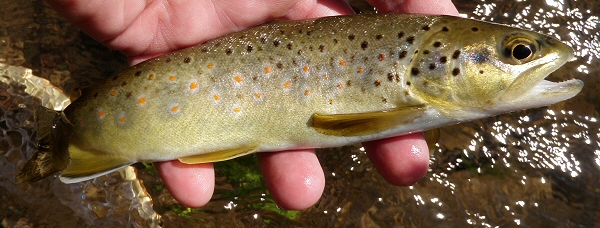
My first fish darted out from a surprisingly deep undercut four feet in front of me; eating a standard red Copper John nymph and barreling downstream into faster water. Nicer still, this was probably one of the biggest browns I’ve pulled out of the canal. It looked healthy, even happy.

Brown Trout from Lyons Canal

Another brown from the canal…they do like hugging those banks.

Six browns of various sizes came to the net that afternoon, all seeming to eye me with what might be described as familiarity bred by a near certainty that we’ve met before. Thankfully, most are small enough to be released by freezer-stocking folks hunting the bigger, stocked rainbows.

Perhaps it’s a reflection of the intervening off-season troutless months, but the brown trout this year seemed feistier and their spots brighter than I remember.

I finished up the day, with long shadows creeping between shafts of the setting sun, tossing streamers into a pond on long-fallow golf course. Decent sized bass cruised the banks, but in such small water quickly disappeared into the weeds. A few of their offspring were fooled with streamers and trailing nymphs; the biggest was about eleven inches.

As the sun fell behind the tips of the pines, it felt good to have worked the rustiness out of my cast and rediscover the confidence that had been in hibernation.


2 Comments

the water was high, but crazy luck abounded. fish caught, beer consumed and recon accomplished. more later.

Laughing Brown

Post Opening Day fishing so fun even the fish were laughing...


Leave a comment

gone fishing

The Opening Day rush should be over by now, which means I’m heading out the door.

On the way will be obligatory stops for supplies and fast food. I’ll warm up with wild browns just outside town. Sean will join me later this evening. The next three days will be focused on fishing, with high water and lingering snow dictating where.

Fly fishing, friendly competition, man food and beer. The stuff vacations are made of.

[singlepic id=761 w=600 h=450 float=center]

Hoping to say hello again to a few of these wild guys...


7 Comments

the challenge of a (personally) delayed trout season opener

It was the ride to the office yesterday that finally triggered that physical feeling that Opening Day is upon us. Despite the early hour — 0600 or so — the ride was comfortable, not too cold and not too warm. The sun was already burning away the coastal overcast, leaving behind clear skies.

Then it hit. Smack dab in the middle of my face shield. The first bug of the season. If I were to guess, I’d say something in the family Chironomidae. Trout food, particularly as pupae.

Until last year, it was imperative to depart Opening Day Saturday, immediately after assisting with a fly fishing class that I’ve been involved with for quite a while.

What changed? I’m certainly not self employed like the Unaccomplished Angler or retired like Mark (@Northern California Trout) and able to traipse off to fish whenever I’d like. I do, however, accrue a healthy number of vacation days at work and now consider it impolite to not use them.

[singlepic id=764 w=200 h=267 float=center]

Stream X

What’s truly changed is my attitude about the start of trout season. Perhaps a modicum of maturity can now be ascribed to my fly fishing. Rather than stand shoulder to shoulder with anglers from “the dark side,” there’s a certain challenge in arriving on the few fishable waters in the western slopes of the Sierra the Monday after the Saturday opener. (According to Mark, this year more anglers may be crowded on less available water due to snow and ice at higher elevations.)

The more accessible waters have been flogged and the fish traumatized by flashy spinners and DayGlo baits, making it all the more challenging and satisfying to hook and land the fish too smart for not caught by these other anglers.

I hope to also visit Stream X, where unmolested wild rainbows likely will attack anything that remotely looks like food. It’s a bonus that this is the time of year when much of the fishing crowd won’t be out during the work week.

So, Opening Day I’ll be helping folks learn how to play and land fish on a fly rod. Sunday I’ll spend time with The Wife. Monday through Friday I’ll be fishing.

See you on the water.


6 Comments

Mother Nature wins, but it’s okay (and accumulatingmy 15 minutes of fame, a few seconds at a time)

The thought last weekend was to get away for a rare five-day retreat, spending some time at the family cabin, entertaining ourselves with visits to wineries in nearby Murphys, squeezing in a bit of fly fishing on one of the few open rivers in the Sierra foothills and generally stepping away — far away — from the everyday.

We had enjoyed three weeks of spring-like weather prior to our departure, but the moment we publicly announced our plans, Mother Nature decided she knew better.

[singlepic id=1076 w=300 h=199 float=center]

A better use of snow.

The drive that got us up to Hwy 108 was easy enough, with stops along the way for lunch and gwaking at Bass Pro. It was after the last stop at Covers Apple Ranch that Mrs. Nature gave us fair warning with steady snowfall as we wound the seven miles to the eastern (and higher) edge of Twain Harte. By the time we reached town, the inches of snow that frosted the familiar with a fresh coat of newness also dictated extreme caution.

While I don’t mind clearing the white stuff to pull into the driveway or the nearly two feet of snow that that muffled and covered the world outside the next morning; I didn’t like the resulting power outage, the excavation of that 60-foot driveway a second and third time, and the increased release of water in the only nearby and fishable tailwater. Though we were thankful for the propane-fired heater, stove and water heater, the lack of power for 48-plus hours wasn’t fun. It was dark by 6:00 p.m. and it’s difficult to read, much less tie flies, by candlelight. Fishing was out of the question the next day as flows on the Stanislaus rose in 40 hours from less than 250 cfs to nearly 1,100 cfs.

We surrendered about 42 hours after our arrival. In that time I learned the value of a snow blower after shoveling the driveway three times, clearing an estimated accumulation of four feet of snow. (My arms agreed with rusty mathematics that suggested I moved over 1,900 cubic feet of the stuff.) Proving that Mother Nature maintains a healthy sense of irony, we were greeted by blue skies just as that last of the gear was packed into the car.

[singlepic id=1082 w=600 h=399 float=center]

Mother Nature, The Joker. The skies cleared after nearly four feet of snow snuffed out
the power and we went about departure preparations. (More photos below.)

However, we both enjoyed being in a winter wonderland for a while, spending one afternoon tucked into The Rock resaurant with a good draught of Smithwicks ale, a few appetizers and a cozy view of dime-sized flakes floating to earth. I personally enjoyed introducing The Wife, for the first time in her life, to real, heavy snowfall. We also learned that the Prius can do well enough in the snow.

I don’t begrudge Mother Nature for cutting our trip short with piles of snow; it’s the resulting runoff that’ll keep the trout happy and make for excellent Sierra fishing in the late summer and fall.

A Few More Seconds of Fame

It’s nice to know that Orvis Fly Fishing Guide Podcast host Tom Rosenbauer thought enough of my comment on Facebook to mention it in his latest podcast. If you’d care to listen, you only have to wait until about 1:30 into the podcast.
[audio:http://media.libsyn.com/media/orvisffguide/15_tips_on_Sight_fishing_for_Stripers.mp3|titles=Orvis Podcast-2/22/2011]

I responded to Mr. Rosenbauer’s podcast of a week ago, “Gear Maintenance in the Off-Season and Ten Tips for the Aging Angler,” with a personal anecdote that there are indeed exercises that could help the aging angler. Though I have yet to be officially recognized for my longevity, a gym membership put to good use during the last year or so seems to have improved my balance during wading, something I attribute to core exercises, namely crunches, bridge, planks and rotational movements.

Admittedly, as a generally lazy meditative lot, exercise may be foreign to most fly fishermen, and the most widely practiced workout is casting, which coincidently builds up muscles used to also hoist a beer or scotch.


More of what we saw during our shortened stay at The Cabin last weekend:
[nggallery id=77]