
- Man vs. Wild takes on the Sierra Nevada: http://tinyurl.com/ne39ws
- Gulls Gone Wild & The Men in Black: http://tinyurl.com/n35lru
- Strikers Gone Wild: http://tinyurl.com/o463cs
Category Archives: Autos, Etc.
new car model to report for police duty
 Even before the first utterance of recession, many have wondered what might become of the American auto industry — no matter if it’s true lack of quality or simply the perception.
I’d like to say that I’ve done my fair share to urge Detroit to build better cars by voting with my money. Money that I’ve spent on — albeit American-built — Honda and Toyota automobiles. But in the absence of a GM-, Ford- or Chrysler-built model suitable for law enforcement, could another auto manufacturer rise to fill the void?
With a joint agreement to with Meridian Automotive Systems, Inc. to work on the design and development of exterior body panels, Carbon Motors’ purpose-built law enforcement vehicle edges closer to fruition. Sure, Carbon Motors — established and run by ex-Ford employees — has high hopes to fulfill a “…critical mission to design, develop, manufacture, distribute, service, and recycle at end-of-life, the world’s first purpose-built law enforcement patrol vehicle.” But with the future of Ford’s Crown Victoria in question, the very existence of Chrysler seemingly doubtful, and GM offering only the front-wheel drive Chevrolet Impala (and SUVs too costly to fuel), might there be room for Carbon Motors’ E7?
The E7 certainly will be competitive and even looks “green,” with plans for a 300-hp forced-induction 3.0 diesel capable of running on biodiesel. Mated to a six-speed transmission, fuel economy may reach as much as 30 mpg. The Crown Vic offers 250 hp and about 24 mpg (highway) at the top end. Carbon Motors also expects the E7 to have 75-mph rear-impact crash capability, something claimed of the Crown Vic, but with some controversy surrounding the claim.
If nothing else, it looks cool with a hint of intimidation.
2010 Prius goes solar…sort of…
Talk about “wow factor.”
The 2010 Toyota Prius seemingly will become the first mass-produced vehicle to offer solar panels. Not to power the vehicle. Not yet. But much like many automotive features now deemed “standard” (seat belts and intermittent windshield wipers), this initial application of solar panels could foreshadow a time when an automobile’s power supply is supplemented or eventually supplanted by electricity supplied by photovoltaic cells.
The 2010 Prius’ option on high-end models for a “solar roof” embeds photovoltaic cells into the roof to power a fan that will bring outside air into the vehicle cabin. And, since the Prius uses an electrical air conditioning unit, the solar panels can also power the air conditioning — which can be activated via the key fob within thirty yards of the vehicle to achieve a pre-set temperature.
Pretty slick and wiz-bang to be sure. And the concept is not new. But automotive progress has always been slow. While Volvo offered the first automobile safety belts in 1849, it wasn’t until 1958 that Saab became the first car manufacturer to introduce seat belts as standard equipment in 1958, and it wasn’t until 1964 that most manufacturers offered them on most models.
But even in the face of volatile fuel prices, it will be a while before lower costs and efficiency make solar panels a viable power supply for hybrid or fully electric vehicles. Solar Electrical Vehicles has been adding a convex solar roof to hybrid cars like the Toyota Prius, Highlander Hybrid and the Ford Escape Hybrid. But according to those who know more than I, these solar modules, rated at up to 1200 watt hours per day, only provide enough power (via battery storage) to propel a car in electric mode up to 20 miles per day. If you only drive 20 miles day, great. As for me, I drive 54 miles a day. Add in a cost of up to $6,500 (including installation but not any state or federal credits), and one will have to hope gasoline jumps to more than $5 a gallon to recoup the costs over five or more years. (Other experts indicate that it would be more efficient to use building mounted solar panels that can better collect power by tracking the sun to store electricity for later transfer to the auto. This would also lessen the weight of the car, increasing its efficiency.)
Also, for now, solar panels’ major flaw is that it is incredibly inefficient. Solar panels traditionally convert 6 to 10 percent of the energy in sunrays into usable energy. Recently, top of the line panels pushed this into the mid teens. But nontechnology, allowing for the production of cheaper “solar dots” could push that conversion factor to the 40 to 60 percent range by converting sunlight into electrical energy at the molecular level.
For now, the Prius’ solar roof will be more of a “look at me” feature with an incredible literal and figurative coolness factor.

a “mini” vacation
Free is good.
A free Mini for a day is very good.
The Wife — courtesy her entry in a public transportation agency’s contest — ended up with a free Zipcar for a day. And as luck would have it, she invited me to come along. For the car, she picked a Mini and left the destination(s) to me.
A silver Mini named “McNorton” waited at a parking garage on Geary St. in San Francisco. We took BART in, hiked a few blocks to the parking garage, and gained entry with a magic wave of a ZipCar card. Pretty unique and convenient system. A few blocks down the road and my wife, decidedly not the “car nut,” was thoroughly enjoying a sporting drive to the Exploratorium, where the kid bailed and we officially began “having a day.” By now my wife had announced a few times that the “wanted this car.”
The car was entertaining on many levels — there’s always switches to play with in unfamiliar cars — but it was the computer’s calculation of average fuel consumption that held our attention at first. Up and down the hills of the city it bounced around the teens, but once we were on the highway to San Mateo, it quickly rose to the rather amazing 30 to 32 mpg range. Did I mention that my wife said she wanted her own Mini?
After a nice visit with my sister’s family in San Mateo, we pointed the bonnet west. Destination: Half Moon Bay. The weather: incredible for January. (I’m very conflicted about enjoying the great weather at a time when we should have rain.) In Half Moon Bay, in my humble opinion, one can find some of the best fish and chips around at the Half Moon Bay Brewing Co. So it was fish and chips for me, mini Kobe burgers for Karen, and an IPA shared between us. A great lunch with a great view on the bay. A quick drive back up the coast brought us back to reality, but it was a great “mini-vacation.”

…and our cops are stuck with crown vics
Lucky English coppers.
autoblog.com picked up and expanded upon a Mitsubishi press release regarding the South Yorkshire (England) police department’s latest vehicular addition:
The South Yorkshire police just added a ten to their squad. No, that’s not a sexist statement about some new hire, it’s a reference to the new Mitsubishi Evolution X they just added to the fleet. Joining an already-intimidating Evo VIII and IX in the motorpool is a specially equipped X that should help keep the Road Crime Unit (RCU) ahead of the baddies. The Evo X should be more than adequate for tracking down drug dealers and car thieves by itself, but deployed as a pack, the trio of Evos will probably scare scofflaws into simply giving up the chase.
Not only it is a very cool ride, but it’ll be outfitted with an onboard Automatic Number Plate Recognition system that will the vehicle registration and alert officers if there is anything remotely suspicious about it. But I don’t think detective work is the main reason for this beast.
Read and drool see more here.
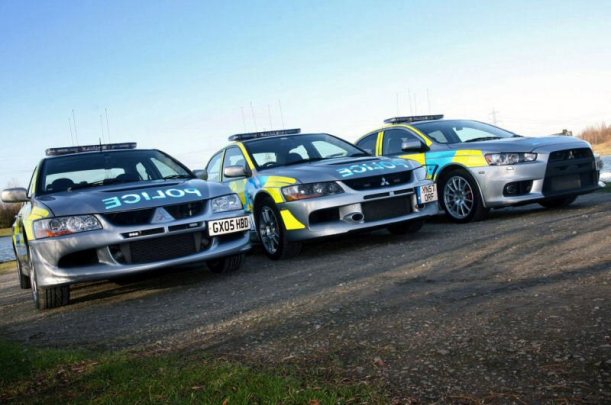
South Yorkshire Police’s pack of Evos.
all parts of the buffalo
Seems it’ll only be a matter of time before we’re putting more than one species in our engines. Rather that waiting millions of years, Connecticut-based Green Earth Technologies only will have to wait for approval from the American Petroleum Institute for new automotive applications of its G-Oil, a biodegradable lubricant made from “American grown base oils” — and you can read that to mean animal fat that would typically be discarded by slaughterhouses.
Beef, it’s not just what’s for dinner anymore.
the “other” konoske website
That’s really a cousin of mine — on some level — at konoske.com.
Despite my displeasure three years ago that he squatted on konoske.com long before even posting a single photograph, it’s hard to ignore the quality of the end product. Sure, konoske.net might enjoy recognition as THE Konoske Web site, but for anyone who enjoys cars, Brian’s portfolio is something worth a longing look.
Brian’s work takes aim a various vehicles — new, vintage, mild, wild, on road, off road, fast, not so fast and probably not mobile at all — in typically wonderful compositions. It’s camerawork like this that can be blamed for my infamous fetish renowned fondness for a well-cleaned car.
Good work Brian.
to infinity mpg and beyond!
The public relations hype news about the Chevy Volt possibly getting a 100 mpg rating from either the EPA or the California Air Resources Board could go down as one of the better attempts by a car maker to dupe consumers. The GM marketing machine seems to be trying to change the rules of the game to fit its skewed own model.
According to General Motors E-Flex spokesman Rob Peterson, the automaker has reached an agreement with the California Air Resources Board (CARB) that would see the 2011 Chevy Volt get a unique classification different from other current hybrids. This new classification takes into account the fact that the Volt’s 40-mile battery range allows it to complete the bulk of the emissions and economy test procedure without ever running the engine, which would likely give it a mpg rating of 100 mpg or better. [On AutoBog.com]
FYI, the EPA hybrid testing cycle currently requires that dual-power vehicles “…complete the test cycle with a charged battery.” This dooms the Volt to an overall 48 mpg rating — Prius and Civic hybrid territory.
According to GM, the Volt doesn’t use any fuel for the first 40 miles of driving, but having to end the cycle with a full battery will require the use of gasoline for recharging. So, based on GM’s argument, which implies thinking that the Volt shouldn’t have to end the testing cycle with a full battery, drivers shouldn’t be concerned with the second 40 miles, during which the Volt’s mpg will fall.
Assuming the Volt gets 50 mpg with the gasoline engine running to charge the battery, its actual mpg rating should require a sliding scale.
Taking into account that the car can go 40 miles using no gas, if one where to drive 50 miles, during the last 10 miles it would use about 0.2 gallons, equaling 250 mpg.
While the average commute for U.S. workers nears 50 miles a day, add any additional miles — pick up the kids, groceries and that coffee iced double tall soy latte — and the rule of diminishing returns comes into play. Add another 30 miles for a total of 80 miles (40 on battery/40 with the engine running) and the total fuel economy falls to about 100 mpg.
Visit the relatives 300 miles away, and the Volt’s mpg dips to 62.5.
This is without including the cost of the electricity to charge the Volt when plugged in. And assuming 50 mpg with the engine running. And assuming driving only on flat ground. (I know from experience that the Prius mpg drops significantly going up hills.)
Does this mean an electric-only vehicle, which doesn’t have a gasoline tank, get ∞ miles per gallon?
Perhaps the EPA should determine mileage over a testing regime that runs for the equivalent of a tank of gasoline, say 400 miles? Sort of like us consumers do?
The truth is somewhere in between, to be sure.
nothing beats a “free” weekend
In the words of my father, I “made out like a bandit” this weekend. And had a spot of luck too.
It began Friday when the new hard drive for our Series 3 Tivo arrived. The old hard drive decided to take a permanent vacation, presenting the dilemma of either purchasing a new Tivo, meaning we’d loose the lifetime subscription that has paid for itself a few times over, or trying to drop in a new hard drive. Either way, it would cost about the same. The hard drive install was quick and easy, and after running through the guided set up our resurrected Tivo was running smoothly with our lifetime subscription still intact.
Saturday afternoon the wife and I visited a fellow fly fisherman and his wife with the express purpose of combing though some fly tying materials. Comb through we did. About an hour and a half later I was putting a grocery bag in my car full of materials, including seven dozen spools of thread of all sorts of colors and hues. All that and a dinner date with my wife.
Sunday’s event was courtesy Honda. As a participant of an online Honda Owners Panel (which conducts surveys about once a month) I was awarded two pass to the IndyCar race at Infineon Raceway. Christopher and I arrived about ten that morning to enjoy a continental breakfast in the Honda tent, which was set up at turn two. (An uphill right-hand sweeper.) After walking around the various exhibits and watching the Historic Gran Prix cars head out to the track for warm up, we headed back to the tent for a great rib lunch. Lunch gave way to a visit by the Ryan Hunter-Reay (driving the ethanol-sponsored Rahal/Letterman Racing #17), then a tour of the garage area. Though I wouldn’t pay for the privilege, it was fun seeing the race in person. Helio Castroneves (Team Penske #3) won, with Ryan Hunter-Reay finishing 18th. Gotta love free stuff.
I’ll be the guy looking for more freebies…
another boy and his (first) car
This weekend I drove my son Sean some 200 miles to find this first car, which ended up being less than 15 miles away from home. But in the end he kept a streak of Honda ownership alive with a 1994 Honda Civic LX sedan. (That should make his maternal grandfather proud!)
Hondas in general and Civic specifically attract a rather fanatical community ranging from teenage kids bent on building upon their dreams of being the next big tuner/racer/drifter to the more practical citizen simply looking for a reliable commuter car. I think we got lucky with this one, swooping in before any other buyer showed up with cash in hand. Particularly considering that this 13-year-old Civic has amazingly low 97,000-some miles on it. Even more amazing is that it was purchased in Chicago and driven here (California).
This little car is a far cry from my first car — a 1971 VW Beetle. I hope that Sean will offer thanks every time he cranks up the air conditioning or sets the cruise control. Of course, car ownership has thrust him into another aspect of adulthood…with the pride comes a price: new tires, new timing belt and water pump (a must on any small car) and dealing with the Department of Motor Vehicles.

I’m hoping this car turns out to be a good find. We only happened upon it after a long-delayed e-mail response to an ad; and then only because we still had yet to drive through the city in which it was located. You can see the picture that was in the ad to the right. Stay tuned, however, I might post some more once Sean washes and waxes it, assuming he’ll stop driving it long enough for a picture.
 fishing for words