fishing for words

(and tossing out random thoughts)


Leave a comment

in the foothills for food

One of the best things about being willing to travel for food is that the allure of food…or wine or beer…can be the thing that motivates.

The release of monthly wine selection, which we elected to pick up rather than expanding our carbon footprint with door-to-door delivery, led to a last-minute decision to take a road trip last Friday that would loop through the Sierra Nevada foothill towns of Murphys and Jamestown. The last-minute part was a decision to make it a day trip rather than pack, unpack, then pack again for a short weekend stay at the cabin.

Spring Flowers at Ironstone Winery

Tulips at Ironstone Winery

Departure time that often dictates one’s route, and since we’d first stop in Murphys, timing put us in Stockton for breakfast. Yes, that Central Valley town, in the middle of some of the most productive farmland in the world. Yet is isn’t the prototypical farming community. Stockton is a city of 300,000.

When the real estate bubble burst, homes built on cheap agricultural land in and around Stockton — almost within commuting distance of San Francisco — were left empty. Without customers, businesses closed and shopping centers went dark. The construction industry that built both residential and commercial properties collapsed, increasing the rolls of unemployed. Income and property and sales tax revenue fell.

But Stockton is a city with a deep freshwater port handling over $1 billion in product shipment annually. It is home to the prestigious University of Pacific and its 7,000 students. During the boom years the city gained a new ballpark, a city activities center, at least one new hotel, an ice rink and a lovely marina. It’s been described as a slice of Los Angeles minus Hollywood.

Our stop for breakfast was at a restaurant within Stockton’s Miracle Mile Improvement District, three blocks south of UOP. Karen found the Midtown Creperie on our ever-present travel companion, Yelp. Years ago I spend half a week in New Orleans and Midtown Creperie offers any almost Disneyesque décor, and though dark, is complete with Mardi Gras beads at each place setting. The mood set, it was the King Cake crepe for me, with dark chocolate sauce substituted for the white chocolate glaze. Karen ordered an omelet with spinach, sausage and tomato with country potatoes. Per our usual strategy in a new place, we split our meals.

Apparently, I haven’t learned my lesson when it comes to trying a place for the first time, particularly one that specializes. The King Cake crepe was good, but with too much going on — apples, cream filling, chocolate sauce and multicolor sugar crystals — it was tough to judge the foundation of the dish, the crepe itself. It was good, to be sure, but I’d say the great presentation didn’t match the flavor. The omelet was good but the sausage was less present than I would usually hope.

After a 30-minute walk down Pacific Avenue and its eclectic mix of shops, we were headed to Ironstone Vineyards, the home of one of Karen’s favorite everyday wines. Outside planters around the winery always filled with the best-looking plants, and being spring, they were filled with flowers. We’re not extravagant with wine club memberships, but it is nice to walk in and taste all we want without a fee, so we did. A case of Karen’s favorite walked out with us.

We hadn’t planned for lunch, but after walking the grounds at Ironstone and up and down Murphys’ Main Street — and the result of my interest in the beers at Alchemy Market — we ended up at the Alchemy Café next door. My wife had suggested sharing a beer — gotta love her — and I suggested a small appetizer. That didn’t quite work out as expected.

We’d been to Alchemy Café before, and split the Thai Chicken Salad, which was more than enough. The idea was to just have small plate to nosh on. Karen ended up with a nice lamb soup. I ordered the Crispy Fried Calamari and forgot about the awesome and complimentary Alchemy’s Famous Gold Nugget Cheese Bread.

Despite its awesomeness, Karen won’t touch Alchemy’s bread. She doesn’t like cheese. But that’s okay. I got the whole serving of this spicy, heavenly goodness. It’s a foundation of ciabatta bread spread with a fluffy mix of salted butter, corn kernels, chopped green onions, minced serrano chiles, minced garlic, chopped cilantro, shredded white cheddar cheese and Parmesan cheese, the baked until golden brown.

Had I remember the bread would come, I’d have skipped the calamari. However, I’m glad I didn’t.

Then there was the beer. Both the Alchemy Café and the associated Alchemy Market offer a good selection of beer, along with a long list of local and not-so-local wines. I tend to gravitate to local brews, and most local offering on the list that day was
Knee Deep Brewing Co.’s Batch 135 from Auburn. To my tastes, it was a bonus that Batch 138 uses Simcoe hops in addition to three unnamed “C” hops (likely Cascade, Chinook, Columbus or Centennial). It was a good light but hopped up beer, though the Simcoe only served up a pine aroma and wasn’t too dominant in the drinking.

We sipped, talked and noshed. It was a great day.

Oh, there were flowers, too.


Leave a comment

will travel for food: Show Dogs & Cellarmakers Brewing

I do enjoy living in California. I love our many outdoor options. I live in a suburb of the Bay Area, in a balance of choice and means. But I have a love/hate relationship with our “big city,” San Francisco.

San Francisco was the seventh most visited city in the United States last year, for good reason — cool summers of fog-kissed sunshine, a history that lives on through landmarks such Golden Gate Bridge, Alcatraz Island, Coit Tower and Fisherman’s Wharf. Lending to its picturesque quality are steep rolling hills patrolled by cable cars and dotted by a mix of architecture styles such as Italianate, Mission, Queen Anne, Stick/Eastlake, Craftsman, Art Deco and Streamline Moderne. Parks are sprinkled about, including the Conservatory of Flowers, Japanese Tea Garden and the San Francisco Botanical Garden. Culture abounds with art museums and performing arts. The sciences are represented at the California Academy of Sciences, the Morrison Planetarium and Steinhart Aquarium.

Wandering through neighborhoods like North Beach, Chinatown, Telegraph Hill and SoMa on a sunny day rank among some of my favorite experiences in The City. Christmas can be made more special with a visit to Union Square and a walk by Macy’s holiday windows displaying SPCA cats and dogs looking for forever homes. Personally, I enjoy carspotting and rarely is there not a sighting of a Ferrari or Tesla or the occasional Aston Martin, Bentley, Rolls Royce or Pagini. (BMWs, Audis, Mercedes-Benzes and Porsches are too commonplace.)

San Francisco is also most densely inhabited large city in our state and the second-most densely populated major city in the United States; second only to New York City. High-rise office buildings blot out the sky and create dark canyons that can be 10 degrees cooler. Our visit last weekend was marked by warmish temperatures, which likely gave rise to the rather pungent odors one might expect during a rainless winter.

Some people wanted champagne and caviar when they should have had beer and hot dogs. - Dwight D. Eisenhower

Some people wanted champagne and caviar when they should have had beer and hot dogs.
– Dwight D. Eisenhower

But we will travel for food, which lured us once again across the Bay. Intellectually, I understand the need for and benefits of mass transit; but deep inside I harbor an irrational fear of missing a scheduled stop. (Yes, I know there will be another bus or train, but that means giving up control of my schedule.) However, I’ve become accustomed to the hour-long ferry ride and have recently adopted the mantra “walking is good.”

Walk we did. To get where we were going, we’d skirt the Tenderloin just above SoMa. The situational awareness I’ve been working on, unfortunately, meant I wouldn’t miss that guy relieving himself in the gutter on Turk Street. More than once we walked through a repellent cloud of “skunk” originating from green stuff, not the black and white animal.

In truth, it was more akin to hiking for food and beer, and lunch at Show Dogs Fine Sausages was the reward on the first leg. House-made hot dogs, sausages and condiments, and beer on tap. What’s not to love? And love it we did. Maximizing our opportunity to taste Show Dogs’ offerings, we split a House Maple Pork sausage and Fried Chicken Sandwich, a pint of 21st Amendment’s seasonal Fireside Chat — a nice, rich and semi-dark English-style ale tweaked with spices — and a side of fries. The maple pork sausage was an experience I’d gladly repeat, even without the sprinkling of bacon. The proportion of maple to pork was perfect. Think of that time at breakfast when your sausage rolled into a bit of syrup. The twist for me was the deliciousness of the fried chicken sandwich, it was outstanding. Sure, it’s fried, but the house-made lemon cayenne aioli, coleslaw, pickled ginger and well-matched bun make it something quite special. The fries weren’t as special, but were perked up by the house-made habanero ketchup.

We’d walk another mile or so to pick up something Karen had ordered, then it’d be another mile to Cellarmaker Brewing Co.’s taproom. But it was one o’clock, and the taproom wouldn’t open until two. So, without thinking, began to head to the Ferry Building.

A few blocks later Karen thought to check the ferry schedule. The next ferry wouldn’t leave until 3:45 p.m. Apparently, God wants us to have beer. And Cellarmaker delivered.

Cellarmaker is small, with a ten-barrel brewery and a twelve-tap tasting room inside a former garage in SoMa. It opened last October with four beers and has since expanded it lineup with a rotation of beers. We settled into the cozy taproom and upon learning that some taps were dry, ordered up five ounces of each available beer. It was nice to see that each glass was pre-wetted with chilled water before filling (I expect that it was distilled water).

We ended up with glasses of Coquette, Simcoe Galaxy IPA, Jagged Little Pale Ale, Coffee and Cigarettes and Kelly’s Blackout Stout. All were good enough to order again, but I fell in love with piney goodness of the Simcoe Galaxy. It reminded me of Skagway Brewing’s Spruce Tip Blonde, which is brewed with spruce tips. The Simcoe Galaxy is not, but the herbal, piney and almost earthy fragrance (of the Simcoe hops?) comes forward and lingers. This is an aroma-heavy beer with a light hazy yellow color and a surprising lightness. Karen was fonder of the easy-drinking Jagged Little Pale Ale, a clean almost-IPA. Coffee and Cigarettes stood out for its aggressive aroma of espresso and burnt malt backed up by a lingering smokiness.

I’m a fan of saisons/farmhouse ales, but Cellarmakers Saison Francisco wouldn’t be released for another week; however the Coquette, a grisette, was a good stand-in. This is in the style of a working-class beer: a light, slightly tart, low alcohol wheat saison about as pale as it comes. Envision sitting down and enjoy a pint after mowing that one-acre lawn on a hot summer day.

We ended up walking just over six miles this day. Nothing like enjoying good food and all that beer without gaining too much weight.


Leave a comment

is anybody home?

The excuses could include the fact that it’s the holiday season, it’s too doggone cold and that the general trout season is closed. Simply, I’ve been busy. Funny thing, though, is that I’m okay with not fly fishing for a while.

It struck me this week how I often remain oblivious to many of the changes in my life. It’s nothing I’m concerned about, and actually pleasant to know that our now kid-less life is evolving into an adventure.

The world is full of books, blogs and articles addressing what one might or should do when the next is inevitably empty. Free time can become something to be filled. Rooms may remain vacant and unused. Hours or days can be occupied reading those books, blogs and articles, or that time can be devoted to doing something that’s enjoyed.

Our time has been spent exploring, taking on a new hobby, re purposing space throughout the house; most of the time doing so together. Last fall’s adventure discovering new places not too far from the cabin will hopefully become part of all of our future visits. One new(ish) hobby is target shooting, something that hearkens back to my growing up years, but has grown to encompass a refinement of skills. Karen took up a new course of study a while ago; I’m exploring — more formally — certain interests, including Javascript and creative writing. I hope to get out on the motorcycle a bit more.

Sure, I turned 50 this year, but like many birthdays it was like every day of my life so far; marked by subtle transition rather than a sudden transformation.

The preceding years were largely artificially constrained by scheduling imposed by schooling, not something I resent, but impactful nonetheless.

Now, I’m looking forwards to more closely following the rhythms of nature.


2 Comments

practicing for retirement

From the start, we knew it’d require a different mindset. Not since our honeymoon 10½ years ago had Karen and I spent more than three or four days at the cabin. Eight days, however, clearly presented an opportunity for adventure; exploration at our own pace.

Potty-Mouth Wine

Potty-Mouth Wine

I did spend a couple of days fishing, but our destinations most days were only decided the evening before and sometimes only that morning. Our internal alarm clocks — or at least mine — meant I was up by oh-dark-thirty every morning, but that left plenty of time for a full breakfast if desired.

More than anything, we wandered; around town (Twain Harte) and through hill and dale. The higher elevations were colored by fall foliage while below 2,000 feet the grass of the oak woodlands was a pale gold.

Our day-long loop through Copperopolis, Angles Camp and Columbia took us through these distinctly different habitats, past the Sierra Conservation Center (aka prison) and over the very low New Melones Reservoir. In all my years in the area, never has New Melones looked less like a lake and more like a canyon than it did last week.

A map won’t tell you that Copperopolis has something of a split personality. The “real” Copperopolis — near Reeds Turnpike — was established in the 1860s and is a bit unique in that it was founded near a copper mine, not gold. But just north, near Hwy 4, is what looks like a Hollywood set plopped down in the middle of nowhere. It reminded me of the town of Lago, in High Plains Drifter; without the red, of course.

The buildings in Copperopolis Town Square tap historical architectural design of the mid and late 1800s, with retail shops and restaurants surrounding a small park with a gazebo, landscaped fountain and flag pole. Allowing for the fact that we were visiting on a Wednesday, during the fall, it was still quite vacant. It’s clearly designed with a pedestrian focus, including park benches, stone masonry walls and faux old-fashioned gas lamp posts. It was a nice enough place for a leisurely walk, with a stop for a root beer float in an old-style ice cream parlor.

The town square is nice enough, but peeking behind the curtain — actually one block off the main street — reveals paved streets complete with sidewalks and lightposts but devoid of homes; just dirt lots. While folks there will tell you Copperopolis Town Square is a phased development, I couldn’t help but wonder if these vacant lots were remnants of the recession. After all, developer Castle & Cooke did break ground on Copperopolis Town Square in April 2006.

Our loosely outlined plan was to stop in Angels Camp and Columbia before returning to the cabin. One suggestion: Don’t visit Angels Camp on a Wednesday; it seems as if half the businesses were closed.

The drive from Angels Camp to Columbia was interrupted, however, by my sudden veering on to Red Hill Road near Vallecito. During the summer I met a young man dispensing tastes at Mammoth Brewing Co. and learned in the course of conversation that his family owned Twisted Oak Winery. He was taking a break from the wine business to learn about beer, and after I mentioned the cabin in Twain Harte, he suggested a stop at the Twisted Oak tasting room in Murphys. I didn’t know the winery was in Vallecito until I saw the sign.

It was clear this was a place where the folks didn’t take themselves too seriously; the posted speed limit on the driveway is 9 mph. One wine label says it all: “*%#&@!” (described as a potty-mouth Rhone-style red blend). It’s a friendly place, and laughter pairs well with wine, so we lingered, bought some wine then headed on down the road.

We covered about 80 miles that day, agreeing to expand the circumference of our exploration the next time we can take the time to slow down.

It became clear we were enjoying ourselves and spending our time wisely when my sister emailed to ask if we had retired and not told her.

Not yet. But it sure was nice to spend a week acting as if we have.


2 Comments

when every leaf is a flower

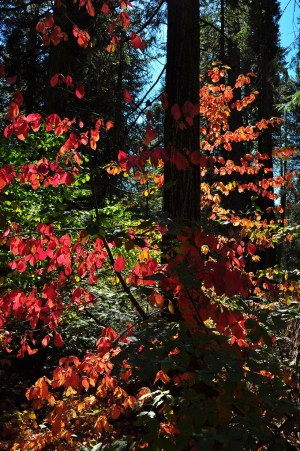
Big Trees & Fall Color

Big Trees & Fall Color

I, for one, believe the best adventures of childhood were often found in the backyard or within one’s immediate neighborhood. As adults we learn of the wider world, of places that are ancient and historical, mysterious, full of wild lands and animals. It’s true, but a life lived yearning to visit these places can let the wonder right outside our door slip away unnoticed.

It was expected that this week at the cabin would entail local exploration, the type of exploration allowed only by ignoring the clock and following a path chosen in the few moments before our next step.

So it was that Karen and I found ourselves at Calaveras Big Trees State Park, after, of course, stopping along the way to pick up seasonal favorites: apple cider donuts and fresh-pressed cider. I was familiar with the area, which is about an hour away from the cabin, but only as an extension of my search for new fishing waters, namely Beaver Creek and the North Fork of the Stanislaus River. To explain briefly, Calaveras Big Trees was created to preserver two groves of some of the most massive giant sequoia trees. (Not always the tallest, but volumetrically the world’s largest trees.) These are Sequoiadendron giganteum, the inland relative to the perhaps more familiar coast redwood (Sequoia sempervirens.

The morning was spend wandering among these enormous trees, looking upward until our neck muscles complained during a hike that covered a few miles. But if the sequoias were the big stars of the show, big leaf maples and dogwoods were the flashy supporting players; this time of year decked out in shades of red, yellow and orange. Their dazzling colors proving that “Autumn is a second spring when every leaf is a flower.”1

Pictures are worth more words than I could possible write, so below is a gallery, a glimpse of what we saw.

1 Albert Camus


2 Comments

hiking through history

We snuck out of the Bay Area on the Thursday a week ago for long weekend, planning to cram a bit of everything into the time we had.

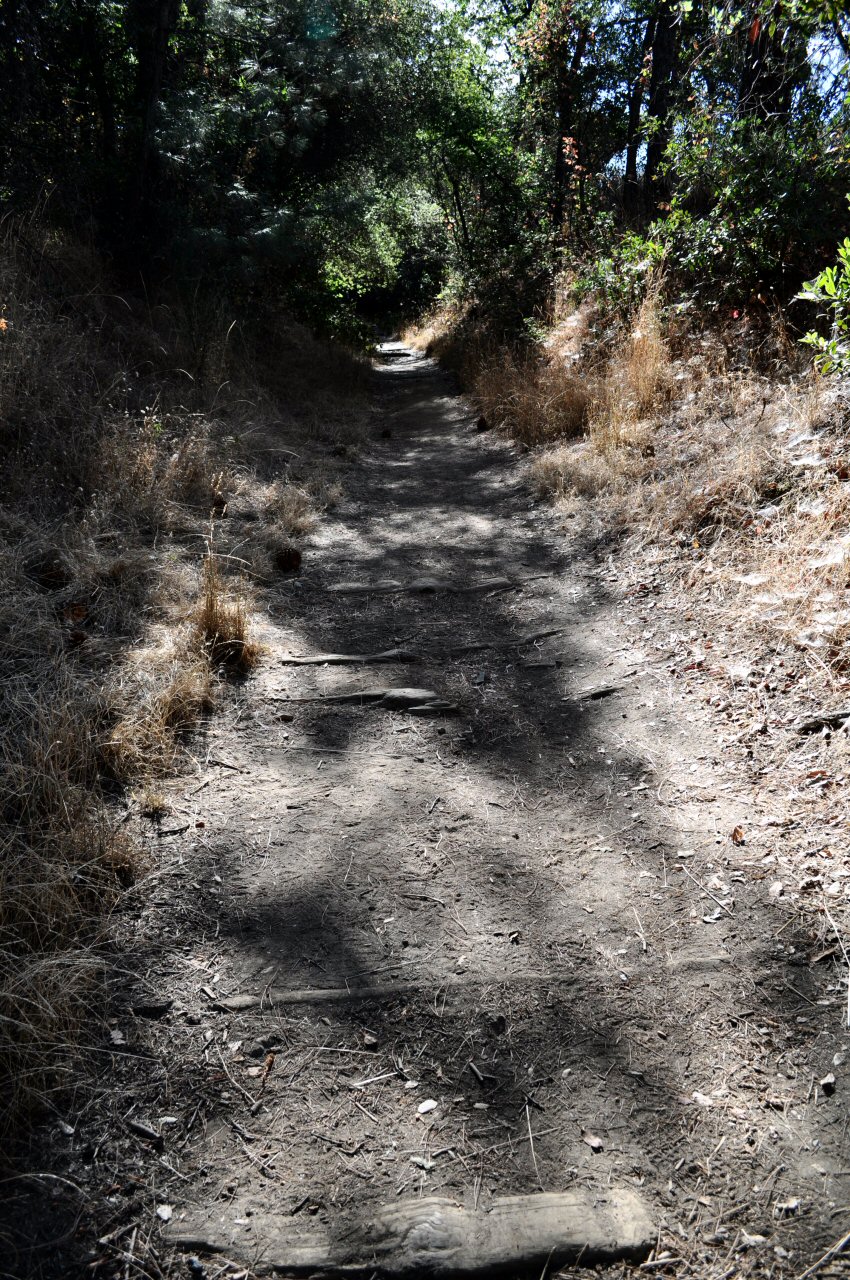
Railroad ties at the West Side Rail Grade trail head.

Railroad ties at the West Side Rail Grade trail head.

In a new spirit of exploring unknown parts of familiar territory, we ended up on the West Side Rail Grade the next morning. The trail — really a former narrow-gauge railbed — begins on Buchanan Road in Tuolumne City and is carved into the hillside above the North Fork Tuolumne River, on the north side of the canyon. It was christened in 1898 as the Hetch Hetchy & Yosemite Valley Railroad under the ownership of the West Side Lumber Co., which used narrow-gauge railroads in the Sierra Nevada Mountains until the 1960s. The HH&YV was primarily employed to haul fresh-cut logs from the sugar pine forests of eastern Tuolumne County to the West Side Lumber Mill in Tuolumne City.

The trailhead is just outside of town, and the first 100 yards are marked by decomposing railroad ties that look like worn steps. After that, most of the trail is exposed, which left us to bake in a remarkably hot morning sun. There are a couple places where benches and tables allow for a break in the shade, and a sprinkling of poison oak along the trail encourages one to stick to the well-worn path.

Though I’m not a history buff, per se, it’s a pleasant surprise to find remains of history in situ. About a mile down the trail we came across long portions of ties and rails, with the trail occasionally shifting from one side of the tracks to the other.

Rails of the Hetch Hetchy & Yosemite Valley Railroad.

Rails of the Hetch Hetchy & Yosemite Valley Railroad.

The grade slopes gently downward, at least for as far as we hiked, and it would be a great place to break in some new boots. Had we continued the full 4½-plus miles, we could have soaked our toes in the North Fork of the Tuolumne River, near Basin Creek. (I originally discovered part of the West Side Rail trail while exploring Forest Service land above Long Barn, and while fishing an upstream portion of the Tuolumne, but have since determined that was another section of the trail that stretches from Hull Creek to the Clavey River, that that’s another hike for another time.)

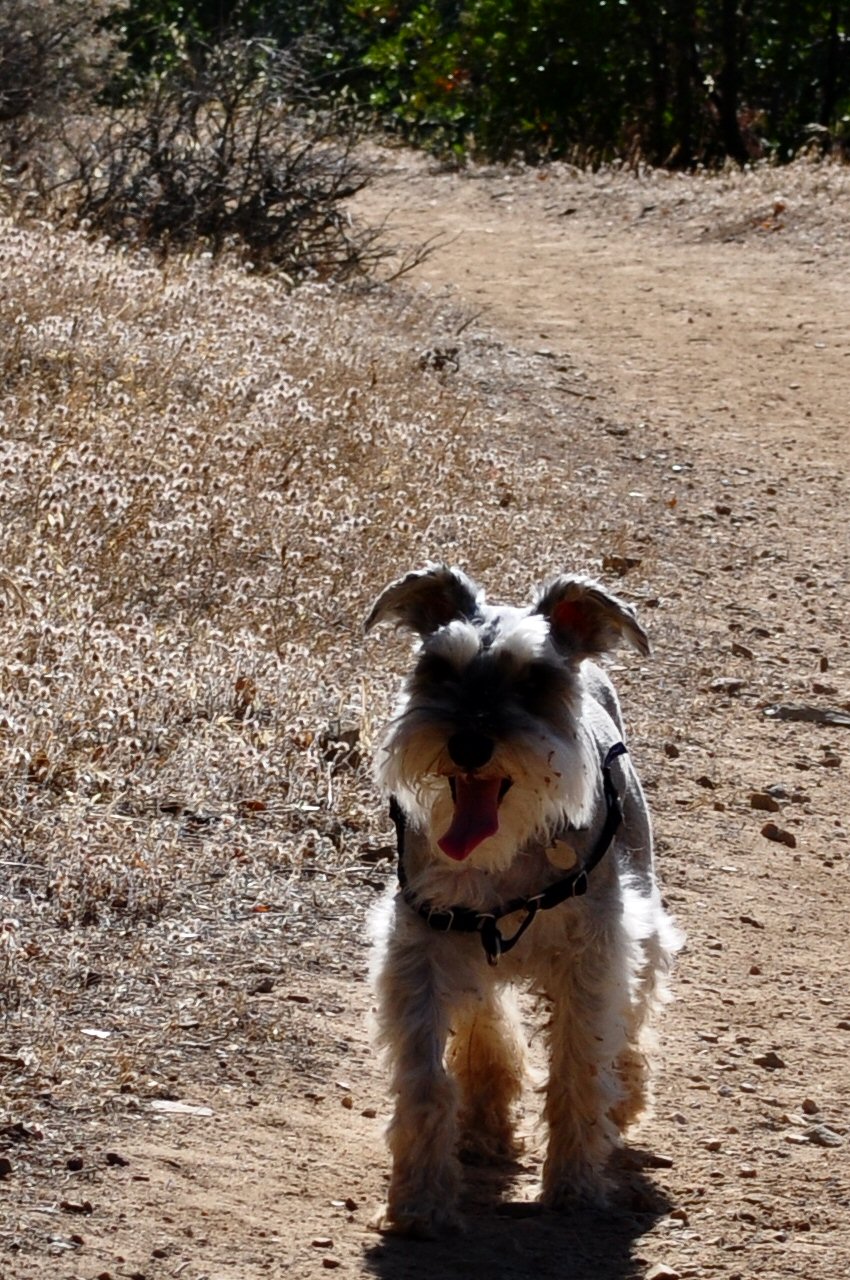
Hot and happy dog.

Hot and happy dog.

We met a few folks along the way: an overachiever who was jogging uphill and a few women who walk it almost every day, one of whom had made a dramatic move from the northern California coastal town of Bolinas to the much drier Sierra foothills.

With the full heat of the sun soon approaching, we left the exploration of a last blind curve for another time, and headed back. This day we had the dog with us and I don’t know if it was he or I who was panting more in the heat.

I have a feeling, though, that we’ll see more of this trail in the spring.


1 Comment

on the (hidden) cost of visiting a “local” fly shop

Sure, deceit is rampant in fly fishing. A common non-answer answer to “What fly you using?” might be, “Well, they’re looking at dries, taking some nymphs too, but streamers might work.” And it’s always delivered with a grin.

That same grin might go along with a tale about the latest and great gear gotten at a great price, but often left unsaid is the “where” of that purchase. While I pondered the gift certificates on my desk and personally wrestled with this question of “where” the last few weeks, it dawned on me that me and my generation maybe the last one with truly equal footing in the pre- and post-Internet world.

My nearest fly shop is about 17 miles away, not too far. It’s a modest affair and on the surface, like many fly shops, seems to have had its struggles over the years. Inventory can still be hit or miss.

The Orvis gift certificates on my desk, however, made the choice between shopping online and visiting a brick-and-mortar shop both a logistical and a financial decision. The closest store, in San Francisco, closed last year. I could shop online, but wading boots were on my list, and just as much as I wouldn’t buy a fly rod without casting it first, I generally don’t buy anything that will be worn without test fitting. I also detest the drawn out process of buying, returning and awaiting shipment of a replacement item.

That’s why the wife and I ended up at the Roseville Orvis store, 80 miles away from home, a weekend ago.

We made a day of it, stopping to walk in Discovery Park along the American River, just above its confluence with the Sacramento River. The weather was great and the river was dotted with boats of anglers searching for the first salmon of the Central Valley season.

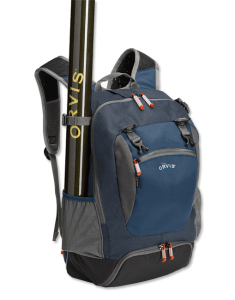
packWe found the Orvis store after realizing it had moved and, feeling a bit like a dork, I carried my waders and socks on the walk to the store. The waders gave me away as soon as I entered the store, and soon I was set with new rubber-soled wading boots. (My old felt boots are still serviceable, but will be relegated to a back role and waters known to be invasive species free.) A small chest pack was selected and a day pack ordered. More than a few flies made it into the bag.

I enjoyed the friendly banter with Frank – comparisons of fishing experiences, hints and suggestions of waters that deserve a visit – something that’ll never be matched online. And there was no cost to fondle wiggle test rods on my wish list.

Fuel to Get There: $18.45
Entrance Fee at Discovery Park: $5.00
Lunch at Smashburger: $10.52
Plenty of New Fly Fishing Gear: Don’t Ask
Personal Service from Guy Who Actually Uses the Gear: Priceless


Leave a comment

backup? what backup?

This should not have been so easy. Having a love/hate relationship with the wizard behind the curtain that makes this blog run, I was totally expecting to embark on an adventure without end, one marked by wrong turns, erroneous Internet advice and little support when I finally decided to restart this blog with a clean slate. Instead, it took less than four hours last weekend to get things back up and running. Well, most of it.

To provide some background, during the last few months I’ve become better acquainted with my host’s support staff than I ever wanted to be. Invariably, each email began with some mention of “excessive usage.” First it was brute-force attacks, then a wonky plugin.

Next came fear. Fear that the next post would spike my usage, earning a prolonged shut down of my site. Fear that I’d lose every post and image uploaded since 1997.

Then I got over myself. The wife had been patiently listening to my grunts, ramblings and cursing for much too long. It was time to do something. Anything.

Most anyone will first search Google, through which you will find contradictory advice on how to handle restarting a self-hosted WordPress blog from zero. After too much time spent looking for the right advice, I just dove in, accepting that it’d either be a surprising success or fantastic failure. I backed up the data, wiped the directory clean, reinstalled WordPress with a new theme, and imported the previously backed up data.

And here we are, up and running. Mostly.

All the words are back. The photos, not so much. (I blame much of the increase in CPU and memory usage on a gallery plugin previously employed, a plugin that became bloated when commercialized.)

The biggest benefit is that everything under the hood is current and up to date. It’ll be a few weeks before all of the photos are restored, but I figure that few folks are interested in my history.

After all, blogs are generally about moving forward, one new post at a time, aren’t they?


7 Comments

first time fly fishing with the wife (or, rolling the dice on being out-fished)

I never pushed fly fishing on my wife, but she’s always supported my pursuit of the sport and listens attentively to accounts of all my adventures. She usually believes the fish are as big as I say.

Then, a few months ago she took me by surprise, asking if I would show her how to cast a fly rod. I’ve had welcome opportunities over the years to help teach, or at least acquaint, a few folks with fly fishing. In addition to assisting with the club’s novice class, it could be said I didn’t teach too many bad habits to my brother and my son, both of whom went on to have some success.

After an involuntary thought that “those who can, do, but shouldn’t necessarily teach,” I agreed to take my wife out for some casting. Good weather offered an opportunity and we spent just under an hour going through the basic motions.

A few weeks later, during a discussion of our weekends, I reminded her that I’d be teaching the novice class on an upcoming Saturday. She asked if there might be room. There was, and soon she had reserved a spot. She learned a lot and suffered through some frustration.

It is nice to have someone to take a photo.

Sure is nice to have someone along to get photographic evidence.

We’d be at the cabin a week after the class, and while a friend would be with us and side trips were planned, it was expected that I’d slip away to chase a few trout. Although we packed extra rods, reels and my spare waders and wading boots, it wasn’t until we stopped at Bass Pro and purchased a license for my wife did the reality sink in that she actually might join me.

Firmly believing that the best way to hook someone on fly fishing is to get into a fish on a fly rod, our destination the next morning was a stocked stream not too far from the cabin. We test-fit the waders at home and knew they would work well enough. My wife set up the rod and reel on her own, we clipped on our wading staffs and headed to the stream. I think it was after a dozen steps or so that my wife began referring to my old wading boots as “clown shoes.” (Admittedly, they were a bit big, but did the job that day.)

My wife doesn’t much like water — it’s for drinking and bathing and that’s about it — but she didn’t flinch much when we began wading. While waders provide a barrier between the wearer and the wetness of the water, one still “feels” the water. I reassured her that in water this cold, after a bit of time, she’d be too numb to notice.

Just before the first strike...

Just before the first strike…

This is a stream best nymphed, with limited dry fly action some afternoons. Offering a running commentary on what I was doing, I rigged up two standard nymphs below an indicator. I explained and demonstrated where to cast (and hooked a fish in the process), and talked about how the trout would be looking for a close approximation of a real insect drifting near a current seam.

The morning was sprinkled with encouragement and advice. My wife’s casting, more like lobbing under the tree limbs above, improved. Her patience was impressive. After the first take of the day, it was more than an hour before a second bump. She wasn’t the only one casting to ghosts. I could count my strikes on one hand.

About midmorning we shifted downstream about 10 feet. The fish in this stream, though raised in a hatchery, move throughout the day, typically following the movement of the shadows. Close to noon, there’s more sunlight than shadows on the water, forcing any trout in the area into a narrow and definable seam. Downstream, I switched to a dry/dropper setup and was sight casting to a decent looking fish. Good placement and presentation earned a solid strike, and I landed my second and last fish of the day. Photo taken and trout released, the focus returned to getting the wife on a fish.

There’s no telling what changed — the temperament of the fish, the depth or general presentation of the flies — but suddenly my wife could lay out a cast, manage the line and fool a fish. A trout was hooked on the second or third strike, offered a dramatic leap and was gone. In between a few more strikes we worked on line management and talked about setting the hook. A few more strikes were missed.

Karen's First Fly Fish

Getting the “hero shot” took some dedication with an uncooperative, slippery fish. But she did it.

Then it all came together.

It was good to get excited about a fish on the line, even if it wasn’t my line. Limiting my advice to keeping the rod tip up and letting out line when the fish demanded it, I set my rod down and carefully moved downstream of the missus. I calmly instructed her to bring the fish head first into the net. For one heart-stopping moment the 12-inch rainbow would have flopped out were it not for my cat-like ninja reflexes luck.

Yes, my wife did receive a proper fly fishing baptism, falling into the water a few times. (No water over the waders and nothing broken.) Tangles were minimal and, amazingly, not one fly was lost the entire day. I do worry, however, that had she hooked (and landed) all the fish that hit her flies, she would have out-fished me.

Ask my wife why she stepped up to try fly fishing and you’ll get some sentimental nonsense that it’s another way to spend time with her husband. That day, in a cool stream away from everyday worries, after landing a trout, she told me of a new understanding of why I enjoy fly fishing.

While we’re not running out to buy her new gear, I’m now optimistic that there’s a greater chance of fly fishing any suspect water we pass during our travels.


3 Comments

dusting off good memories

Just about two weeks ago I awoke to two unfamiliar sights that dusted off old memories. Bright sunshine, a cloudless sky and startlingly green lawns made possible by man’s influence on the course of water in this Southern California desert.

I hadn’t been in Riverside County for more years that I care to count, and this was the first time in a long while that I was visiting the lower half of the state without any plan or itinerary. There was a more mundane reason for this trip, but much of the time it offered a chance to really look around.

There’s always a risk that memories won’t match up with the reality of a place after the passing of decades years. Not this time. Sure, there probably where more people, more cars on the road, and more of those funky strip malls that seem endemic to Southern California, but it was the nature of the place — something that I tend to tune into more than man-made landmarks — that matched my memories.

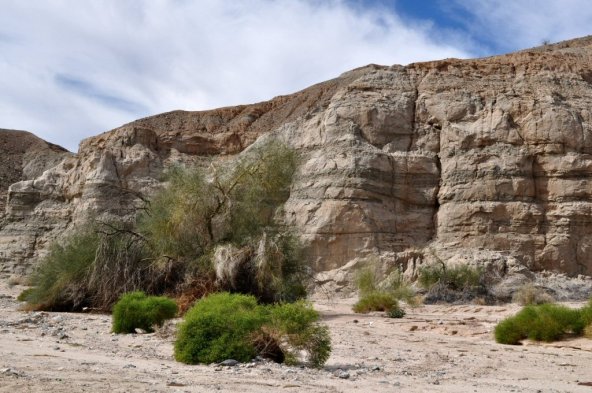
My viewpoint was a bit muddled…I had spent my early high school years looking east to find Mt. San Jacinto; this trip it was west. But much of the terrain was familiar. The steep escarpments of the San Jacinto and Santa Rosa mountain ranges. The dramatic demarcation between the watered and arid land of the Coachella Valley. The canyons carved over decades by flash floods. Clusters of course native grasses and sparse bushes watched over by the occasional ironwood tree.

A beauty of its own.

A beauty of its own.

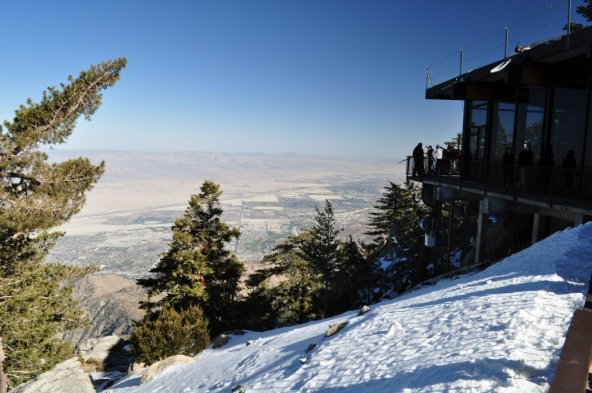
High above were the “sky islands” of the mountains. The Palm Springs Aerial Tram took us from a dry canyon (2,643 ft.) to the near alpine conditions surrounding the mountain station at 8,516 ft., where the snow was in the foreground of a view of the vast and dry valley below. This engineering marvel — only the first tower is accessible by road, the others only on foot and by helicopter — passes through five climate zones during its 2.5 mile climb.

Looking out over Palm Springs and the Coachella Valley desert from 8,500 feet.

Looking out over Palm Springs and the Coachella Valley desert from 8,500 feet.

Our drive one day included a stop at one of the big date ranches in Indio, where I was reminded how much I enjoy that fruit. (Those with lower moisture content, thus not sticky, can be good snacks to carry during hunting and fishing…) We also passed the Salton Sea, an ecological oddity that no one seems to know what to do with.

It’s always a risk revisiting a place of the “good ol’ days.” I’d dare say that this trip, and memories it created, were almost as good as those days long gone.