Sometimes life just throws a curveball. Two weeks ago it felt like every curveball was followed by another.
So, I abandoned the original plans to sandwich a cabin visit with the sister and family between two full days of fishing and just go with the flow.
That meant the two-and-a-half hour drive to Twain Harte stretched out to about four, interrupted by a longer than usual stop at Bass Pro.
It also took longer than usual to coax that first trout to take a fly in a nearby stream.
Back at the cabin, I whiled away some time reading and generally taking it easy.
The sister, her husband and two sons taller than most everyone pulled in about noon Friday. Soon enough we were beating the heat at Twain Harte Lake. A visit to the cabin is a mixed blessing during hot weather; the lake offers respite, complete with an old-school snack shack with burgers, fries, milkshakes and snow cones. The cabin, however, and despite a lack of insulation, seems to retain all the heat of the day well into the evening.
The nephews goaded their parents into the usual swim to a platform near the center of the lake, then a swim to “The Rock.” Then back. I admired their energy from shore, dipping my feet in the water and reading. The afternoon was completed with a visit to the snack shack.
Normally the only overexertion on my vacations entails scrambling over boulders and under downed trees in search of trouts that sometimes aren’t there. Saturday I opted for an easy, sure thing, fishing a well-stocked creek that’s often pounded by the put-and-take crowd. This day I’d be alone for well into four hours, targeting specific fish and trying to coax dry-fly takes.
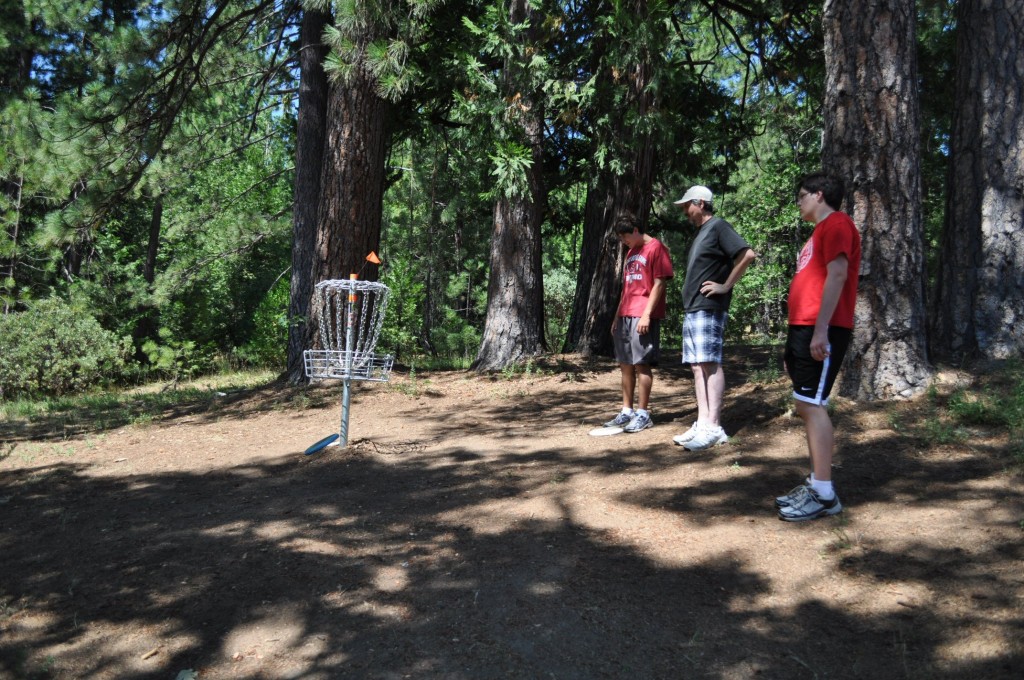
I found my cabin mates finishing up the breakfast clean up when I returned about mid-morning. They planned to hit the local disc golf course, and I figured I’d lug my camera along. I’ve come to realize that I don’t have a lot of hero shots of myself during fishing, hiking, motorcycling, etc., so I’m trying to step in to take a few photos for folks when I can.
The boys pondering Luci’s shot. Missed by that much.
This disc golf course is purely a volunteer effort that gets some financial support from the local community, and it’s nice to see younger folks join in the creation of something positive. The course winds its way through a now fallow traditional golf course, over an irrigation ditch and under a flume.
My nephew Nicholas plays Ultimate Frisbee and might be expected to be the odds-on favorite, and while Tom, his father, will deny his intense completive streak, it quickly became clear that the rest of us were there to, pretty much, watch a one-on-one match. On the fourth basket (hole) another player gave us another disc, allowing me to participate. Like the amateur I am, there was a lot of wasted effort spent on power when form was more important. I later learned that my arm isn’t as young as it used to be. There was no use keeping track of my score; I was always one stroke behind Tom or Nick. And where either of them could curve a Frisbee around an obstacle, my choice was limited to going straight through if I could or give it a very wide berth. The competition would end with Tom winning by a stroke. I believe Tom also won our game of mini golf that evening.
The afternoon was again spent on the beach, with swimming, conversation, tossing of the Frisbee and a return to the snack shack.
Proving that there’s not competiveness in their family, Tom and Nick returned to the disc golf course the morning before our departure for a grudge friendly rematch. Nick recovered some dignity with a win.
This short trip was a welcome, unscripted getaway.
Nathin launching one from the first tee.
Nathan letting one loose behind Lyons Canal.
Tom scoring on the first hole, aka basket.
The boys pondering Luci’s shot. Missed by that much.
Luci showing that form honed after years of playing disc golf. That or ballet.
Tom working out of the ‘rough.”
Nick in the rough. (It looks worse than it really was.)
Sean lining up a putt on hole four at Twain Harte Miniature Golf.
When it comes to the oldest son, the easiest way to level the playing field is to chase wild trout. While there may be some claim that genetics would ensure that he’d be at least half as good a fly fisherman as his old man, the truth is that there’s no substitute for experience.
The day after our Annual One-Day Tioga/Sonora Pass Tour, we had an agreement to take it easy, meaning no alarms. We were still up and out at a decent hour, though long after the sun had begun to warm things up. This Friday being designated a “Man Day,” our first stop was for convenience store coffee and breakfast. The day would later include miles of dirt roads, a lot of hiking, and a whole heap of fly fishing. Manly stuff indeed.
We were headed northeast to Arnold, cutting across the dry, now golden Sierra Nevada foothills once scoured by ‘49ers. We passed the time during the hour-plus drive with conversation, the usual good-natured ribbing, and a good playlist. The focus of the day was a small freestone stream rumored to be well worth the effort. It could be easily accessed through a state park.
We didn’t want easy.
After inquiring about this stream a few months back, a club member cryptically described in a hushed voice a series of left and right turns leading to a serviceable Forest Service road that eventually crossed Stream X. His tale of the wild trout that lived there was peppered with warnings of fast-moving logging trucks and rattlesnakes.
With the help of a National Forest Service map of the area, I had determined the most likely route. But there’s nothing like local knowledge. We stopped at Ebbetts Pass Sporting Goods for guidance and picked up a few flies from one of the best selections I’ve run across. Bill, owner and long-time resident who’s hunted and fished the area for some 30 years, is always willing to take the time to offer advice. (Based on our conversations, I now have a list of rarely fished and not-so-easily accessed waters.) Bill’s confirmation of our route also included some obfuscation…the first left was after a city limits sign and our destination was near the bridge.
The paved road extended farther than expected. The vegetation here was a bit greener and denser than that around the Family Cabin and a welcome change. Soon enough we were on the dirt road. Not your typical Forest Service road, rather one made more drivable thanks to constant compaction by heavy truck traffic and frequent watering.
It became clear during our pre-fishing ritual — changing into waders and checking rods — that we were in the right place at the right time. Chance would have it that I looked up just in time, over the top the car and through the trees to a bend in the creek about 50 yards away, to catch a glint that could only have been from a jumping fish. An added bonus: it was just us.
Sean was on the stream first and hooked a trout in a small pool. It was about nine inches, and coloration and big parr marks confirmed it as wild. Looking over this stream, it was clear this would be a day of pocket water. At the end of the day, about 75% of the water we’d fish was pocket water and more than 90% of our takes would be on dries.
In typical fashion, we leapfrogged past each other as we headed upstream. Sean lagged behind at one of the better shaded pools in this section. Upstream was a wide, sweeping bend. Trees provided shade on the inside. The outside of the bend must be scoured during heavy runoff, leaving a big field of rounded stones of all sizes. Tire ruts leading down to the stones were left by the logging company’s watering truck and — as evidenced by a pod of obviously stocked trout darkening the center of the bend — a DFW stocking truck. Temptation got the best of me and I got a few planters to take a big stonefly pattern. Sean had since emerged and I moved upstream, only to be halted by a fence extending through the stream and up both banks.
Returning to the bend, Sean and I agreed that, with the two other fishermen who had since arrived, it was suddenly too crowded.
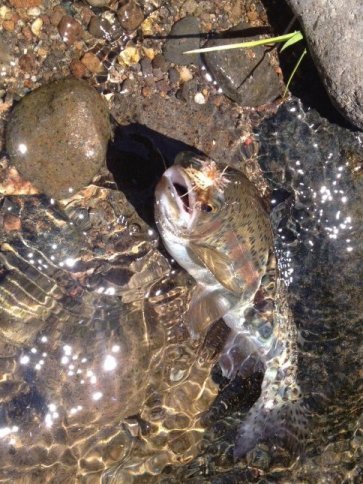
A rainbow trout that’s a bit bigger than expected in this small creek.
Nice surprise in a small creek.
During my time upstream, the driver of the watering truck had chatted up Sean. While sucking water from a beautiful stream that’s habit for wild trout is uncool, at least the driver offered up details about how to get to a more remote and less-fished section upstream. Following his recommendation, we picked our way down a less-frequented road. This isn’t your graded road, but rather a barren section of forest sprinkled with stones and crisscrossed by fallen branches. The type of road that wouldn’t necessarily require four-wheel drive, but where I would have been thankful to have a bit more ground clearance than offered by my (trusty) Accord.
It was slow going. The road meandered away from the stream and gained elevation before a fork dropped us down to a wood bridge.
Here the character of the stream changes. It’s nearly all pocket water. And skinny.
As expected, the fish were spooky. We didn’t really see the fish; we caught flashes of fast-moving shadows in the periphery of our vision. This is the kind of stream that tests one’s ability to pick out suspect water and adequately present a fly. There might be strikes on your first two drifts. After that, it was time to move on. Thankfully, there was a lot of stream available.
My first cast was to ideal pocket water behind a large boulder. Water tumbled past the boulder into a pool that while not deep, was dark enough to hide fish. That first drift netted a brilliant eight-inch rainbow. This was repeated often as we hiked upstream, with nearly every fish chasing our dry flies.
It’s likely we could’ve spent all day moving upstream. But we did have to pick up a wine club shipment in Murphys, so we headed back to try fishing downstream of the bridge. There were a few spots but it wasn’t too far before the stream enters a canyon narrow enough to encourage a solid risk/reward assessment before continuing.
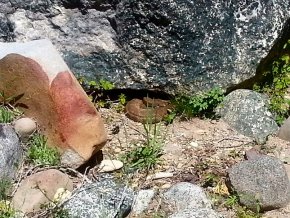
A not-so-nice surprise.
Sean, who wasn’t aware of my decision, was hiking along a deer trail above the stream while I headed back upstream. There was no scream or shout, and it wasn’t until he caught up with me that I learned of the first rattlesnake sighting of the season. Sean was foolish coolheaded enough to linger long enough to take a photo.
We debated stopping to fish again on the way out but decided otherwise. Our drive back to the highway included sightings of a coyote and turkey. After a stop at Ebbetts to report on our success (suitably suppressing how excellent it really was), it was time for a post-fishing beer. Luckily, Snowshoe Brewing wasn’t more than 15 minutes away.
We completed the day picking up that wine, tasting some of that winery’s products, and grabbing decent-but-not-great burgers at a place adjoining a gas station. Music and banter continued on the drive back, with a promise to keep up the illusion that this really-not-so-secret place was our little secret.
I did outfish the boy. I also whooped him in a game of mini golf. Even so, I think he had a pretty great time.
The Oldest Son and I kept tradition alive with the Annual One-Day Tioga/Sonora Pass Tour last week and found a few Sierra Nevada rivers and streams running a bit too high for easy fishing, despite the lack of snow this year.
This excursion — passing through Yosemite’s high country and over two passes exceeding 9,000 feet — was marked this year by a deliberate slowing down. As always, the plan was to fish along the way. This time, however, there was an acceptance that fish would be there, or not, when we arrived. Perhaps it’s maturity. Perhaps overconfidence in my abilities. Whatever the case, it would open our eyes to new sights and new fishing possibilities.
The Tuolumne Meadows general store being assembled for the season.
We left the Family Cabin later than usual but quickly covered our longest continuous stretch of driving before arriving at Yosemite’s Big Oak Flat entrance station. Less than an hour later we pulled into the Tuolumne Meadows campground parking lot. A crew was stretching canvas over the wood frame of the campground’s general store. The meadows were already exposed and beginning to brown. The upside: it’ll probably be a relatively light mosquito season. But if you have any inclination to fish high-country streams or rivers, the season will be about a month head this year. Don’t be fooled; it was still cold.
We wadered up and spooked a few trout in one river, wrongly thinking that they had forgotten about fisherman during the winter. We explored a few other streams just past Tioga Pass. Reading a roadside monument, I learned of Bennettville, a mining town that never produced ore during its existence from the 1870s through 1933. It did, however, give birth to the Great Sierra Wagon Road, which later became Hwy 120 and the Tioga Pass Road.
The Tuolumne River, with Sean in the far background.
The morning spent, we headed down to the Tioga Gas Mart and after picking up a few bottles of Mammoth Brewing beer, stopped for a barbecue lunch.
A few more miles behind us, we stopped on the bridge over the Little Walker River. I judged it just on the verge of being fishable and expected Molybdenite Creek, which feeds into the Little Walker, to be in similar shape and worth the time to show Sean this favorite place for the first time. Disappointed to find two other fisherman, we hiked around them before dropping down to the creek.
The Bennettville Marker near Saddlebag Creek. The town is about a mile west.
My favorite spots on this creek are pools usually created by piles of brush or the ledge of a small waterfall. Eventually, I hooked a couple of wild fish, lost most on dry flies that were just a bit too big, but finally landed a nice brook trout. Downstream, Sean also hooked a nice brookie.
We worked our way downstream, exploring the confluence of the two creeks, then began the return upstream, revisiting suspect water. Sean landed another brook trout from the pool I had fished.
The other fisherman had left, leaving upstream water open. Through a thick stand of pines and aspen I found a curve in the creek that created a pool and nice looking tailout. Trees crowding the edge of the creek limited casting to short casts parallel to the stream. Reaching the tailout required letting a fly drift under an overhanging log. But it was too good to pass up. A few drifts netted a decent brook trout.
Once my focus was off the tail out, a small pod of fish working at the head of the pool came into focus. It was pretty clear they were stocked trout, and while their domesticated appetite might not present a huge challenge, their position did, requiring casting from a crouched position and underneath an overhanging birch branch. Sean joined me later, and despite losing three or flies between the two of us, it was a fun casting and fighting fish in close quarters.
On the way toward Sonora Pass, we skipped the raging West Walker in favor of the upper North Fork of the Tuolumne, on the west slope. There we’d find stock rainbows willing to hit stimulators well into the evening.
In the end, we fished places unfamiliar and usually unfishable this time of year.
The spirit of exploration spilled over to the next day…
More on that next week.
The Bennettville Marker near Saddlebag Creek. The town is about a mile west.
The Tuolumne River, with Sean in the far background.
Ice along the Tuolumne River.
Our old friend, Lembert Dome.
The Tuolumne Meadows general store being assembled for the season.
I never pushed fly fishing on my wife, but she’s always supported my pursuit of the sport and listens attentively to accounts of all my adventures. She usually believes the fish are as big as I say.
Then, a few months ago she took me by surprise, asking if I would show her how to cast a fly rod. I’ve had welcome opportunities over the years to help teach, or at least acquaint, a few folks with fly fishing. In addition to assisting with the club’s novice class, it could be said I didn’t teach too many bad habits to my brother and my son, both of whom went on to have some success.
After an involuntary thought that “those who can, do, but shouldn’t necessarily teach,” I agreed to take my wife out for some casting. Good weather offered an opportunity and we spent just under an hour going through the basic motions.
A few weeks later, during a discussion of our weekends, I reminded her that I’d be teaching the novice class on an upcoming Saturday. She asked if there might be room. There was, and soon she had reserved a spot. She learned a lot and suffered through some frustration.
Sure is nice to have someone along to get photographic evidence.
We’d be at the cabin a week after the class, and while a friend would be with us and side trips were planned, it was expected that I’d slip away to chase a few trout. Although we packed extra rods, reels and my spare waders and wading boots, it wasn’t until we stopped at Bass Pro and purchased a license for my wife did the reality sink in that she actually might join me.
Firmly believing that the best way to hook someone on fly fishing is to get into a fish on a fly rod, our destination the next morning was a stocked stream not too far from the cabin. We test-fit the waders at home and knew they would work well enough. My wife set up the rod and reel on her own, we clipped on our wading staffs and headed to the stream. I think it was after a dozen steps or so that my wife began referring to my old wading boots as “clown shoes.” (Admittedly, they were a bit big, but did the job that day.)
My wife doesn’t much like water — it’s for drinking and bathing and that’s about it — but she didn’t flinch much when we began wading. While waders provide a barrier between the wearer and the wetness of the water, one still “feels” the water. I reassured her that in water this cold, after a bit of time, she’d be too numb to notice.
Just before the first strike…
This is a stream best nymphed, with limited dry fly action some afternoons. Offering a running commentary on what I was doing, I rigged up two standard nymphs below an indicator. I explained and demonstrated where to cast (and hooked a fish in the process), and talked about how the trout would be looking for a close approximation of a real insect drifting near a current seam.
The morning was sprinkled with encouragement and advice. My wife’s casting, more like lobbing under the tree limbs above, improved. Her patience was impressive. After the first take of the day, it was more than an hour before a second bump. She wasn’t the only one casting to ghosts. I could count my strikes on one hand.
About midmorning we shifted downstream about 10 feet. The fish in this stream, though raised in a hatchery, move throughout the day, typically following the movement of the shadows. Close to noon, there’s more sunlight than shadows on the water, forcing any trout in the area into a narrow and definable seam. Downstream, I switched to a dry/dropper setup and was sight casting to a decent looking fish. Good placement and presentation earned a solid strike, and I landed my second and last fish of the day. Photo taken and trout released, the focus returned to getting the wife on a fish.
There’s no telling what changed — the temperament of the fish, the depth or general presentation of the flies — but suddenly my wife could lay out a cast, manage the line and fool a fish. A trout was hooked on the second or third strike, offered a dramatic leap and was gone. In between a few more strikes we worked on line management and talked about setting the hook. A few more strikes were missed.
Getting the “hero shot” took some dedication with an uncooperative, slippery fish. But she did it.
Then it all came together.
It was good to get excited about a fish on the line, even if it wasn’t my line. Limiting my advice to keeping the rod tip up and letting out line when the fish demanded it, I set my rod down and carefully moved downstream of the missus. I calmly instructed her to bring the fish head first into the net. For one heart-stopping moment the 12-inch rainbow would have flopped out were it not for my cat-like ninja reflexes luck.
Yes, my wife did receive a proper fly fishing baptism, falling into the water a few times. (No water over the waders and nothing broken.) Tangles were minimal and, amazingly, not one fly was lost the entire day. I do worry, however, that had she hooked (and landed) all the fish that hit her flies, she would have out-fished me.
Ask my wife why she stepped up to try fly fishing and you’ll get some sentimental nonsense that it’s another way to spend time with her husband. That day, in a cool stream away from everyday worries, after landing a trout, she told me of a new understanding of why I enjoy fly fishing.
While we’re not running out to buy her new gear, I’m now optimistic that there’s a greater chance of fly fishing any suspect water we pass during our travels.
Opening day of the general trout season in California is this Saturday.
But I won’t be on the water. I will instead sacrifice the first opportunity to be skunked on my favorite stream for the greater good. (Very Vulcan of me, right?)
The first two years after I picked up a fly rod — some seven years ago — I would start preparing for the new trout opener a few weeks after the closing of the previous season.
I do still care about the trout opener. It opens wading access on the west slope of the Sierra usually long before the passes to the eastside are cleared. Being on the water at the earliest legal minute had become tradition. Even back when I was throwing hardware, it wasn’t about filling the freezer; it was simply about being out there, working the rust out of skills unused during the winter. Four seasons ago I accepted the invite of a fellow forum contributor to join him opening day in chasing down backcountry trout. He would provide the four-wheel drive truck, I provided flies. It was a day filled with good friendship, great weather and beautiful country unseen by most. Unfortunately, any trout that may have been in the half dozen streams we visited remained unseen.
The biggest influence in my changed opening day perspective is also one of the bigger rewards that have come with fly fishing. Notwithstanding the excitement of a big Eagle Lake rainbow taking me into my backing, I’ve find an unquantifiable pleasure in helping bring others into the sport. My contributions to the club’s novice fly fishing class aren’t huge, but the enthusiasm imparted by the instructors, including myself visibly, sparks something in the students. The payoff often comes a few weeks or months later, when one of those students, all smiles, presents a photo of the fish caught because of something learned in class.
So, while I’m not retired, but I’ve become one of those guys for whom the trout opener only marks the point in time that most trout water is wide open to fishing. I’m lucky enough to have a place in the Sierra foothills available to me most any time, and I have grown content to head up the week after the opener, often to find welcome solitude on most rivers and streams. I have also taken to the challenge of finding the ‘smarter’ fish left behind after the crowds of opening day.
When I finally do make that first cast for trout this year, it’ll be later, but for good reason.
I’m not the best fly tier. Most of my creations might be ranked as mediocre. I can tie decent flies — some have fooled some pretty crafty wild trout, though hunger might factor into this more than I care to admit. Most importantly, tying my own flies allows me to stock up on patterns I can’t buy in a fly shop. I’m a casual tier, not the crazy old guy who will tie two dozen hopper patterns in a single sitting. With the last kid still at home, I don’t yet have a fly tying room, so I’m relegated to an old TV tray in the corner of the den.
I have read a few fly-tying instruction books, some are pretty good, but aren’t as thorough as they could be. For instance, when I start to tie a fly it goes something like this: select a hook, usually a smaller one about size 20, then drop the hook. If I’m lucky, I find it immediately rather than two days later embedded in my bare foot. I’m thinking my fly tying room will have white tile flooring and a custom desk with magnetic strips inlaid near the edges.
This last weekend I went through the ritual of tying a few dozen flies of the coming trout season in the Sierra Nevadas. I had procrastinated more than ever this year and it was the prodding of the fly fishing club’s auction chairman for donations that finally got me to spend a day at the vise. This auction is held every year and is our single biggest fundraiser. The money raised goes to organizations such as CalTrout, Project Healing Waters, Putah Creek Trout and United Anglers of Casa Grande High School, as well as a club-sponsored scholarship.
The fact that some of these flies would be on public display — with an expectation that other folks might buy them with real money — has always been a good motivator. In the end, I deemed about every other fly worthy of such an honor.
The other, not-so-pretty-flies, ended up in the fly box. I am sure they’ll still fool the fish.
But I can help thinking that I’ll have to buy back the better-looking flies at the auction…
Just about two weeks ago I awoke to two unfamiliar sights that dusted off old memories. Bright sunshine, a cloudless sky and startlingly green lawns made possible by man’s influence on the course of water in this Southern California desert.
I hadn’t been in Riverside County for more years that I care to count, and this was the first time in a long while that I was visiting the lower half of the state without any plan or itinerary. There was a more mundane reason for this trip, but much of the time it offered a chance to really look around.
There’s always a risk that memories won’t match up with the reality of a place after the passing of decades years. Not this time. Sure, there probably where more people, more cars on the road, and more of those funky strip malls that seem endemic to Southern California, but it was the nature of the place — something that I tend to tune into more than man-made landmarks — that matched my memories.
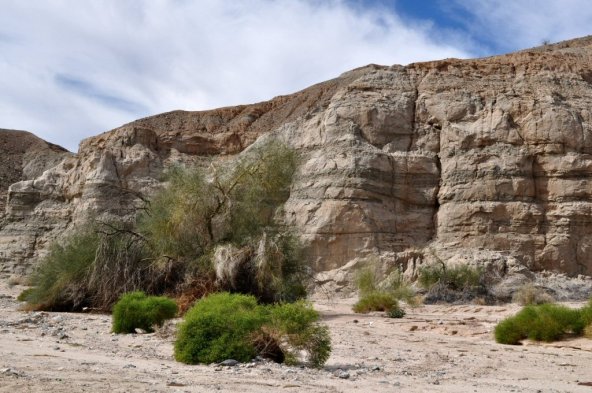
My viewpoint was a bit muddled…I had spent my early high school years looking east to find Mt. San Jacinto; this trip it was west. But much of the terrain was familiar. The steep escarpments of the San Jacinto and Santa Rosa mountain ranges. The dramatic demarcation between the watered and arid land of the Coachella Valley. The canyons carved over decades by flash floods. Clusters of course native grasses and sparse bushes watched over by the occasional ironwood tree.
A beauty of its own.
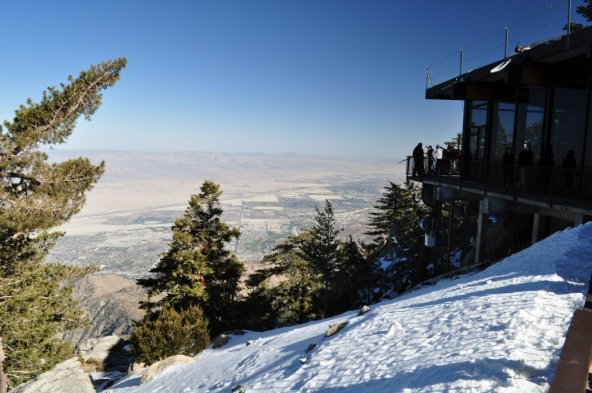
High above were the “sky islands” of the mountains. The Palm Springs Aerial Tram took us from a dry canyon (2,643 ft.) to the near alpine conditions surrounding the mountain station at 8,516 ft., where the snow was in the foreground of a view of the vast and dry valley below. This engineering marvel — only the first tower is accessible by road, the others only on foot and by helicopter — passes through five climate zones during its 2.5 mile climb.
Looking out over Palm Springs and the Coachella Valley desert from 8,500 feet.
Our drive one day included a stop at one of the big date ranches in Indio, where I was reminded how much I enjoy that fruit. (Those with lower moisture content, thus not sticky, can be good snacks to carry during hunting and fishing…) We also passed the Salton Sea, an ecological oddity that no one seems to know what to do with.
It’s always a risk revisiting a place of the “good ol’ days.” I’d dare say that this trip, and memories it created, were almost as good as those days long gone.
A beauty of its own.
Traveling down Box Canyon Road.
Looking down Box Canyon Road.
At the Forever Marilyn statue in Palm Springs.
Looking up at the route of the Palm Springs Aerial Tram.
Karen and mom at the overlook of the Palm Springs Aerial Tram.
The top station of the Palm Springs Aerial Tram.
Look down on the route of the Palm Springs Aerial Tram.
Looking out over Palm Springs and the Coachella Valley desert from 8,500 feet.
The ridge line at top of Palm Springs Aerial Tram.
It’s likely that many of you have never seen “The Gumball Rally.” I have. I’m likely one of the few to see it on the silver screen (as a kid). This weekend, I’ll have my own little Gumball Rally.
I can’t say whether my opinion is biased because I saw “The Gumball Rally” before “The Cannonball Run” (1984) and its sequels. But to this day I think “The Gumball Rally” is the best car-centric movies about an illicit coast-to-coast race than any of the Cannonball films.
Sure, it didn’t have A-list stars (it did help move along the careers of Gary Busey as his nutty self and Raul Julia as Italian loverboy and Le Mans winner Franco Bertollini) and one has to get past the initial shock of its 1970s production quality. But it’s a better film.
“The Gumball Rally” starts in New York. “The Cannonball Run” starts in…Connecticut? Both end up in Los Angeles.
A comparison of all the cars in each film is a wash. However, the lead characters in “The Gumball Rally” (Michael Sarrazin as Michael Bannon and Nicholas Pryor as Professor Samuel Graves) drive an AC Cobra while the protagonists in “The Cannonball Run” (Burt Reynolds as J.J. McClure and Dom DeLuise as Victor Prinzi) drive a souped-up Dodge Tradesman ambulance. Hal Needham and Brock Yates’ actually drove a Tradesman in the actual 1979 race upon which both movies are based, but I’ll take the painfully quick and sexy Cobra any day. The stunt driving by 1960s Cobra racer John Morton lends realism to “The Gumball Rally” and, overall, the cars in “The Gumball Rally” are more beautiful.
If you want stunts, “Cannonball Run” wins. But the scenes of pure speed in “The Gumball Rally” don’t get in the way of funnymen being funny and vice versa.
I love the one liners peppered throughout “The Gumball Rally.” Erstwhile race organizer Michael Bannon: “Some of you won’t make it, but for those of you that do there will be no glory, no headlines. Just a few magic hours flat-out against the red line with no catalytic converter and no 55-mile-per-hour speed limit.” Then there is Raul Julia’s race car driver character’s commentary, with a somewhat corny but appropriate Italian accent, on the rear view mirror: “What’s behind me is not important.”
A final showdown in the L.A. River puts “The Gumball Rally” over the top. (The actors reportedly drove the cars throughout most of the movie, even in the river.)
This Monday I’ll be leaving Palm Desert with my wife, driving a Lincoln Town Car to the San Francisco Bay Area as a “hired driver.” I’ll be Jose from “The Gumball Rally,” the down-on-his-luck mechanic who hired on drive a Rolls-Royce Silver Shadow without telling the owner would be racing cross country, to my wife’s Angie (Jose’s girlfriend).
It’ll be like my own personal Gumball Rally. Except for the high speeds, a paint-peeling sandstorm or trophy.
It’ll only be 500 miles instead of 2,800, but with the right attitude, any road trip can be fun.
( I dedicate this trip to all of my Gumball crew from Perris High School, Class of 1981. It was what I did with you that led to my so-far 27-year career.)
If the headline got you here, great. But let’s first clear the air…
I’m not the master; I’m more of a jack of all trades and master of none.
My last trip of this trout season to the foothills of the Sierra Nevada was like many before it. It offered solitude and a stillness that can only be found in the fall.
It is possible to spend time on most moving waters here — even those that are well stocked — without any company, and my usual arrival at sunup ensures that it’s just me and the fish for a few hours.
Such was the case on one of those streams, one that also sees a small fall run of spawning browns. I hooked only one of those browns this year, a big one that, after we eyeballed each other, promptly snapped my tippet and headed back downstream. Before and after I lost him, there were plenty of raceway rainbows that were willing to play.
When the sun finally warmed up the landscape enough, four gentlemen waded into the stream downstream from me, and slowly began to work their way upstream. I gave them a welcoming wave. Eventually, they were close enough that I could hear their conversation. Phrases drifted over the water…
“They biting?”
“Some, but that guy up there is getting five for every one of mine.” (‘That guy’ was me.)
“Wonder what he’s using?”
“It’s gotta be a nymph or something ‘cause I’m getting nothing on my Adams.”
During my few years of fly fishing I’ve learned to discern the experienced fly fisherman from those new to the sport. It was clear that despite their apparent age, two of the gentlemen had probably cast a fly rod only once before.
I can’t say whether it was the ego boost that comes with someone’s admiration of my catch rate or a more altruistic pay-it-forward attitude, but since I had long lost count of how many fish had wet my net, I offered my spot to the group. After assurances that I had caught plenty of fish, they gratefully accepted. I mentioned that black nymphs of almost any style might work, offered a bit of advice on depth, and the two more experienced guys helped the other two rig up. I think between the four of them they used four different types of indicators.
One of the gentlemen broke away to chat with me. All four gentlemen were over 70 years old. While two of them were more experienced, that experience was with bass or in Alaska, not so much in the Central Sierras. There was no bragging between us, a simple sharing of information and stories. One of their group was from South Africa and had never caught a trout. He did that morning and gave me one of the biggest smiles you might imagine.
I’d end up showing these guys where to find the fish on this stretch, explaining then showing that during a limited window — when the sun is at the proper angle on this stream — during which dry flies will get some attention.
All of us accepted each other in the common bond of fly fishing. While most fish were caught and released, there was a stringer produced and a few fish taken by one guy who was recently retired, but only after asking if we thought it okay. (He somewhat sheepishly explained that he wife had complained that through all his years of fly fishing, and all the money spent, that not once had he brought home trout for dinner.) There was no dissention, knowing that these were stocked fish that might not last through the winter.
When I left, there were smiles all around. We were friends that might have never met were it not for our shared hobby. It was a good way to end my season.
I don’t remember how it was learned. There has been a lot of trail and error, fishing trips and advice from guides and fly fishing friends. It certainly wasn’t during my first year of fly fishing, when it was all new and mysterious — and happiness was fooling a single wild trout. Mistakenly filled with a dream of never being skunked again, all virgin water held promise, particularly without the knowledge that is only gathered with time on the water. Maybe, at first, this knowledge is founded upon a dog-eared book authored by Whitlock, Humphreys, Cutter or Rosenbauer. But over time, those written words merge with experiences to become more instinct than reason.
Only lately did it become clear — while reflecting on fishing an Eastern Sierra river a bit more than a few weeks ago — that my approach to water, at least assessment of it, was without conscious thought that day. A first trout that came to the net early that morning would be the only fish for a period of time longer than I liked. But there was a lot of water to fish. It wasn’t too long before the burble of the river, the lowing of cattle and the rhythm of casting encouraged giving in to just being there and trusting in my strategy.
I no longer feel frustration (I’ll admit to a bit of irritation) when the net remains dry and the fish don’t respond to sound tactics. Digging a bit deeper often reveals a smidgen of an idea that I may be employing the appropriate tactics, just not in the right place. If asked, I usually can’t describe the right place, but I’ll know it when I see it.
I saw that right place that morning on the Upper Owens River, but it wasn’t until long after the fact did I recognize my knowing that it was the right place. At the moment, it simply felt right. It was a small bend where the water tumbled over and through a few polished rocks, with enough speed to carve underneath the bank a small undercut. Above this bend, a confluence of two braids would funnel any food to where fish should be waiting.
What those books don’t tell you, and can’t if they hope to find new readers, is that as insight is accumulated, at sometime it’ll be a gut feeling telling you that you’re in the right place, at the right time, casting the right fly with the right technique. With a lot of luck, you may even feel that a drift is so right that a hook up is almost — almost — guaranteed. That day half a dozen trout from that bend would end up in my net.
It took some thinking about that day before I realized that it was following a feeling, a learned intuition perhaps, and that not overthinking worked out pretty well.







 fishing for words