The bad news is that work this year dictates quick trips pretty much limited to the family cabin. The good news is that this allows for frequent trips that engender exploration.
Last week I decided that the two full days available for fishing would be dedicated to moving waters with familiar names but until now remained unfished. And no one told me it was humpy week. Red and yellow to be exact.
Road work meant the last five miles of my trip took half an hour. Luckily, a month ago I found a small section of the North Fork of the Tuolumne River not more than 20 minutes from the cabin, a convenient place to get the skunk off after a midafternoon arrival in the Sierra foothills. It’s not remote and often occupied, with a limited number of wild trout, but it’s a place that offers room to practice casting to specific seams and shelter.
Like much of the moving water in the Sierras, this section of the Tuolumne was already low. The early season spoiled me, so the fisherman in me was also initially disheartened to find two kids frolicking in the main pool. As a dad, I appreciated that these kids were having a good time outdoors. However, despite the splashing and noise, a trout would periodically and enticingly slash at the surface.
Though a short drive, I hate wasting an opportunity to fool a fish with a dry/dropper combination. A red humpy and a self-tied small, go-to bead-head nymph.
It took a few casts to warm up.
Then the fish warmed up to my presentation.
[singlepic id=1226 w=600 h=450 float=right]
Darn fish wouldn't stay in focus. (But was caught near the rock, in focus, in the background.)
So it went for a few hours. The humpy dried off many times after being battered and half swallowed. These fish were hungry and made me look good.
That’d be the theme this trip, and though I didn’t find as many wild trout as hoped, I did well enough to consider it time well spent.
The next three days I’d fish four unfamiliar waters, landing fish from each, often amid relative solitude (we’ll get to that next week). When not alone, I was lucky enough to enjoy conversation with fishermen more knowledge about the area than I, fly fishermen who were happy to offer friendly advice and recommend additional venues. One gentleman, with a long history of fishing the foothills, related bit of history that suggests in high-water years there’s a very real possibility of brook trout being washed out of a reservoir into a nearby steam.
Yes, it was time very well spent.
[singlepic id=1225 w=600 h=228 float=right]
Big-tailed rainbow...surprising for a stocked fish.
Hopefully, today will be a second day of exploration of waters somewhere on the map below. The best outcome will include fishable water, wild fish and solitude.
It turns the tables a bit when it’s the kids introducing parents to new places and experiences and revisiting the familiar after three decades is icing on the cake, though there’s bound to be disagreement in our personal memories.
[singlepic id=1223 w=300 h=400 float=right]
Mom and Dad at the cabin, for their first visit.
But easy agreement was found in the beauty of the scenery and shared remembrances during a long drive up and over Tioga Pass, along the shores of Mono Lake, before a return over Sonora Pass.
The parents arrived at the cabin late that Sunday afternoon, and after running an errand that took entirely too long for Dad, dinner was enjoyed and we settled in for the evening. Thankfully, the storm that had dumped snow on the passes had dissipated the day before and the warmth of the sunshine had cleared the roads.
Mom, Dad and I leisurely left Twain Harte with a route in mind but absent any planned stops or timetable. The hillsides leaned more toward gold, but were freckled by islands of still-green grass.
I’ve driven this road many mornings, but saw things a bit differently today since I wasn’t preoccupied with wetting my fly line. Miles rolled by, lubricated by conversation. Soon it was time for a stop to stretch our legs. Though there aren’t many hatcheries that will, in my mind, match the magnificence of the historic Mt. Whitney Fish Hatchery visited in my youth, there was something familiar about walking around the Moccasin Creek Hatchery with the folks.
After the excitement of gaining 1,500 feet in elevation over the two miles of the “new” Old Priest Grade, it was all new territory for Mom and Dad as we wound through Big Oak Flat, Groveland, and past Buck Meadows. Highway 120 took us from 2,838 feet at Big Oak Flat to Yosemite National Park’s Big Oak Flat Entrance Station at 4,900 feet. Dad was impressed by the tidiness of the towns and the number of old buildings alongside the roadway, many of which are still in use.
If it wasn’t enough to have fantastic weather, traffic was light. By mid morning we arrived at the entrance station, where the purchase of an annual pass got us across the park border. Words in many foreign languages hung in the cool air, reminding me of the many nature blessings that aren’t more than a day’s drive from home that attract visitors from around the world.
I’ve always throught that the changes in vegetation and terrain grow more dramatic once inside the formal boundaries of Yosemite. Heavy forest yielded to granite, which only seems to yield to water in the form of glaciers, ice and liquid. We pushed on to Olmsted Point, taking obligatory photos, then on to Tenaya Lake. Availing ourselves of the facilities near the lake, I made a mental note that I need to spend more time exploring Tenaya Lake and its surroundings.
There’s a drama that comes with finally emerging from the forest to be presented with the dramatic vista of Tuolumne Meadows, then dropping into the meadow itself. This time I was taken aback by the dramatic change in its appearance compared with that of last spring, when my brother, son and I were on our way to a challenging life-affirming hike to the top of nearby Lembert Dome. Last year the meadows were covered with water. This year, the grass was already the gray-brown of late August.
I had to explain to Dad that the Tuolumne Meadows campground wasn’t open yet when he asked why I was parking alongside the highway. He’d never been here so early in the season. (The campground would open two weeks later, rather early.) Though last June there was snow on the ground and big puddles filled with mosquito larvae, there was nothing of the sort this last week of May. A stroll toward the entrance was accompanied by a bit of debate about the differences between today’s visit and our memories of camping trips more than two decades ago. Regardless of the differences of opinion and any discrepancy in our memories, there was more than enough that was still the same to foster a feeling of familiarity.
[singlepic id=1218 w=600 h=407 float=center]
Mom and Dad’s triumphant return after 30-some years.
My worries about the water were confirmed during this walk through the campground when I stopped near the same spot from which I took a photo of Lembert Dome in 2011. Last year, there was no discernable difference between the channels of the Tuolumne River and the river itself, and the water was within two feet of the bottom of the Tuolumne Meadows (Hwy. 120) Bridge. This year, the channel nearest the campground was no more than a foot deep, and the river was barely touching the bridge abutments.
[singlepic id=1221 w=300 h=225 float=right]
The three of us at Leavitt Falls Overlook.
The reminiscing was further fueled by the sheer rock walls along the descent from Tioga Pass to Lee Vining. The thought of dropping in at Bodie Mike’s for a barbecue lunch was derailed by Dad’s sudden proposition of stopping at the Tioga Gas Mart — that he didn’t recall seeing before — to grab lunch at the Whoa Nellie Deli. A word of warning: Be careful what you order. It’s all big at Whoa Nellie. The Cowboy Steak Sandwich is not so much as sandwich as it is a steak slapped on a roll.
The easy drive north on Hwy. 395 from Lee Vining was a welcome change after such a big lunch. By the time we arrived to the intersection of Hwys. 395 and 108, the urge to nap had passed. A good thing considering the hairpin curves that would take us from 6,765 feet to 9,623 feet at Sonora Pass. Before our main ascent, the Leavitt Falls overlook offered a last opportunity to stretch our legs before the long trip over the pass. The reduced volume of water coming over the falls was another reminder that it’s going to be a dry year in the Sierra Nevada. We posed for photos, then began the long climb.
[singlepic id=1220 w=600 h=450 float=center]
Getting a roadside education at Sonora Pass.
This was undiscovered country for the parents, who never had a reason to travel this road. To my eye, Hwy. 108 over Sonora Pass offers much more dramatic transitions. The road rises faster and the changes in terrain and vegetation follow suit. Surprised to find it open, we stopped at the Donnell Reservoir scenic overlook, with a sweeping over the Stanislaus River canyon and the Central Valley. The road from there is bit less remarkable, winding through heavy forest and passing towns that only seem to be wide spots in road.
It was a long but worthwhile day; one that both revived and created memories.
There was exploration, fish caught, and the folks who raised us would revisit an old vacation spot at 9,000 feet — all despite weather last week that threatened to put the kibosh on all of it.
I started a mini-vacation two Fridays ago with a run up to the cabin, for once not battling traffic for any of the 142 miles. The plan was to get in a bit of fishing before the parents arrived Sunday afternoon and a drive over Tioga and Sonora passes on Monday. Besides an introduction to the cabin, history was the main reason for this tour. Our family typically spent vacation in one of the best possible venues, outdoors and many summers that meant Tuolumne Meadows.
But as of Friday, both passes were closed as late-season snow fell under dark gray clouds.
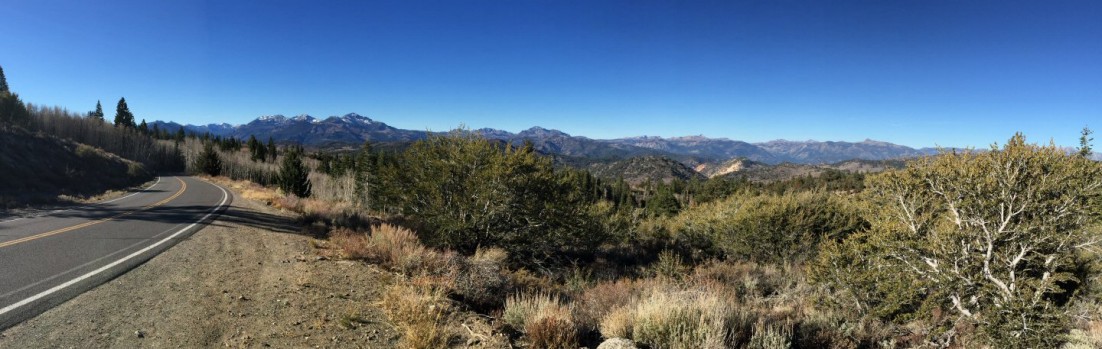
Willing to gamble only so much on the weather that afternoon, I set out for the ol’ irrigation canal, knowing it offers shelter and, if needed, a quick exit. During a few short hours the shifting weather offered sunshine, rain, hail and even a light flurry of snow. The fishing was as expected; my flies were hit mostly by wild browns and only the smartest stocked rainbows that hadn’t fall victim to salmon eggs or spinners. The stink of a possible skunking lifted, I retreated to a hot dinner and prepared for the next two days.
Instead of huddling inside, I was up before the sun on Saturday counting on the early hour and cold weather — about 48°F — working to my advantage. I choose wisely. Although I was on a well-fished creek, it was just me, the trout and couple of ducks for three hours. Fortitude and toughness won me solitude and a good number of fish that morning. Or, perhaps, it just proves that early bird adage.
By midday I was cleaned up and headed to the Moccasin Creek Hatchery for Trout Fest; the only time of the year that anyone is allowed to put a hook in its raceways. The grins of the kids were contagious; the K-9 demo of a quagga mussel search pretty amazing, and the general mood was generally festive. A local fly fishing club offered casting instruction in another raceway, allowing folks to cast an all-to-big fly to trout with appetites bigger than their four or five inches. I talked up a few of the hatchery personnel in hopes of lining up my plans for Sunday morning.
Those conversations suggested a return to the lower North Fork of the Tuolumne (near Basin Creek), a section of the river I had first visited about four years ago and enjoyed as an early season venue. This section is deep in a canyon and quite beautiful, despite its relative closeness to civilization. Most of the fish I caught back then there were stocked and in the intervening years that section of the Tuolumne had fallen off the stocking list as the result of an environmental lawsuit. But the word was that there were wild trout to be found.
Usually I’m up and out the door at the crack of dawn, but I’d reserved that Sunday morning for leisurely exploration of Forest Service roads outside of Long Barn. I was surprised to find much of my route paved with asphalt, and after marking a good-looking creek or two on the GPS, I headed to Tuolumne City and the four-mile descent to the lower North Fork of the Tuolumne.
Like so often happens, a small, nice looking wild rainbow slammed my dry fly on the first cast. (They always seem to do that when I’m least prepared.) I missed that first fish but managed to find almost dozen other little rainbows, scattered in the likely spots.
After a morning of rewards, I headed back to a hot shower before the arrival of the parents. But the folks’ visit will have to wait until next week.
If you have any inclination to fish the high country in the central Sierra Nevada, now’s that time to get going.
The two pictures below of the a side channel of the Tuolumne River were taken from roughly the same position in the Tuolumne Meadows campground, looking toward Lembert Dome. The left-hand photo was taken last week (May 28, 2012). The right-hand photo was taken during late June 2011.
The dogwoods’ stark white blooms peeked out from behind pines as unfamiliar water teased with promise. A slight breeze carried mayflies upstream. Spring was winding its way higher and higher up the Sierra Nevada range, bringing renewal. It arrived with a beautiful recklessness.
Wildflowers popped up randomly, seeking purchase in the cracks of granite boulders. The river, though somewhat tamed by a mild winter, flowed high with snowmelt. If the warmth of the day suggested that this trout season would peak early, it was the mayflies that served notice that the spring runoff had already begun to recede.
Spring Runoff
A decision to devote this year to exploration of the many streams and rivers surrounding The Cabin led me to this upper stretch of the Tuolumne River; a widely known section, until now, unvisited. Upstream, pocket water was edged by sedges, willows and horsetails, while downstream plunge pools hugged outcroppings of granite. It’s just shy of a month since the start of the season yet it was only my eyes that scanned the water that morning for any hint of fish.
It would be disingenuous to suggest that all of the time spent and distance traveled to this and similar waters is devoted to casting practice, or perfecting my presentation. It’s the fish that I’m after. Thus far this season, however, I’ve fallen under the spell of ‘the turn.’ Fly fishermen more commonly will speak fervently about ‘the take,’ and it can be exciting, but for me it’s the anticipation that builds with that telltale flash, or if sight fishing, the shift of an eye or opening of the mouth that comes before the strike or refusal. It’s the amount of this turn, lack thereof, or ultimately the take that offers the most accurate appraisal of a fly’s presentation.
It was upstream that I half kneeled behind a boulder, tossing more than casting a dry/dropper combination into a likely pocket. Almost imperceptibly the dry fly, a yellow humpy this time, skipped a beat and the hook was set. The reward was eight inches of a brilliantly painted wild rainbow trout. The fish had struck a small, size 18 red-butt Zebra midge I tied on a whim last fall, not knowing or caring if it was an actual pattern. After a quick look at the little fish, I slipped it back into the water.
My casting went unanswered for a while and I headed downstream, purposely ignoring the pool just below where I had parked the car. With the new trout season came the stocking of fish, and it really wasn’t speculation to think they’d still be there later.
It was more bushwhacking than fishing on the way downstream. Any fish that might have been there remained unseen. The same gradient that allowed for a stairway of likely pools also funneled this part of the river into a canyon. With the passing of years I have come to understand a need to balance the distance traveled in the search for fish with the consideration that an equivalent distance must be retraced to my starting point. I turned around when venturing further downstream meant following a trail too far away from the water. Less attractive was the slippery bed of pine needles and the leaves of California black oaks.
On a piece of lichen-dotted granite — not a boulder, more of an exposed part of the mountain — I sat, watched and listened. Thought not silent, there was peace in the sounds of the river washing over rocks, the breeze rocking the tip tops of the trees and chirping birds unmindful of my presence. Heading upstream meant hiking uphill and arriving at the pool previously disregarded, my excuse was taking time to watch the water while the truth was I needed to catch my breath.
This was one of those long, wide pools that suggest fish and are often quickly fished out. Grabbing my attention on the opposite bank, however, was what looked to be the tip top of a pine tree, out of which sprung gnarled branches extending into the water and above its surface. It was prime shelter just off the fastest seam. Not fishing means not catching, but in my few short years of fly fishing I’ve learned from my quarry to maximize reward with efficiency, so I waited and watched. First it was only a nose prodding the water’s surface inches away from the branch, then a small splash. A fish finally crashed through the surface. Though its prey was unseen, I tied on a black-bodied caddis and stripped line for a cast.
A simple quartering upstream cast put my flies just out of sight of the fish but in a current that would pull them just past the ripples of another rise form. The first look at the dry fly was only a tentative bump. Readjusting and allowing my back cast to go high over the willows behind me, I would cast a few more times before appetite overwhelmed caution, and a decent rainbow came to the net.
When appetite overcomes caution...
This was the game played over the next hour or so. I’d periodically examine my knots and flies, taking my time and only casting again when the trout’s feeding fell back into a natural rhythm. Half a dozen more fish were fooled and more than a few of those netted.
I’m not a great caster, and often label my casting skill as ‘simply adequate.’ Normally a difficult-to-reach fish would be ignored. That wouldn’t be the case today.
What caught my attention was a couple of regular rises, slightly downstream and on the other side of the tree, underneath a branch extending about three feet above the surface. The tree top seemed to end somewhere below that branch, allowing for another couple of feet of clear water before a boulder diverted the river back into the main part of the pool. In hindsight it’s hard to tell why I tried the cast, though in the moment there wasn’t much thinking involved, only action. The fly fell right where intended and travelled no more than six inches before it was inhaled.
This was one of those rare moments, and a sense of wonderment washed over me. A decent rainbow trout and I exchanged looks. I released it, but it lingered between my boots before slowly disappearing upstream. More casts were made, most on target. Hook sets were missed, but some connected and I would be eyeball-to-eyeball with three more fish.
There was an unusual contentedness within when I left about noon, happy to have found fish, and happy they were willing.
Twas an imployment for his idle time, which was not idly spent; for angling was after tedious study, a rest to his mind, a cheerer of his spirits, a divertion of sadness, a calmer of unquiet thoughts, a Moderator of passions, a procurer of contentedness, and that it begot habits of peace and patience in those that professed and practice’d it.”
— Izaac Walton, The Complete Angler, or Contemplative Man’s Recreation: Being a Discourse on Rivers, Fish-Ponds, Fish and Fishing (1653, 8th ed.)
I’m in the doldrums…taxes need to be done, it’s another four weeks before the Trout Opener, the cold, rainy November weather we didn’t get in November is here now…and seems to be hanging on in Vermont while Hendricksons are hatching early in the East. The anticipation of our Opener usually brings about a focus, but the gear’s long been sorted, flies tied, new reel set up…with little to do but wait, my attention span seems pretty short these days.
I can’t resist and The Wife chuckles knowing that it’s never going to be in the budget, but I would gladly own a vehicle for every day of the week; and two for Sundays…as long as I had the garage space. I can’t buy but can still look, and anyone my age as young as I might love their next fishing vehicles to be one of these recent concepts from Jeep.
The Jeep J-12 Concept…a knock off of the always macho J-20…
The FC concept is as a tribute to the unique Jeep Forward Control that was sold from 1956 and 1965.
You could, however, get your mitts on this oldie but goodie…I remember the first one I saw, in Tuolumne Meadows I believe, in green.
A 1970 Jeep Jeepster Commander…with a special and patriotic Hurst package…
On stopping a damn dam: Could it be that all those Californians that long-ago brought a housing boom to Washington State brought more than their luggage? We in the not-anymore-so Golden State are too familiar with the fight over water and the damming of rivers, and now Kirk Werner of UnaccomplishedAngler.com is asking for help…and we should give it. A movement is afoot to stop in the preliminary permitting process a small hydroelectric dam proposed for an upper section of Washington’s Skykomish River. I’ve not fished the Sky, but have hopes that as the years wear on that I might get to know it and other Washington rivers in my pursuit of a native westslope cutthroat.
…And you can’t help but like the little guy, but maybe I pushed my luck actually following through with the threat that I’d drop by to get his signature on a set of “Olive the Woolly Bugger” books…but Kirk seem more than willing to sign copies of his books without you hovering over him if you make a Kickstarter pledge that could launch an Olive iPad app…a good idea for fly fishing fathers who figure they could receive the wife’s approval to get more new gear if only they could only pass their current gear down to their kids. I don’t need the books but I’m keen on something that might keep me entertained in the off season interest kids in the hobby.
I lied, so forget what I wrote. I will buy some new gear at the club auction next week, if I can fend off other bidders. A club member (and fantastic woodworker) donated some nice handmade nets big enough for optimism but more in keeping with the size of fish I land. I’m guessing I’m in for some combat bidding.
In all fairness, my dad didn’t see it coming. I blame it on the thin air or the simple joy of being outdoors in God’s country.
For more than a few years, my brother, my sister, and I eagerly anticipated a week or more of camping in the Tuolumne Meadows campground. These trips were filled with hiking, fishing, campfires, hiking that was sporadically interrupted by fishing, and that general freedom engendered by nature’s wide-open spaces.
Many hikes started in the campground or nearby, which meant a starting elevation of at least 8,500 feet and often closer to 9,500 feet. Many of the trails were obvious or followed rivers or streams, and were usually marked on the USGS maps dad packed with the space blankets, water, lunches, snacks and other supplies. Some hikes were long and generally flat, others shorter but a bit tougher on the shorter legs of kids. The trail to Lake Elizabeth gained about 1,000 feet in elevation over 4.5 miles. Getting to Gaylor Lakes required rising 600 feet in what seemed like the first mile of the three. (Gaylor Lakes supposedly offered great fishing, but the inhalation of swarms of mosquitoes that rose with every step on the surrounding marshes cut the trip short.)
Lembert Dome — a 900-foot tall mass of granite — towers above the nearby Tuolumne River. From the meadows one can often see tiny people standing on top. Then, one summer, me, my dad, my brother and my sister saddled up and began an ill-fated hike that would take us to the top of the dome on a relatively easy trail, but one that grows steeper as it ascends the backside.
The trail cut through a forest and over a few streams as it traced the lower edge of the dome, then looped toward the back the dome. All the while we gained elevation, but it’s the last fourth of the 2.8 miles that asked the most of our legs. This climb started with a clear demarcation of the alpine zone. Trees became fewer and shorter, some stunted, and soon we stood on granite. Then it got a bit tricky, with some rock scrambling and careful footwork required before we reached the top.
Yes, we made it... (This is the original, unaltered photo. Scroll down for a better colorized version. And where the heck did I get that belt buckle?)
Standing on top of this massive granite dome, where the air seems just slightly thinner, the deep greens of the meadows and trees contrast with a sky of eye-straining blues and snow-capped mountains reaching 11,000 feet or more. We lingered and marveled; maybe a bit too long.
Not exactly the best boots for hiking.
The hike had taken a little bit longer than expected and dad was a tad anxious about getting back to camp dome before dark. From where we stood, the face of the dome didn’t look too steep. It also looked like a shortcut.
We didn’t know that there was a surprising amount of glacial polish and exfoliation, cracks parallel to the surface that develop with expansion and contraction‡. Our Sears Roebuck and Co. boots would have been more at home on a flat construction site and offered limited grip. (You might know these boots; versions are still sold today under the Diehard brand — the ones with white leather crepe sole with a tread best described as small rolling hills.) Baseball-sized rocks and small BBs of decomposed granite tumbled beside us as we picked our way down.
We’d also find out that the stitching and rivets in our jeans didn’t offer much traction. It wasn’t easy to walk down the steep granite, so we controlled much of our descent with the seat of our pants. Literally. We slid on our bums. I think our pants gave up their last threads that day.
We did make it down Lembert Dome that afternoon and my brother and I hiked back to camp with just a bit of bravado. Dad, no doubt, and probably my sister, were relieved.
We were too young to be appropriately terrified worried that day. Now that age has tempered my bravado, when I think about this, I’m suitably scared for that young man. But I’m always glad that he had this adventure.
...and here we are with the color slightly adjusted. (Forgot that Mark was ever so small.)
Us kids looking out from atop Lembert Dome. Not so scary...
My brother, my son, and I made it back in 2011. This time there'd be no sliding down Lembert Dome's face.
† This prompt was issued a few days ago, but nothing immediately think came to mind, which I chalk up to a lack of adventurousness the preparedness taught to me by the Boy Scouts.
‡ There is no general agreement among geologists as to the exact cause of this phenomenon.

 Willing to gamble only so much on the weather that afternoon, I set out for the ol’ irrigation canal, knowing it offers shelter and, if needed, a quick exit. During a few short hours the shifting weather offered sunshine, rain, hail and even a light flurry of snow. The fishing was as expected; my flies were hit mostly by wild browns and only the smartest stocked rainbows that hadn’t fall victim to salmon eggs or spinners. The stink of a possible skunking lifted, I retreated to a hot dinner and prepared for the next two days.


 fishing for words