It was a dark and stormy night…more accurately, a morning.
Remember a few weeks ago when California was drier than a cork leg? That ain’t so true anymore, though The Drought is not over by a long stretch.
My drive to work at 0545 yesterday was dark and slow, musically accompanied by pounding rain. Traffic moved at about 40 mph in a 65 mph stretch of highway. Lakes and ponds formed where none had existed for 10 or more years. Later, flooding closed my route home by early afternoon. Flooding also removed the option of a more northerly alternate route.
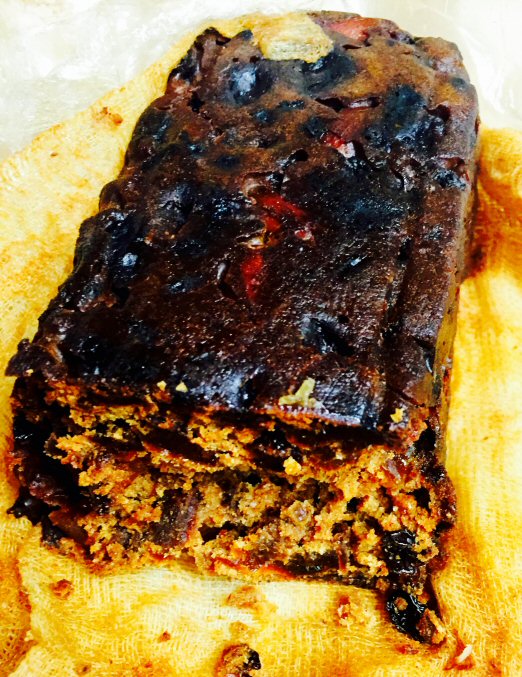
Arizmendi Bakery’s fruitcake, called the drunk uncle of fruitcakes. (Definitely made with a bounty of brandy.)
I instead decided to play chauffeur for the afternoon, heading to San Francisco to pick up Karen and meet our son. It took a bit longer than expected as half the signalized intersections along my route were dark, a result of storm-induced flooding. An underground PG&E substation at Post and Stockton streets exploded that morning as a result. Union Square and surrounding neighborhoods were without power well into the evening. Those dark signalized intersections offered abundant evidence that too many of today’s drivers don’t know how to react to a flashing red signal or in-operational traffic signals.
We snacked leisurely, watching waves of rain wash the streets. We also found the Christmas fruitcake I was looking for, then dropped the son at his place and picked up some casual carpoolers. These people had been waiting in the dark, in pouring rain, for 50 minutes. We picked ’em up thinking that it would make for a more rapid trip home in the HOV lane. Based on the lack of traffic — some folks had left work early and others didn’t go to work at all — it was unnecessary. Call it a mitzvah
This morning wasn’t bad except that Hwy 37 WB was closed and the detour through Novato added 20 minutes to my commute. The rain has let up so far today, but we clearly got enough rain to soak the ground and the temporary lakes and ponds are only slowly disappearing.
Through all this, my attention is on the weather radar, hoping to see snow accumulating in the Sierra Nevadas. It’s said we need at least five more storms of this magnitude to remove the specter of another drought year.
As if it hasn’t been a figuratively dry trout season for me, a long trip last weekend over three passes, along rivers and over two reservoirs showed that things are literally drying up…
This was my last and only second trip to the Sierras during the general trout season. It was happenstance that kept me off the water and only sheer determination — and a desperate desire for a break from every-day life — that crammed a 400-plus mile drive and not enough fishing into a single day.
Firsthand reports dashed any hope of great fishing. Small streams were trickles, meaning wild fish were off limits. State-stocked waters that normally received a few buckets of fish before the end of the season didn’t.
Another view of the sunrise from Sonora Pass.
Optimism being the most overused tool in a fly fisherman’s arsenal, I still hit the road over Sonora Pass before sunup. If there were few fish to be had, at least a sunrise at 9,000 feet doesn’t disappoint. This late in the year, a sunrise seems to last longer.
Looking a bit southwest from Sonora Pass.
There was unexpected company on the West Walker River, a couple planning to soak bait. They went their way, I went mine. I’d have pocket water all to myself, whitefish on the mind, and the sound of reveille arising (a bit too late in the morning this time?) from the Marine Corps Mountain Warfare Training Center.
My “office” for the morning. (West Walker River)
Just like that “confidence fly” most fly fishermen keep tucked away, there are pieces of water one comes to expect to hold fish. My expectation held true this morning. It didn’t take long before a fish was fooled with my favorite red-butt zebra midge pattern. While not large, white tips on smooth fins suggested it was a more educated trout. Even if was a hatchery fish, it had spent enough time in the wild to learn a few things while it’s pectoral and caudal fins healed. There would be no whitefish this year and nothing big, but all of the trout I found were feisty.
This isn’t the time of year that these trout rise to dry flies, but the water level requires stealth, a dry-dropper setup, light casts to small seams and short drifts. It’s hard to disagree that this type of rig might be a reflection of my middle-of-the-road nature, mixing the oft-look’d-down-upon tactic of nymphing with the loftier technique of dry fly fishing. Deep down I hoped for a rise to the dry fly, but ice crunching underfoot suggested it was not to be.
My plans called for crossing Monitor Pass on the way to the East Carson River, then over Ebbetts Pass, and finally completing a twisting and oblong course over the man-made New Melones Lake. Unfamiliar with the route and wary of unpredictable delays, I was on the road again before noon.
Many times I’ve enjoyed driving — whether a car or motorcycle — over Tioga and Sonora passes many times, during the spring, summer and fall. Any threat of snow brings about closures, but during this trip Tioga and Sonora pass, as well as Ebbetts and Monitor pass had reopened after brief snow closures earlier in the week.
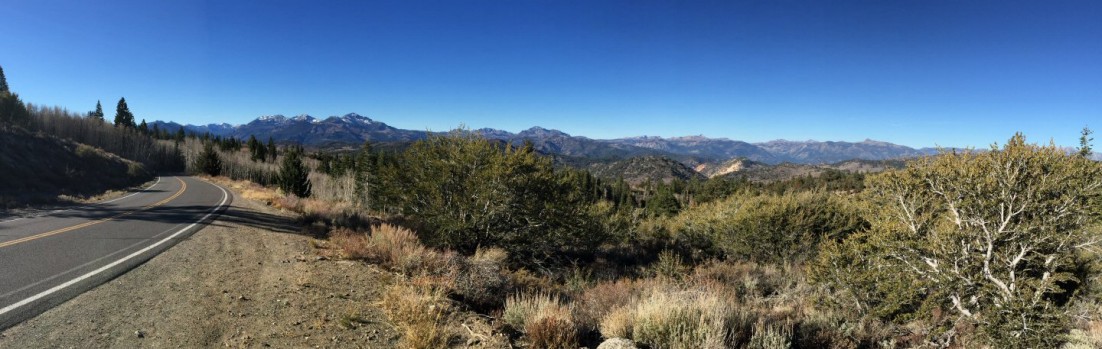
Looking west from near Monitor Pass.
The landscape and vegetation of each pass is unique, with stark changes as one gains elevation. Over Monitor Pass, Highway 89 twists between and over numerous peaks, alternating between barren high desert to east and the fir and pine forests on the western slopes. Once over the summit, the road quickly descends to meet Highway 4, then crosses the East Carson River.
This was first visit to the East Carson River. The wild trout section was low and slow, and out of the shadows of the high canyon walls. Sunlight reflected off nearly every eddy, riffle and pool, and, as might be expected, the fishing was great but the catching not. It was suggested after the fact that I should have fished upstream, where a summer of stocking might mean a few stupid willing fish would remain. I chalked this visit up to exploration. Since it wasn’t too far away, I drove to Markleeville. I had to drive through town a second time; I blinked and missed it the first time through.
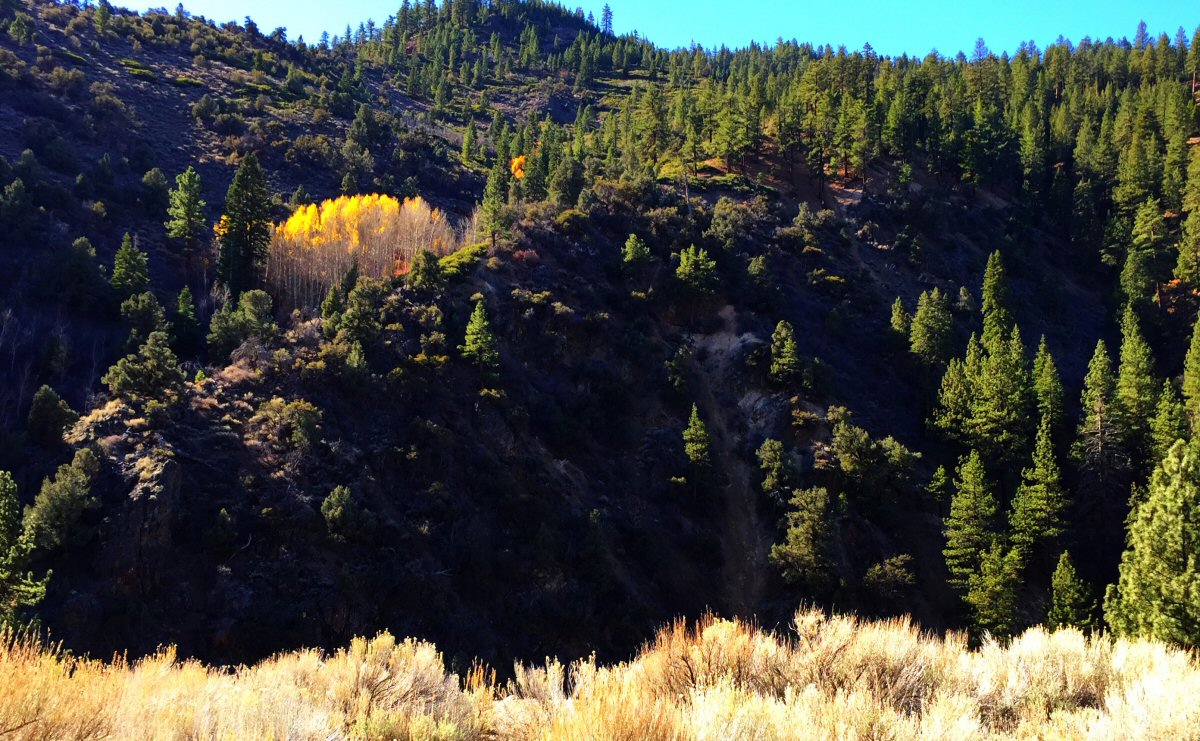
Colors along Highway 89, just south of the East Carson River.
The route over Ebbetts Pass is more adventurous than the comparatively high-speed Highway 108 over Sonora Pass and Highway 120, which winds through Yosemite and over Tioga Pass.
Driving over Ebbetts Pass is not for the faint of heart. Sandwiched between a full-width, two-lane state highway is a section reminiscent of the descriptions our parents and grandparents might offer of roads built only wide enough that two Model Ts could squeeze by each other. This middle section, from Lake Alpine to Silver Creek, is a barely two-lane road. There is no center line or fog lines. Shoulders are a rarity. Steep curvy portions, precipitous drop-offs and vistas of pristine landscapes are plentiful. If the narrowness of this road isn’t enough to reduce one’s speed, the beauty was. Lack of planning meant I couldn’t linger. Plans are already afoot to return with a greater abundance of time.
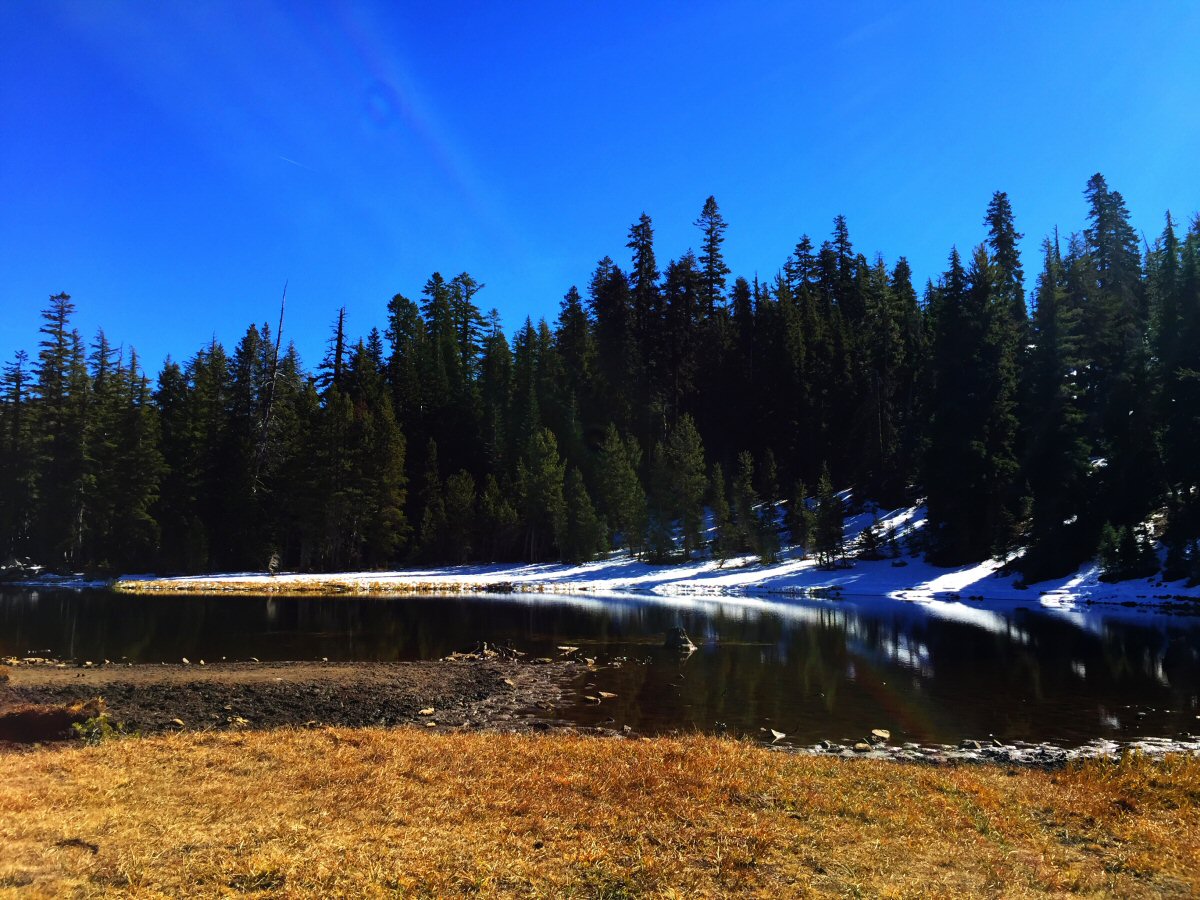
Ebbetts Pass tarn.
The rest of my drive was in relatively civilized areas. I’d pick up apple cider outside of Arnold, then wine and special spices in Murphys. I crossed New Melones Lake, which looked more a river at flood stage (it was formed by the damming of the Stanislaus River). Back in Twain Harte early, I cleaned up and planned to attend to a few items on the to-do list, figuring I’d walk to the local Ace store for a halogen bulb and any other necessary item. During the walk I began an exploration of a different variety. More on that next time my fingers are willing to dance on the keyboard…
Leavitt Falls, late in the fall.
All of the photos, and some more:
Sunrise from Emigrant Gap on Highway 108.
Sunrise from Sonora Pass on Highway 108.
Another view of the sunrise from Sonora Pass.
Looking a bit southwest from Sonora Pass.
Looking back toward Sonora Pass.
Over the West Walker River from the Leavitt Falls Vista Point.
Leavitt Falls, late in the fall.
Sun appears over the West Walker River.
My “office” for the morning. (West Walker River)
Looking west from near Monitor Pass.
Colors along Highway 89, just south of the East Carson River.
There’s something wonderfully satisfying about the surprising fight-per-ounce ratio of a wild trout that is followed by a revelation of coloration more vivid than man might create. That’s doubly true when the wild fish is native.
There are purists who would dismiss the progeny of planted parents, but earlier this week, Mark Kautz raised an interesting thought about a possible decline of opportunities to catch wild trout on his Northern California Trout blog as the California Department of Fish & Wildlife’s stocking program shifts to triploid trout.
Shelving the wild vs. native fish discussion for a bit, if I can’t chase native trouts, I’m just as happy stalking their wild brethren. Wild trout are the reason I took up fly fishing. There comes a point in every fishing career that you develop an affinity for a style of fishing, or a species, and often both. It can happen unexpectedly and unconsciously.
With me it began on a little creek in the Walker River watershed, with a spinning rod and a size one spotted Panther Martin teardrop. The cookie-cutter planter rainbows are the standard fare downstream, but my recent rediscovery of the benefits of hiking a bit farther than most weekend warriors had convinced me that whacking through dense stands of cottonwood could be worth the effort.
Trout are one species that adhere to the adage that “life will find a way,” and there’s no better example that the wild fish that often can be found upstream of the ruts created by the DFW’s live-haul stocking trucks. That day it was a cast to riffles in the shade of streamside willows that introduced me to a sizeable wild trout, at least by my standards. Until then, my familiarity of trout with parr marks had been limited to fish measuring less than six inches; this one was about twelve inches long. That wild trout was my gateway fish to appreciation of native populations.
As Mark observed, it’s likely that many folks expect to stock their freezers with trout poundage with a value equal to the cost of a fishing license; perhaps by any means necessary and without knowledge of or concern about the toll on wild and/or native trout. Perhaps it’s fed by the illusion of self-sustenance, even if for only a few days each year. It’s just as likely those fish won’t be replaced as the DFW’s triploid trout — chosen in response to a legal action challenging its hatchery and stocking operations — can’t reproduce. In the long-run, this should be a good thing for California’s native fishes. (It should be noted that the California DFW hatchery system has been gearing up production of native fish for selected waters.)
Still, it’s hard not to wonder if meat fishing, especially in a state as populous as California, would decimate populations of wild fish that have gained a foothold where native fish don’t exist. Also, with California’s now minimal sustainable populations of native fish, it could eventually impact native fish without stronger enforcement of regulations. That, or we have to hope, as Mark alluded, that meat fisherman will be more inclined to drive a few miles to grab some steaks than clamber over rocks, descend into a canyon or even walk a few thousand feet upstream.
Thank you, Mark, for the thought-provoking discourse.
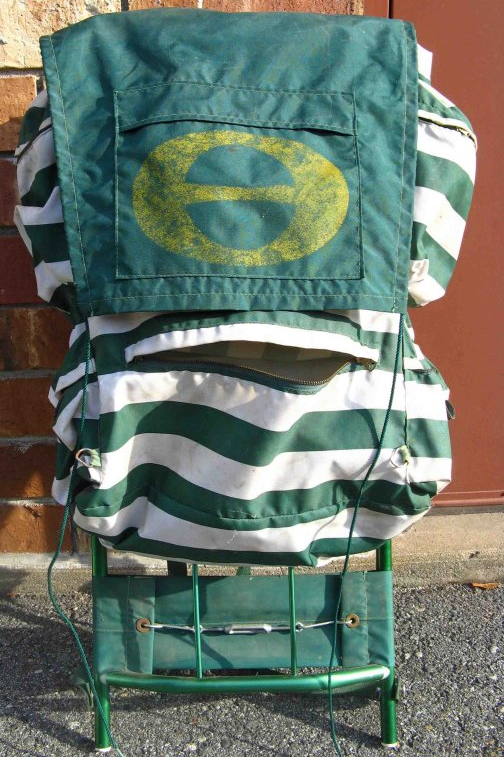
While the most radical statement I made during the ‘70s was the purchase of a white and green-striped backpack emblazoned with the ecology symbol, I’ve always been pretty certain that Styrofoam isn’t environmentally friendly. Yet there it is; big blocks of the stuff being used in the restoration of the wetlands north of my commute on Hwy 37.
Used one like this in Boy Scouts.
Restoration of this area, in the Napa River delta and known as Cullinan Ranch, began three years ago. According to the website, long-term farming led to subsidence — up to six feet — as the marsh dried out. This puts the area below mean sea level. The hope is to restore 1,500-plus acres of tidal wetlands in the San Pablo Bay National Wildlife Refuge. But it’s estimated it would take Mother Nature about six decades to rebuild the site with sediment deposited in by the Napa and Sacramento-San Joaquin rivers.
It seems that’s where Styrofoam geofoam plays a part.
About two weeks ago, semi loads of big blocks of geofoam were offloaded while tractors of all sorts and sizes carved out a building-sized ditch paralleling Hwy 37 for about four miles. Now that ditch is being filling with geofoam. The geofoam website lists various applications of the stuff and touts its benefits.
I just can’t get my mind around it. I can understand stabilizing the embankment along the highway, but stuffing what in essence is Styrofoam into the earth as part of restoring a site to its natural composition seems contradictory.
Of course, once covered with dirt and after vegetation takes hold, no one will know.
I sit down tentatively in front of the keyboard, the one-eyed monster stares back, unblinking. The view out the window reminds me that midsummer has passed and for the first time in a month I’m fully aware of just how much fishing I’ve missed. It’s a long time before the end of the season, and there should be opportunity to haunt favorite fishy places. But there’s no making up for time lost.
It’s been a while since I’ve written anything just for fun. The prospect of doing so is exciting but a bit terrifying. I’ve been challenged the last month or so by genetics that required minor surgery on my left hand, not my casting hand, thank goodness. Apparently I inherited from some long-forgotten Northern European ancestor the necessary components to develop Dupuytren’s contracture. After outpatient surgery, I was in a brace for two weeks. There was no keyboarding at 70 words per minute. But life didn’t sit still. Work piled up. I was in the middle of three different website projects as well as my regular job. It’s taken weeks just to get back to par. To the three readers still left, I’m sorry for the absence.
My forced downtime did not go to waste. Karen and I spent a weekend in Chico; no fishing, just lots of beer tasting at the Sierra Nevada Beer Camp Across America.
The weekends this month are already full with life’s non-fishing activities and that’s just fine. Given that California’s in the middle of a horrendous drought, the trout have more important things to do than ignore my fly as it drifts by. Vegetation has become tinder for fires. It’s anyone’s guess if this winter will put a dent in the drought. The recent reports of warm water game fish and mammals appearing in the ocean off the California coast (mahi mahi, yellowfin tuna, pilot and Bryde’s whales) and the recent humidity and showers could be the tea leaves predicting El Niño is developing. However, expectations have recently changed, and it may be a weak event.
In the meantime, you’ll find me preparing for the time opportunity presents itself.
The second day of my Memorial Day trip was undecided until I rolled out of bed that morning. A lot of the time, my angling is a solo affair. There was initial hope that Sean might join me — hitting the high country together is nearly an annual affair — but as happens with kids, they get jobs, take on other responsibilities and interests, and simply can’t always get away. Funny how that works: just as a parent gains a bit more freedom, children tend to lose theirs.
Lyell Fork bridges.
A lack of soreness from the previous day’s hiking encouraged the consideration of another adventure, this time one that would harken back to the adventures of the younger me. During the family vacations in Tuolumne Meadows, we’d often hear about the trail along the Lyell Fork of the Tuolumne River, but a trail I can’t recall ever hiking.
Lingering was nice that morning, but the trail head was about two and a half hours away. I’m pretty practiced at whipping together a lunch and getting the gear ready. The previous day had shown that my Orvis day pack would serve me well, and with only one rod, the other rod pocket kept a water bottle handy. I was on the road about 7:00 a.m. That’s late for me, but today wasn’t to be rushed.
Having traveled the route so many times, it could be said that I’m able to make the drive to Tuolumne Meadows with my eyes closed. But that would be a waste. Though I know what’s around that next corner, each visit offers a new revelation. The Sierra Nevada was called the Range of Light by John Muir for a reason; every view changes, depending upon the season and time of day.
The canyon where I stopped and turned around.
Memorial Day weekend marks the beginning of the camping season, but campsites in Tuolumne Meadows are usually still covered in snow or flooded by snowmelt. There was still traffic, mostly comprised of rock climbers itching for that first touch of that unique Sierra Nevada granite, and sprinkled with the usual sightseers passing through on their way to the valley.
I pulled into the Tuolumne Meadows Wilderness Center just before ten. A line of hopeful backpackers wound around the building, but parking was easy to find. Pack secured and confirming I had the proper map, I hit the trail a few minutes later.
The trail was both familiar and unknown. Many high Sierra trails must look the same at the onset. About a mile along, landmarks revealed this was new ground. There were the rusted steel signs pointing to various destinations, the two bridges that lead to the opposite side of the Lyell Fork, and the river itself, meandering through meadows and twisting through and over the batholith that forms the core of the Sierra Nevada mountains.
This is the type of country that refreshes the soul.
Another view, looking down river.
After a mile, I was alone on the trail. The hike was easier than expected. I was inclined to chalk that up to hard-won improvements in my physical fitness — particularly with a trailhead elevation of 8,600 feet — but later determined that the elevation gain was less than 500 feet. Roughly two miles in I left the trail to follow the course of the river. It wasn’t easy. Down trees, boulders and the Lyell’s long elbows required numerous detours.
Further upstream.
About four miles along I came to a narrow canyon. Continuing up river would require a long detour. But I had started a bit late, and daylight can be precious when in the wild.
I rigged up the 3 wt. rod and began that slow walk downstream, presenting my fly to suspect water. The river was high, limiting where a cast could be made without immediate drag.
This is the type of country and the type of fish where stealth pays off. I spooked fish with every step. Where possible, I’d cast four or five feet from the bank, with only a few rises to show for it.
The course of many high Sierra rivers is dictated by huge granite outcroppings, creating pools. In midsummer these pools attract swimmers, but this early in the season it was still too cold for such nonsense. I found one such monolith that directed the Lyell Fork almost ninety degrees from its course, creating a deep pool that offered a feeding lane and overhead protection. Up against the granite was slack water, from which decent sized brook trout would intermittently rocket to the surface.
I tend to avoid putting myself in position to hook a fish without an easy way to bring them to the net. A fishless morning, however, changed my outlook. Moving away from the water and giving the fish a wide berth, I quietly and slowly crept to the top of the outcropping. Carefully peeking over the edge, I could see about half a dozen trout about fifteen feet below. Counting on the height to conceal any false casts, I laid a stimulator in the seam that would funnel insects to the trout. A fish rose, inspected my fly, and dismissed it. That was the pattern on subsequent casts.
Offering a break for both myself and the fish, I sat down to tie on an Elk Hair Caddis. That’s all it took. A nice-sized brook trout nailed it and went wild. It jumped like a rainbow and shook its head like a salmon. My excitement began to change to panic with the realization that there was about twenty feet of line between me and the fish and that I had to lead it thirty feet to my right if there was any hope of getting it to the net. It was a thrilling fight for all of about forty seconds, and I did get a good look at what could’ve been about twelve inches of healthy Salvelinus fontinalis before a not-so-long distance release.
Marmot!?
The tug of that fish — and the fact that I once again was able to fool a wild fish (an accomplishment that continues to amaze me) — made the day seem brighter. I wandered downstream a bit, trying to sneak up on fish in the meadows, and after a few hits but nothing solid, I sat down in the world’s best dining room for a peanut butter and jelly sandwich.
I met more people on the hike out, followed a marmot for a few hundred yards and lingered here and there. It was another day of personal accomplishment. No knee brace was required and my breathing wasn’t labored like it was last year.
Now, I hope to get back when the water’s lower and the fish hungrier.
The beginning of my hike. On the John Muir Trail following the Lyell Fork of the Tuolumne River.
The Dana Fork of the Tuolumne River, I believe.
The hike really begins. I was alone.
Crossing the Lyell Fork.
Lyell Fork bridges.
Rapids on the Lyell Fork.
Further upstream.
The view, looking roughly northwest, from the mouth of the canyon, where I turned around.
My family spent many summer vacations in Tuolumne Meadows. These trips were a family affair and in the interest of keeping everyone engaged, it was more than fishing. We’d spend the days hiking to higher elevations — the campground was at 8,600 feet — and sometimes we’d end up at nearly 10,000 feet. Mepps spinners would be cast into water along the trail and sometimes the destination was a lake where fishing was rumored to be amazing. Mom would keep the troops focused by wondering out loud about what might be around the next bend. My brother and sister and I would spend countless hours exploring the banks of the Tuolumne River, watching the occasional bear that wandered into the campground, and waiting for the rare treat of visiting the campground store, where we’d get to pick one comic book and maybe enjoy an ice cream.
Idealization taints memories but, for me, the Sierra Nevada high country has always lived up to my recollection. That’s what fueled the rest of my plan for Memorial Day Weekend 2014.
The view from where I started.
First-hand reports made it clear that water would be high in the Walker River Basin. But I had a plan that tied into two keywords in my last post: “maturity” and “adventure.” Not to get too personal, but I’m no spring chicken rooster, and for more than five years I’ve worn a compression brace on my right knee. Years ago, while carrying a bag of cement on my shoulder, I stepped into an unseen depression, twisted my knee and fell to the ground. I was young then, so shook it off. It was only years later that I began to feel a bit of pain after long walks. This year I finally got out of my rocker to walk every day. Not Forrest Gump style, but about five miles a day. That, in combination with weight loss, has eliminated the need for the brace.
Cautiously optimistic, in planning for this trip I had decided to walk up the Little Walker River, hoping this would rekindle my enjoyment of high country hikes. I enjoy fishing this creek’s small water, though most of my experience had been limited to the stretch through and downstream of the campground. Sticking to my plan, I ignored warnings of high and muddy water. The drive over Sonora Pass would take about two hours, but it’s one drive that’s always enjoyable as the terrain changes with the elevation and, particularly this time of year, snow still dusts the pass. This day the drive was even more pleasant; being a weekday I saw only four cars at lower elevations, and no one above 6,000 feet.
The section of Hwy 108 between Twain Harte and the junction with Hwy 395 rarely runs straight. It’s a good road and relatively fast considering the twists and turns. On the eastside, after beginning a descent into the high desert, there are at least four severe hairpin turns. It seems that every year I either run into a cattle drive on the highway or a semi-trailer truck stuck at a hairpin. This year it was another truck. I waited about 10 minutes as the driver unsuccessfully tried to free the drive wheels, which had sunk in the loose dirt on the inside of the turn, before walking up to ask if it would be okay to try to drive around on the shoulder. He helped me move a few big rocks. After getting past, I was talking with the driver, emphasizing that this hairpin was only the first, when assistance arrived in the form of a Ford Police Interceptor Utility in California Highway Patrol colors.
The longest part of this drive always seems to be the three or so miles down a washboard dirt road to the Obsidian Campground in the Humboldt-Toiyabe National Forest. It’s not a bad drive, and was made nicer this year by a late-season storm that dropped enough rain to keep the dust down. Best of all: I was the only person there.
One of many fallen trees…
I began hiking where a bridge crosses the Little Walker. Topographical maps showed a nearby trail, but that trail would only appear intermittently during my hike. This part of the river flows through a narrow canyon, and since my preferred tactic is to hike as far up as possible and return by slowly fish downstream, I headed for high ground. This is terrain marked by small and rounded granite cobbles, perhaps glacial debris, sandy loams and decomposed granite. Willow and quaking aspen grow along the creek, replaced by conifers and mountain hemlock, which tolerate a drier environment. Hiking was relatively easy. There’s not much underbrush and the only hurdles — literally — were the many downed trees.
After about an hour I emerged from the canyon to find the wide-open expanse of Burt Canyon. Here the Little Walker meanders through stands of willows. The mountains that looked so far away when I started at about 7,400 feet seemed to be within reach. That was clearly an optical illusion as I was at about 8,600 feet and those mountains scraped the sky. The hiking was easy here and I continued on for about another hour.
I find solitude to be refreshing, so I pulled up a boulder and sat. Handfuls of raisins fed my body. The silence of the mountains, the sound of birds and gurgling water, and the unfathomable history of this place, fed my mind and soul. It was as if I was one of only few humans to pass this way.
The view in Burt Canyon, where I turned around.
Shaking off such romanticism, I rigged up the 3 wt. rod. This is the type of water that begs for a dry fly, with the usual small dropper. I fished suspect water, sneaking through willows as best I could, but apparently not well enough. I re-entered the narrow canyon of the Little Walker River with only a single rise so far.
It took a combination of hiking, climbing and crawling to follow the course of the creek, which wound around boulders, under fallen trees, sometimes cascading ten feet. The water was indeed high. Side arm casting, parallel to the creek was the best option. The fish were there, and a few rose to my fly, but none with enough an appetite to bite. If you fish, you know that there are those special spots that you know must hold fish. During high water flows, those locations change, and observation is the name of the game.
I had taken to hiking above the narrowest sections of the canyon and noticed one such spot. A large boulder was forcing the creek to bend almost ninety degrees, so that even at high flows, a pool was created. A large pine offered shade and security.
Hugging the conifer to hide my profile, my first cast fell into place and the fly slipped along a seam. I let it flow around the boulder until out of sight but before my fly line could spook any fish higher up in the pool. On the third or fourth cast a fish slammed the dry. This wasn’t a long pool, so the fish was resigned to head shaking and circling, but it did stress my little rod. I hadn’t expected to find a thirteen-inch holdover rainbow, but that’s what I was looking at in the net. That pool gave up a few more small fish, wild rainbow and brook trout of no more than eight inches, before I moved on.
Confident these fish could be fooled, it was time to stop for lunch in a small meadow passed on the hike upstream. The entrée was a jelly sandwich — I forgot to buy peanut butter at Twain Harte Market — accompanied by pretzels and raisins for dessert. During this repast, telltale rises in a slow bend caught my attention.
Lunch finished, I crept up to the edge of the creek. I made my first casts while still a few feet away; the high water had fish hugging the banks. The fish landed was a bright wild rainbow. A cast to the far bank brought up a couple of brilliantly colored brook trout. Feeling accomplished, I started to hike back to the car.
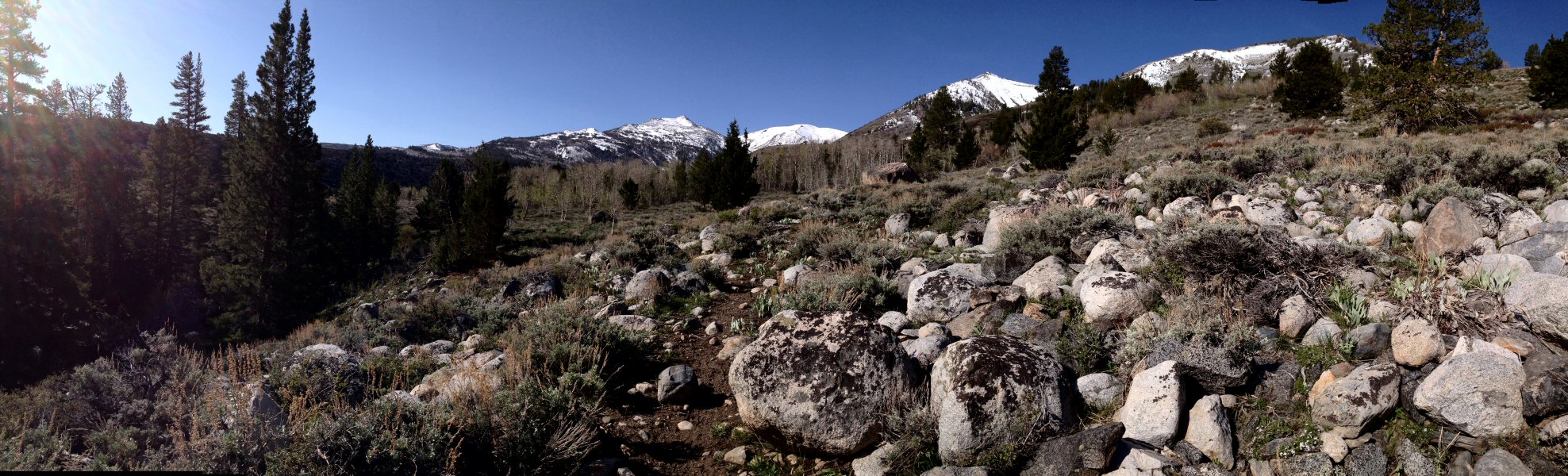
Panorama from a stop along the Little Walker.
The bridge where I had parked came into sight, and below another fly fisherman, dappling a small pool. In short order he had hooked a big hatchery rainbow. His problem was getting it in the net. The pool was at the limit of the reach of his 5 wt., maybe nine feet, and the skinny water in this wide spot of the creek meant the rod often had to manage the full weight of the struggling fish. It wasn’t until I was on the bridge and ready to render aid, that he had the fish in the net. We chatted briefly before he headed off to clean his lunch.
That morning, in my focus on the adventure ahead, I hadn’t taken a good look at the water around this bridge. Now I could see that, directly underneath, it offered some interesting water. I clambered down. Fish hit my flies cast after cast. The hatchery rainbows were numerous and hooking one was a non-event. It was the occasional brook trout that made it fun. The challenge was getting my flies past the rainbows at the top of the run so the brookies at the bottom could get a look. I’m not complaining about having a chance at numerous fish, but I had come here for the wild ones.
On my way to the Little Walker, a quick look at the West Walker revealed it was running high, but clear. Knowing that time was limited if I was to get back over the pass before dark, I packed up and headed to Pickel Meadow. During the regular season the Pickel Meadow dirt parking lot would have half a dozen cars in it. This early in the season there were only two cars and three fly fisherman.
They had been fishing all morning and had found fish stacked up in a few bends. High-stick nymphing had worked best. And clearly, these guys have a more class than I; they were setting up a table and chairs for lunch, with all the fixin’s for Dagwood sandwiches. They also gave me explicit directions on how to get to the best spots (walk to the second willow and cast downstream) and told me to have at ‘em.
Perhaps it was laziness, but I decided to stick with a dry dropper. The fish were easy to spot, and I’m sure I was from their point of view, so I tried to hide behind a third willow while casting upstream. Helped by a twelve-foot leader, good drifts prompted rises to the dry fly. Proving that hatchery fish tend to be dumber, I had landed almost a dozen in less than an hour.
About then, one of the gentlemen from the parking lot walked up and asked what I was doing to hook so many fish. He was new to fly fishing, but enjoying it so far. We talked tactics and I again found myself in the role of teacher. I shared some flies with him and recommended other nearby waters. Then it was time to head back to the cabin.
It’s taken me seven-plus years to take “catching” out of the equation of fishing. Now I’m able to hike, if not with the energy of my teenage self, at least without getting (too) winded or an aching knee.
There was a lot of fishing and more hiking crammed into last weekend that originally envisioned. Much of the time, there was more of a focus on adventure and exploration than catching. Perhaps it’s maturity.
Lessons have been learned the last few years and avoidance of the Bay Area commute dictates my departure time. Shoving off during the late morning and making a few stops along the way lead to a late afternoon arrival in Twain Harte. Being the Thursday before Memorial Day weekend, the town still had that hushed, pre-summer feel.
With gear stowed and a few hours of sunlight left, it was time to preemptively get the skunk off. Fifteen minutes up the highway and ten minutes down a Forest Service road is a stretch of a fork of a relatively well-known Sierra Nevada river that offers prototypical put-and-take habitat with all the conveniences. It’s easily accessed, offers a picnic area and toilets, and the makeup of the river in this area naturally corrals the hatchery brood into three pools.
The artificial twilight created by towering pines made it difficult to see into the water, but the occasional slurp confirmed they were there. This fork is just above 5,000 feet elevation, and generally doesn’t contain much water. Even less this year, compared to the same time last year.
It seems to me that even factory fish retain a natural skittishness, which this day warranted a dry/dropper setup with a light touch. Half a dozen rainbow trout made it to the net in the following forty minutes. During that time, a couple of other folks had arrived to try their luck. The skunk off, it was time to head upstream.
This is a place I usually think of as a quick venue to resurrect skills left unpracticed during the winter and to work the rust out. The spirit of this weekend, however, was to challenge myself.
Hatchery fish clearly abide by that movie utterance that “…life will not be contained” and I was counting on this. About 100 feet upstream, this river is marked by pocket water winding through thick brush. The burble of plunge pools hinted at possible places where any wild offspring might be found. Dappling more than casting, I found a surprising number of the more attractive progeny. None were longer than six inches, making me wish for much smaller rod.
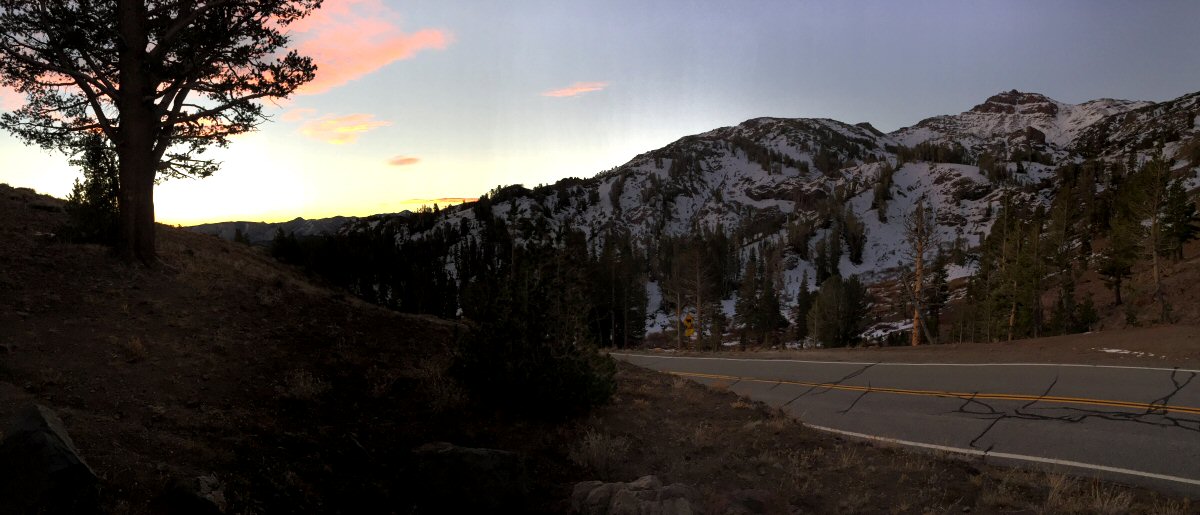
Sonora Pass (@Emigrant Pass): Where I’d be headed the next day.
There’s a feeling altogether different about fooling wild trout. Granted, they are hungry and more opportunistic, and high-Sierra trout will take most any well-presented fly; but they require a stealthy approach. Over-lining these fish guarantees they’ll scatter. Every suspect pool — successfully approached — yielded a fish. After about an hour, I returned downstream. There still being light and good water available, there was time to make a few more casts.
It’s fair to say, fly fishing, fully embraced, tends to permeate one’s life. Two years after attending a fly fishing class I had become the fly fishing club’s secretary, webmaster and was leading an annual outing. Later I was enlisted to help with that same class. One could have a long debate as to whether the hobby attracts those predisposed or the hobby itself engenders the idea, but paying it forward, it seems to me, is part and parcel with fly fishing.
So it was, after a few minutes of hearing the crack of a fly line that I wandered downstream to find a woman waving a rod around in a most inelegant manner. Greetings were tentatively exchange with the question if she’d like a bit of advice. The next hour I offered a condensed version of fly fishing basics, kept within my limited sphere of knowledge. She had whipped the fly off her leader, so I gifted her a couple of flies and used the opportunity to demonstrate a dry/dropper rig.
By then, the sunlight was fading, and having reassured myself that I could still manage to bring up a few fish after a winter away from fishing, it was time to head back to the cabin for dinner and an early bedtime. The morning would come early as my plan was to head over Sonora Pass and hike up the Little Walker River — despite warnings it was high and muddy earlier in the week.
But as I said, this trip was more about adventure than catching.
January’s promise to get out and fish earlier, more often and in different places now echoes with so much emptiness that the unthinkable is the only resolution.
Yes, I will be chasing trout this weekend. Memorial Day weekend.
The events and circumstances that kept me closer to home haven’t been unpleasant. They just didn’t include trout. Staying home last weekend included free and unrestricted quantities of barbecue and wine, not really a bad thing.
This is the first and possibly one of the few times to get to the cabin this summer, and despite the Sierra Nevada and its foothills being infested with a couple thousand campers and anglers, I’m going. With fishing reports read and flows checked, plans are firming.
An eyewitness account from a fellow fly fisherman suggests that a target river and one of its tributaries will still be high and muddy for a few days. But that bad news lends some optimism that little R Creek may have the water needed for guilt-free fishing for its wild rainbows. It’s a ten-mile dirt road drive to this little gem, so while in the area it’ll make sense to explore other blue lines on the map and not too far away.
It’s a certainty that a few high mountain streams will be walked, likely with the oldest son. A few will be familiar, others offering an opportunity to explore. Generally, this trip will be characterized by a philosophy that hiking a few thousand feet, maybe a mile or two, will leave the crowds behind.
Hopefully I’ll be the guy you won’t see this weekend.
The only reason I haven’t curled up in a fetal position and yielded to California’s 500-year drought is there’s at least a few days of trout fishing on the horizon.
It’ll be good news and bad news situation. The good news being that low water will allow access to most streams and rivers during my limited time fishing this month. The bad news is that the water may be gone when I can next venture into the Sierras.
But the stories that truly illustrate the far-reaching impact of The Great Drought are smaller in scope and often just as alarming.
Spring fishing in the Sierra Nevadas usually means fewer people and rattlesnakes. This year, at least the rattlesnakes will be more numerous.
Wildlife experts from the high Sierra to Southern California report that snake sightings are up, largely due to the warm, dry weather that has gripped much of the West. Rattlesnakes, like many animals, have been drawn out of their wintertime dormancy earlier this year because of the mild conditions that have accompanied the drought, experts say.
Reproduction declines have been noticed since 2007, before the drought, Meese said, but recent counts have shown even steeper declines. A statewide survey of tricolored blackbirds, known for their red shoulder patch with a bright white stripe, was recently concluded and the results are due out in three weeks.
At issue for the birds is a lack of insects since female birds require insects in their diet to form eggs. Also, young birds require insects during the first nine days of life, when they cannot digest plant material. Meese contends that the effects of the drought have created lower populations of insects, as well as less-extensive wetlands from which blackbirds can feed.
…the warm, dry winter threw cherry trees off their game all over the state. California usually delivers the nation’s early season cherries, but with yields down around a third of what they usually are you can expect to pay a whole lot more at the market.
What the trees want is a wet, chilly winter with fog that keeps the daytime temperatures under 55 degrees.
But, clearly, the trees aren’t getting what they want.
California honey prices are being pushed to new highs. California was at the top of the list of honey-producing states a couple of years ago. Not anymore. This third year of drought could cut production to its lowest since 1981.
Suction dredge mining remains an issue for our rivers but, apparently, now is the time to shut down those machines and pick up a pan in the search for gold. Accessibility is creating a mini-gold rush in the Sierra foothills.
If there’s a silver lining, it’s that the severity of this drought has shifted the discussion on fracking.
Fracking a single oil well in California last year took 87 percent of the water consumed in a year by a family of four, according to the Western States Petroleum Association, an industry lobbying group. That amount — a modest one by national standards, the oil industry argues — has become an increasingly delicate topic since a drought was officially declared early this year in the state.
The drought, combined with a recent set of powerful earthquakes, has provided the momentum for about a dozen local governments across California, the third-largest oil producing state, to vote to restrict or prohibit fracking in their jurisdictions, as concerns over environmental effects and water usage have grown.
At the same time, a bill that would declare a statewide moratorium on fracking has been gathering support in the State Senate, a year after a similar effort failed.
The frail nature of our infrastructure — arrogantly designed to fight Mother Nature’s wisdom — is certain to be tested in the many months between now and the next rainfall. A switch to ignoble warm water species might salve the itch to fish, but at what cost to one’s pride?








 As a native Californian, most of the drought news is the “usual” hue and cry about
  fishing for words