fishing for words

(and tossing out random thoughts)


4 Comments

worrying about women in fly fishing

I worry about women in fly fishing and how it might affect me.

Not because women take instruction better and may easily out cast and out fish me. Not because every other fly fishing blog post seems to include an image of any number of women that attract attention away from the fish they might be holding. I’m not so worried that with the emergence of fly fishing gear for women, I might someday try on a pair of waders only to find them a bit snug in the wrong places. I’m also not worried about the women-only fly fishing outings. (I can always volunteer to be the camp cook, right?) And I’m not worried that women tend to generally be better fly fishers than men. There are already so many people, male and female, who are more accomplished fly fishers than I.

Maybe it’s a self-confidence issue. I don’t view myself as that rugged, burly guy. Thank God my wife loves me, but I tend to fall in the adorkable category, leaning slightly more toward dork. Suffice to say, I don’t really stand out in any way. I can easily disappear in a crowd.

I am worried, however, that in any photo, even if I’m holding a sparkling, iridescent 24-inch trout, I’ll be upstaged by any women fly fisher who happens along to help with the netting.

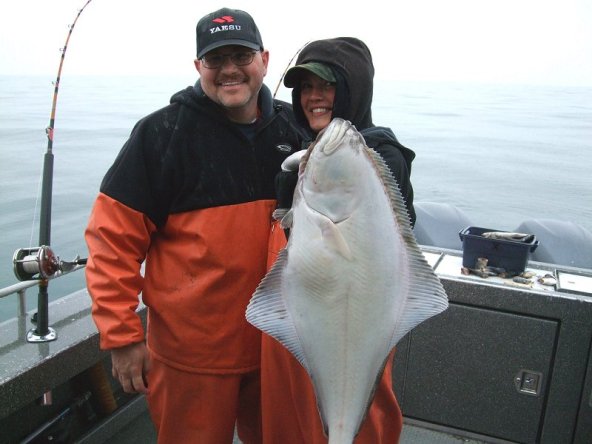
The evidence is below. Not fly fishing, to be sure, and even though the deckhand is behind a decent halibut and attired in unflattering foul-weather gear, most comments about this photo weren’t about the fish, but about much she was leaning in, her smile, etc.

Me, my fish and the deckhand who’d fillet it.


7 Comments

watch not, do (or what do you expect from fly fishing media?)

Maybe it’s just jealousy that [name redacted] earns money (or at least gets a tax write off) fly fishing, but I was bit more than puzzled after running across a new-to-me fly fishing show. The show is nationally distributed, so it must attract enough of an audience, but I just can’t figure it out. Perhaps it’s because it highlights waters in another part of the country, and I’m generally unfamiliar with the fishing opportunities outside the West.

The show is decidedly destination focused, with very little instruction. The host and show do enthusiastically support various charitable organizations and events, which is a great.

After a few episodes, however, I can’t decide if this show is one big advertisement for pay-to-play fisheries or a true reflection of the fly fishing experience in other locales. I’m used to stepping away from civilization for most of my fishing, but half the scenes in this show include a nice-looking cabin or lodge in the background, with parking only a few steps away from the water. Most of the time, this show is like fly fishing porn; easy fishing and big fish, always with plenty of casting room.

But if I can’t be out on the water, and whether tying flies or just vegetating in front of the TV, I expect most fly fishing shows to — directly or indirectly — teach me something beyond where to go.

Perhaps I ask a little too much of fly fishing media?


3 Comments

the rambling of an unfocused mind

I can’t seem to get anything written lately. But not really because of a lack of ideas. My mind is just a bit scattered with all that’s going on. The holidays, life, stuff. A day of solo fly fishing would help, I’m sure, but that ain’t happening anytime soon.

**********

I gotta follow my own advice: For the last few years [name redacted] has made it a point of ending any email or conversation that includes the mention of someone’s passing with the comment (paraphrasing here), “We’re getting older, you know, and fewer and fewer of our friends are still alive.”

My advice (more paraphrasing): “Appreciate the fact that you can still make that comment.”

Considering this wisdom, I’m now convinced that I need to avoid making any more friends and truly appreciate and make the best of what life has to offer. For the last 30 years I’ve always thought my future was much further ahead. I still do. But I’d like to think that my wife and I have learned a lesson or two over the years…doing now what we can rather than shelve that cruise, fishing trip or nicety of life until retirement.

**********

Seems I’ll always be in that awkward stage. Though I’m better than I was when younger, I still accidentally break things now and again. I dress better too, but other than the typical aloha shirt and shorts, I don’t have an easily identifiable “style.”

I thank God there are no full-length mirrors on the water. The few pictures of me in full fly fishing regalia confirm that I look less like the well-put together guy in the Orvis catalog — you know the one, with the sexy loops in his back cast, making even a plaid shirt look good — and more like a walking sausage. I can’t help but wonder if even the fish I land are a bit embarrassed for me.

**********

A week ago my wife told me she was getting her legs “sugared.” My imagination had just started to run away. Then she explained it…what a buzzkill…


2 Comments

one thing to do when not fly fishing this winter

Even though there is no fly fishing in Yemen (and even if there were you probably wouldn’t want to go), I was pleasantly surprised to see that the rather unassuming Salmon Fishing in the Yemen was recognized by the Hollywood Foreign Press Association (HFPA) with three Golden Globe nominations for: Best Actor in a Comedy (Ewan McGregor), Best Actress in a Comedy (Emily Blunt) and Best Motion Picture–Musical or Comedy. A pretty big deal for a movie that pulled in less than $9 million in the U.S.

Salmon Fishing in the Yemen is one of those stories about unreasonably good-looking people surmounting challenges to fulfill a dream thought absurd, and one of the best examples of a “feel good” movie. I enjoyed it despite issues with some of the fly fishing scenes, which is okay. Fly fishing is essentially a plot device (in both the book and movie) to explore love, separation and loss and ultimately, inspiration and faith. It’s refreshing to see a balanced portrayal of an Arab character and his Middle Eastern country, and the likable cast does a great job bringing a not-quite-over-the-edge spark of screwball energy to their characters. (I would suggest that Ewan McGregor and Emily Blunt haven’t been duly awarded for their trade craft.) The direction of Lasse Hallström offers beautiful landscapes as a supporting character.

In a nutshell, the attempt to bring fly fishing to the Yemen River is the quixotic* quest through which the characters search for contentment. A bit like fly fishing itself.

So, this winter, instead of justifying your lack of fishing with excuses of brutal cold, iced guides and the simple lack of a rational reason to fly fish in January, sit down with that beer or scotch, and enjoy. You can even tell your significant other that this is a film with fly fishing that they may actually enjoy.

*Yup, I worked “quixotic” into two posts in a row.


3 Comments

avoiding that 12-step program

I’m trying to avoid that 12-step program.

I’ve seen the results of the sickness. It’s not pretty. Often, it means a car can’t be parked in the garage.

An unchecked inventory of rods, reels, waders, vests and more spills from the shelves. A lathe, peppered with bits of grip cork, sits front and center, over fading oil stains. Boxes of feathers, thread, fur and hooks litter the floor. A pontoon boat or float tubes fill much of the rest of the space.

After taking an unblinking look at my array of fly fishing gear, it’s become clear that the time to act is now, before I lose control to an outside intervention. The rule around the house is that if an item hasn’t been used in a year, you’d better have a darn good reason — other than unshared sentimentality — for hanging on to it.

That hard look uncovered that 10-foot, 7 wt. rod that’s been wetted only once, chasing bass three years ago. I wouldn’t say I’m a trout snob, but bass fishin’ just hasn’t grabbed hold of me. And the trout I do chase generally don’t require much more than a 5 wt. (I’m actually leaning more toward a 4 wt. nowadays, but that’d require another acquisition.)

Luckily, I don’t have much, yet. There’s an old bamboo rod in one of those cases, but it’s safe; the wife suggested it could be decorative in the fly tying room that’ll be occupied by the last kid at home, probably for another three years. The spinning rods were long ago tucked into the garage at the cabin in the hope that visiting nephews might enjoy them. A boxful of spinners should join them shortly.

I expect that one’s collection of fly rods and reels is acquired for no other reason than fishing. Sometimes we want the latest and greatest, and forget what we already have. Sometimes it’s the search for the gear that will allow for longer casts, straighter cast, more accurate casts, or all of the above. Other considerations include differences in feel, flex, power, speed and fit and finish.

Maybe it’s a quixotic quest, but after casting various rods owned by friends and guides’ rods during the last year, I’m hoping to apply greater scrutiny any future gear acquisitions…buying only what I need, spending the money to get what I really want (with the required scrimping and saving). And there’ll still be room for a back up rod.

I’m hopeful that my belief that garages are for cars — many Californians seem to think that garages are above-ground basements — will keep to a minimum prevent any hoarding.


1 Comment

a benefit to keeping fly fishing one of the smaller sports

I suppose it’s inevitable that with time and age I’ll someday become that “get off my lawn” guy. This week, however, I purposely took a step in that direction.

Over the last few years I have dealt with customer service at Sage, Redington (prior to its acquisition by Sage), TFO, Orvis and Galvan. In every case, response was immediate and exceeded my expectations.

Last month I contacted [name redacted], the manufacturer of a now relatively well-known brand, regarding the replacement of an integrated iPhone adapter. Apparently, I can replace it myself, saving a bit of money, but the part can only be bought from the manufacturer.

Hindsight being 20/20, I should have seen trouble on [name redacted]’s website email form, which stated, “Due to extremely high email volume, if you require order changes or immediate assistance, please call our Customer Service Department,” followed by a toll free phone number and the typical office hours. Heeding this advice, I called. After a cursory “hello,” I described the issue to the customer service representative, offered the model number and was told they could certainly send out the part.

“Can you take a credit card,” I asked. The answer: “No.”

The silence that followed was finally disturbed by the representative telling me that I could send a check or money order. I did so on Oct. 5.

Life interrupted and it wasn’t until earlier this week that I realized the part had not arrived. The check had been cashed, but no part. So I called. And called. And called. And called. And called.

Each of those five calls, no matter the extension I chose, entailed more than a few seconds of silence before an automated message told me that my call was important and a representative would get to me shortly. That message was immediately followed by a click and dial tone. I’ve since sent an email, despite the advice mentioned above, and three days later there has been no reply.

Sidestepping any debate of the merits or problems of growing the sport of fly fishing, it dawned on me this week that the relatively small population of fly fisherman — those who regularly support manufacturers and retailers of fly fishing gear — offers a benefit rarely seen in other consumer segments. Strong customer service.

That’s why I’m now more inclined to encourage only a limited number of folks join the sport. The fewer of us who fly fish, the harder retailers and manufacturers have to work to keep our business. Not necessarily a bad thing.


2 Comments

with the proper attitude fly fishing keeps one young (or, once I was but the learner; now I am the master.)

If the headline got you here, great. But let’s first clear the air…
I’m not the master; I’m more of a jack of all trades and master of none.

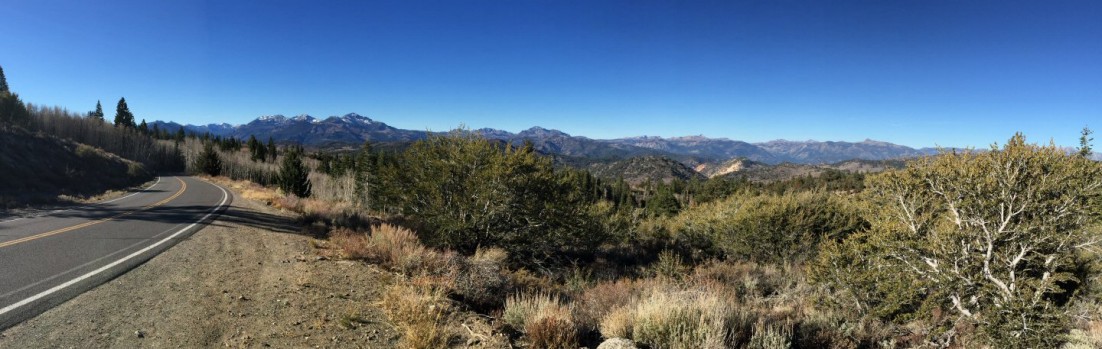
My last trip of this trout season to the foothills of the Sierra Nevada was like many before it. It offered solitude and a stillness that can only be found in the fall.

It is possible to spend time on most moving waters here — even those that are well stocked — without any company, and my usual arrival at sunup ensures that it’s just me and the fish for a few hours.

Such was the case on one of those streams, one that also sees a small fall run of spawning browns. I hooked only one of those browns this year, a big one that, after we eyeballed each other, promptly snapped my tippet and headed back downstream. Before and after I lost him, there were plenty of raceway rainbows that were willing to play.

When the sun finally warmed up the landscape enough, four gentlemen waded into the stream downstream from me, and slowly began to work their way upstream. I gave them a welcoming wave. Eventually, they were close enough that I could hear their conversation. Phrases drifted over the water…

“They biting?”
“Some, but that guy up there is getting five for every one of mine.” (‘That guy’ was me.)
“Wonder what he’s using?”
“It’s gotta be a nymph or something ‘cause I’m getting nothing on my Adams.”

During my few years of fly fishing I’ve learned to discern the experienced fly fisherman from those new to the sport. It was clear that despite their apparent age, two of the gentlemen had probably cast a fly rod only once before.

I can’t say whether it was the ego boost that comes with someone’s admiration of my catch rate or a more altruistic pay-it-forward attitude, but since I had long lost count of how many fish had wet my net, I offered my spot to the group. After assurances that I had caught plenty of fish, they gratefully accepted. I mentioned that black nymphs of almost any style might work, offered a bit of advice on depth, and the two more experienced guys helped the other two rig up. I think between the four of them they used four different types of indicators.

One of the gentlemen broke away to chat with me. All four gentlemen were over 70 years old. While two of them were more experienced, that experience was with bass or in Alaska, not so much in the Central Sierras. There was no bragging between us, a simple sharing of information and stories. One of their group was from South Africa and had never caught a trout. He did that morning and gave me one of the biggest smiles you might imagine.

I’d end up showing these guys where to find the fish on this stretch, explaining then showing that during a limited window — when the sun is at the proper angle on this stream — during which dry flies will get some attention.

All of us accepted each other in the common bond of fly fishing. While most fish were caught and released, there was a stringer produced and a few fish taken by one guy who was recently retired, but only after asking if we thought it okay. (He somewhat sheepishly explained that he wife had complained that through all his years of fly fishing, and all the money spent, that not once had he brought home trout for dinner.) There was no dissention, knowing that these were stocked fish that might not last through the winter.

When I left, there were smiles all around. We were friends that might have never met were it not for our shared hobby. It was a good way to end my season.
3 Comments

how to bully your way on to any water, haul friends and beer, and look awesome doing it

On a stream last week my needs (a solid and reliable rod and reel) transcended desires (the latest and greatest gear). Maybe it’s the fact that I landed a good number of fish, and not one looked at my rod in disgust. (I did get the downturned eye of disdain, but only once they were in the net.)

And while that argument has been settled, this week it’s become clear that I’ll forever covet any conveyance that’ll get me to the water with a dollop of awesomeness.

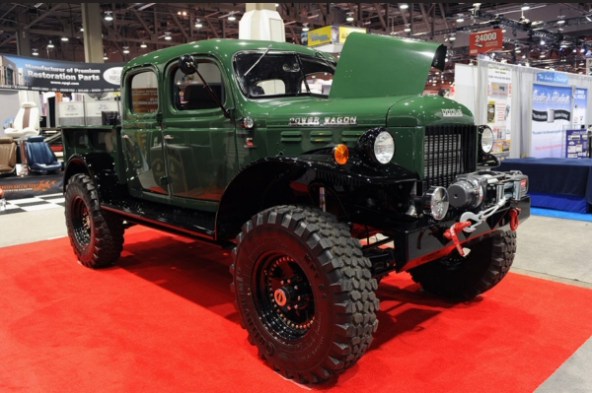
Nothing screams “Get off my lawn river!” like three tons of vintage Dodge Power Wagon.

Legacy Power Wagon

Legacy Classic Trucks brought this beast to this year’s Specialty Equipment Market Association (SEMA) Show. The Legacy Power Wagon is available in a two-door configuration for the less social fly fishermen and a four door for those friends who bring beer. Engine options are either a 426-cubic-inch V8 with 425 horsepower from Mopar or a 3.9-liter Cummins turbo diesel four-cylinder good for 480 pound-feet of torque. This one would set you back about $180,000. Equal to just a few Helios 2 rods, huh? Best of all, you can pick one up at the workshop in Jackson Hole, Wyo., not too far some decent fishing.


1 Comment

think not, do (and why I think one can trust their feelings…after a bit of real-world learning)

I don’t remember how it was learned. There has been a lot of trail and error, fishing trips and advice from guides and fly fishing friends. It certainly wasn’t during my first year of fly fishing, when it was all new and mysterious — and happiness was fooling a single wild trout. Mistakenly filled with a dream of never being skunked again, all virgin water held promise, particularly without the knowledge that is only gathered with time on the water. Maybe, at first, this knowledge is founded upon a dog-eared book authored by Whitlock, Humphreys, Cutter or Rosenbauer. But over time, those written words merge with experiences to become more instinct than reason.

Only lately did it become clear — while reflecting on fishing an Eastern Sierra river a bit more than a few weeks ago — that my approach to water, at least assessment of it, was without conscious thought that day. A first trout that came to the net early that morning would be the only fish for a period of time longer than I liked. But there was a lot of water to fish. It wasn’t too long before the burble of the river, the lowing of cattle and the rhythm of casting encouraged giving in to just being there and trusting in my strategy.

I no longer feel frustration (I’ll admit to a bit of irritation) when the net remains dry and the fish don’t respond to sound tactics. Digging a bit deeper often reveals a smidgen of an idea that I may be employing the appropriate tactics, just not in the right place. If asked, I usually can’t describe the right place, but I’ll know it when I see it.

I saw that right place that morning on the Upper Owens River, but it wasn’t until long after the fact did I recognize my knowing that it was the right place. At the moment, it simply felt right. It was a small bend where the water tumbled over and through a few polished rocks, with enough speed to carve underneath the bank a small undercut. Above this bend, a confluence of two braids would funnel any food to where fish should be waiting.

What those books don’t tell you, and can’t if they hope to find new readers, is that as insight is accumulated, at sometime it’ll be a gut feeling telling you that you’re in the right place, at the right time, casting the right fly with the right technique. With a lot of luck, you may even feel that a drift is so right that a hook up is almost — almost — guaranteed. That day half a dozen trout from that bend would end up in my net.

It took some thinking about that day before I realized that it was following a feeling, a learned intuition perhaps, and that not overthinking worked out pretty well.


1 Comment

the conundrum of working-class guy’s fly fishing vehicle

Ask around, do a little research and you’ll likely find that the question “what’s the best vehicle for fly fishing” is often answered “truck.”

But I’m still paying into social security so others can fly fish when they want a working stiff. I need transportation that is, first and foremost, reliable, and just as important, economical. I have to spend money on gas to make money, and the less I spend upfront the better.

During better weather, the Honda CB750 and its 45+ miles per gallon is a fine option. But it’s difficult to load the necessary fly fishing gear, and the cooler of post-fishing beer, on a motorcycle. I’ve tried.

Being a bit obsessive about conducting research on anything that will cost more than $50, I’ve been thinking — probably too much according to those around me — about the vehicle that, in about 1½ to 2 years, will replace my current 2003 Honda Accord. Since I’ll likely buy a certified pre-owned car, it’s going to be something currently on the market. My current car gets 30 to 32 mpg most of the time, and on long trips to fishing venues, I’ve seen 34+ mpg. But over 80% of my driving is commuting to and from work.

I’ve debated the merits of various models, including sport utility vehicles and all-wheel-drive cars. A hybrid is out of the question; too heavy and not enough clearance for the occasional Forest Service road. Subaru is a commonly offered up make as an all-encompassing solution. But I’ve noticed two things: most Subaru owners talk about the sportiness of the ride, the go-almost-anywhere capability, but rarely praise their cars’ mpg, and it seems to be a roll of the dice when it comes to build quality. That might be said about any make, but that’s my experience.

Despite the fact that I’ve been a Honda owner for well over 20 years, I opened up my consideration to other options, particularly now that the mpg on midsize sedans is edging up.

But, and a bit ironically, it’s fly fishing that helped firmed up my decision. At least for now.

I’ve driven my Honda on a good many, only slightly improved, Forest Service roads. Sometimes for miles, over the relatively soft dirt along the Upper Owens River, for example, or over rocks on my way to the Little Walker River, and on washboard roads in the hills behind the cabin.

Still, the doggone car doesn’t squeak or rattle.

I’m hoping this will still hold true for my next car, until that someday when I can justify a dedicated fishing truck.