It was in the shade of a concrete canyon that we reminisced over breakfast about those last few days in San Diego. It was a visit without an itinerary but nonetheless full. Balboa Park. A working lunch and dinner. Coronado Island.
The trip last week was free of monetary worries; part of a package to celebrate my having worked 30 years with the company. Whether it was a perk or disruption, the rest of my co-workers would join us for a day at the office and the celebration that evening.
Karen and I were on the road early that Wednesday, weaving through the normal early-morning traffic. Highways 680, 24, 980 and 880 got us to Oakland International Airport in good time. My past airport experiences had been marked by apprehension and anxiety. For me, arriving 15 minutes early equates to being on time; on time is late. Airports bring too many unpredictable variables into play. I didn’t like it and constantly imagined missing a parking lot shuttle or flight.
We arrived at the airport more than two hours before our flight, allowing time for a leisurely breakfast. It made me feel like a real traveler. I was relaxed, in fact.
And my wife had a plan. Her mother was a stewardess back when that job title wasn’t outdated, but the knowledge she imparted still applies today. My wife would take a window seat, and I’d take the aisle seat. As long as the flight wasn’t completely full, this might, deviously, deter anyone from taking the seat between us. It worked. No more than 70% of the seats were occupied, allowing us to enjoy some elbow room.
The flight was comfortable. The first landing attempt waved off, the second attempt turbulent but successful. The weather was clear and San Diego almost seemed to sparkle.
I was originally under the impression that my boss, the company owner, would be our chauffer. But I was handed the keys. He’d be our navigator. Along the way we were regaled with tales of his family’s history in San Diego. The first relative arrived in the late 1800s. During his youth, he wasn’t allowed south of Broadway. Our hotel, Hotel Palomar San Diego, was just north of the old Woolworths, where he never had a sandwich.
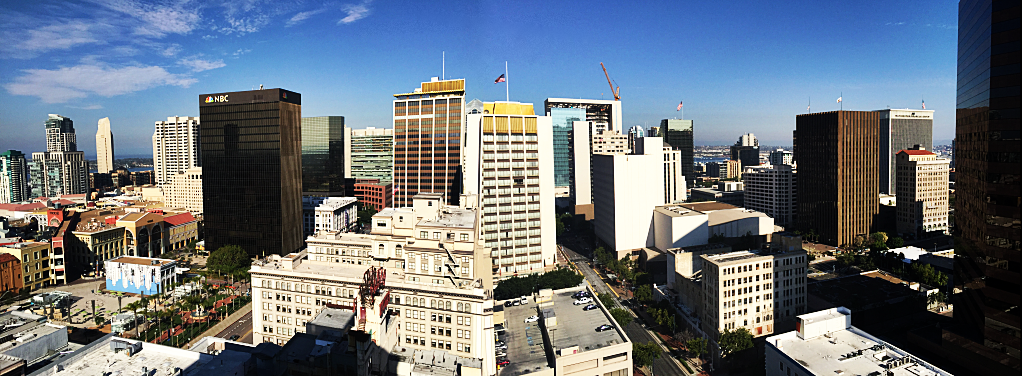
What would be the view from our room on the 18th floor of the Palomar.
San Diego is one of the more puzzling cities I’ve visited. Its waterfront is wide open, as most are. But a few blocks in, it’s a mashup of old and new, with older buildings’ blank walls facing a street for two or three blocks. Often, only a single door or parking garage entrance hints that there is something behind the featureless edifice. While development of the city’s Gaslamp Quarter does seem offer a mix of people living, working, shopping and dining, most areas don’t.
This isn’t helped by the many, multi-lane one-way streets. I read somewhere that one-way streets encourage greater car speeds and discourage pedestrian and bike traffic. This seemed to be the case in the one-thousand block of Fifth Avenue, our home base for three days.
If our stay is any indication, San Diego has some of the best weather anywhere in the country. After our quick tour and dropping the boss off at the office (farther up Fifth Avenue), we ended up in Balboa Park. We took a quick tour of an anemic display of California native plants, the headed toward the Spreckels Organ, lucky enough to quickly find a parking stall.
More people than you’d expect for a Wednesday walked up and down the sidewalks. Balboa Park’s landscaping isn’t easily described. From any single location one might see five or more different species of trees. Lawns lush by California standards give way to xeriscaping, planted with succulents from around the world. There was a remote familiarity to it. This is what I grew up with in the San Gabriel Valley.
Karen had suggested The Prado for lunch. (I silently mulled over feelings that any restaurant with a name that starts with “The” could quickly empty my wallet.) Located in the House of Hospitality, it’s at the center of Balboa Park and was built for the 1915-16 Panama-California Exposition. The building echoes the Spanish Colonial Revival style apparent throughout the park, though there is an argument that, being an architectural stylistic movement that arose in the United States during the early 20th century, it’s wrong to connect it with Panama.
We were seated immediately and our server was almost doting. Splitting the entrée, as we often do, limits the choices bit – it’s well known that Karen doesn’t eat cheese (I do) – but we agreed upon steak tacos.
Often it’s the entirety of a meal that makes it better than good and that was the case with this meal. The rice and beans were better than most, the steak cooked well but still tender, and the tortillas were more flavorful than their thinness would suggest.
It was a delicious start to a trip that would end up offering much good food, fantastic weather and a lesson in slowing down.




 This same research suggests that when fly fishing, less than 10 brain centers may be active. When one first takes up fly fishing, high expectations could bring a few more brain centers into action. However, over time, the combination of that anticipation as well as affirming memories of previous fly fishing successes, in theory, increases the duration of signals sent to the satiety center in the hypothalamus.

 I’d usually dismiss this type of book. Too often advice or self-improvement books reflect on an author’s early years, that period of time when one can afford to fail, eat broke food and sleep on a friend’s sofa.
 Even with age, all is not lost when it comes to fly fishing. Wading in cool trout waters is excellent therapy for sore knees. Aches and pains fade away with one’s focus on the flies, even if that means watching an indicator (aka bobber). If it ever comes down to needing a more sedentary mode of fly fishing, I’m lucky enough to enjoy stillwater nymphing and have suitable waters not too far away.
 Growing up we visited the Martinelli’s* operation in Watsonville, Calif.; the Blue Diamond Growers* plant in Sacramento; the


 Finally seated at Tony’s Pizza Napoletana, nearly elbow to elbow with other guests, we unfolded a menu with three pages of pizza and another of pasta and Italian specialties. Two words stood out: Coal Fired. Below it was a pizza that sounded too good to pass up.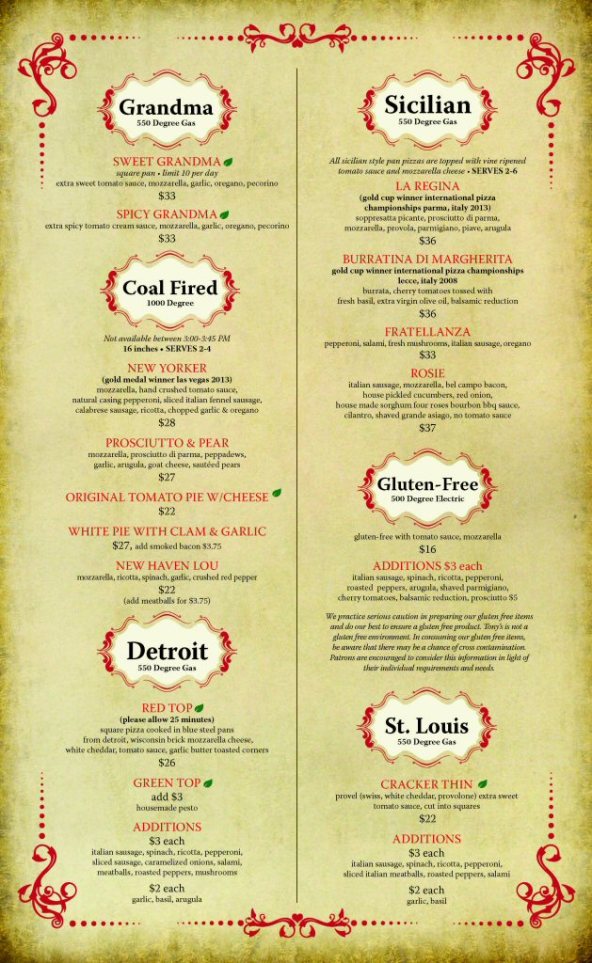
 Our days were measured by trout caught, bears seen and miles hiked; nights by stars and the embers of a campfire. During those summers we’d rarely see a familiar face, but the place seemed unchanging. We grew a lot during those short visits, climbing granite domes, hiking trails commonly rising 1,000 feet in less than five miles, floating in a river that only a few miles earlier was born of snowmelt.
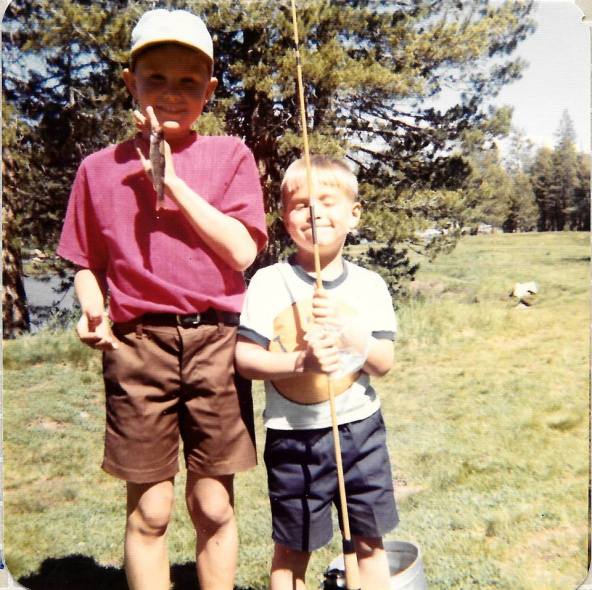 It wouldn’t be out of place to say that Tuolumne Meadows, a less visited part of Yosemite National Park, helped form the person I am today. I’ve since returned to Tuolumne Meadows, one time fishing there with my sons, another time hiking up Lembert Dome with my brother and one son. Nature seems to ignore us humans; the changes over the last three decades are entirely ours.
