Opening day of the general trout season in California is this Saturday.
But I won’t be on the water. I will instead sacrifice the first opportunity to be skunked on my favorite stream for the greater good. (Very Vulcan of me, right?)
The first two years after I picked up a fly rod — some seven years ago — I would start preparing for the new trout opener a few weeks after the closing of the previous season.
I do still care about the trout opener. It opens wading access on the west slope of the Sierra usually long before the passes to the eastside are cleared. Being on the water at the earliest legal minute had become tradition. Even back when I was throwing hardware, it wasn’t about filling the freezer; it was simply about being out there, working the rust out of skills unused during the winter. Four seasons ago I accepted the invite of a fellow forum contributor to join him opening day in chasing down backcountry trout. He would provide the four-wheel drive truck, I provided flies. It was a day filled with good friendship, great weather and beautiful country unseen by most. Unfortunately, any trout that may have been in the half dozen streams we visited remained unseen.
The biggest influence in my changed opening day perspective is also one of the bigger rewards that have come with fly fishing. Notwithstanding the excitement of a big Eagle Lake rainbow taking me into my backing, I’ve find an unquantifiable pleasure in helping bring others into the sport. My contributions to the club’s novice fly fishing class aren’t huge, but the enthusiasm imparted by the instructors, including myself visibly, sparks something in the students. The payoff often comes a few weeks or months later, when one of those students, all smiles, presents a photo of the fish caught because of something learned in class.
So, while I’m not retired, but I’ve become one of those guys for whom the trout opener only marks the point in time that most trout water is wide open to fishing. I’m lucky enough to have a place in the Sierra foothills available to me most any time, and I have grown content to head up the week after the opener, often to find welcome solitude on most rivers and streams. I have also taken to the challenge of finding the ‘smarter’ fish left behind after the crowds of opening day.
When I finally do make that first cast for trout this year, it’ll be later, but for good reason.
One of the truly great things about fly fishermen is nearly all of them will join in celebrating any aspect or level of the sport, be it the fish, gear, venue or tactic. There can be some good natured ribbing about one’s choice of Tenkara or pursuit of carp, and while we appreciate the top-of-the-line rods and reels get much of the press, we know that even gear showing the patina of age can get the job done.
There was no better evidence of this than our recent club auction. This is one time that the humblest of gear rubs shoulders with high-end counterparts, where a Sage One rod could be found across the aisle from an old and chipped well-used Pflueger Medalist.
Many of the items, old and new, are donated. Those with that dose of ‘character’ that can only come from service — worn cork grips, dents in metal fly boxes — often find their way from club members’ estates. These items earn appreciative comments and usually find a new home.
Despite a penchant to buy the latest and greatest or the newest must have, fly fishermen seem to be prolific recyclers. That’s pretty awesome.
*And while there’s no denying that their main motivation is to sell new gear, more than a handful of fly shops have programs that facilitate the sale of gear via a store credit. Notwithstanding their ulterior motive, it’s nice to see.
I don’t remember how it was learned. There has been a lot of trail and error, fishing trips and advice from guides and fly fishing friends. It certainly wasn’t during my first year of fly fishing, when it was all new and mysterious — and happiness was fooling a single wild trout. Mistakenly filled with a dream of never being skunked again, all virgin water held promise, particularly without the knowledge that is only gathered with time on the water. Maybe, at first, this knowledge is founded upon a dog-eared book authored by Whitlock, Humphreys, Cutter or Rosenbauer. But over time, those written words merge with experiences to become more instinct than reason.
Only lately did it become clear — while reflecting on fishing an Eastern Sierra river a bit more than a few weeks ago — that my approach to water, at least assessment of it, was without conscious thought that day. A first trout that came to the net early that morning would be the only fish for a period of time longer than I liked. But there was a lot of water to fish. It wasn’t too long before the burble of the river, the lowing of cattle and the rhythm of casting encouraged giving in to just being there and trusting in my strategy.
I no longer feel frustration (I’ll admit to a bit of irritation) when the net remains dry and the fish don’t respond to sound tactics. Digging a bit deeper often reveals a smidgen of an idea that I may be employing the appropriate tactics, just not in the right place. If asked, I usually can’t describe the right place, but I’ll know it when I see it.
I saw that right place that morning on the Upper Owens River, but it wasn’t until long after the fact did I recognize my knowing that it was the right place. At the moment, it simply felt right. It was a small bend where the water tumbled over and through a few polished rocks, with enough speed to carve underneath the bank a small undercut. Above this bend, a confluence of two braids would funnel any food to where fish should be waiting.
What those books don’t tell you, and can’t if they hope to find new readers, is that as insight is accumulated, at sometime it’ll be a gut feeling telling you that you’re in the right place, at the right time, casting the right fly with the right technique. With a lot of luck, you may even feel that a drift is so right that a hook up is almost — almost — guaranteed. That day half a dozen trout from that bend would end up in my net.
It took some thinking about that day before I realized that it was following a feeling, a learned intuition perhaps, and that not overthinking worked out pretty well.
There are times when the catching is good, but the fishing still unsatisfying. I was felt this way on Hot Creek, just a bit, during this last club trip to the Eastern Sierra.
I may not eagerly jump out of bed on a work day, but by nature — likely because I’m in tune with nature on most fishing trips — I’m an early morning fly fisher.
It’s a strategy that works for me. It puts me on the water long before almost anyone else. Nymphs work well for me in the twilight of the morning. The darkness lends the fish in my net a a mysterious, ghostly quality.
That’s what put me on Hot Creek about mid afternoon on a Thursday.
It was nicer than I expected, with a mid week crowd comprised of a single fisherman and myself, and the normally frustrating winds almost nonexistent. Caddis coated the bushes. An errant mayfly dipped up and down in the air.
I’d been told that a certain crane fly imitation would work well. I didn’t have one. The hoppers that were suggested didn’t get even a glance from fish clearly seen to be eating. For a time I watched the graceful and economical movements of a pod of trout, rising to feed and falling back to the bottom. Obviously, there was something that I couldn’t see bringing them to the surface.
Like most any water, Hot Creek comes with its own piece of counseling: go small. And in the afternoon, dry flies.
Normally I’d head upstream and work my way down, but after a friendly conversation with older gent already fishing (and giving him a size 20 caddis for use as an indicator above a trailing something about size 22-24), I decided to stick and move as I worked my way up the creek.
I rigged up in similar fashion, with a black caddis trailing a size 24 parachute Adams. This time of year, tactics at Hot Creek are often dictated by the abundant weed growth. A soft footfall serves one well, and I carefully picked my way around bushes while watching the “lanes.” In the past, I bypassed these areas under the pretext of one excuse or another. (My casting isn’t good enough, I won’t get a long enough drift, too many people, etc.)
It wasn’t too long before I saw that first nose, more of a bump in the water, a tell-tale sign of a feeding trout.
I cast well upstream. It took a few more casts, but with some skill luck, a good drift put the fly where it needed to be.
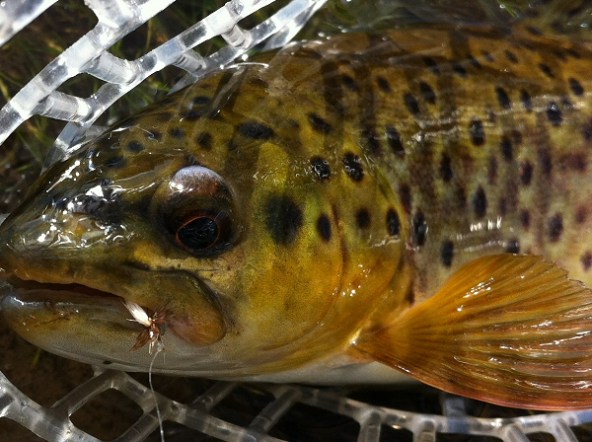
It still amazes me that a nice Hot Creek brown like this can be landed on so small a fly.
I’d repeat this more times than I care to recall but was rewarded with eight beautiful trout, mostly browns, all of which were no less than 13”. The biggest and prettiest crowded about 24” of beauty into 15” of fish.
Next year, I think this place will deserve an entire day of my attention.
This year’s annual club trip to the Eastern Sierras — organized by yours truly — came a tad bit later this year, but its planning nearly nine months ago couldn’t anticipate the snowfall that wouldn’t arrive last winter. From afar I watched the guide reports and river flows, but all of that was forgotten two Sundays ago, once an amazingly fat brook trout slammed the first dry fly cast into a suspect pool.
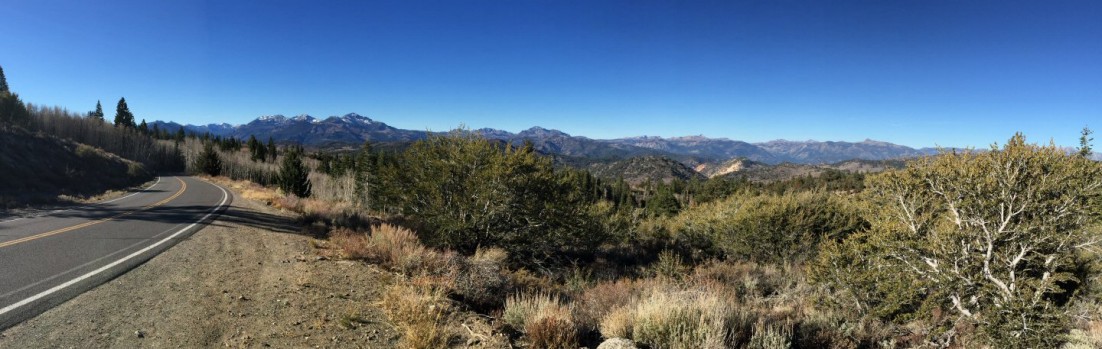
This is a good time of year to be in the Eastern Sierras. Fewer people, perhaps only the hardier (and those without kids), remain to fish, hike and camp. Being a bit more mature, our group rents a couple of rustic cabins, though we do cook dinner ourselves (clam linguine one night). The days are often cloudless and, at an elevation of 7,000 feet, this expanse of high desert warms up fast. Temperatures swing the other direction just as fast, dropping to the mid-to-low 30s in the evening. Startlingly brilliant stars illuminate the clear nights.
Once over Sonora Pass, my first stop was on the Little Walker River. This small water is often overshadowed by its bigger brethren, the East Walker and West Walker rivers, which offer bigger and more fish. A year after discovering the charm of the Little Walker, and during my first turn as “fishmaster” for this trip, I fished this creek with the club’s outings chairman. We had a wonderful time finding wild brook, brown and rainbow trout exactly where they should be. Jim has since passed away, but the Little Walker reminds me of his broad smile.
It surprised me to see a brookie so big in the Little Walker.
It was with Jim that I first explored Hot Creek, one of the waters that would be frequented during the week. Since I’d have six full days to fish, and in light of Hot Creek’s popularity, the plan was to fish it during midweek. It was a sound philosophy; avoiding as many other fly fishermen as possible and hoping that reduced fishing pressure over a day or two would improve my chances.
Hot Creek Morning.
Hot Creek has been the marlin to my Santiago. It’s a spring creek with a high fish population, estimated to be 8,000 to 10,000 trout per mile. But these are highly educated trout that have probably seen every fly in the catalog. Throw in clear, low water and weeds that limit opportunities to small lanes and the chance of a drag-free drift, and this fly fishing heaven can become hellish, particularly late in the year. Most descriptions of Hot Creek include words that tend to scare me: “technical,” “attentive mends,” “drag-free drifts,” “multiple hatches.” That first visit with Jim five years ago didn’t dispel any of my trepidation, despite my landing two decent fish.
Although I was on the road Tuesday morning later than intended, I descended into the canyon well before the sun was fully on the water. A single fly fisherman had arrived before me. Reminding myself that there was no need to rush, I slowly and softly walked upstream, taking time to stop and watch the water. In the absence of light, the water was dark and unyielding.
Trusting to my experience that fish would be in a familiar spot, I finally stopped to cast a size 16 dark brown-bodied caddis trailing a smaller dropper (maybe size 22, or 24); a red-butt zebra midge type of fly made up during a fit of madness inspiration at the fly-tying vise. This was truly blind casting. There was a lane big enough to allow for a decent drift of about two feet. I kept my false casts short and out of view of the trout I hoped were there, and used a single-haul cast to finally lay the flies on target. The caddis dipped on my third cast and a good-looking 11 inches of brown trout went airborne. I don’t know if it’s the lack of depth in the creek, but I don’t think I’ve seen brown trout as acrobatic as those in Hot Creek.
Hot Creek Brown. Love that pectoral fin!
With the first fish to the net, my pulse finally began to slow and my body relaxed. My casting settled down. Two more fish made it to my net during the next hour, one a dark-hued rainbow of about 14 inches. There are bigger fish in Hot Creek, but any decent fish hooked, played through the mass of weeds, and landed, is still a pretty big deal in my book.
Soon the first few caddisflies and mayflies appeared in the air as sunlight began to warm the water. The sunlight also revealed pods of fish, some hovering between weeds, others just on the edge.
Yes it was dark, but this wild fish also has a dark cast to it.
I downsized my caddis fly to a size 22, hoping that it might get a look or two. It did, but only in passing. I would land a total of six fish that morning and walk out of the canyon feeling pretty good about it. But it was a conversation — with a friendly guy who toughs out his year splitting time between fly fishing the Eastern Sierra and running a scuba shop in Cabo San Lucas — that had me pondering a return in the evening.
Evidence that I’ve had little time to write this week…visit by the brother, a newphew’s first football game of the season, and a son’s graduation from the police academy…
Newphew Nicholas running down the ball.
Napa College POST Academy “Class 84” ready for inspection.
Sean ready for inspection.
Sean recieving a certificate for an RTO score of 100% based on “performance, maturity, professional conduct, attitude and readiness to enter an FTO program.”
Mark and Sean, hopefully soon to be two generations of peace officers.
Since pictures are worth a thousand words, and it would take many thousands to tell of the adventure and fun enjoyed last week with my brother’s family, below is a gallery of photos that tell the story than I could. The days were filled with swimming at the local lake, visiting a historic gold rush town and panning for gold, more fun — swimming, sliding, diving, building sand castles — at the lake, hiking, mini golf and a trip to Yosemite. Enjoy!
Due to loading issues, the gallery has been moved here.


 fishing for words