There’s a fear that can creep over me in the company of other fly fishermen. Those who know me personally are likely to agree there’s a touch of restraint in my personality. Blending into a crowd is specialty learned during middle school; let’s spin it as a well-honed survival skill. Thankfully, in the years since, I have been able to put myself out there with the backing of friends and colleagues, though I still haven’t totally abandoned my introversion.
It was a recent podcast that made me realize that perhaps that fear coincides with the niggling thought that I may be a lazy fly fisher.
But I will hike to the fish. There was no hesitation last summer to march three miles into high-altitude lakes for brook trout no longer than the spread of my hand. I also tie flies. I built a fly rod. And it’s no problem getting up early to spend the day driving the 240-mile loop that takes me over Tioga Pass and Sonora Pass, alongside high-elevation streams and lakes as well as high-desert rivers.
I still feel a bit unworthy among my fly fishing peers. When others are describing the physical skill it took to lay a dry fly in front of a big trout 40 feet away, across four different currents and through 30 mile-per-hour crosswinds, I have no response. Oh, I’m catching fish to be sure. Just with less effort. It’s called nymphing; often under an indicator or dry fly.
It’s not that I’m apprehensive of trying different techniques. I’ll swing small wet flies, cast dries as far as I can — maybe 20 feet accurately — and chuck streamers when an opportunity presents itself.
Thinking about it, after being hammered by messages in blogs, podcasts and online forums that nymphing is inelegant (it is), too productive to be considered a real challenge and more akin to lure fishing than fly fishing, it occurs to me that nymphing, in fact, requires a bit more creativity than other tactics.
Why?
Nymphing often requires visualizing where your fly is and what its doing; rarely can you see it like a dry fly. It takes some thinking to set the depth at which that bead-head fly might be presented to fish hugging the stream bottom.
Observational skills are much more important. With dry flies you can rely on visual cues. When swinging flies, the take is abrupt and obvious. Nymphing, however, requires keen observation of subtle clues: the movement of the rod tip, the twitch of a strike indicator, even a suspicious flash of color. It takes skill to discern a take from your fly bumping simply into a rock or snag or hanging up on weeds.
What I’m trying to imply is that there’s another level of mental dexterity involved in nymphing and not required of other tactics. All tactics benefit from some knowledge of fish habits, hydrology and entomology and basic situational awareness.
Nymphing, however, requires imagination.
Guess that’s why it works so well for a day dreamer like me.
Fly fishermen tend to be nice folks. More than once I’ve been offered advice or invited to fish an incredibly productive spot alongside another fisherman. Complete strangers have offered to give me “the fly of the day.”
But it seems that the gloves come off away from the water.
Last Tuesday was my club’s annual auction. This is an event I look forward to, even if I’m not in the market for anything extravagant. There’s always a huge selection of member-tied flies, old reels and rods, and books to peruse.
It’s an opportunity for a great deal. And if an item is bid up, at least the money goes toward substantial donations made by the club every year to worthwhile conservation organizations. Everyone ends up happy. Or so I thought.
I wasn’t in the market for too much gear this year, but placed bids on about a dozen items. Among them were a few sets of a half dozen flies, a member-crafted wood cribbage board, a couple of books and an old reel. I revisited each item at least four times, revising my bid as necessary. My expectation was that about half would be lost to last-minute bids.
One last glance at a few times suggested that I just might win a few goodies. It’s unclear if it was the fact that five minutes passed after the official closing time before an announcement was made or an indication of “sniping” was more rampant than I expected, but thoughts of losing more than a few games of cribbage to my wife quickly faded when I was handed one set of flies.
I was relieved that I didn’t overspend. But a little disappointed.
I should have known better. It seems that all fly fishermen are always looking for a deal, but are willing to open their wallets when getting gear also supports conservation. That’s a good thing.
It’s clear that nature’s dewatering of California this year will leave the trout that can be found skittish and stressed. I suppose that only the most thoughtful fishermen will leave them well enough alone as the summer wears on, or perhaps cross to the dark side of warm water species.
Opening Day may mark the beginning of the few weeks during which decent trout fishing may be found not too far away, while fish mortality is at a minimum. After that, it’s unlikely you’ll find solitude at a high alpine stream, creek or lake. The same climate change pushing wildlife to higher altitudes will similarly affect their human hunters.
This summer and fall — when still-flowing rivers will only offer skinny water — will be seasons of small fly rods and even smaller flies. A few small wild trout fisheries I hold dear (and of which I also hold a delusion that only I know about them) won’t withstand much molestation, meaning I’ll also be somewhere else.
It’s been proposed that “heroic measures” will be needed to save California’s salmon runs. As the weather warms up and naturally flowing water is scarce, it’ll be just as heroic to leave alone those fish that have nowhere else to go.
With our latest rain, I’m hoping it won’t be 1975 all over again. Then and now, precipitation was routed around California by a high pressure ridge for months. December of that year was the beginning of two years of drought conditions. Our reservoirs are now lower than at the same time in 1977, which was preceded by two dry years. Jerry Brown was governor back then; irony or conspiracy?
Without non-stop rain through the rest of our rainy season the coming summer will be one of dirty cars and brown lawns. Communal showering may become de rigueur, perhaps followed by an uptick in births.
Back then I wasn’t fishing as much as I do now. There are a few small streams — only shared with the most trusted — that will go unvisited this year. It’s a given that low reservoirs will push more fisherman to moving waters that remain open which, more likely, will be tailwaters.
Automatic readings last Thursday show the snowpack in the Sierra Nevada is now at 15 percent of normal, up from 12 percent on Jan. 30. At this rate, we only need 28 storms of similar magnitude to reach normal levels. And that still won’t be enough.
So this week my news feed coughed up an item about a Kickstarter campaign to fund the development of newfangled Tacky Fly Boxes.
Reading the Tacky Fly Boxes vision statement it seemed to me that it’s not fly retention that’s my problem; it’s retention of the entire box. The entire box should be coated in tacky stuff.
About seven years ago I stumbled upon a stretch of river that wasn’t more than 30 minutes away from the cabin by road, but in the early trout season offered an opportunity to fish in solitude. It’s an area deep within a canyon where dogwood and pines filter the sunlight. Only occasionally is the shade is broken by shafts of light, lending an emerald-green cast to the air. The river is lined by boulders much of its length here, and stepping from rock to rock is necessary.
The excitement that comes with discovering new water was amplified by the willing rainbows. It was the kind of catching that’s so good you purposely slow down to savor each cast, hookset and fish itself. But this was my early days of fly fishing. I hadn’t yet acquired any habits or routines.
At $1 or more each, they add up.
The plan that day was to fish one river in the morning and another in the afternoon. When I arrived at the second river I reached into my vest pocket, unzipped and now empty. No fly box. It’d be a lie to say there was no panic. To those who say fly fishing really isn’t that expensive, try losing an almost full fly box. Buying a few flies at a time doesn’t seem like much; add them up and it can be tidy sum.
After only a short internal debate I headed back to the first river. It should have been a futile search. More than likely, the fly box was about five miles downstream by now.
Retracing my steps, on the last boulder, nestled in moss, was my fly box.
I’ve adopted on-the-water rituals since then. I have lost a net to some trees while hiking through thick bush. One rod’s been broken. That fly box, however, was the one lost item that made me question taking up this hobby.
I didn’t give up. It’s all been downhill ever since.
Whenever I’m flipping channels, I find myself stopping all too often on one reality television or another and occasionally spend too much time staring in disbelief. Few are engaging enough to warrant a season pass on the Tivo.
To me, reality television seems makes everyone else appear way more broken or stupid than myself or anyone I know, and if watched with the proper amount of cynicism, the absurdity quickly transforms into at least amusement, if not eventually outright hilarity. It’s almost a form of therapy that can make one feel so much better about one’s lot in life. (Full disclosure: Karen and I regularly watch “COPS,” and we figure there’s got to be a drinking game centered on the common suspect retort, “These aren’t my pants.”)
It’s been a bad year for water in California. The April opener was one of the best in years thanks to low water levels.
Next week we’ll see for ourselves what Eastern Sierra rivers and lakes look like four months later.
One guide recently referred to Bridgeport Reservoir as a “pond.” Bridgeport is so low that its outflow into the East Walker River has been tainted by algae — algae that usually floats closer to the surface of the reservoir — and now the river is regularly off color and weedier than usual. Lake Sabrina in the Bishop area is so low that the front (manmade) lake no longer exists. The level of Crowley Lake is better than might be expected, but low enough to concentrate fish in the deepest areas.
The route taken by myself and guys from the club will be dictated by the Rim Fire. Hwy 120 remains closed. An expectation that the fire might not be fully contained until Sept. 20 doesn’t lend any clarity as to when it might open.
That’s not a big issue for me. I usually head over Sonora Pass via Hwy 108, with stops at the West Walker River, Little Walker River or Molybdenite Creek.
Thankfully, there will be water to fish when we settle in at Tom’s Place Resort (which certainly isn’t the resort you might think it is). The Upper Owens is supposed to be in good shape. The Middle Owens is flowing at an unseasonably high level. I may head to the high country, visiting alpine lakes and streams where I hope the fish are already preparing for a long winter.
However it works out, there will be lies told over beer and good grub.
It was long ago decided that this blog was to be guided by a few simple rules; that it would be family focused and friendly, devoid of rants or advice, and mostly my space to write about the misadventures of my life.
Today, however, things are bit somber.
CalFire Rim Fire Incident Report
California’s fire season is shaping up to be one of historic proportions. The Rim Fire still raging near Yosemite Valley is one of 11 major fires currently burning in our bone-dry state. Those are only “major” fires. During the last few weeks, about 150 fires were sparked by lightning strikes. CalFire figures show that through the middle of August, 4,715 separate fires have burned the state — beating by a wide margin the historical annual average since 2008 of 3,000 fires. The Rim Fire is now the largest fire in the recorded history of the Sierra Nevada and, as of today, the 5th largest wildfire in California’s history.
In this moment, all eyes are understandably on the immediate danger to lives and property. Prayers are being said for the firefighters. This is devastation on an unimaginable scale.
As a fly fisherman, I can’t help but ask questions about the long-term impact on the many streams and rivers now stripped of bankside vegetation, and the fish in their waters. The extent of ecological damage won’t be understood for a long time. The intensity of the blaze — flames reportedly reached 100 to 200 feet as they shot up canyons — left nothing behind. While the Groveland Ranger District of the Stanislaus National Forest, the area predominately affected by the Rim Fire, has gone through cycles of intense wildfires, those fires have burned only small areas. (Decades of fire suppression and logging can be blamed.) Conjecture is that the Rim Fire, however, may have denuded up to a 1,000 acres.
The northern edge of the Rim Fire crossed the Clavey River, one of the longest undammed rivers in the Sierra Nevada, a designated wild and scenic river, and home to native coastal rainbow trout. The fire burned along extended stretches of the South and Middle Fork of the Tuolumne River as well as Cherry Creek, all waters known for fishing, whether stocked or wild fish. Many other but lesser known streams, streams I’ve found wild populations of trout, also fall within the boundaries of the Rim Fire.
The Clavey River
Relatively little is known about the effect of fire on fish populations. An admittedly hasty search of the Internet offers some insight. It’s clear that the effects of fire on fish populations can be complex, with dependency on the length of the event, size of the habitat, the home range of the fish, specialization of spawning habitats and the type of fish. Of course, most studies cite salmonid fishes (trout, salmon, chars, freshwater whitefishes and grayling) as the taxonomic group slowest to recover after a fire.
That said, the effect of fire on native salmonid populations can be highly variable, with extinctions observed in some isolated small headwater streams, but a quick rebound when a species’ home range extends to multiple tributaries within a single watershed.
In affected rivers, streams and lakes, fires can most notably affect water temperature and water chemistry as well as the local invertebrates, amphibians and fish. No longer shaded by trees and brush, water temperature can rise, reducing the solubility of dissolved oxygen. Absorption of ash can increase the water’s pH and impact nutrient levels in aquatic systems. Studies document five- to 60-fold increases in phosphate, nitrate, and ammonium concentrations in streams affected by fires that have swept through larger watersheds. Conditions in these waters returned to normal with a few weeks, but were later impacted by rain flushing additional ash and soil through the watershed.
It’s likely that the smallest streams will have most dramatically impacted by the fire. Though most people dance around the issue, this has been another drought year for California, and water levels are so low that any longish exposure to the fire may have “cooked” many of those small streams.
Nature, however, can be resilient; as long as we don’t get in the way. Anyone who’s visited Mt. St. Helens National Volcanic Monument can attest to that.
A beetle native to the Sierras, which has infrared receptors allowing it to detect fire, could be first on scene to feast on the blackened trees. They, in turn, will draw birds. New growth will sprout, creating forage for small mammals and, eventually, deer and bears.
Sean lining up a putt on hole four at Twain Harte Miniature Golf.
When it comes to the oldest son, the easiest way to level the playing field is to chase wild trout. While there may be some claim that genetics would ensure that he’d be at least half as good a fly fisherman as his old man, the truth is that there’s no substitute for experience.
The day after our Annual One-Day Tioga/Sonora Pass Tour, we had an agreement to take it easy, meaning no alarms. We were still up and out at a decent hour, though long after the sun had begun to warm things up. This Friday being designated a “Man Day,” our first stop was for convenience store coffee and breakfast. The day would later include miles of dirt roads, a lot of hiking, and a whole heap of fly fishing. Manly stuff indeed.
We were headed northeast to Arnold, cutting across the dry, now golden Sierra Nevada foothills once scoured by ‘49ers. We passed the time during the hour-plus drive with conversation, the usual good-natured ribbing, and a good playlist. The focus of the day was a small freestone stream rumored to be well worth the effort. It could be easily accessed through a state park.
We didn’t want easy.
After inquiring about this stream a few months back, a club member cryptically described in a hushed voice a series of left and right turns leading to a serviceable Forest Service road that eventually crossed Stream X. His tale of the wild trout that lived there was peppered with warnings of fast-moving logging trucks and rattlesnakes.
With the help of a National Forest Service map of the area, I had determined the most likely route. But there’s nothing like local knowledge. We stopped at Ebbetts Pass Sporting Goods for guidance and picked up a few flies from one of the best selections I’ve run across. Bill, owner and long-time resident who’s hunted and fished the area for some 30 years, is always willing to take the time to offer advice. (Based on our conversations, I now have a list of rarely fished and not-so-easily accessed waters.) Bill’s confirmation of our route also included some obfuscation…the first left was after a city limits sign and our destination was near the bridge.
The paved road extended farther than expected. The vegetation here was a bit greener and denser than that around the Family Cabin and a welcome change. Soon enough we were on the dirt road. Not your typical Forest Service road, rather one made more drivable thanks to constant compaction by heavy truck traffic and frequent watering.
It became clear during our pre-fishing ritual — changing into waders and checking rods — that we were in the right place at the right time. Chance would have it that I looked up just in time, over the top the car and through the trees to a bend in the creek about 50 yards away, to catch a glint that could only have been from a jumping fish. An added bonus: it was just us.
Sean was on the stream first and hooked a trout in a small pool. It was about nine inches, and coloration and big parr marks confirmed it as wild. Looking over this stream, it was clear this would be a day of pocket water. At the end of the day, about 75% of the water we’d fish was pocket water and more than 90% of our takes would be on dries.
In typical fashion, we leapfrogged past each other as we headed upstream. Sean lagged behind at one of the better shaded pools in this section. Upstream was a wide, sweeping bend. Trees provided shade on the inside. The outside of the bend must be scoured during heavy runoff, leaving a big field of rounded stones of all sizes. Tire ruts leading down to the stones were left by the logging company’s watering truck and — as evidenced by a pod of obviously stocked trout darkening the center of the bend — a DFW stocking truck. Temptation got the best of me and I got a few planters to take a big stonefly pattern. Sean had since emerged and I moved upstream, only to be halted by a fence extending through the stream and up both banks.
Returning to the bend, Sean and I agreed that, with the two other fishermen who had since arrived, it was suddenly too crowded.
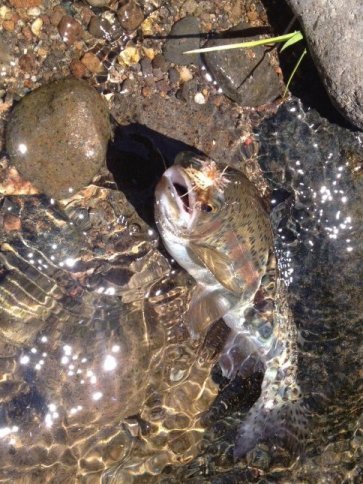
A rainbow trout that’s a bit bigger than expected in this small creek.
Nice surprise in a small creek.
During my time upstream, the driver of the watering truck had chatted up Sean. While sucking water from a beautiful stream that’s habit for wild trout is uncool, at least the driver offered up details about how to get to a more remote and less-fished section upstream. Following his recommendation, we picked our way down a less-frequented road. This isn’t your graded road, but rather a barren section of forest sprinkled with stones and crisscrossed by fallen branches. The type of road that wouldn’t necessarily require four-wheel drive, but where I would have been thankful to have a bit more ground clearance than offered by my (trusty) Accord.
It was slow going. The road meandered away from the stream and gained elevation before a fork dropped us down to a wood bridge.
Here the character of the stream changes. It’s nearly all pocket water. And skinny.
As expected, the fish were spooky. We didn’t really see the fish; we caught flashes of fast-moving shadows in the periphery of our vision. This is the kind of stream that tests one’s ability to pick out suspect water and adequately present a fly. There might be strikes on your first two drifts. After that, it was time to move on. Thankfully, there was a lot of stream available.
My first cast was to ideal pocket water behind a large boulder. Water tumbled past the boulder into a pool that while not deep, was dark enough to hide fish. That first drift netted a brilliant eight-inch rainbow. This was repeated often as we hiked upstream, with nearly every fish chasing our dry flies.
It’s likely we could’ve spent all day moving upstream. But we did have to pick up a wine club shipment in Murphys, so we headed back to try fishing downstream of the bridge. There were a few spots but it wasn’t too far before the stream enters a canyon narrow enough to encourage a solid risk/reward assessment before continuing.
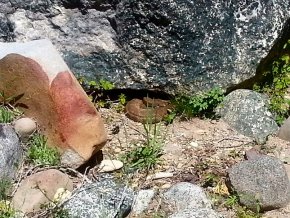
A not-so-nice surprise.
Sean, who wasn’t aware of my decision, was hiking along a deer trail above the stream while I headed back upstream. There was no scream or shout, and it wasn’t until he caught up with me that I learned of the first rattlesnake sighting of the season. Sean was foolish coolheaded enough to linger long enough to take a photo.
We debated stopping to fish again on the way out but decided otherwise. Our drive back to the highway included sightings of a coyote and turkey. After a stop at Ebbetts to report on our success (suitably suppressing how excellent it really was), it was time for a post-fishing beer. Luckily, Snowshoe Brewing wasn’t more than 15 minutes away.
We completed the day picking up that wine, tasting some of that winery’s products, and grabbing decent-but-not-great burgers at a place adjoining a gas station. Music and banter continued on the drive back, with a promise to keep up the illusion that this really-not-so-secret place was our little secret.
I did outfish the boy. I also whooped him in a game of mini golf. Even so, I think he had a pretty great time.
I never pushed fly fishing on my wife, but she’s always supported my pursuit of the sport and listens attentively to accounts of all my adventures. She usually believes the fish are as big as I say.
Then, a few months ago she took me by surprise, asking if I would show her how to cast a fly rod. I’ve had welcome opportunities over the years to help teach, or at least acquaint, a few folks with fly fishing. In addition to assisting with the club’s novice class, it could be said I didn’t teach too many bad habits to my brother and my son, both of whom went on to have some success.
After an involuntary thought that “those who can, do, but shouldn’t necessarily teach,” I agreed to take my wife out for some casting. Good weather offered an opportunity and we spent just under an hour going through the basic motions.
A few weeks later, during a discussion of our weekends, I reminded her that I’d be teaching the novice class on an upcoming Saturday. She asked if there might be room. There was, and soon she had reserved a spot. She learned a lot and suffered through some frustration.
Sure is nice to have someone along to get photographic evidence.
We’d be at the cabin a week after the class, and while a friend would be with us and side trips were planned, it was expected that I’d slip away to chase a few trout. Although we packed extra rods, reels and my spare waders and wading boots, it wasn’t until we stopped at Bass Pro and purchased a license for my wife did the reality sink in that she actually might join me.
Firmly believing that the best way to hook someone on fly fishing is to get into a fish on a fly rod, our destination the next morning was a stocked stream not too far from the cabin. We test-fit the waders at home and knew they would work well enough. My wife set up the rod and reel on her own, we clipped on our wading staffs and headed to the stream. I think it was after a dozen steps or so that my wife began referring to my old wading boots as “clown shoes.” (Admittedly, they were a bit big, but did the job that day.)
My wife doesn’t much like water — it’s for drinking and bathing and that’s about it — but she didn’t flinch much when we began wading. While waders provide a barrier between the wearer and the wetness of the water, one still “feels” the water. I reassured her that in water this cold, after a bit of time, she’d be too numb to notice.
Just before the first strike…
This is a stream best nymphed, with limited dry fly action some afternoons. Offering a running commentary on what I was doing, I rigged up two standard nymphs below an indicator. I explained and demonstrated where to cast (and hooked a fish in the process), and talked about how the trout would be looking for a close approximation of a real insect drifting near a current seam.
The morning was sprinkled with encouragement and advice. My wife’s casting, more like lobbing under the tree limbs above, improved. Her patience was impressive. After the first take of the day, it was more than an hour before a second bump. She wasn’t the only one casting to ghosts. I could count my strikes on one hand.
About midmorning we shifted downstream about 10 feet. The fish in this stream, though raised in a hatchery, move throughout the day, typically following the movement of the shadows. Close to noon, there’s more sunlight than shadows on the water, forcing any trout in the area into a narrow and definable seam. Downstream, I switched to a dry/dropper setup and was sight casting to a decent looking fish. Good placement and presentation earned a solid strike, and I landed my second and last fish of the day. Photo taken and trout released, the focus returned to getting the wife on a fish.
There’s no telling what changed — the temperament of the fish, the depth or general presentation of the flies — but suddenly my wife could lay out a cast, manage the line and fool a fish. A trout was hooked on the second or third strike, offered a dramatic leap and was gone. In between a few more strikes we worked on line management and talked about setting the hook. A few more strikes were missed.
Getting the “hero shot” took some dedication with an uncooperative, slippery fish. But she did it.
Then it all came together.
It was good to get excited about a fish on the line, even if it wasn’t my line. Limiting my advice to keeping the rod tip up and letting out line when the fish demanded it, I set my rod down and carefully moved downstream of the missus. I calmly instructed her to bring the fish head first into the net. For one heart-stopping moment the 12-inch rainbow would have flopped out were it not for my cat-like ninja reflexes luck.
Yes, my wife did receive a proper fly fishing baptism, falling into the water a few times. (No water over the waders and nothing broken.) Tangles were minimal and, amazingly, not one fly was lost the entire day. I do worry, however, that had she hooked (and landed) all the fish that hit her flies, she would have out-fished me.
Ask my wife why she stepped up to try fly fishing and you’ll get some sentimental nonsense that it’s another way to spend time with her husband. That day, in a cool stream away from everyday worries, after landing a trout, she told me of a new understanding of why I enjoy fly fishing.
While we’re not running out to buy her new gear, I’m now optimistic that there’s a greater chance of fly fishing any suspect water we pass during our travels.




 fishing for words