fishing for words

(and tossing out random thoughts)


3 Comments

on becoming one of those guys

Opening day of the general trout season in California is this Saturday.

But I won’t be on the water. I will instead sacrifice the first opportunity to be skunked on my favorite stream for the greater good. (Very Vulcan of me, right?)

The first two years after I picked up a fly rod — some seven years ago — I would start preparing for the new trout opener a few weeks after the closing of the previous season.

I do still care about the trout opener. It opens wading access on the west slope of the Sierra usually long before the passes to the eastside are cleared. Being on the water at the earliest legal minute had become tradition. Even back when I was throwing hardware, it wasn’t about filling the freezer; it was simply about being out there, working the rust out of skills unused during the winter. Four seasons ago I accepted the invite of a fellow forum contributor to join him opening day in chasing down backcountry trout. He would provide the four-wheel drive truck, I provided flies. It was a day filled with good friendship, great weather and beautiful country unseen by most. Unfortunately, any trout that may have been in the half dozen streams we visited remained unseen.

The biggest influence in my changed opening day perspective is also one of the bigger rewards that have come with fly fishing. Notwithstanding the excitement of a big Eagle Lake rainbow taking me into my backing, I’ve find an unquantifiable pleasure in helping bring others into the sport. My contributions to the club’s novice fly fishing class aren’t huge, but the enthusiasm imparted by the instructors, including myself visibly, sparks something in the students. The payoff often comes a few weeks or months later, when one of those students, all smiles, presents a photo of the fish caught because of something learned in class.

So, while I’m not retired, but I’ve become one of those guys for whom the trout opener only marks the point in time that most trout water is wide open to fishing. I’m lucky enough to have a place in the Sierra foothills available to me most any time, and I have grown content to head up the week after the opener, often to find welcome solitude on most rivers and streams. I have also taken to the challenge of finding the ‘smarter’ fish left behind after the crowds of opening day.

When I finally do make that first cast for trout this year, it’ll be later, but for good reason.

1 Comment

recycling fly fishermen

One of the truly great things about fly fishermen is nearly all of them will join in celebrating any aspect or level of the sport, be it the fish, gear, venue or tactic. There can be some good natured ribbing about one’s choice of Tenkara or pursuit of carp, and while we appreciate the top-of-the-line rods and reels get much of the press, we know that even gear showing the patina of age can get the job done.

There was no better evidence of this than our recent club auction. This is one time that the humblest of gear rubs shoulders with high-end counterparts, where a Sage One rod could be found across the aisle from an old and chipped well-used Pflueger Medalist.

Many of the items, old and new, are donated. Those with that dose of ‘character’ that can only come from service — worn cork grips, dents in metal fly boxes — often find their way from club members’ estates. These items earn appreciative comments and usually find a new home.

Despite a penchant to buy the latest and greatest or the newest must have, fly fishermen seem to be prolific recyclers. That’s pretty awesome.


*And while there’s no denying that their main motivation is to sell new gear, more than a handful of fly shops have programs that facilitate the sale of gear via a store credit. Notwithstanding their ulterior motive, it’s nice to see.


Leave a comment

a week of fly fishing, part two: a personal challenge (or, an unfamiliar approach to familiar waters)

There are times when the catching is good, but the fishing still unsatisfying. I was felt this way on Hot Creek, just a bit, during this last club trip to the Eastern Sierra.

I may not eagerly jump out of bed on a work day, but by nature — likely because I’m in tune with nature on most fishing trips — I’m an early morning fly fisher.

It’s a strategy that works for me. It puts me on the water long before almost anyone else. Nymphs work well for me in the twilight of the morning. The darkness lends the fish in my net a a mysterious, ghostly quality.

But this last trip, after that aforementioned conversation with the guy from Cabo, I thought it was time to change it up.

That’s what put me on Hot Creek about mid afternoon on a Thursday.

It was nicer than I expected, with a mid week crowd comprised of a single fisherman and myself, and the normally frustrating winds almost nonexistent. Caddis coated the bushes. An errant mayfly dipped up and down in the air.

I’d been told that a certain crane fly imitation would work well. I didn’t have one. The hoppers that were suggested didn’t get even a glance from fish clearly seen to be eating. For a time I watched the graceful and economical movements of a pod of trout, rising to feed and falling back to the bottom. Obviously, there was something that I couldn’t see bringing them to the surface.

Like most any water, Hot Creek comes with its own piece of counseling: go small. And in the afternoon, dry flies.

Normally I’d head upstream and work my way down, but after a friendly conversation with older gent already fishing (and giving him a size 20 caddis for use as an indicator above a trailing something about size 22-24), I decided to stick and move as I worked my way up the creek.

I rigged up in similar fashion, with a black caddis trailing a size 24 parachute Adams. This time of year, tactics at Hot Creek are often dictated by the abundant weed growth. A soft footfall serves one well, and I carefully picked my way around bushes while watching the “lanes.” In the past, I bypassed these areas under the pretext of one excuse or another. (My casting isn’t good enough, I won’t get a long enough drift, too many people, etc.)

It wasn’t too long before I saw that first nose, more of a bump in the water, a tell-tale sign of a feeding trout.

I cast well upstream. It took a few more casts, but with some skill luck, a good drift put the fly where it needed to be.

Hot Creek Brown/Small Fly

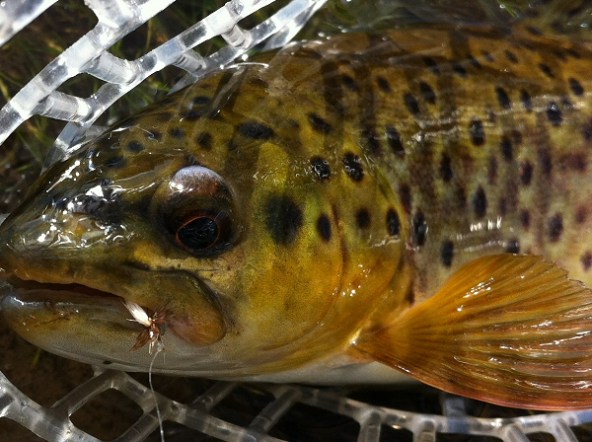
It still amazes me that a nice Hot Creek brown like this can be landed on so small a fly.

I’d repeat this more times than I care to recall but was rewarded with eight beautiful trout, mostly browns, all of which were no less than 13”. The biggest and prettiest crowded about 24” of beauty into 15” of fish.

Next year, I think this place will deserve an entire day of my attention.


1 Comment

another part of the why there was no post last week

Rock Creek Sunrise

Heading up the canyon early in the morning, somewhere close to 10,000 feet.


Leave a comment

folks might think I’m one of those guys, but I’m now old enough to not care

This is how my journey of self discovery (one of many recently) started this week:

“The new seat for my custom motorcycle seat arrived today. I’m going to test ride it tomorrow,” I told my brother, realizing that its arrival Monday sort of made it a birthday gift to myself.

“Cool. How much did that cost?” asked Mark.

“Oh, about $400…”

“You mush like your tush…”

The conversation went on with justifications about spending that kind of money, talk about long rides that have been planned for some as-yet unset date.

I’m certainly not wealthy, but with a bit of scrimping and saving in other parts of my life, I can equip myself with motorcycle (or fly fishing) gear that increases my enjoyment. Good gear is worth it: not thinking about how my butt may start to go numb is priceless.

Stuart Smalley

“I deserve good things, I am entitled to my share of happiness. I refuse to beat myself up. I am an attractive person. I am fun to be with.” Three out of four ain’t bad. Dig the sweater.

I’m tough on all my gear, but the big name waders I purchased almost five years ago only recently needed repair after hiking through brambles and blackberries, scrambling over boulders, only to be unceremoniously crumbled and thrown in the trunk until their next use or being unpacked and hopefully cleaned at home.

There’s also that one rod I use most, even when it’s not an exact match for my quarry, even when it’s a bit too long for the brush-lined banks of relatively small water. It’s the one that casts best. I don’t have to accommodate the rod, it fits me. Like that motorcycle seat, I don’t think about it, it just does its job. Also like that seat, my favorite wasn’t cheap. But it does everything that I ask of it, without me asking.

In some respects, I was a fly fishing snob in my formative fishing years, arguing that landing a 14-inch trout on my less-than-$100 rod was equivalent to a 21-inch fish on more expensive gear. Back then, I figured waving around a more expensive rod would scream “poser.” Perhaps I’m wiser now. Or, like that honey badger, I just don’t care.

Luckily, my wife’s been the most ardent support of my purchasing good stuff. I’ve just been a bit too miserly to listen. So when the bill comes, she can’t complain. She started it.


2 Comments

another reason why it’s safer fishing that small creek

Apparently you never know what will find you when chasing salmon and halibut in the salt off Vancouver Island, B.C. via New York Daily News


6 Comments

the excuse for no post

My brother and I were here…

A Skykomish River Tribtutary

Mid morning on a Skykomish River tribtutary, with lots of fishy water.

…fishing…

Brother fish a tributary of the Skykomish.

My brother fishing…

…with Kirk “Unaccomplished Angler” Werner and Orvis guide Derek Young, for this…

Wild Rainbow on Skykomish Tributary

Healthy wild rainbow, who was right where he should have been.


3 Comments

start them lying fishing young

From well-known outdoor writer Tom Stienstra in the San Francisco Chronicle today, presented without comment:

Tall tale about giant bass

Word came from Pleasanton last week that a 13-year-old boy had landed a record 18-pound, 9-ounce largemouth bass at Shadow Cliffs Lake. It seemed too good to believe. Unfortunately, it was.

At Shadow Cliffs, park rangers say several people saw the boy wade into the lake and scoop up a large dead fish. Park officials said they do not acknowledge the fish as a record.

When the story first emerged, the boy said he caught the fish with a lure, that the giant bass did not fight much, and he gave it to a friend to eat. A photo of the fish I was provided showed that its eyes had turned white and its body had a layer of slime, similar to that of a fish that has been dead for some time.

This is yet more proof that, while all people are born honest, by the time they go fishing they usually get over it.


2 Comments

fishing, learning and getting graded by trout

When you mention stillwater nymphing to a group of fly fishermen, you can’t expect more than a quarter of the group to stick around. Certainly, it’s not for everyone. It just happens that a lake offered my most productive fly fishing day ever entre into the sport.

After the drive over Tioga Pass last month, the plan was for Willy, Bill and me to spend that Wednesday with a guide, learning the specifics and generalities of Crowley Lake. Learn we did. Catching, not so much.

The high water this year had the Los Angeles Department of Water & Power monkeying around with the lake level, which, combined with warmer-than-usual fall weather, led to heavy weed growth. Not only were weeds growing up from the bottom, algae floated on top. We’d be parking the boat over a channel created by McGee Creek in search of a literal window through which we might present our flies.

Doug would be more than our guide that day. He would be teacher and cheerleader. Questions wafted through the air with the midges. Discussions centered around the fly(ies) of the day, casting, adjusting the depth of flies, and reading the fish finder to determine boat position.

Unlike most of my experiences on Crowley, conversations went on uninterrupted. The fish were there. Willy hooked a couple of decent rainbows early in the day, but strikes were few. Bill landed a nice brown later in the day, as did I. Violating the rule about moving away from fish, we did, wetting our lines at Green Banks, near Leighton Springs and Alligator Point, only to end up back at McGee.

That learning was put to the test Thursday, when Willy and I spent the day in his boat, searching for open channels and properly positioning the boat. Eight hook ups, with one beefy brown to the net and three rainbows lost — big fish that jumped and cleared the water by a body length or more — suggested we’d done well.

Willy on a fish…

Day two entailed my learning how to launch a boat on a rather shallow ramp, and soon enough we would be on the way. Unlike the previous morning, a nice breeze rippled the water; perhaps the same breeze that pushed the top-water algae to the opposite side of the lake. It was one of those clear, crisp high Sierra mornings when the mountains seem that much closer.

Willy and I had discussed strategy while slowly cruising through the marina with a probably misguided reliance upon my previous experience — five years worth — at Crowley. We’d end up agreeing to revisit the McGee Creek channel, but with my suggestion, which had no basis in any empirical evidence, that we’d push closer to shore and fish in about 10 feet of water.

A few boats and float tubers were already in the vicinity when we both began to carefully watch the depth finder for the edges of weeds and the telltale dip of the creek channel. We crossed it a few times and when we finally anchored, it had taken longer to get into position a few feet away from the channel (so we could cast to it) than it did to make the run from the marina to our destination. We were set to cast.

I felt a bit of a dorky tingle as I locked forceps to my bottom fly — I’d seen guides do this, but never myself — and lowered it over the gunwale to gauge the depth as which to set my indicator. I nervously cast out to where we hoped to intercept cruising fish; thinking that this was a test that would be graded by the fish we landed, or didn’t.

My big shouldered brown.

As often happens on this lake, it wasn’t too long before Willy’s indicator went subsurface. Once the hook was set (and the fish obviously felt it), a big, beautiful rainbow cleared the water by a body length of at least 18 inches, if not 20, and threw the hook. Willy and I gawked at each other in disbelief. For me it wasn’t so much because Willy didn’t land the fish, but for the simple reason that this fish clearly demonstrated that we, on our own, had done something right.

Willy would hook (and lose) another big rainbow later than morning, and we’d both elicit strikes when raising our rods (and flies) to cast, with one fish hitting Willy’s fly just a few feet from the boat. There were a few other fish for me, including one huge brown…not long, but linebacker big, with shoulders and a head big enough to give me pause before reaching into the net.

It wasn’t the wide-open fishing, or even the hot and heavy fishing, that I’ve previously seen on Crowley. It’s not always a numbers game and the difference this time — a huge difference in fact — was that we did it on our own and that the fish seemed to agree that we did something right.


Leave a comment

more on CA DFG’s conversion to triploids: all of California’s stocked rainbow trout soon to be dumb(er)?

Just last week we posted that nearly all of California’s hatchery-raised rainbow trout will be triploids within two to three years.

Now we can’t help but wonder what it really means.

According to U.K. Salmon and Freshwater Fisheries Consultant David J. Solomon:

Apart from having three sets of chromosomes, as opposed to the usual two in trout, there are a number of other relevant differences [between diploid and triploid trout].

Many organs and tissues have larger but fewer cells in triploids, including the brain, muscle, retina, liver and kidney (Benfey, 1999). This appears to arise because the extra set of chromosomes dictates an increase in cell nucleus dimensions which in turn affects overall cell size.

Fewer brain cells doesn’t mean will mean you’ll hook a triploid trout on every cast, particularly if diploid trout (with the normal chromosomal configuration) are present in the same water. Solomon goes on…

However, this rather fundamental difference appears to have remarkably little knock-on effect upon physiology, behaviour and general performance. Development rates appear very similar, until the onset of sexual maturity in diploids. Diet utilisation and energetics appear unaffected. Triploids are generally less aggressive than diploids, which leads to poorer performance when the two are reared together in intensive culture – but these differences disappear when the two are reared separately.

It’ll be interesting…