fishing for words

(and tossing out random thoughts)


2 Comments

practicing for retirement

From the start, we knew it’d require a different mindset. Not since our honeymoon 10½ years ago had Karen and I spent more than three or four days at the cabin. Eight days, however, clearly presented an opportunity for adventure; exploration at our own pace.

Potty-Mouth Wine

Potty-Mouth Wine

I did spend a couple of days fishing, but our destinations most days were only decided the evening before and sometimes only that morning. Our internal alarm clocks — or at least mine — meant I was up by oh-dark-thirty every morning, but that left plenty of time for a full breakfast if desired.

More than anything, we wandered; around town (Twain Harte) and through hill and dale. The higher elevations were colored by fall foliage while below 2,000 feet the grass of the oak woodlands was a pale gold.

Our day-long loop through Copperopolis, Angles Camp and Columbia took us through these distinctly different habitats, past the Sierra Conservation Center (aka prison) and over the very low New Melones Reservoir. In all my years in the area, never has New Melones looked less like a lake and more like a canyon than it did last week.

A map won’t tell you that Copperopolis has something of a split personality. The “real” Copperopolis — near Reeds Turnpike — was established in the 1860s and is a bit unique in that it was founded near a copper mine, not gold. But just north, near Hwy 4, is what looks like a Hollywood set plopped down in the middle of nowhere. It reminded me of the town of Lago, in High Plains Drifter; without the red, of course.

The buildings in Copperopolis Town Square tap historical architectural design of the mid and late 1800s, with retail shops and restaurants surrounding a small park with a gazebo, landscaped fountain and flag pole. Allowing for the fact that we were visiting on a Wednesday, during the fall, it was still quite vacant. It’s clearly designed with a pedestrian focus, including park benches, stone masonry walls and faux old-fashioned gas lamp posts. It was a nice enough place for a leisurely walk, with a stop for a root beer float in an old-style ice cream parlor.

The town square is nice enough, but peeking behind the curtain — actually one block off the main street — reveals paved streets complete with sidewalks and lightposts but devoid of homes; just dirt lots. While folks there will tell you Copperopolis Town Square is a phased development, I couldn’t help but wonder if these vacant lots were remnants of the recession. After all, developer Castle & Cooke did break ground on Copperopolis Town Square in April 2006.

Our loosely outlined plan was to stop in Angels Camp and Columbia before returning to the cabin. One suggestion: Don’t visit Angels Camp on a Wednesday; it seems as if half the businesses were closed.

The drive from Angels Camp to Columbia was interrupted, however, by my sudden veering on to Red Hill Road near Vallecito. During the summer I met a young man dispensing tastes at Mammoth Brewing Co. and learned in the course of conversation that his family owned Twisted Oak Winery. He was taking a break from the wine business to learn about beer, and after I mentioned the cabin in Twain Harte, he suggested a stop at the Twisted Oak tasting room in Murphys. I didn’t know the winery was in Vallecito until I saw the sign.

It was clear this was a place where the folks didn’t take themselves too seriously; the posted speed limit on the driveway is 9 mph. One wine label says it all: “*%#&@!” (described as a potty-mouth Rhone-style red blend). It’s a friendly place, and laughter pairs well with wine, so we lingered, bought some wine then headed on down the road.

We covered about 80 miles that day, agreeing to expand the circumference of our exploration the next time we can take the time to slow down.

It became clear we were enjoying ourselves and spending our time wisely when my sister emailed to ask if we had retired and not told her.

Not yet. But it sure was nice to spend a week acting as if we have.


2 Comments

on the Rim Fire (and why it might be better find other places to fish, for now, and let nature heal, undisturbed)

It was long ago decided that this blog was to be guided by a few simple rules; that it would be family focused and friendly, devoid of rants or advice, and mostly my space to write about the misadventures of my life.

Today, however, things are bit somber.

CalFire Rim Fire Incident Report

CalFire Rim Fire Incident Report

California’s fire season is shaping up to be one of historic proportions. The Rim Fire still raging near Yosemite Valley is one of 11 major fires currently burning in our bone-dry state. Those are only “major” fires. During the last few weeks, about 150 fires were sparked by lightning strikes. CalFire figures show that through the middle of August, 4,715 separate fires have burned the state — beating by a wide margin the historical annual average since 2008 of 3,000 fires. The Rim Fire is now the largest fire in the recorded history of the Sierra Nevada and, as of today, the 5th largest wildfire in California’s history.

In this moment, all eyes are understandably on the immediate danger to lives and property. Prayers are being said for the firefighters. This is devastation on an unimaginable scale.

As a fly fisherman, I can’t help but ask questions about the long-term impact on the many streams and rivers now stripped of bankside vegetation, and the fish in their waters. The extent of ecological damage won’t be understood for a long time. The intensity of the blaze — flames reportedly reached 100 to 200 feet as they shot up canyons — left nothing behind. While the Groveland Ranger District of the Stanislaus National Forest, the area predominately affected by the Rim Fire, has gone through cycles of intense wildfires, those fires have burned only small areas. (Decades of fire suppression and logging can be blamed.) Conjecture is that the Rim Fire, however, may have denuded up to a 1,000 acres.

The northern edge of the Rim Fire crossed the Clavey River, one of the longest undammed rivers in the Sierra Nevada, a designated wild and scenic river, and home to native coastal rainbow trout. The fire burned along extended stretches of the South and Middle Fork of the Tuolumne River as well as Cherry Creek, all waters known for fishing, whether stocked or wild fish. Many other but lesser known streams, streams I’ve found wild populations of trout, also fall within the boundaries of the Rim Fire.

The Clavey River

The Clavey River

Relatively little is known about the effect of fire on fish populations. An admittedly hasty search of the Internet offers some insight. It’s clear that the effects of fire on fish populations can be complex, with dependency on the length of the event, size of the habitat, the home range of the fish, specialization of spawning habitats and the type of fish. Of course, most studies cite salmonid fishes (trout, salmon, chars, freshwater whitefishes and grayling) as the taxonomic group slowest to recover after a fire.

That said, the effect of fire on native salmonid populations can be highly variable, with extinctions observed in some isolated small headwater streams, but a quick rebound when a species’ home range extends to multiple tributaries within a single watershed.

In affected rivers, streams and lakes, fires can most notably affect water temperature and water chemistry as well as the local invertebrates, amphibians and fish. No longer shaded by trees and brush, water temperature can rise, reducing the solubility of dissolved oxygen. Absorption of ash can increase the water’s pH and impact nutrient levels in aquatic systems. Studies document five- to 60-fold increases in phosphate, nitrate, and ammonium concentrations in streams affected by fires that have swept through larger watersheds. Conditions in these waters returned to normal with a few weeks, but were later impacted by rain flushing additional ash and soil through the watershed.

It’s likely that the smallest streams will have most dramatically impacted by the fire. Though most people dance around the issue, this has been another drought year for California, and water levels are so low that any longish exposure to the fire may have “cooked” many of those small streams.

Nature, however, can be resilient; as long as we don’t get in the way. Anyone who’s visited Mt. St. Helens National Volcanic Monument can attest to that.

A beetle native to the Sierras, which has infrared receptors allowing it to detect fire, could be first on scene to feast on the blackened trees. They, in turn, will draw birds. New growth will sprout, creating forage for small mammals and, eventually, deer and bears.

It just takes time. Though it may not look the same.

For a while, though, many Tuolumne County fisheries will probably be best left alone.


2 Comments

hiking through history

We snuck out of the Bay Area on the Thursday a week ago for long weekend, planning to cram a bit of everything into the time we had.

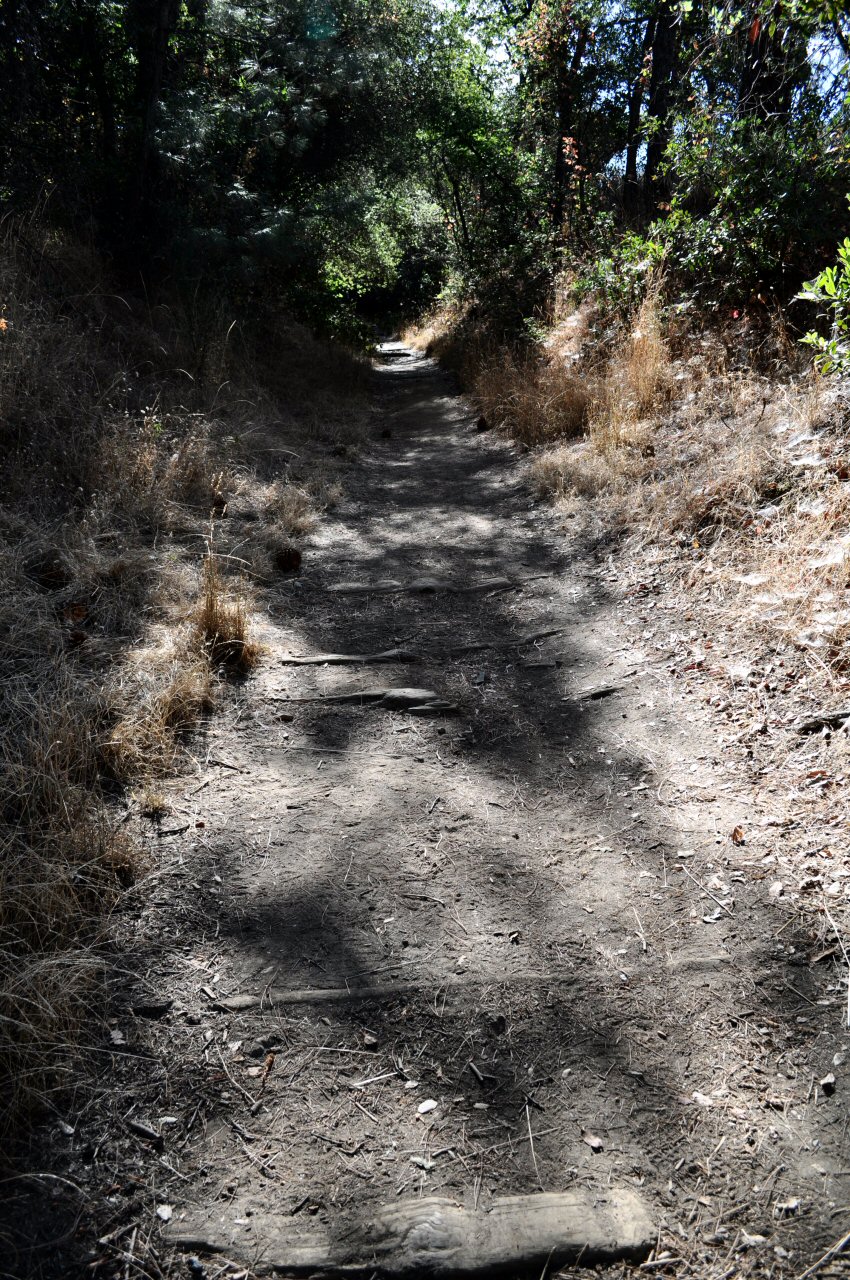
Railroad ties at the West Side Rail Grade trail head.

Railroad ties at the West Side Rail Grade trail head.

In a new spirit of exploring unknown parts of familiar territory, we ended up on the West Side Rail Grade the next morning. The trail — really a former narrow-gauge railbed — begins on Buchanan Road in Tuolumne City and is carved into the hillside above the North Fork Tuolumne River, on the north side of the canyon. It was christened in 1898 as the Hetch Hetchy & Yosemite Valley Railroad under the ownership of the West Side Lumber Co., which used narrow-gauge railroads in the Sierra Nevada Mountains until the 1960s. The HH&YV was primarily employed to haul fresh-cut logs from the sugar pine forests of eastern Tuolumne County to the West Side Lumber Mill in Tuolumne City.

The trailhead is just outside of town, and the first 100 yards are marked by decomposing railroad ties that look like worn steps. After that, most of the trail is exposed, which left us to bake in a remarkably hot morning sun. There are a couple places where benches and tables allow for a break in the shade, and a sprinkling of poison oak along the trail encourages one to stick to the well-worn path.

Though I’m not a history buff, per se, it’s a pleasant surprise to find remains of history in situ. About a mile down the trail we came across long portions of ties and rails, with the trail occasionally shifting from one side of the tracks to the other.

Rails of the Hetch Hetchy & Yosemite Valley Railroad.

Rails of the Hetch Hetchy & Yosemite Valley Railroad.

The grade slopes gently downward, at least for as far as we hiked, and it would be a great place to break in some new boots. Had we continued the full 4½-plus miles, we could have soaked our toes in the North Fork of the Tuolumne River, near Basin Creek. (I originally discovered part of the West Side Rail trail while exploring Forest Service land above Long Barn, and while fishing an upstream portion of the Tuolumne, but have since determined that was another section of the trail that stretches from Hull Creek to the Clavey River, that that’s another hike for another time.)

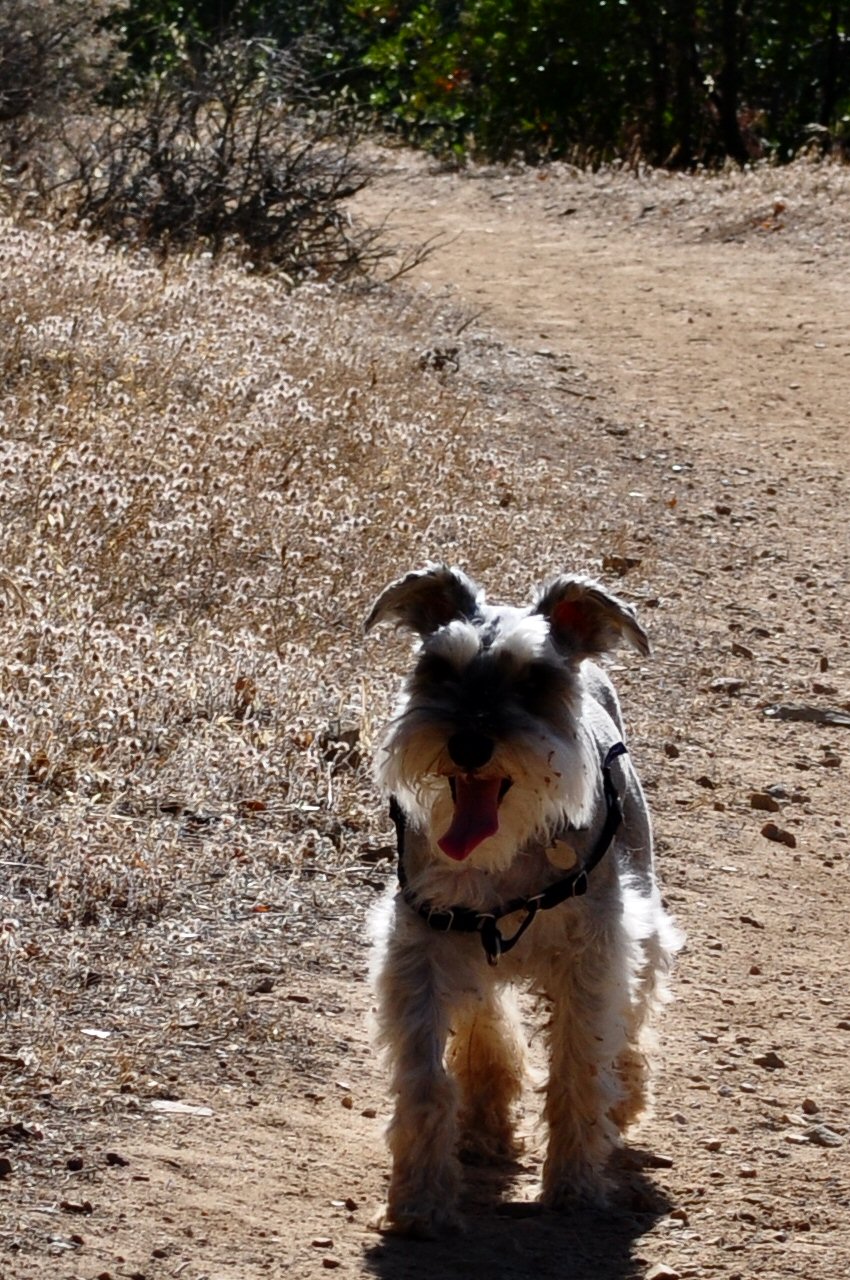
Hot and happy dog.

Hot and happy dog.

We met a few folks along the way: an overachiever who was jogging uphill and a few women who walk it almost every day, one of whom had made a dramatic move from the northern California coastal town of Bolinas to the much drier Sierra foothills.

With the full heat of the sun soon approaching, we left the exploration of a last blind curve for another time, and headed back. This day we had the dog with us and I don’t know if it was he or I who was panting more in the heat.

I have a feeling, though, that we’ll see more of this trail in the spring.


4 Comments

respite from curveballs

Sometimes life just throws a curveball. Two weeks ago it felt like every curveball was followed by another.

So, I abandoned the original plans to sandwich a cabin visit with the sister and family between two full days of fishing and just go with the flow.

That meant the two-and-a-half hour drive to Twain Harte stretched out to about four, interrupted by a longer than usual stop at Bass Pro.

It also took longer than usual to coax that first trout to take a fly in a nearby stream.

Back at the cabin, I whiled away some time reading and generally taking it easy.

The sister, her husband and two sons taller than most everyone pulled in about noon Friday. Soon enough we were beating the heat at Twain Harte Lake. A visit to the cabin is a mixed blessing during hot weather; the lake offers respite, complete with an old-school snack shack with burgers, fries, milkshakes and snow cones. The cabin, however, and despite a lack of insulation, seems to retain all the heat of the day well into the evening.

The nephews goaded their parents into the usual swim to a platform near the center of the lake, then a swim to “The Rock.” Then back. I admired their energy from shore, dipping my feet in the water and reading. The afternoon was completed with a visit to the snack shack.

Normally the only overexertion on my vacations entails scrambling over boulders and under downed trees in search of trouts that sometimes aren’t there. Saturday I opted for an easy, sure thing, fishing a well-stocked creek that’s often pounded by the put-and-take crowd. This day I’d be alone for well into four hours, targeting specific fish and trying to coax dry-fly takes.

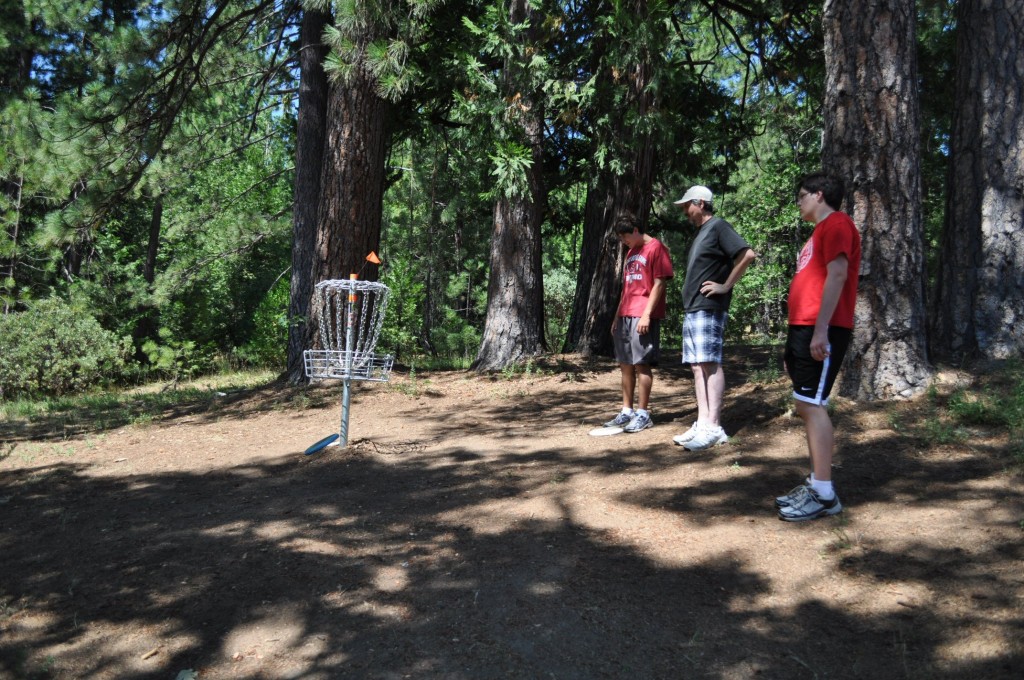
I found my cabin mates finishing up the breakfast clean up when I returned about mid-morning. They planned to hit the local disc golf course, and I figured I’d lug my camera along. I’ve come to realize that I don’t have a lot of hero shots of myself during fishing, hiking, motorcycling, etc., so I’m trying to step in to take a few photos for folks when I can.

The boys pondering Luci's shot. Missed by that much.

The boys pondering Luci’s shot. Missed by that much.

This disc golf course is purely a volunteer effort that gets some financial support from the local community, and it’s nice to see younger folks join in the creation of something positive. The course winds its way through a now fallow traditional golf course, over an irrigation ditch and under a flume.

My nephew Nicholas plays Ultimate Frisbee and might be expected to be the odds-on favorite, and while Tom, his father, will deny his intense completive streak, it quickly became clear that the rest of us were there to, pretty much, watch a one-on-one match. On the fourth basket (hole) another player gave us another disc, allowing me to participate. Like the amateur I am, there was a lot of wasted effort spent on power when form was more important. I later learned that my arm isn’t as young as it used to be. There was no use keeping track of my score; I was always one stroke behind Tom or Nick. And where either of them could curve a Frisbee around an obstacle, my choice was limited to going straight through if I could or give it a very wide berth. The competition would end with Tom winning by a stroke. I believe Tom also won our game of mini golf that evening.

The afternoon was again spent on the beach, with swimming, conversation, tossing of the Frisbee and a return to the snack shack.

Proving that there’s not competiveness in their family, Tom and Nick returned to the disc golf course the morning before our departure for a grudge friendly rematch. Nick recovered some dignity with a win.

This short trip was a welcome, unscripted getaway.


7 Comments

first time fly fishing with the wife (or, rolling the dice on being out-fished)

I never pushed fly fishing on my wife, but she’s always supported my pursuit of the sport and listens attentively to accounts of all my adventures. She usually believes the fish are as big as I say.

Then, a few months ago she took me by surprise, asking if I would show her how to cast a fly rod. I’ve had welcome opportunities over the years to help teach, or at least acquaint, a few folks with fly fishing. In addition to assisting with the club’s novice class, it could be said I didn’t teach too many bad habits to my brother and my son, both of whom went on to have some success.

After an involuntary thought that “those who can, do, but shouldn’t necessarily teach,” I agreed to take my wife out for some casting. Good weather offered an opportunity and we spent just under an hour going through the basic motions.

A few weeks later, during a discussion of our weekends, I reminded her that I’d be teaching the novice class on an upcoming Saturday. She asked if there might be room. There was, and soon she had reserved a spot. She learned a lot and suffered through some frustration.

It is nice to have someone to take a photo.

Sure is nice to have someone along to get photographic evidence.

We’d be at the cabin a week after the class, and while a friend would be with us and side trips were planned, it was expected that I’d slip away to chase a few trout. Although we packed extra rods, reels and my spare waders and wading boots, it wasn’t until we stopped at Bass Pro and purchased a license for my wife did the reality sink in that she actually might join me.

Firmly believing that the best way to hook someone on fly fishing is to get into a fish on a fly rod, our destination the next morning was a stocked stream not too far from the cabin. We test-fit the waders at home and knew they would work well enough. My wife set up the rod and reel on her own, we clipped on our wading staffs and headed to the stream. I think it was after a dozen steps or so that my wife began referring to my old wading boots as “clown shoes.” (Admittedly, they were a bit big, but did the job that day.)

My wife doesn’t much like water — it’s for drinking and bathing and that’s about it — but she didn’t flinch much when we began wading. While waders provide a barrier between the wearer and the wetness of the water, one still “feels” the water. I reassured her that in water this cold, after a bit of time, she’d be too numb to notice.

Just before the first strike...

Just before the first strike…

This is a stream best nymphed, with limited dry fly action some afternoons. Offering a running commentary on what I was doing, I rigged up two standard nymphs below an indicator. I explained and demonstrated where to cast (and hooked a fish in the process), and talked about how the trout would be looking for a close approximation of a real insect drifting near a current seam.

The morning was sprinkled with encouragement and advice. My wife’s casting, more like lobbing under the tree limbs above, improved. Her patience was impressive. After the first take of the day, it was more than an hour before a second bump. She wasn’t the only one casting to ghosts. I could count my strikes on one hand.

About midmorning we shifted downstream about 10 feet. The fish in this stream, though raised in a hatchery, move throughout the day, typically following the movement of the shadows. Close to noon, there’s more sunlight than shadows on the water, forcing any trout in the area into a narrow and definable seam. Downstream, I switched to a dry/dropper setup and was sight casting to a decent looking fish. Good placement and presentation earned a solid strike, and I landed my second and last fish of the day. Photo taken and trout released, the focus returned to getting the wife on a fish.

There’s no telling what changed — the temperament of the fish, the depth or general presentation of the flies — but suddenly my wife could lay out a cast, manage the line and fool a fish. A trout was hooked on the second or third strike, offered a dramatic leap and was gone. In between a few more strikes we worked on line management and talked about setting the hook. A few more strikes were missed.

Karen's First Fly Fish

Getting the “hero shot” took some dedication with an uncooperative, slippery fish. But she did it.

Then it all came together.

It was good to get excited about a fish on the line, even if it wasn’t my line. Limiting my advice to keeping the rod tip up and letting out line when the fish demanded it, I set my rod down and carefully moved downstream of the missus. I calmly instructed her to bring the fish head first into the net. For one heart-stopping moment the 12-inch rainbow would have flopped out were it not for my cat-like ninja reflexes luck.

Yes, my wife did receive a proper fly fishing baptism, falling into the water a few times. (No water over the waders and nothing broken.) Tangles were minimal and, amazingly, not one fly was lost the entire day. I do worry, however, that had she hooked (and landed) all the fish that hit her flies, she would have out-fished me.

Ask my wife why she stepped up to try fly fishing and you’ll get some sentimental nonsense that it’s another way to spend time with her husband. That day, in a cool stream away from everyday worries, after landing a trout, she told me of a new understanding of why I enjoy fly fishing.

While we’re not running out to buy her new gear, I’m now optimistic that there’s a greater chance of fly fishing any suspect water we pass during our travels.


3 Comments

on becoming one of those guys

Opening day of the general trout season in California is this Saturday.

But I won’t be on the water. I will instead sacrifice the first opportunity to be skunked on my favorite stream for the greater good. (Very Vulcan of me, right?)

The first two years after I picked up a fly rod — some seven years ago — I would start preparing for the new trout opener a few weeks after the closing of the previous season.

I do still care about the trout opener. It opens wading access on the west slope of the Sierra usually long before the passes to the eastside are cleared. Being on the water at the earliest legal minute had become tradition. Even back when I was throwing hardware, it wasn’t about filling the freezer; it was simply about being out there, working the rust out of skills unused during the winter. Four seasons ago I accepted the invite of a fellow forum contributor to join him opening day in chasing down backcountry trout. He would provide the four-wheel drive truck, I provided flies. It was a day filled with good friendship, great weather and beautiful country unseen by most. Unfortunately, any trout that may have been in the half dozen streams we visited remained unseen.

The biggest influence in my changed opening day perspective is also one of the bigger rewards that have come with fly fishing. Notwithstanding the excitement of a big Eagle Lake rainbow taking me into my backing, I’ve find an unquantifiable pleasure in helping bring others into the sport. My contributions to the club’s novice fly fishing class aren’t huge, but the enthusiasm imparted by the instructors, including myself visibly, sparks something in the students. The payoff often comes a few weeks or months later, when one of those students, all smiles, presents a photo of the fish caught because of something learned in class.

So, while I’m not retired, but I’ve become one of those guys for whom the trout opener only marks the point in time that most trout water is wide open to fishing. I’m lucky enough to have a place in the Sierra foothills available to me most any time, and I have grown content to head up the week after the opener, often to find welcome solitude on most rivers and streams. I have also taken to the challenge of finding the ‘smarter’ fish left behind after the crowds of opening day.

When I finally do make that first cast for trout this year, it’ll be later, but for good reason.


3 Comments

avoiding that 12-step program

I’m trying to avoid that 12-step program.

I’ve seen the results of the sickness. It’s not pretty. Often, it means a car can’t be parked in the garage.

An unchecked inventory of rods, reels, waders, vests and more spills from the shelves. A lathe, peppered with bits of grip cork, sits front and center, over fading oil stains. Boxes of feathers, thread, fur and hooks litter the floor. A pontoon boat or float tubes fill much of the rest of the space.

After taking an unblinking look at my array of fly fishing gear, it’s become clear that the time to act is now, before I lose control to an outside intervention. The rule around the house is that if an item hasn’t been used in a year, you’d better have a darn good reason — other than unshared sentimentality — for hanging on to it.

That hard look uncovered that 10-foot, 7 wt. rod that’s been wetted only once, chasing bass three years ago. I wouldn’t say I’m a trout snob, but bass fishin’ just hasn’t grabbed hold of me. And the trout I do chase generally don’t require much more than a 5 wt. (I’m actually leaning more toward a 4 wt. nowadays, but that’d require another acquisition.)

Luckily, I don’t have much, yet. There’s an old bamboo rod in one of those cases, but it’s safe; the wife suggested it could be decorative in the fly tying room that’ll be occupied by the last kid at home, probably for another three years. The spinning rods were long ago tucked into the garage at the cabin in the hope that visiting nephews might enjoy them. A boxful of spinners should join them shortly.

I expect that one’s collection of fly rods and reels is acquired for no other reason than fishing. Sometimes we want the latest and greatest, and forget what we already have. Sometimes it’s the search for the gear that will allow for longer casts, straighter cast, more accurate casts, or all of the above. Other considerations include differences in feel, flex, power, speed and fit and finish.

Maybe it’s a quixotic quest, but after casting various rods owned by friends and guides’ rods during the last year, I’m hoping to apply greater scrutiny any future gear acquisitions…buying only what I need, spending the money to get what I really want (with the required scrimping and saving). And there’ll still be room for a back up rod.

I’m hopeful that my belief that garages are for cars — many Californians seem to think that garages are above-ground basements — will keep to a minimum prevent any hoarding.


1 Comment

the conundrum of working-class guy’s fly fishing vehicle

Ask around, do a little research and you’ll likely find that the question “what’s the best vehicle for fly fishing” is often answered “truck.”

But I’m still paying into social security so others can fly fish when they want a working stiff. I need transportation that is, first and foremost, reliable, and just as important, economical. I have to spend money on gas to make money, and the less I spend upfront the better.

During better weather, the Honda CB750 and its 45+ miles per gallon is a fine option. But it’s difficult to load the necessary fly fishing gear, and the cooler of post-fishing beer, on a motorcycle. I’ve tried.

Being a bit obsessive about conducting research on anything that will cost more than $50, I’ve been thinking — probably too much according to those around me — about the vehicle that, in about 1½ to 2 years, will replace my current 2003 Honda Accord. Since I’ll likely buy a certified pre-owned car, it’s going to be something currently on the market. My current car gets 30 to 32 mpg most of the time, and on long trips to fishing venues, I’ve seen 34+ mpg. But over 80% of my driving is commuting to and from work.

I’ve debated the merits of various models, including sport utility vehicles and all-wheel-drive cars. A hybrid is out of the question; too heavy and not enough clearance for the occasional Forest Service road. Subaru is a commonly offered up make as an all-encompassing solution. But I’ve noticed two things: most Subaru owners talk about the sportiness of the ride, the go-almost-anywhere capability, but rarely praise their cars’ mpg, and it seems to be a roll of the dice when it comes to build quality. That might be said about any make, but that’s my experience.

Despite the fact that I’ve been a Honda owner for well over 20 years, I opened up my consideration to other options, particularly now that the mpg on midsize sedans is edging up.

But, and a bit ironically, it’s fly fishing that helped firmed up my decision. At least for now.

I’ve driven my Honda on a good many, only slightly improved, Forest Service roads. Sometimes for miles, over the relatively soft dirt along the Upper Owens River, for example, or over rocks on my way to the Little Walker River, and on washboard roads in the hills behind the cabin.

Still, the doggone car doesn’t squeak or rattle.

I’m hoping this will still hold true for my next car, until that someday when I can justify a dedicated fishing truck.


2 Comments

(relatively) word-free Friday

Since pictures are worth a thousand words, and it would take many thousands to tell of the adventure and fun enjoyed last week with my brother’s family, below is a gallery of photos that tell the story than I could. The days were filled with swimming at the local lake, visiting a historic gold rush town and panning for gold, more fun — swimming, sliding, diving, building sand castles — at the lake, hiking, mini golf and a trip to Yosemite. Enjoy!

Due to loading issues, the gallery has been moved here.


4 Comments

my very best Goldilocks impersonation and the chance encounters of fly fishing

Last week in a nutshell: Trout weren’t caught where expected; a good many others landed where only a few were caught before. One river was frustrating; another too low; one just right. Fellow fly fishermen were met and their company enjoyed on the water.

Some folks won’t understand the almost 200 miles traveled to catch and release the trout I finally found. But a quiet sense of urgency seems to settles in after the summer solstice, an urgency that leads to miles of driving before sunup.

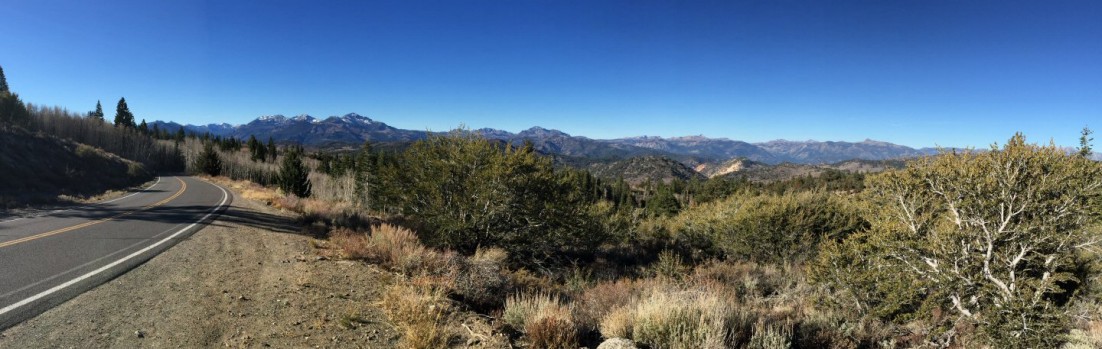
With water in many Sierra rivers, creeks and streams low this year, this urgency demanded a trip, however quick, to the Walker River Basin. It’s a watershed I’ve visited less than I should, considering the beauty of the country traveled distracts from the time it takes to get there. Breakfast is light and handy, the air cold and crisp as I crest the Sonora Pass. Horizon-to-horizon cloud cover dulls the day.

Morning commute traffic means something entirely different here. Before reaching the high desert of the Eastern Sierras, the two lanes of Hwy 108 winds through forests of pines and aspens near the Leavitt Meadow Campground, and though its twists and turns demand slower speeds, both lanes are usually vacant. But not this morning.

Thanks were muttered to the mechanic who last worked on my brakes as a cowboy sidled alongside to suggest it best that I pull to the side of the road and wait. I did and prayed just a little as a herd of cattle gave me the close up and personal experience I never wished to have, as well as one of those encounters that makes a journey all the more memorable.

A few miles more and two hours after my departure, an internal debate of where to fish the East Walker River was quickly settled by the absence of vehicles near the “miracle mile.” After a few wrong turns (caution is warranted driving a sedan on these dirt turnoffs), it was time to gear up. A lack of competition other fishermen tends to eliminate a subconscious desire to rush this process, and I stood there looking like a sausage standing on end while wishing another angler “Good morning.”

East Walker Brown

The single East Walker brown that came out to play…and on a red-butt zebra midge tied by yours truly.

His accented response was explained in the resulting conversation. He was visiting from France, working his way up the Sierras, and with admiration in his voice told me he enjoyed a quite a time on Hot Creek the day before. We talked techniques, and in a bit of name dropping I mentioned that three-time French Fly Fishing World Champion Pascal Cognard had recently spoken at a club meeting. (The French team has been ranked #1 by the International Fly-Fishing Federation for a number of recent years.) I mangled Pascal’s last name but once it was clear I was talking about competitive fly fishing and who I talking about, my new friend told me that he had competed against Pascal. Small world.

We spent a bit of time within sight of each other and I spent time watching his strategy. That French nymphing brought the first fish to the net within half an hour before I wandered downstream.

The East Walker has become my nemesis. It’s never not given up a fish and admittedly I haven’t spent much time fishing it. This day I poked and prodded likely pools, riffles and runs, with only one small brown to show for four hours of effort. Hungry and a bit frustrated, it was time to retrace my route, with stops at the Little Walker and West Walker rivers.

Though “little” is in its name, the Little Walker was too low for my tastes since I was hoping to fish stretches holding the wild trout that live there. It was back down another dirt road to the highway.

Bank on West Walker River

Rewarded will be a nice cast to within a foot or so of this bank on the West Walker…

The idea of unknown possibilities kept at bay a creeping despondency that was nourished by the still overcast sky, an unwetted net and the aches that come with age exertion. The West Walker is typical of the rivers in the Eastern Sierra…you might miss it if you didn’t know it was there. It winds through high desert terrain, below banks that conceal its course. Parking the car alongside the handful of trucks emblazoned with one military insignia/motto or another, I loaded up and headed out the half mile to a bend that seemed to interest a handful of anglers.

The number of fishermen made it a less than optimal situation, but my eye was drawn to flashes on the surface, near the tail of the bend and just below a lone fly fisherman. I walked quietly to a position downstream and behind him. Our conversation began when he stopped to replace a lost fly. He’d arrived at the nearby U.S. Marine Corps Mountain Warfare Training Center only two days ago, heard that the fishing was “on” and now stood on the shore of the West Walker in his fatigues.

He was enjoying himself. Though stocked rainbows, a long pod of fish had stacked up against the opposite bank, next to reeds and in deeper channels, and were earnestly feeding on the surface. Every other cast was welcomed with a bump, slash and, best of all, a solid strike. I was invited to join in and set up on a small point just downstream.

West Walker Rainbow on a Dry Fly

The reward.

The next three hours were filled will double hook ups and an inevitable comparison of our fish, talk of flies and home, and rain, wind and sun. Good fishing makes triumph seem easier in the face of a challenge, and despite powerful wind gusts — gusts that didn’t help casting but allowed the sun to shine — we continued fishing. Sidearm casts two feet off the water got flies close enough to feeding lanes. We never exchanged names but were fast friends in fly fishing that day.

Breaking my rule of never leaving willing fish, I headed back over the pass. My sister and her family were joining me for a three-day weekend, and though fishing is a big part of my time in those mountains, it had been a while since they’d been to the cabin and there was family fun to be had; fun that would be a bonus on top of that day on the three Walkers.