The bad news is that work this year dictates quick trips pretty much limited to the family cabin. The good news is that this allows for frequent trips that engender exploration.
Last week I decided that the two full days available for fishing would be dedicated to moving waters with familiar names but until now remained unfished. And no one told me it was humpy week. Red and yellow to be exact.
Road work meant the last five miles of my trip took half an hour. Luckily, a month ago I found a small section of the North Fork of the Tuolumne River not more than 20 minutes from the cabin, a convenient place to get the skunk off after a midafternoon arrival in the Sierra foothills. It’s not remote and often occupied, with a limited number of wild trout, but it’s a place that offers room to practice casting to specific seams and shelter.
Like much of the moving water in the Sierras, this section of the Tuolumne was already low. The early season spoiled me, so the fisherman in me was also initially disheartened to find two kids frolicking in the main pool. As a dad, I appreciated that these kids were having a good time outdoors. However, despite the splashing and noise, a trout would periodically and enticingly slash at the surface.
Though a short drive, I hate wasting an opportunity to fool a fish with a dry/dropper combination. A red humpy and a self-tied small, go-to bead-head nymph.
It took a few casts to warm up.
Then the fish warmed up to my presentation.
[singlepic id=1226 w=600 h=450 float=right]
Darn fish wouldn't stay in focus. (But was caught near the rock, in focus, in the background.)
So it went for a few hours. The humpy dried off many times after being battered and half swallowed. These fish were hungry and made me look good.
That’d be the theme this trip, and though I didn’t find as many wild trout as hoped, I did well enough to consider it time well spent.
The next three days I’d fish four unfamiliar waters, landing fish from each, often amid relative solitude (we’ll get to that next week). When not alone, I was lucky enough to enjoy conversation with fishermen more knowledge about the area than I, fly fishermen who were happy to offer friendly advice and recommend additional venues. One gentleman, with a long history of fishing the foothills, related bit of history that suggests in high-water years there’s a very real possibility of brook trout being washed out of a reservoir into a nearby steam.
Yes, it was time very well spent.
[singlepic id=1225 w=600 h=228 float=right]
Big-tailed rainbow...surprising for a stocked fish.
Hopefully, today will be a second day of exploration of waters somewhere on the map below. The best outcome will include fishable water, wild fish and solitude.
It turns the tables a bit when it’s the kids introducing parents to new places and experiences and revisiting the familiar after three decades is icing on the cake, though there’s bound to be disagreement in our personal memories.
[singlepic id=1223 w=300 h=400 float=right]
Mom and Dad at the cabin, for their first visit.
But easy agreement was found in the beauty of the scenery and shared remembrances during a long drive up and over Tioga Pass, along the shores of Mono Lake, before a return over Sonora Pass.
The parents arrived at the cabin late that Sunday afternoon, and after running an errand that took entirely too long for Dad, dinner was enjoyed and we settled in for the evening. Thankfully, the storm that had dumped snow on the passes had dissipated the day before and the warmth of the sunshine had cleared the roads.
Mom, Dad and I leisurely left Twain Harte with a route in mind but absent any planned stops or timetable. The hillsides leaned more toward gold, but were freckled by islands of still-green grass.
I’ve driven this road many mornings, but saw things a bit differently today since I wasn’t preoccupied with wetting my fly line. Miles rolled by, lubricated by conversation. Soon it was time for a stop to stretch our legs. Though there aren’t many hatcheries that will, in my mind, match the magnificence of the historic Mt. Whitney Fish Hatchery visited in my youth, there was something familiar about walking around the Moccasin Creek Hatchery with the folks.
After the excitement of gaining 1,500 feet in elevation over the two miles of the “new” Old Priest Grade, it was all new territory for Mom and Dad as we wound through Big Oak Flat, Groveland, and past Buck Meadows. Highway 120 took us from 2,838 feet at Big Oak Flat to Yosemite National Park’s Big Oak Flat Entrance Station at 4,900 feet. Dad was impressed by the tidiness of the towns and the number of old buildings alongside the roadway, many of which are still in use.
If it wasn’t enough to have fantastic weather, traffic was light. By mid morning we arrived at the entrance station, where the purchase of an annual pass got us across the park border. Words in many foreign languages hung in the cool air, reminding me of the many nature blessings that aren’t more than a day’s drive from home that attract visitors from around the world.
I’ve always throught that the changes in vegetation and terrain grow more dramatic once inside the formal boundaries of Yosemite. Heavy forest yielded to granite, which only seems to yield to water in the form of glaciers, ice and liquid. We pushed on to Olmsted Point, taking obligatory photos, then on to Tenaya Lake. Availing ourselves of the facilities near the lake, I made a mental note that I need to spend more time exploring Tenaya Lake and its surroundings.
There’s a drama that comes with finally emerging from the forest to be presented with the dramatic vista of Tuolumne Meadows, then dropping into the meadow itself. This time I was taken aback by the dramatic change in its appearance compared with that of last spring, when my brother, son and I were on our way to a challenging life-affirming hike to the top of nearby Lembert Dome. Last year the meadows were covered with water. This year, the grass was already the gray-brown of late August.
I had to explain to Dad that the Tuolumne Meadows campground wasn’t open yet when he asked why I was parking alongside the highway. He’d never been here so early in the season. (The campground would open two weeks later, rather early.) Though last June there was snow on the ground and big puddles filled with mosquito larvae, there was nothing of the sort this last week of May. A stroll toward the entrance was accompanied by a bit of debate about the differences between today’s visit and our memories of camping trips more than two decades ago. Regardless of the differences of opinion and any discrepancy in our memories, there was more than enough that was still the same to foster a feeling of familiarity.
[singlepic id=1218 w=600 h=407 float=center]
Mom and Dad’s triumphant return after 30-some years.
My worries about the water were confirmed during this walk through the campground when I stopped near the same spot from which I took a photo of Lembert Dome in 2011. Last year, there was no discernable difference between the channels of the Tuolumne River and the river itself, and the water was within two feet of the bottom of the Tuolumne Meadows (Hwy. 120) Bridge. This year, the channel nearest the campground was no more than a foot deep, and the river was barely touching the bridge abutments.
[singlepic id=1221 w=300 h=225 float=right]
The three of us at Leavitt Falls Overlook.
The reminiscing was further fueled by the sheer rock walls along the descent from Tioga Pass to Lee Vining. The thought of dropping in at Bodie Mike’s for a barbecue lunch was derailed by Dad’s sudden proposition of stopping at the Tioga Gas Mart — that he didn’t recall seeing before — to grab lunch at the Whoa Nellie Deli. A word of warning: Be careful what you order. It’s all big at Whoa Nellie. The Cowboy Steak Sandwich is not so much as sandwich as it is a steak slapped on a roll.
The easy drive north on Hwy. 395 from Lee Vining was a welcome change after such a big lunch. By the time we arrived to the intersection of Hwys. 395 and 108, the urge to nap had passed. A good thing considering the hairpin curves that would take us from 6,765 feet to 9,623 feet at Sonora Pass. Before our main ascent, the Leavitt Falls overlook offered a last opportunity to stretch our legs before the long trip over the pass. The reduced volume of water coming over the falls was another reminder that it’s going to be a dry year in the Sierra Nevada. We posed for photos, then began the long climb.
[singlepic id=1220 w=600 h=450 float=center]
Getting a roadside education at Sonora Pass.
This was undiscovered country for the parents, who never had a reason to travel this road. To my eye, Hwy. 108 over Sonora Pass offers much more dramatic transitions. The road rises faster and the changes in terrain and vegetation follow suit. Surprised to find it open, we stopped at the Donnell Reservoir scenic overlook, with a sweeping over the Stanislaus River canyon and the Central Valley. The road from there is bit less remarkable, winding through heavy forest and passing towns that only seem to be wide spots in road.
It was a long but worthwhile day; one that both revived and created memories.
There was exploration, fish caught, and the folks who raised us would revisit an old vacation spot at 9,000 feet — all despite weather last week that threatened to put the kibosh on all of it.
I started a mini-vacation two Fridays ago with a run up to the cabin, for once not battling traffic for any of the 142 miles. The plan was to get in a bit of fishing before the parents arrived Sunday afternoon and a drive over Tioga and Sonora passes on Monday. Besides an introduction to the cabin, history was the main reason for this tour. Our family typically spent vacation in one of the best possible venues, outdoors and many summers that meant Tuolumne Meadows.
But as of Friday, both passes were closed as late-season snow fell under dark gray clouds.
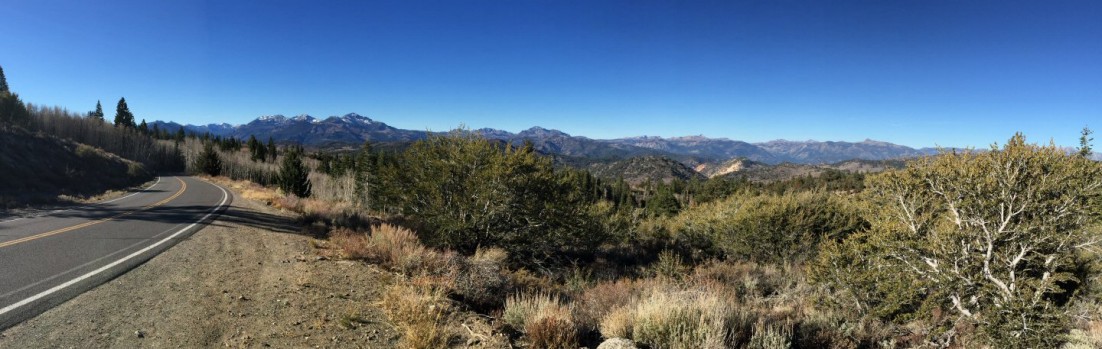
Willing to gamble only so much on the weather that afternoon, I set out for the ol’ irrigation canal, knowing it offers shelter and, if needed, a quick exit. During a few short hours the shifting weather offered sunshine, rain, hail and even a light flurry of snow. The fishing was as expected; my flies were hit mostly by wild browns and only the smartest stocked rainbows that hadn’t fall victim to salmon eggs or spinners. The stink of a possible skunking lifted, I retreated to a hot dinner and prepared for the next two days.
Instead of huddling inside, I was up before the sun on Saturday counting on the early hour and cold weather — about 48°F — working to my advantage. I choose wisely. Although I was on a well-fished creek, it was just me, the trout and couple of ducks for three hours. Fortitude and toughness won me solitude and a good number of fish that morning. Or, perhaps, it just proves that early bird adage.
By midday I was cleaned up and headed to the Moccasin Creek Hatchery for Trout Fest; the only time of the year that anyone is allowed to put a hook in its raceways. The grins of the kids were contagious; the K-9 demo of a quagga mussel search pretty amazing, and the general mood was generally festive. A local fly fishing club offered casting instruction in another raceway, allowing folks to cast an all-to-big fly to trout with appetites bigger than their four or five inches. I talked up a few of the hatchery personnel in hopes of lining up my plans for Sunday morning.
Those conversations suggested a return to the lower North Fork of the Tuolumne (near Basin Creek), a section of the river I had first visited about four years ago and enjoyed as an early season venue. This section is deep in a canyon and quite beautiful, despite its relative closeness to civilization. Most of the fish I caught back then there were stocked and in the intervening years that section of the Tuolumne had fallen off the stocking list as the result of an environmental lawsuit. But the word was that there were wild trout to be found.
Usually I’m up and out the door at the crack of dawn, but I’d reserved that Sunday morning for leisurely exploration of Forest Service roads outside of Long Barn. I was surprised to find much of my route paved with asphalt, and after marking a good-looking creek or two on the GPS, I headed to Tuolumne City and the four-mile descent to the lower North Fork of the Tuolumne.
Like so often happens, a small, nice looking wild rainbow slammed my dry fly on the first cast. (They always seem to do that when I’m least prepared.) I missed that first fish but managed to find almost dozen other little rainbows, scattered in the likely spots.
After a morning of rewards, I headed back to a hot shower before the arrival of the parents. But the folks’ visit will have to wait until next week.
We knew the weekend warriors were gone. We also knew they’d have hit hard a creek that’s always fun in terms of catching. Our plan was to find all the fish too smart for everyone else.
As we geared up that morning, the count favored Sean, and I trailed by a considerable margin but refused to bring up the excuse that I had relied on a dry fly for much of the previous day while he took the easy way out used nymphs.
We go to this creek when we want to catch something, enjoying our tax (and licensing) dollars at work. The rainbow trout stocked here are generally of the Eagle Lake strain, a hard fighting fish that often entertains with acrobatics. Fishing here stacks the deck if you’re measuring success by the number of fish caught. I’ll admit to also enjoying the look of astonishment on the faces of other fishermen, the ones not using flies, when in 15 minutes Sean or I pull out three fish to their one. So, please, shelve any debate about “missing the point,” this is a place of pure fun.
As we walked down to the creek, it was clear that we’d have it to ourselves. Sean headed upstream. We’d both be nymphing — I’ve not known stocked trout to look up much — and this section offered plenty of deeper runs and pools. It didn’t take long for either of us to hook up.
With the intensive fishing over Opening Day weekend, I expected the catching to be a bit slower. I wasn’t disappointed. With a bit of work and a change to a favorite red chironomid, I regularly elicited strikes, particularly with a slow lift at the end of a drift. Catching had slowed for Sean, so he headed downstream to a fast run.
[singlepic id=1199 w=300 h=225 float=right]
Sean's first big Opening Day trout.
Though a bit later I saw Sean’s rod go “bendo,” I knew the water he was fishing was fast and a fish of nearly any size would have an advantage in the current. I had no worries. Over the years during the too infrequent trips with me, Sean has become a better fly fisherman, enough to venture out on his own last year to find success on some streams in Yosemite’s high country. (There’s some fondness in my memory of a Reno telephone number showing up on my caller ID, only to find it was Sean resorting to a pay phone to call me with the news that he had landed his first wild brown on a fly.) After I saw him bend down with the net, I refocused on my fishing.
In the meantime, Sean had started upstream, and when I finally looked up, even at a distance I could see that the fish on his stringer wasn’t a cookie cutter stocker. With a grin to match, he held up a rainbow that measured an honest 18 inches. After the obligatory photo, he headed back downstream.
As often happens, I became lost in the fishing. Testing every edge and riffle, rewarded with strikes where expected and others that came as a total surprise. A bait fisherman took a seat on the opposite bank, asked about the fishing, then, after telling him it had slowed down, I landed three decent fish in less than ten casts.
Sean had returned while I was distracted. Suspiciously happy, he announced that he decided that first fish wasn’t big enough and hoisted up a 20-incher that had been added to the stringer.
[singlepic id=1200 w=600 h=800 float=left]
Sean with a fine mess o' trout.
If our little father-son competition was to be measured by inches, those last two fish would put Sean over the top.
However, we weren’t measuring in inches, and my count had long ago surpassed Sean’s. Nevertheless, this was probably Sean’s best Opening Day. Ever.
If we were counting — and my son and I certainly don’t — we were both winners this delayed Opening Day weekend.
Mostly, it was great just to get outdoors and chase trout once again. And get out we did, and away from any crowds.
Eleven miles out, to be exact. R. Creek is a tiny thing, a small stream I am sure is barely given any notice by the few folks crossing the small stone bridge. We’d certainly have never taken note of it, much less visited, were it not for two older fishermen who took a liking to our catch-and-release ethic and, in a quiet whisper, described this crick full of small wild and willing rainbows.
We made to R. Creek sometime after eight o’clock. It was one of those so-called ‘bluebird days’ of a California spring, when everything is still green. Just as expected and hoped, we were the only ones on the creek.
The water was running a bit high, but it still looked about as inviting as a small creek can be. A few casts in the usual spots suggested that like the fish, we’d have to adjust to the higher flow if there was to be any catching.
We headed upstream, testing each pocket, pool and riffle. Sean was nymphing. It was a dry/dropper combination for me; a size 20 Parachute Adams trailing a similarly sized Flashback Pheasant Tail.
A bit of strategic thinking is required when it comes to accessing this creek through thick stands of pine, oaks and streamside blackberry bushes. Felt-soled wading boots don’t help and my elbow can attest to the lack of traction afforded on a mat of pine needles and oak leaves.
Then I found it. That picture perfect bend, with a half sunken log offering shade and shelter to a small pod of trout. It was a deeper pool than usual on this creek, about three feet deep. My first cast revealed that depth wasn’t an issue when a six-inch rainbow rocketed from the depths to grab the Parachute Adams.
[singlepic id=1196 w=600 h=450 float=left]
R. Creek rainbow on a dry. Beauty!
Now, I’m still very much in touch with my inner caveman when it comes to fishing — I like to catch — and will use what works. But when a dry fly works, there truly is nothing like an aggressive take on the surface, regardless of the size of fish.
I had landed a beautiful ten incher and missed a few more strikes by the time Sean found me. We let the pool rest and ventured upstream. We would return later and we both hooked a couple of fish.
As happens with days during which the fishing and catching are good, time lost meaning and any argument to leave quickly fell away amid furtive glances to promising water. We decided to venture downstream into unexplored territory. Dismissed two years ago as a fool’s errand, it was clear we were mistaken. The shallow braided water soon regained the manner of a proper stream offering countless possibilities.
Sticking with the dry/dropper combo — it was too much fun to not try a dry — I found a long run of riffles that again offered the shelter of a fallen log. Shadows darted after my fly as it rushed downstream. There was no false casting here, just a quick whip to get the fly back upstream.
Sean and I would leapfrog one another as we explored further downstream. Sean would end up landing more fish, but I daresay that I was one who had the most fun. R. Creek is becoming a favorite place.
The general trout season opens tomorrow here in California and though I’ll likely be awake before sunup, it won’t be to beat the freezer-filling crowd to streamside.
Work’s got to get done if there’s any hope of having time to wet the line on any unfamiliar waters, and I’ll be helping a new group of students learn some of the ins and outs of fly fishing before heading for the hills in the afternoon. Perhaps more accurately, my casting will be an example of what not to do for these novice fly fishermen.
This is the fourth year that Opening Day has been more of a casual affair. Admittedly, I am itching to get out there with the fly rod; but it’s become a ritual not to be rushed, knowing that my son and I will likely be the only people on a small stream just far enough out a Forest Service road that most folks will give up and turn around about a mile short. Google Maps shows another creek a couple of miles further that just might be worth a try.
The maximization of our fishing time will include a few roadside spots as well, and on Monday, after the weekend warriors have left, we’ll slink down to some stocked waters trusting that we’ll be able to hook the dumb smart fish that didn’t fall victim to power bait or shiny objects.
If you’re out in the Sierra foothills this weekend, look for the guy with the funny cast. That’ll be me.
I’ll be on the road to the Sacramento edition of the International Sportsmen’s Exposition this morning and, according to forecasts, should be slogging through welcome but heavy rain. Don’t get too excited for me: it’s going to be a bit more like torture.
I’m leaving the checkbook and credit cards at home, carrying only enough cash for lunch.
I’m taking a cheaper simpler approach to the coming year that will be reflected in my fly fishing, though stopping short of tenkara. Last year didn’t go well, fishing wise, and changes on the job this year will bring incessant deadlines and blank pages in need of words. Anyone with a job today should be grateful, and I am, but it’s going to be tough to string together more than a few days off without risking some kind of pre- or post-vacation penalty. Big hopes for 2013 require planning. The fiscal reality is that dollars can stretch only so far. (Yes, I do feel some guilt that I won’t be helping a great deal to lift the fly fishing industry out of its apparent struggles, so it’ll be up to the rest of you this year.)
Much of the change this year can be blamed on my brother. Our conversations of late reminded me that what sticks with us most are the experiences of our life: riding our bikes as kids to the five ‘n dime or hiking the Sierra Nevada high country during family vacations. I don’t think we truly appreciated it at the time. The considerable value we now place on these experiences seemed to swell as our own children grew up.
So my visit to the ISE will be maddening, comprised of gear I won’t buy and guide trips I won’t take. There will be a visit with Derek Young, who I got to know as an unassuming and friendly guy before he was named 2011 Orvis Guide of the Year, some milling about various seminars, and likely encounters with other folks I’ve fished with.
My plans entail simplifying and diversifying. Much of my fishing will be refocused to waters near and not-too-far-from the family cabin in the Sierra foothills, something that’s long overdue. I’ll “make do” with gear I have and spend at least two long weekends there each month of the trout season. (My budget may allow for a very nice net handcrafted by a fly fishing club member and up for auction in April.)
It’ll be more about an exploration; a more mature approach in which satisfaction doesn’t hinge on numbers worth bragging about. There’s too much ground to cover in a single year, but the goal will be to cast flies to waters along the Highway 4 corridor, further up Highway 108, and on new stretches of the various forks of the Stanislaus River. All of those weekends should provide plenty of opportunity to spend more than a few days in the Walker River Basin; it’s only two hours away. There’s only one guide trip on the books (with Derek), and that may be the only one this year.
Dates have also been cleared on the cabin calendar for visits by my brother’s and sister’s families. And it’ll be darn nice if the wife — who recently rediscovered the detachment and contentment that can be found in the foothills — joins me more than a few times.
Diversification will mean revisiting diversions that aren’t enjoyed enough. Acting like tourists in our backyard, something started with our visit to Alcatraz last month. I’ll send the motorcycle seat out for a custom fitting more suited to longer rides. Rides that may or may not include fishing, and some that may include the wife.
You can chalk all of this up to wisdom gained with age, or — like me — simply decide to make the most with what you’ve got while you can.
Teaching fly fishing requires enthusiasm. Teaching it well requires a bit more. A little curiosity helps.
It was my brother who provided the curiosity. Not openly, but in that tone of voice we’ve all heard before.
We were discussing ideas for his first visit to California in eight years and our trip to, up and over the Sierra Nevadas. “I’d be willing to try fly fishing if you have some gear I could use,” he said over the phone.
I’d thought plenty about offering such an opportunity but hadn’t mentioned it. Everyone has a story about how they were introduced to the sport. Mine surely isn’t unique, but it did imbue me with a belief that a curious mind opens the door to the best first fly fishing experience.
Along with the gear, I’d bring considerable enthusiasm. (It’d help to understand that my sister’s family has given me the nickname of “The Herring Merchant.”*)
That’s how Mark, Sean and I found ourselves on “Hatchery Creek,” not too far away from the cabin, just as sunlight touched the top of the hills. With borrowed waders, boots and a wading staff but minus an overloaded vest, Mark looked just about as silly as I. (It’s a tenant of fly fishing that fish don’t care how one looks.)
[singlepic id=1188 w=325 h=244 float=center]
Mark on a fish.
This creek tucks against a hillside and, controlled by a powerhouse, is nearly always fishable regardless of spring runoff. Though near a main highway, it’s sheltered by heavily treed banks, and — except for the occasional burps of a Jake brake — the outside world is easily left behind. Though the outcome of our day had yet to be determined, the absence of other fisherman was a welcome sign.
After gearing up and giving a primer on the creek, I led Mark toward one of my favorite runs. It’s the same piece of water on which I educated both sons as to the nuances of hydrology. On the surface it looks fast, and most would call it too fast for fish. The most obvious (and dependable) spot for trout here is near the far bank, where the water’s velocity is slowed by friction. Perhaps because of constant shadows and the lack of light, it’s difficult to see the nearer telltale seams that suggest hidden trout. As both sons learned years ago, a little bit of patience and a passable drift in the proper location will surprise you. It’s also a great spot to swing a fly at the end of the drift.
We were rigged up with nymphs under an indicator. It was too early for dry flies, and to my knowledge this creek is devoid of any real insect hatches, with only occasional dry fly takes in the afternoon.
There’s nothing more conducive to learning than doing, and my strategy was simple: talk, walk, fish and hope that Mark would get into at least one fish while doing so. I would take on the role of guide. I’d assemble leaders, tie knots and select flies. It would be Mark’s “job” to focus on hooking and landing a fish.
It Ain’t Pretty, But Works
For those who haven’t fly fished, casting nymphs (often heavier, underwater flies) with an indicator (yeah, like a bobber) is an inelegant affair. In this case it was more of a lobbing action. After a bit of discussion about this technique and a quick demonstration, Mark made his first casts. Occasionally I’d offer a bit of advice. The suggestion of a casting target that’d offer a better drift into a good trout lie. A recommendation to keep a tight line between the rod to the indicator, then a gentle admonishment to keep an eye on the indictor for any movement that didn’t seem “normal.” A description of the slight lift the rod should be given at the end of every drift.
It was that last piece of advice that gave Mark his first surprise. He’d made a good drift with no takers. Toward the end of the run, the rod tip was raised, the movement of the indicator slowed, and the flies below rose toward the water’s surface, as an emerging insect might do.
That’s how Mark hooked his first trout on a fly rod. Just as quickly as it was on, it was off.
It didn’t matter that we didn’t land that fish. It’s the confidence and faith that washed over Mark’s face that mattered. His big brother wasn’t just blowing smoke. An unseen fish had risen to take a fly presented just as he had advised. Without any encouragement from me, the training wheels were off.
Heading upstream, Mark stopped at a suspect pool while I ventured toward a stretch where riffles tumbled into a long, deep run that abutted a boulder, which in turn created a pool that offered a long tailout. Sean had fished the area earlier, but had since headed downstream.
When Mark moved to the pool behind that boulder, just below me, I futilely tried to keep an eye on my indicator as well as Mark’s. I needn’t have. Before I knew it Mark had set the hook. Encouraging him to keep the rod tip up, a bend in the rod and to allow the fish to tired ever so slightly, I dropped set aside my rod, grabbed my net, and headed downstream.
Mark was broadly smiling as the rod tipped danced. Not an acrobatic fish, it splashed enough to put on a bit of a show. Soon Mark turned its head and we had a decent trout in the net.
[singlepic id=1189 w=480 h=640 float=center]
Mark and his first fly rod fish.
Mark waded over for the obligatory fish photo. Excitement shifted to quiet contemplation. We talked of wetting hands before handing trout, the ease of removing a barbless hook, and keeping the fish in the water until all were ready for the photo. Photo taken, we let it rest in the net. It was a remarkably clean, deep bellied and heavily dotted hatchery rainbow trout measuring an honest 13 inches; a admirable first fly rod fish.
It quickly recovered and, as discussed, Mark softly cradled the trout as I lowered the lip of the net. Often, it seems to me that time slows in the minute or so before a trout finally swings its tail and darts for the familiar safety of deeper water. I never asked Mark if he felt that same sensation, but the look on his face confirmed that he had discovered the magic of catch and release fishing.
The Lesson Learned
At that moment I got it. A curtain parted ever so slightly, giving me privileged insight into why fly fishing guides, those who truly enjoy what they do, do what they do.
More could be written about that day. About the other fish that Mark stalked, hooked and landed, and his amazement that he could do so while hardware and bait fishermen struggled for even a single fish. About Mark’s discovery of trout in places he previously might have dismissed as holding fish. About a simple enjoyment in finding that sharing of one’s love of fly fishing can spark the beginnings of such a passion in another.
But looking above, there’s not much else to worth writing about Mark’s first fly fishing experience and how it rekindled in me renewed appreciation for the little things, beyond the fishing, that bring such joy to the sport.
[In the movie “Love and Death”] Boris is in love with Sonja, but she is unhappily married to Voskovec the Herring Merchant (“his mentality,” she complains, “has reduced all the beauty of the world to a small pickled fish“). She takes lovers. (“She takes uppers?” Boris repeats, incredulous, when he hears this news). Voskovec, preparing his pistols to fight a duel in defence of his wife’s honour, accidentally shoots himself. Sonja goes to his deathbed in the company of a couple of doctors. In what is, I think, my favourite exchange in all film, Sonja talks to the expiring man…Here’s the tender deathbed scene:
SONJA: You were a kind and loving husband. Generous and always considerate. (To doctors) What’s he got? About eight minutes?
DOCTOR: (consulting his watch) I think I’m slow. He’s got about three.
VOSKOVEC: Swimming out! Swimming out to the open sea like the great … wild … herring! [Dies]
(You can find more photos here under “The Brother’s Visit – Tuolumne Meadows, Eastern Sierra, First Time Fly Fishing”.)

 Willing to gamble only so much on the weather that afternoon, I set out for the ol’ irrigation canal, knowing it offers shelter and, if needed, a quick exit. During a few short hours the shifting weather offered sunshine, rain, hail and even a light flurry of snow. The fishing was as expected; my flies were hit mostly by wild browns and only the smartest stocked rainbows that hadn’t fall victim to salmon eggs or spinners. The stink of a possible skunking lifted, I retreated to a hot dinner and prepared for the next two days.


 fishing for words