Following up its good news/bad news report on Lake Tahoe, the California Office of Environmental Health Hazard Assessment paints a bleaker picture in its August 2013 Indicators of Climate Change in California.
To sum it up, analysis of monitoring data and scientific research from throughout the state outlines the effects of climate change: The spring runoff in the Sierra Nevada has declined over the last century. The period of time when winter temperatures in the Central Valley are cold enough for the development of fruit and nut tree flowers has been decreasing since 1950. River runoff declined during the 20th Century:
River Runoff
Percent Decline
in 20th Century
Sacramento River System*
9%
San Joaquin River System
6%
Kings River
6%
Kern River
8%
Mokelumne River
7%
Trinity River
8%
Truckee River
13%
Carson and Walker rivers
5%
*includes the Sacramento River and major tributaries, the Feather, Yuba and American rivers.
Changes in average temperatures have led to die-offs of native vegetation at the lower range of various species’ elevation range (during the last six decades Sierra Nevada conifers have clearly retreated upslope) and is pushing about half of the small mammals in Yosemite National Park to higher elevations. The annual acreage burned by wildfires in the state increased since 1950, with the three largest fire years occurring during the last 10 years. The acidity in the coastal waters around Monterey Bay is increasing at a rate greater than that in the open ocean near Hawaii. The average annual temperature in mountain lakes, including Lake Tahoe, has risen over the last few decades.
And butterflies are emerging earlier during the spring in the Central Valley.
Yet, there’s no real trend that can be discerned from the data. The rise in the sea level rise along the California coast is bucked the global pattern and has be relatively constant during the last two decades.
If it does, there’s likely to be flooding in this neck of the woods but next summer’s small stream trout season might look a bit more promising.
According to International Research Institute for Climate and Society Chief Forecaster Tony Barnston we’ll know soon enough:
The development of El Niño depends greatly on what happens in the coming two months. If we do not get at least some development by the end of August, then the chances of getting development later become much lower.”
Here’s to hoping for a snowpack that more than makes up for what was lacking this year.
Us fly fishers can safely assume trout will be where we left them last season, but the clock ticked a minute closer to the Outdoor Apocalypse with the new version of the U.S. Department of Agriculture’s “Plant Hardiness Zone Map.” Welcome news for gardeners at more northerly latitudes, to be sure, but I for one am not looking forward to roses and magnolias crowding the banks of Sierra streams any time soon.
And though the USDA website notes…
Climate changes are usually based on trends in overall average temperatures recorded over 50-100 years. Because the (new map) represents 30-year averages of what are essentially extreme weather events (the coldest temperature of the year), changes in zones are not reliable evidence of whether there has been global warming.
…the new hardiness map shows a decided shift north nationwide.
And while these warmth loving plants won’t give triffids any competition, by the time they show up next to my favorite trout waters, it’s likely the trout will be gone and the water rendered unfishable by an invasion of members of the Centrarchidae family.
The thought last weekend was to get away for a rare five-day retreat, spending some time at the family cabin, entertaining ourselves with visits to wineries in nearby Murphys, squeezing in a bit of fly fishing on one of the few open rivers in the Sierra foothills and generally stepping away — far away — from the everyday.
We had enjoyed three weeks of spring-like weather prior to our departure, but the moment we publicly announced our plans, Mother Nature decided she knew better.
[singlepic id=1076 w=300 h=199 float=center]
A better use of snow.
The drive that got us up to Hwy 108 was easy enough, with stops along the way for lunch and gwaking at Bass Pro. It was after the last stop at Covers Apple Ranch that Mrs. Nature gave us fair warning with steady snowfall as we wound the seven miles to the eastern (and higher) edge of Twain Harte. By the time we reached town, the inches of snow that frosted the familiar with a fresh coat of newness also dictated extreme caution.
While I don’t mind clearing the white stuff to pull into the driveway or the nearly two feet of snow that that muffled and covered the world outside the next morning; I didn’t like the resulting power outage, the excavation of that 60-foot driveway a second and third time, and the increased release of water in the only nearby and fishable tailwater. Though we were thankful for the propane-fired heater, stove and water heater, the lack of power for 48-plus hours wasn’t fun. It was dark by 6:00 p.m. and it’s difficult to read, much less tie flies, by candlelight. Fishing was out of the question the next day as flows on the Stanislaus rose in 40 hours from less than 250 cfs to nearly 1,100 cfs.
We surrendered about 42 hours after our arrival. In that time I learned the value of a snow blower after shoveling the driveway three times, clearing an estimated accumulation of four feet of snow. (My arms agreed with rusty mathematics that suggested I moved over 1,900 cubic feet of the stuff.) Proving that Mother Nature maintains a healthy sense of irony, we were greeted by blue skies just as that last of the gear was packed into the car.
[singlepic id=1082 w=600 h=399 float=center]
Mother Nature, The Joker. The skies cleared after nearly four feet of snow snuffed out the power and we went about departure preparations. (More photos below.)
However, we both enjoyed being in a winter wonderland for a while, spending one afternoon tucked into The Rock resaurant with a good draught of Smithwicks ale, a few appetizers and a cozy view of dime-sized flakes floating to earth. I personally enjoyed introducing The Wife, for the first time in her life, to real, heavy snowfall. We also learned that the Prius can do well enough in the snow.
I don’t begrudge Mother Nature for cutting our trip short with piles of snow; it’s the resulting runoff that’ll keep the trout happy and make for excellent Sierra fishing in the late summer and fall.
I responded to Mr. Rosenbauer’s podcast of a week ago, “Gear Maintenance in the Off-Season and Ten Tips for the Aging Angler,” with a personal anecdote that there are indeed exercises that could help the aging angler. Though I have yet to be officially recognized for my longevity, a gym membership put to good use during the last year or so seems to have improved my balance during wading, something I attribute to core exercises, namely crunches, bridge, planks and rotational movements.
Admittedly, as a generally lazy meditative lot, exercise may be foreign to most fly fishermen, and the most widely practiced workout is casting, which coincidently builds up muscles used to also hoist a beer or scotch.
More of what we saw during our shortened stay at The Cabin last weekend:
[nggallery id=77]
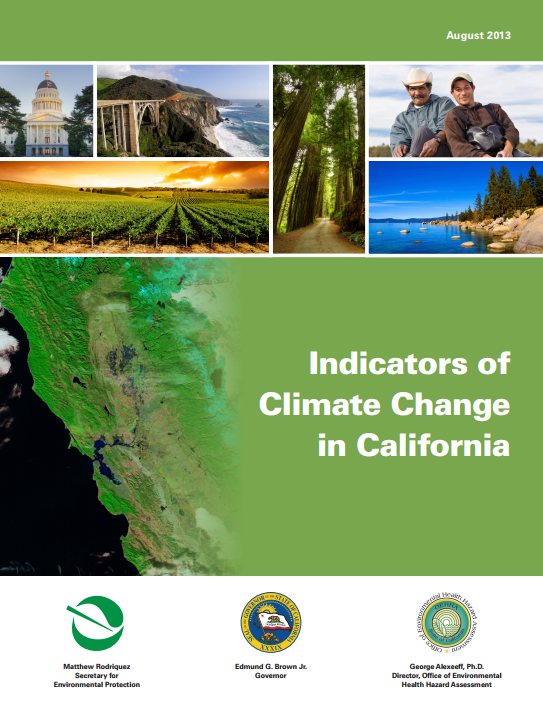 Following up its good news/bad news report on Lake Tahoe, the California Office of Environmental Health Hazard Assessment paints a bleaker picture in its August 2013 Indicators of Climate Change in California.
 …the new hardiness map shows a decided shift north nationwide.
 fishing for words