If we were counting — and my son and I certainly don’t — we were both winners this delayed Opening Day weekend.
Mostly, it was great just to get outdoors and chase trout once again. And get out we did, and away from any crowds.
Eleven miles out, to be exact. R. Creek is a tiny thing, a small stream I am sure is barely given any notice by the few folks crossing the small stone bridge. We’d certainly have never taken note of it, much less visited, were it not for two older fishermen who took a liking to our catch-and-release ethic and, in a quiet whisper, described this crick full of small wild and willing rainbows.
We made to R. Creek sometime after eight o’clock. It was one of those so-called ‘bluebird days’ of a California spring, when everything is still green. Just as expected and hoped, we were the only ones on the creek.
The water was running a bit high, but it still looked about as inviting as a small creek can be. A few casts in the usual spots suggested that like the fish, we’d have to adjust to the higher flow if there was to be any catching.
We headed upstream, testing each pocket, pool and riffle. Sean was nymphing. It was a dry/dropper combination for me; a size 20 Parachute Adams trailing a similarly sized Flashback Pheasant Tail.
A bit of strategic thinking is required when it comes to accessing this creek through thick stands of pine, oaks and streamside blackberry bushes. Felt-soled wading boots don’t help and my elbow can attest to the lack of traction afforded on a mat of pine needles and oak leaves.
Then I found it. That picture perfect bend, with a half sunken log offering shade and shelter to a small pod of trout. It was a deeper pool than usual on this creek, about three feet deep. My first cast revealed that depth wasn’t an issue when a six-inch rainbow rocketed from the depths to grab the Parachute Adams.
[singlepic id=1196 w=600 h=450 float=left]
R. Creek rainbow on a dry. Beauty!
Now, I’m still very much in touch with my inner caveman when it comes to fishing — I like to catch — and will use what works. But when a dry fly works, there truly is nothing like an aggressive take on the surface, regardless of the size of fish.
I had landed a beautiful ten incher and missed a few more strikes by the time Sean found me. We let the pool rest and ventured upstream. We would return later and we both hooked a couple of fish.
As happens with days during which the fishing and catching are good, time lost meaning and any argument to leave quickly fell away amid furtive glances to promising water. We decided to venture downstream into unexplored territory. Dismissed two years ago as a fool’s errand, it was clear we were mistaken. The shallow braided water soon regained the manner of a proper stream offering countless possibilities.
Sticking with the dry/dropper combo — it was too much fun to not try a dry — I found a long run of riffles that again offered the shelter of a fallen log. Shadows darted after my fly as it rushed downstream. There was no false casting here, just a quick whip to get the fly back upstream.
Sean and I would leapfrog one another as we explored further downstream. Sean would end up landing more fish, but I daresay that I was one who had the most fun. R. Creek is becoming a favorite place.
The general trout season opens tomorrow here in California and though I’ll likely be awake before sunup, it won’t be to beat the freezer-filling crowd to streamside.
Work’s got to get done if there’s any hope of having time to wet the line on any unfamiliar waters, and I’ll be helping a new group of students learn some of the ins and outs of fly fishing before heading for the hills in the afternoon. Perhaps more accurately, my casting will be an example of what not to do for these novice fly fishermen.
This is the fourth year that Opening Day has been more of a casual affair. Admittedly, I am itching to get out there with the fly rod; but it’s become a ritual not to be rushed, knowing that my son and I will likely be the only people on a small stream just far enough out a Forest Service road that most folks will give up and turn around about a mile short. Google Maps shows another creek a couple of miles further that just might be worth a try.
The maximization of our fishing time will include a few roadside spots as well, and on Monday, after the weekend warriors have left, we’ll slink down to some stocked waters trusting that we’ll be able to hook the dumb smart fish that didn’t fall victim to power bait or shiny objects.
If you’re out in the Sierra foothills this weekend, look for the guy with the funny cast. That’ll be me.
When I decided to step into the light and embrace fly fishing a few years ago, certain waters came to my attention. Many were governed by regulations limiting fishing to un-baited, single-hook, artificial lures. Others were specifically deemed zero-limit barbless hook fisheries. It was exciting.
A relatively short section of a certain Sierra Nevada creek was particularly alluring. Tales abounded of big browns and hefty rainbows. Most important to a novice fly fisher, only a few fly-eating trees follow its course. All this was gleaned from photos.
Then I read the associated article, and shuddered. It took only one word, an adjective often casually thrown around by old timers, to stop me in my tracks: ‘technical.’ I immediately visualized streamside judges waving numbers in the air, giving low-digit scores to my casting.
My discouragement mounted as the research piled up. There was no consolation to be found in other articles, books or discussions with more experienced fly fishermen. Much of the season this creek requires accurate sight casting, with presentation made difficult by heavy weeds that limited the ‘natural’ drift of your fly. In a nutshell, I was told, it was a creek only to be fished by those who had paid their dues.
But there I was, still in my first year of fly fishing, standing on its banks. I was asked by a more seasoned fly fishing club member to join him on this creek. He was one of the guys who had taken me under his wing, and it seemed to me that a refusal of the invite would have been rude at the very least, and would call into question my ability to absorb the knowledge he had thus far imparted.
The creek wasn’t as wide or as deep and I had envisioned. Most places one could cross in three or four strides without the water rising much above the knees. The water clarity fit that timeworn description ‘gin clear.’ We’d set out for his favorite spot, and I was upstream a few yards.
On the trail we had discussed flies. He told me he’d be using dries but that I’d be fine with a dry-dropper combination and lowering his voice, added that a lot of guys might have a fancier cast, but this fishery often rewarded the spirit and stick-to-itiveness of an angler, not the casting. Fish don’t judge casting.
It wasn’t until I landed that first brilliant rainbow that my fear fell away. Sure, it took more than a few casts to find the lane, but the abundance of trout ensured that any adequate presentation wouldn’t be ignored.
That first rainbow that rewarded this fly fisherman with a strong fight and great colors.
In the end, both my dry fly and nymph elicited strikes. I had taken on this Creek of Fear and won. Recently, one guide went so far as to say this creek is a good place for novices, a place that demands hard work but quickly rewards. I’ve since fished this creek half a dozen times. I netted nice brown and rainbow trout each time, but only after putting in the work, even if just sitting, watching and learning the day’s lesson before the first cast.
I’m still a bit intimidated when good casting or technical prowess is mentioned as necessary to success in any fishery. But perhaps I am not as unaccomplished ( [uhn-uh–kom-plisht] adj 1. not accomplished, incomplete; 2. certain angler of the Pacific Northwest*.) as I think, though there will be lot of learning before I too can “snicker at the new guys.”
* Kirk’s Kickstarter campaign is funded! He and Olive must feel so accomplished! Now the real work begins. To help Kirk feel less unaccomplished, join in the Kickstarter campaign that could launch his book character Olive, the Woolly Bugger and friends into the digital world with an iPad app. There’s only three days left. (In full disclosure, I’ve contributed in the hope of getting my complimentary copy of the app, so I’d also appreciate any contribution that would get me something out of this deal.)
Us fly fishers can safely assume trout will be where we left them last season, but the clock ticked a minute closer to the Outdoor Apocalypse with the new version of the U.S. Department of Agriculture’s “Plant Hardiness Zone Map.” Welcome news for gardeners at more northerly latitudes, to be sure, but I for one am not looking forward to roses and magnolias crowding the banks of Sierra streams any time soon.
And though the USDA website notes…
Climate changes are usually based on trends in overall average temperatures recorded over 50-100 years. Because the (new map) represents 30-year averages of what are essentially extreme weather events (the coldest temperature of the year), changes in zones are not reliable evidence of whether there has been global warming.
…the new hardiness map shows a decided shift north nationwide.
And while these warmth loving plants won’t give triffids any competition, by the time they show up next to my favorite trout waters, it’s likely the trout will be gone and the water rendered unfishable by an invasion of members of the Centrarchidae family.
It didn’t take long after high winds brought an early end to our adventures on Crowley Lake to decide that it was the perfect afternoon to introduce Willy to the wonderfully willing brook trout in an upper section of Rock Creek, just below the lake.
Caddis on Rock Creek.
It was late when we arrived, but nearly magic hour on this wide spot. In a voice hushed for no other reason than wonderment at the beauty of where we were, I described what to expect. Every pool, tailout, rock and bend prompted a memory of a fish that rose to a fly in the seasons before. Colors grew more vivid as I described the 13-inch wild rainbow that surprised me and my 3 wt. rod during the spring a year ago. Willy headed downstream, I went up.
Fall in the eastern Sierras is a feast for the eyes; the low sun filters through the yellow and orange leaves of the quaking aspens, the evergreens seem to take on a darker hue, and through a bleak and gray winter may be nearing, for now the sky is a brilliant blue.
It’s that time of year when small brook trout flame with spawning colors. Willy, a striped bass fisherman of note who’s landed big fish of many species, broadly smiled while cradling one of these gems in his hand; reminded of how fun and beautiful these trout can be.
The numbers of fish we landed was lost in concentration as we targeted specific fish. I’d started with a dry/dropper combination, but soon opted for only a small humpy, for no other reason than the excitement of surface grabs. I’d end up climbing, literally, upstream, targeting small whirlpools tucked between the rocks. Nearly every one gave up a fish.
This time of year just as colorful as the trees…
With the tops of the tree shadows reaching the far side of the creek, we both ventured upstream, where Willy pulled a few fish out of a plunge pool that offers a small, but textbook example of the effect of currents on the drift of a fly, with almost intimate takes from fish less than three feet away.
Thinking we’d already had too much fun, we found our way back to the road, from which Willy could get a good look at the lake. The plunge pool we’d been fishing was the outlet for the lake, and as if an illustration from any good fly fishing book, signs of rising fish dotted what was in essence the tailout for the lake. This was feeding activity that couldn’t be passed up by any fly fisherman.
The wind, accelerating down the canyon, made casting difficult, at least for me, but we both got flies out far enough and every decent presentation earned at least a strike, and a few rainbows were landed.
It has been a textbook day, and the trout did everything they were supposed to do. It’s the best way to learn.
When you mention stillwater nymphing to a group of fly fishermen, you can’t expect more than a quarter of the group to stick around. Certainly, it’s not for everyone. It just happens that a lake offered my most productive fly fishing day ever entre into the sport.
After the drive over Tioga Pass last month, the plan was for Willy, Bill and me to spend that Wednesday with a guide, learning the specifics and generalities of Crowley Lake. Learn we did. Catching, not so much.
The high water this year had the Los Angeles Department of Water & Power monkeying around with the lake level, which, combined with warmer-than-usual fall weather, led to heavy weed growth. Not only were weeds growing up from the bottom, algae floated on top. We’d be parking the boat over a channel created by McGee Creek in search of a literal window through which we might present our flies.
Doug would be more than our guide that day. He would be teacher and cheerleader. Questions wafted through the air with the midges. Discussions centered around the fly(ies) of the day, casting, adjusting the depth of flies, and reading the fish finder to determine boat position.
Unlike most of my experiences on Crowley, conversations went on uninterrupted. The fish were there. Willy hooked a couple of decent rainbows early in the day, but strikes were few. Bill landed a nice brown later in the day, as did I. Violating the rule about moving away from fish, we did, wetting our lines at Green Banks, near Leighton Springs and Alligator Point, only to end up back at McGee.
That learning was put to the test Thursday, when Willy and I spent the day in his boat, searching for open channels and properly positioning the boat. Eight hook ups, with one beefy brown to the net and three rainbows lost — big fish that jumped and cleared the water by a body length or more — suggested we’d done well.
Willy on a fish…
Day two entailed my learning how to launch a boat on a rather shallow ramp, and soon enough we would be on the way. Unlike the previous morning, a nice breeze rippled the water; perhaps the same breeze that pushed the top-water algae to the opposite side of the lake. It was one of those clear, crisp high Sierra mornings when the mountains seem that much closer.
Willy and I had discussed strategy while slowly cruising through the marina with a probably misguided reliance upon my previous experience — five years worth — at Crowley. We’d end up agreeing to revisit the McGee Creek channel, but with my suggestion, which had no basis in any empirical evidence, that we’d push closer to shore and fish in about 10 feet of water.
A few boats and float tubers were already in the vicinity when we both began to carefully watch the depth finder for the edges of weeds and the telltale dip of the creek channel. We crossed it a few times and when we finally anchored, it had taken longer to get into position a few feet away from the channel (so we could cast to it) than it did to make the run from the marina to our destination. We were set to cast.
I felt a bit of a dorky tingle as I locked forceps to my bottom fly — I’d seen guides do this, but never myself — and lowered it over the gunwale to gauge the depth as which to set my indicator. I nervously cast out to where we hoped to intercept cruising fish; thinking that this was a test that would be graded by the fish we landed, or didn’t.
My big shouldered brown.
As often happens on this lake, it wasn’t too long before Willy’s indicator went subsurface. Once the hook was set (and the fish obviously felt it), a big, beautiful rainbow cleared the water by a body length of at least 18 inches, if not 20, and threw the hook. Willy and I gawked at each other in disbelief. For me it wasn’t so much because Willy didn’t land the fish, but for the simple reason that this fish clearly demonstrated that we, on our own, had done something right.
Willy would hook (and lose) another big rainbow later than morning, and we’d both elicit strikes when raising our rods (and flies) to cast, with one fish hitting Willy’s fly just a few feet from the boat. There were a few other fish for me, including one huge brown…not long, but linebacker big, with shoulders and a head big enough to give me pause before reaching into the net.
It wasn’t the wide-open fishing, or even the hot and heavy fishing, that I’ve previously seen on Crowley. It’s not always a numbers game and the difference this time — a huge difference in fact — was that we did it on our own and that the fish seemed to agree that we did something right.
About a month ago, Willy and I loaded up at his house and left just before 7:00 a.m. and headed east, skipping from one highway to another, toward Toms Place, Calif., the annual fall destination for the club’s Eastern Sierra outing. It’d be my fourth. Along the way we’d be travelling through the Sierra foothills and Yosemite*, stopping at the Crowley Lake Marina for a quagga mussel inspection of Willy’s Bay Ranger.
Over the last eight-plus years I’ve had multiple opportunities to drive Hwy 120, up along scrubland bordering Priest Grade to where the highway becomes Big Oak Flat Road and winds through the sparse foothill woodland surrounding Groveland and much of the roadway, then finally rising into heavier stands of conifers — more correctly a lower montane forest — before the Yosemite entrance station at about 5,000 feet. My past trips encompassed ambitious one-day, 225-mile fishing trips with stops to cast a line at four or five different creeks or rivers as well as motorcycling over Sonora and Tioga passes shortly after opening, when snowdrifts 10-plus feet high line the high-country portions of the road.
It’s a fantastic road trip, to be sure, but on this drive I found that the view was very different from the passenger’s seat of Willy’s Cadillac Escalade.
The motley crew that would comprise the 2011 DVFF Eastern Sierra Trip.
The road welcomed us with limited traffic, and only a few miles of road construction slowed our progress. Anyone who’s driven through Tracy, Manteca and Oakdale — perhaps headed to Two Mile Bar or Goodwin Dam on the Stanislaus River — know that there’s plenty of nothing to look at. It’s here that the road seems to drone on between orchards and field crops, time seems to slow and I’m thankful that the highway is now three lanes through Tracy, once a bottleneck no matter the time of day.
It’s outside of the appropriately named Oakdale that the oak woodland takes hold. The oak trees and an occasional gray pine break up the monotony of the now golden grasses. Then there’s the always subtle shock of the “girls, girls, girls” sign that appears out of nowhere, perched above a rundown hotel and shadowy outbuilding truly in the middle of nowhere, all of which is enclosed by a substantial not-so-ornamental iron fence. That sign is also a landmark signaling the last mile or so before the right turn toward Yosemite.
The history of the Sierra foothills comes to life driving through Big Oak Flat and Groveland in the form of vacant stone buildings adorned with iron shutters and doors that recognize the danger of fire during the hot summers. Jeffery, Yellow and Ponderosa fight for space between buildings. The road here barely allows the passing of two motorhomes, forcing life to slow to a crawl. Not necessarily a bad thing.
As we approached the national park border the density of the forest was more imposing than my long held impression resulting from occasional glances from the driver’s seat. I’d seen these trees before, but details now stood out. A thick green canopy blocks any view of the sky and despite a distinct lack of branches from the ground to a few feet above the average man’s head, there were so many trees that the concentration of trunks cut the range of visibility to a couple hundred yards. As the miles slide by, the undergrowth grows lush.
More than just a stop to hit the restrooms, the Big Oak Flat entrance to Yosemite marks the start of a big change in vegetation and terrain. After another half hour and a left turn toward Tuolumne Meadows, Western Juniper, Red Fir and Lodgepole Pine dominate the view, indicators of the upper montane forest. Meadows of unreal green — in essence nature’s sponges for snowmelt — occasionally come in to view, edged by skunk cabbage and corn lily. In another hour, slabs of granite and collections of boulders begin to replace meadows.
Then, unexpectedly, the view opens up to vast expanses of what I’ve always known as granite and that, in all of my limited travels, seems to be the unique calling card of the Yosemite high country. A less brilliant white, I’d later learn that it’s actually a mix of granitoids and in many cases leans toward granodiorite, which is darker, almost moody and reflective of the changeable weather. It also marks the march into the subalpine forest as one nears 9,000 feet in elevation.
This day was clear and the only distraction was a fuel gauge needle too close to “E” for comfort. Since I tend to measure distance by time instead of mileage, I guessed that the gas station in Tuolumne Meadows would arrive at least a few comfortable miles before the needle was pegged. I grimaced a bit with each incline and hoped I was right.
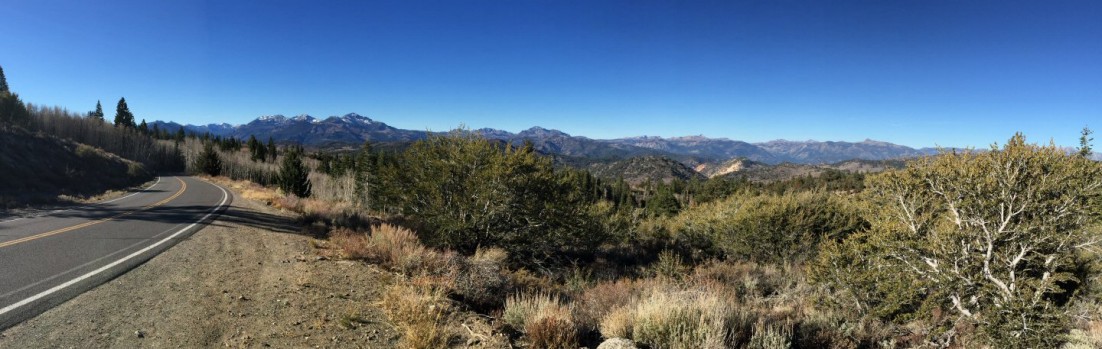
The East side of the Sierra Nevada mountains. (Photo courtesy Fed Glaser.)
My concerns were alleviated by the sight of the sapphire-blue waters of Tenaya Lake, probably one of the most photographed bodies of water within the borders of Yosemite National Park. The beauty of Tenaya belies the fact that it’s a barren, fishless lake. Thankfully, I knew it was less than 10 miles to the Tuolumne Meadows gas station, one of the few Chevron stations with a mini-store that offers rock climbing equipment for sale and rent. We’d done alright so far. It was 11:00 a.m., putting us on schedule to stop for lunch in Lee Vining.
This time the appearance of Tuolumne Meadows and its namesake river was a far cry from a visit in June with my brother and one son. The river was no longer near flood stage; the water had receded and the meadow was again grass. Lembert Dome loomed above us, sheer peaks watched from the southeast and the now fishable Dana Fork of the Tuolumne River teased us from alongside the road. Soon we reached Tioga Pass station and began a descent that would take us past Tioga and Ellery lakes, and into Lee Vining Canyon.
This 9-mile stretch of road harbors the majority of my childhood memories of family vacations. Scattered about are small meadows dotted with small stands of Lodgepole and other pines, and laced by small streams with small, willing wild brook and brown trout. Tioga Lake recalls a day of crazy fishing, when my sister, brother, dad and I stood on rocks a few feet above the lake casting spinners and watching the (stocked) rainbow trout chase our lures, only to strike at the last minute.
It all changes after Ellery Lake. Sheer rock is the predominate feature. Only small plants and hardy trees cling to crevices. Only on the canyon floor, the eventual destination of Lee Vining Creek after its exit from Ellery Lake, offers any great expanse of green. The Eastern Sierra high desert — a Pinyon pine-Juniper woodland — begins near the canyon floor, offering a stark contrast, beautiful in its own way, to the forest passed through to get there.
We had about 12 more miles to Lee Vining and sat down for lunch on the patio at Bodie Mike’s Barbeque just after noon. With the seasoning that comes with eating out-of-doors, we dug in, enjoying the view toward Mono Lake between bites. It was a quick drive to Crowley Lake Marina to surprise the marina attendant with a bone-dry boat. It took longer to affix the tag than conduct the inspection.
A few minutes later we tucked our stuff into the cabin to find ourselves with more time than expected on our hands. The afternoon sun was still well above the mountains to the west. We were there to fish, so took a short stroll to the nearby Rock Creek to cast a few flies.
Rock Creek isn’t too big, but usually heavily stocked and fished just as much. Willy and I split up. I would find a few rising fish willing to strike my offerings, but the kicker was Willy’s first fish — his first post retirement trout. A not-too-shabby brown trout of about 14 inches.
We spent a bit more time casting to rising fish, next to the opposite shore, of course. A few took our offerings, fewer were landed, but it was good to spend a few hours getting the “skunk” off before dinner.
Looking back, it was a good start to what would be a trip that was great for reasons I didn’t expect.
*Not through Yosemite Valley, however. The road to the valley dead ends near the Happy Isles Visitor Center. Hwy 120 passes the valley and heads through the high country and Tuolumne Meadows, then over Tioga Pass.
If you’re looking to build self-confidence and have taken up fly fishing, there is no shortage of instructional books, DVDs, websites and podcasts. Some folks will proclaim that things like more expensive better rods, a specific brand of fly line and the one killer fly will be the keys to a better fly fishing experience. But the best thing any angler can do is to just keep casting; confidence comes with learning to do things on your own.
Building this necessary confidence took me a while. Those who’ve seen my fishing — specifically my casting — might agree that blind confidence is a much bigger part of the equation than skill.
In casting, confidence requires first believing that you won’t piece a body part and, second, that you’ll get the fly where it needs to go.
When it comes to flies, there’s a prevalent theory that anglers gravitate toward certain flies — and hook most fish with them — because they have confidence in those flies. Confidence or lack thereof can also apply to the landing of or losing those hooked fish. My “confidence flies” are the Zebra Midge, AP Nymph and something like a Copper Chromie, but with red thread and silver wire.
Confidence in flies can be challenged again when you tie your own. The flies that work, the ones in which an angler has the most confidence, will be the ones tied most often. That certainly applies to my tying. (See the list above.)
My confidence was called into question this year, once again, when I hooked that first fish on the rod I built during the winter. My confidence grew with each fish coaxed to the net.
Soon I’ll be testing the limits of that confidence. I’ll be working with knotted leaders.
Yeah, old school stuff. There are folks who eschew modern loop-to-loop connections and extruded knotless leaders and swear by knotted leaders. In my case, I’ll be duplicating a time-tested formula used for stillwater nymphing (3 feet of 1X, 3 feet of 3X and 7 to 10-plus feet of 5X to the depth fished).
It’s my knot-tying ability that’ll be tested…in a lake where 18-inch rainbow, brown or cutthroat trout aren’t uncommon, and often one might get into a 24 incher. It doesn’t help that I have an inherent mistrust of tippet. The formula works; at least when tied by guides I’ve hired.
This time I’ll be me tying the knots, and I’d daresay that any fish I land will be well deserved.
Teaching fly fishing requires enthusiasm. Teaching it well requires a bit more. A little curiosity helps.
It was my brother who provided the curiosity. Not openly, but in that tone of voice we’ve all heard before.
We were discussing ideas for his first visit to California in eight years and our trip to, up and over the Sierra Nevadas. “I’d be willing to try fly fishing if you have some gear I could use,” he said over the phone.
I’d thought plenty about offering such an opportunity but hadn’t mentioned it. Everyone has a story about how they were introduced to the sport. Mine surely isn’t unique, but it did imbue me with a belief that a curious mind opens the door to the best first fly fishing experience.
Along with the gear, I’d bring considerable enthusiasm. (It’d help to understand that my sister’s family has given me the nickname of “The Herring Merchant.”*)
That’s how Mark, Sean and I found ourselves on “Hatchery Creek,” not too far away from the cabin, just as sunlight touched the top of the hills. With borrowed waders, boots and a wading staff but minus an overloaded vest, Mark looked just about as silly as I. (It’s a tenant of fly fishing that fish don’t care how one looks.)
[singlepic id=1188 w=325 h=244 float=center]
Mark on a fish.
This creek tucks against a hillside and, controlled by a powerhouse, is nearly always fishable regardless of spring runoff. Though near a main highway, it’s sheltered by heavily treed banks, and — except for the occasional burps of a Jake brake — the outside world is easily left behind. Though the outcome of our day had yet to be determined, the absence of other fisherman was a welcome sign.
After gearing up and giving a primer on the creek, I led Mark toward one of my favorite runs. It’s the same piece of water on which I educated both sons as to the nuances of hydrology. On the surface it looks fast, and most would call it too fast for fish. The most obvious (and dependable) spot for trout here is near the far bank, where the water’s velocity is slowed by friction. Perhaps because of constant shadows and the lack of light, it’s difficult to see the nearer telltale seams that suggest hidden trout. As both sons learned years ago, a little bit of patience and a passable drift in the proper location will surprise you. It’s also a great spot to swing a fly at the end of the drift.
We were rigged up with nymphs under an indicator. It was too early for dry flies, and to my knowledge this creek is devoid of any real insect hatches, with only occasional dry fly takes in the afternoon.
There’s nothing more conducive to learning than doing, and my strategy was simple: talk, walk, fish and hope that Mark would get into at least one fish while doing so. I would take on the role of guide. I’d assemble leaders, tie knots and select flies. It would be Mark’s “job” to focus on hooking and landing a fish.
It Ain’t Pretty, But Works
For those who haven’t fly fished, casting nymphs (often heavier, underwater flies) with an indicator (yeah, like a bobber) is an inelegant affair. In this case it was more of a lobbing action. After a bit of discussion about this technique and a quick demonstration, Mark made his first casts. Occasionally I’d offer a bit of advice. The suggestion of a casting target that’d offer a better drift into a good trout lie. A recommendation to keep a tight line between the rod to the indicator, then a gentle admonishment to keep an eye on the indictor for any movement that didn’t seem “normal.” A description of the slight lift the rod should be given at the end of every drift.
It was that last piece of advice that gave Mark his first surprise. He’d made a good drift with no takers. Toward the end of the run, the rod tip was raised, the movement of the indicator slowed, and the flies below rose toward the water’s surface, as an emerging insect might do.
That’s how Mark hooked his first trout on a fly rod. Just as quickly as it was on, it was off.
It didn’t matter that we didn’t land that fish. It’s the confidence and faith that washed over Mark’s face that mattered. His big brother wasn’t just blowing smoke. An unseen fish had risen to take a fly presented just as he had advised. Without any encouragement from me, the training wheels were off.
Heading upstream, Mark stopped at a suspect pool while I ventured toward a stretch where riffles tumbled into a long, deep run that abutted a boulder, which in turn created a pool that offered a long tailout. Sean had fished the area earlier, but had since headed downstream.
When Mark moved to the pool behind that boulder, just below me, I futilely tried to keep an eye on my indicator as well as Mark’s. I needn’t have. Before I knew it Mark had set the hook. Encouraging him to keep the rod tip up, a bend in the rod and to allow the fish to tired ever so slightly, I dropped set aside my rod, grabbed my net, and headed downstream.
Mark was broadly smiling as the rod tipped danced. Not an acrobatic fish, it splashed enough to put on a bit of a show. Soon Mark turned its head and we had a decent trout in the net.
[singlepic id=1189 w=480 h=640 float=center]
Mark and his first fly rod fish.
Mark waded over for the obligatory fish photo. Excitement shifted to quiet contemplation. We talked of wetting hands before handing trout, the ease of removing a barbless hook, and keeping the fish in the water until all were ready for the photo. Photo taken, we let it rest in the net. It was a remarkably clean, deep bellied and heavily dotted hatchery rainbow trout measuring an honest 13 inches; a admirable first fly rod fish.
It quickly recovered and, as discussed, Mark softly cradled the trout as I lowered the lip of the net. Often, it seems to me that time slows in the minute or so before a trout finally swings its tail and darts for the familiar safety of deeper water. I never asked Mark if he felt that same sensation, but the look on his face confirmed that he had discovered the magic of catch and release fishing.
The Lesson Learned
At that moment I got it. A curtain parted ever so slightly, giving me privileged insight into why fly fishing guides, those who truly enjoy what they do, do what they do.
More could be written about that day. About the other fish that Mark stalked, hooked and landed, and his amazement that he could do so while hardware and bait fishermen struggled for even a single fish. About Mark’s discovery of trout in places he previously might have dismissed as holding fish. About a simple enjoyment in finding that sharing of one’s love of fly fishing can spark the beginnings of such a passion in another.
But looking above, there’s not much else to worth writing about Mark’s first fly fishing experience and how it rekindled in me renewed appreciation for the little things, beyond the fishing, that bring such joy to the sport.
[In the movie “Love and Death”] Boris is in love with Sonja, but she is unhappily married to Voskovec the Herring Merchant (“his mentality,” she complains, “has reduced all the beauty of the world to a small pickled fish“). She takes lovers. (“She takes uppers?” Boris repeats, incredulous, when he hears this news). Voskovec, preparing his pistols to fight a duel in defence of his wife’s honour, accidentally shoots himself. Sonja goes to his deathbed in the company of a couple of doctors. In what is, I think, my favourite exchange in all film, Sonja talks to the expiring man…Here’s the tender deathbed scene:
SONJA: You were a kind and loving husband. Generous and always considerate. (To doctors) What’s he got? About eight minutes?
DOCTOR: (consulting his watch) I think I’m slow. He’s got about three.
VOSKOVEC: Swimming out! Swimming out to the open sea like the great … wild … herring! [Dies]
(You can find more photos here under “The Brother’s Visit – Tuolumne Meadows, Eastern Sierra, First Time Fly Fishing”.)

 …the new hardiness map shows a decided shift north nationwide.


 fishing for words