Ask around, do a little research and you’ll likely find that the question “what’s the best vehicle for fly fishing” is often answered “truck.”
But I’m still paying into social security so others can fly fish when they want a working stiff. I need transportation that is, first and foremost, reliable, and just as important, economical. I have to spend money on gas to make money, and the less I spend upfront the better.
During better weather, the Honda CB750 and its 45+ miles per gallon is a fine option. But it’s difficult to load the necessary fly fishing gear, and the cooler of post-fishing beer, on a motorcycle. I’ve tried.
Being a bit obsessive about conducting research on anything that will cost more than $50, I’ve been thinking — probably too much according to those around me — about the vehicle that, in about 1½ to 2 years, will replace my current 2003 Honda Accord. Since I’ll likely buy a certified pre-owned car, it’s going to be something currently on the market. My current car gets 30 to 32 mpg most of the time, and on long trips to fishing venues, I’ve seen 34+ mpg. But over 80% of my driving is commuting to and from work.
I’ve debated the merits of various models, including sport utility vehicles and all-wheel-drive cars. A hybrid is out of the question; too heavy and not enough clearance for the occasional Forest Service road. Subaru is a commonly offered up make as an all-encompassing solution. But I’ve noticed two things: most Subaru owners talk about the sportiness of the ride, the go-almost-anywhere capability, but rarely praise their cars’ mpg, and it seems to be a roll of the dice when it comes to build quality. That might be said about any make, but that’s my experience.
Despite the fact that I’ve been a Honda owner for well over 20 years, I opened up my consideration to other options, particularly now that the mpg on midsize sedans is edging up.
But, and a bit ironically, it’s fly fishing that helped firmed up my decision. At least for now.
I’ve driven my Honda on a good many, only slightly improved, Forest Service roads. Sometimes for miles, over the relatively soft dirt along the Upper Owens River, for example, or over rocks on my way to the Little Walker River, and on washboard roads in the hills behind the cabin.
Still, the doggone car doesn’t squeak or rattle.
I’m hoping this will still hold true for my next car, until that someday when I can justify a dedicated fishing truck.
There are times when the catching is good, but the fishing still unsatisfying. I was felt this way on Hot Creek, just a bit, during this last club trip to the Eastern Sierra.
I may not eagerly jump out of bed on a work day, but by nature — likely because I’m in tune with nature on most fishing trips — I’m an early morning fly fisher.
It’s a strategy that works for me. It puts me on the water long before almost anyone else. Nymphs work well for me in the twilight of the morning. The darkness lends the fish in my net a a mysterious, ghostly quality.
That’s what put me on Hot Creek about mid afternoon on a Thursday.
It was nicer than I expected, with a mid week crowd comprised of a single fisherman and myself, and the normally frustrating winds almost nonexistent. Caddis coated the bushes. An errant mayfly dipped up and down in the air.
I’d been told that a certain crane fly imitation would work well. I didn’t have one. The hoppers that were suggested didn’t get even a glance from fish clearly seen to be eating. For a time I watched the graceful and economical movements of a pod of trout, rising to feed and falling back to the bottom. Obviously, there was something that I couldn’t see bringing them to the surface.
Like most any water, Hot Creek comes with its own piece of counseling: go small. And in the afternoon, dry flies.
Normally I’d head upstream and work my way down, but after a friendly conversation with older gent already fishing (and giving him a size 20 caddis for use as an indicator above a trailing something about size 22-24), I decided to stick and move as I worked my way up the creek.
I rigged up in similar fashion, with a black caddis trailing a size 24 parachute Adams. This time of year, tactics at Hot Creek are often dictated by the abundant weed growth. A soft footfall serves one well, and I carefully picked my way around bushes while watching the “lanes.” In the past, I bypassed these areas under the pretext of one excuse or another. (My casting isn’t good enough, I won’t get a long enough drift, too many people, etc.)
It wasn’t too long before I saw that first nose, more of a bump in the water, a tell-tale sign of a feeding trout.
I cast well upstream. It took a few more casts, but with some skill luck, a good drift put the fly where it needed to be.
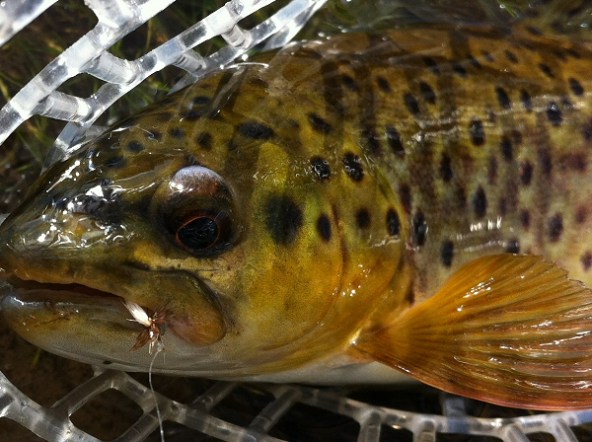
It still amazes me that a nice Hot Creek brown like this can be landed on so small a fly.
I’d repeat this more times than I care to recall but was rewarded with eight beautiful trout, mostly browns, all of which were no less than 13”. The biggest and prettiest crowded about 24” of beauty into 15” of fish.
Next year, I think this place will deserve an entire day of my attention.
This year’s annual club trip to the Eastern Sierras — organized by yours truly — came a tad bit later this year, but its planning nearly nine months ago couldn’t anticipate the snowfall that wouldn’t arrive last winter. From afar I watched the guide reports and river flows, but all of that was forgotten two Sundays ago, once an amazingly fat brook trout slammed the first dry fly cast into a suspect pool.
This is a good time of year to be in the Eastern Sierras. Fewer people, perhaps only the hardier (and those without kids), remain to fish, hike and camp. Being a bit more mature, our group rents a couple of rustic cabins, though we do cook dinner ourselves (clam linguine one night). The days are often cloudless and, at an elevation of 7,000 feet, this expanse of high desert warms up fast. Temperatures swing the other direction just as fast, dropping to the mid-to-low 30s in the evening. Startlingly brilliant stars illuminate the clear nights.
Once over Sonora Pass, my first stop was on the Little Walker River. This small water is often overshadowed by its bigger brethren, the East Walker and West Walker rivers, which offer bigger and more fish. A year after discovering the charm of the Little Walker, and during my first turn as “fishmaster” for this trip, I fished this creek with the club’s outings chairman. We had a wonderful time finding wild brook, brown and rainbow trout exactly where they should be. Jim has since passed away, but the Little Walker reminds me of his broad smile.
It surprised me to see a brookie so big in the Little Walker.
It was with Jim that I first explored Hot Creek, one of the waters that would be frequented during the week. Since I’d have six full days to fish, and in light of Hot Creek’s popularity, the plan was to fish it during midweek. It was a sound philosophy; avoiding as many other fly fishermen as possible and hoping that reduced fishing pressure over a day or two would improve my chances.
Hot Creek Morning.
Hot Creek has been the marlin to my Santiago. It’s a spring creek with a high fish population, estimated to be 8,000 to 10,000 trout per mile. But these are highly educated trout that have probably seen every fly in the catalog. Throw in clear, low water and weeds that limit opportunities to small lanes and the chance of a drag-free drift, and this fly fishing heaven can become hellish, particularly late in the year. Most descriptions of Hot Creek include words that tend to scare me: “technical,” “attentive mends,” “drag-free drifts,” “multiple hatches.” That first visit with Jim five years ago didn’t dispel any of my trepidation, despite my landing two decent fish.
Although I was on the road Tuesday morning later than intended, I descended into the canyon well before the sun was fully on the water. A single fly fisherman had arrived before me. Reminding myself that there was no need to rush, I slowly and softly walked upstream, taking time to stop and watch the water. In the absence of light, the water was dark and unyielding.
Trusting to my experience that fish would be in a familiar spot, I finally stopped to cast a size 16 dark brown-bodied caddis trailing a smaller dropper (maybe size 22, or 24); a red-butt zebra midge type of fly made up during a fit of madness inspiration at the fly-tying vise. This was truly blind casting. There was a lane big enough to allow for a decent drift of about two feet. I kept my false casts short and out of view of the trout I hoped were there, and used a single-haul cast to finally lay the flies on target. The caddis dipped on my third cast and a good-looking 11 inches of brown trout went airborne. I don’t know if it’s the lack of depth in the creek, but I don’t think I’ve seen brown trout as acrobatic as those in Hot Creek.
Hot Creek Brown. Love that pectoral fin!
With the first fish to the net, my pulse finally began to slow and my body relaxed. My casting settled down. Two more fish made it to my net during the next hour, one a dark-hued rainbow of about 14 inches. There are bigger fish in Hot Creek, but any decent fish hooked, played through the mass of weeds, and landed, is still a pretty big deal in my book.
Soon the first few caddisflies and mayflies appeared in the air as sunlight began to warm the water. The sunlight also revealed pods of fish, some hovering between weeds, others just on the edge.
Yes it was dark, but this wild fish also has a dark cast to it.
I downsized my caddis fly to a size 22, hoping that it might get a look or two. It did, but only in passing. I would land a total of six fish that morning and walk out of the canyon feeling pretty good about it. But it was a conversation — with a friendly guy who toughs out his year splitting time between fly fishing the Eastern Sierra and running a scuba shop in Cabo San Lucas — that had me pondering a return in the evening.
“We’ve been busy…” would be the applicable excuse to explain the lack of posts here, and it’s true in more than one way. The nose has certainly been to the grindstone, but thankfully interrupted by (multiple) visits from out-of-state family rarely seen south of the 47th parallel, too much food, copious beer tasting, and the celebration of one of those big steps down the path of life. The yard lies ignored.
Another road trip begins in just over 24 hours, an annual trek that’ll put us in the middle of a pretty fishy — and pretty — spot east and a smidge south of Yosemite. We’ve fished there before quite a few times, but this year, conditions seem to be a couple weeks ahead; more of what might be expected later in the month. The upside is that a small river not visited before may be a prime candidate this year.
At any rate, life’s been good lately, and now that we’re on the downhill slide into the holidays it’s hard to believe another year is closing fast.
Since pictures are worth a thousand words, and it would take many thousands to tell of the adventure and fun enjoyed last week with my brother’s family, below is a gallery of photos that tell the story than I could. The days were filled with swimming at the local lake, visiting a historic gold rush town and panning for gold, more fun — swimming, sliding, diving, building sand castles — at the lake, hiking, mini golf and a trip to Yosemite. Enjoy!
Due to loading issues, the gallery has been moved here.
Last week in a nutshell: Trout weren’t caught where expected; a good many others landed where only a few were caught before. One river was frustrating; another too low; one just right. Fellow fly fishermen were met and their company enjoyed on the water.
Some folks won’t understand the almost 200 miles traveled to catch and release the trout I finally found. But a quiet sense of urgency seems to settles in after the summer solstice, an urgency that leads to miles of driving before sunup.
With water in many Sierra rivers, creeks and streams low this year, this urgency demanded a trip, however quick, to the Walker River Basin. It’s a watershed I’ve visited less than I should, considering the beauty of the country traveled distracts from the time it takes to get there. Breakfast is light and handy, the air cold and crisp as I crest the Sonora Pass. Horizon-to-horizon cloud cover dulls the day.
Morning commute traffic means something entirely different here. Before reaching the high desert of the Eastern Sierras, the two lanes of Hwy 108 winds through forests of pines and aspens near the Leavitt Meadow Campground, and though its twists and turns demand slower speeds, both lanes are usually vacant. But not this morning.
Thanks were muttered to the mechanic who last worked on my brakes as a cowboy sidled alongside to suggest it best that I pull to the side of the road and wait. I did and prayed just a little as a herd of cattle gave me the close up and personal experience I never wished to have, as well as one of those encounters that makes a journey all the more memorable.
A few miles more and two hours after my departure, an internal debate of where to fish the East Walker River was quickly settled by the absence of vehicles near the “miracle mile.” After a few wrong turns (caution is warranted driving a sedan on these dirt turnoffs), it was time to gear up. A lack of competition other fishermen tends to eliminate a subconscious desire to rush this process, and I stood there looking like a sausage standing on end while wishing another angler “Good morning.”
The single East Walker brown that came out to play…and on a red-butt zebra midge tied by yours truly.
His accented response was explained in the resulting conversation. He was visiting from France, working his way up the Sierras, and with admiration in his voice told me he enjoyed a quite a time on Hot Creek the day before. We talked techniques, and in a bit of name dropping I mentioned that three-time French Fly Fishing World Champion Pascal Cognard had recently spoken at a club meeting. (The French team has been ranked #1 by the International Fly-Fishing Federation for a number of recent years.) I mangled Pascal’s last name but once it was clear I was talking about competitive fly fishing and who I talking about, my new friend told me that he had competed against Pascal. Small world.
We spent a bit of time within sight of each other and I spent time watching his strategy. That French nymphing brought the first fish to the net within half an hour before I wandered downstream.
The East Walker has become my nemesis. It’s never not given up a fish and admittedly I haven’t spent much time fishing it. This day I poked and prodded likely pools, riffles and runs, with only one small brown to show for four hours of effort. Hungry and a bit frustrated, it was time to retrace my route, with stops at the Little Walker and West Walker rivers.
Though “little” is in its name, the Little Walker was too low for my tastes since I was hoping to fish stretches holding the wild trout that live there. It was back down another dirt road to the highway.
Rewarded will be a nice cast to within a foot or so of this bank on the West Walker…
The idea of unknown possibilities kept at bay a creeping despondency that was nourished by the still overcast sky, an unwetted net and the aches that come with age exertion. The West Walker is typical of the rivers in the Eastern Sierra…you might miss it if you didn’t know it was there. It winds through high desert terrain, below banks that conceal its course. Parking the car alongside the handful of trucks emblazoned with one military insignia/motto or another, I loaded up and headed out the half mile to a bend that seemed to interest a handful of anglers.
The number of fishermen made it a less than optimal situation, but my eye was drawn to flashes on the surface, near the tail of the bend and just below a lone fly fisherman. I walked quietly to a position downstream and behind him. Our conversation began when he stopped to replace a lost fly. He’d arrived at the nearby U.S. Marine Corps Mountain Warfare Training Center only two days ago, heard that the fishing was “on” and now stood on the shore of the West Walker in his fatigues.
He was enjoying himself. Though stocked rainbows, a long pod of fish had stacked up against the opposite bank, next to reeds and in deeper channels, and were earnestly feeding on the surface. Every other cast was welcomed with a bump, slash and, best of all, a solid strike. I was invited to join in and set up on a small point just downstream.
The reward.
The next three hours were filled will double hook ups and an inevitable comparison of our fish, talk of flies and home, and rain, wind and sun. Good fishing makes triumph seem easier in the face of a challenge, and despite powerful wind gusts — gusts that didn’t help casting but allowed the sun to shine — we continued fishing. Sidearm casts two feet off the water got flies close enough to feeding lanes. We never exchanged names but were fast friends in fly fishing that day.
Breaking my rule of never leaving willing fish, I headed back over the pass. My sister and her family were joining me for a three-day weekend, and though fishing is a big part of my time in those mountains, it had been a while since they’d been to the cabin and there was family fun to be had; fun that would be a bonus on top of that day on the three Walkers.
As alluded to in my last Friday post, the excellent fishing just over a week ago was often centered on a certain little red humpy. Accompanying the good fishing was good weather. I couldn’t have asked for any better; it was in the mid 80°s those four days. The following week the average daily highs climbed above 100°.
When it comes to fishing unfamiliar waters, I’m a big fan of hedging my bets. While specific locations and tactics will be obfuscated in conversations with just-met fly fisherman, and stops at local shops often require filtering out hyperbole, it’s usually fellow fly fishing club members that will usually — with a caveat that certain tidbits never be shared — give the most accurate information.
That’s what led me to Calaveras Big Trees State Park to check out Beaver Creek and the North Fork of the Stanislaus River.
I’ll get the North Fork of the Stan out of the way first. I fished it later in the day and did land a few fish. It’s not my favorite type of river. It’s certainly scenic, shadowed by groves of ponderosa and sugar pines, incense cedars, white firs, mountain dogwood and, of course, giant sequoia redwoods. It looks to offer a great opportunity for rafting and I probably should reserve final judgment until there’s a chance to visit when the water is lower. But it’ not the easiest stretch of water to fish as it tumbles through truck-size boulders that mean edging a few yards downstream might entail a half-mile hike just to get around those boulders.
[singlepic id=1228 w=300 h=225 float=right]
Missed hatch on Beaver Creek.
Beaver Creek, however, was a reminder of why I enjoy fly fishing smaller waters; they require a more personal involvement with nature. Though it took bushwhacking to move upstream, Beaver Creek offers the intimate style of water I favor, and that certainly made any difficult terrain less of a burden. My hope was to find the wild fish I had been told about, but if they were there, they weren’t as aggressive as the stocked rainbows. I was pleasantly surprised, however, by a wild brown that nailed the humpy only seconds after it landed near a likely seam.
I fished a few other less remarkable sections of the Stanislaus, revisited Herring Creek, and wet a line in some of the ol’ regular spots. It was a good few days. And when the humpy didn’t work, one of my “confidence” flies, a stimulator of nearly any color, did.
I’m glad I went exploring when I did; it’s likely that within a month some of these creeks will be a bit too skinny.


 fishing for words