fishing for words

(and tossing out random thoughts)


1 Comment

getting out and up in the Sierras (and personal accomplishment)

My family spent many summer vacations in Tuolumne Meadows. These trips were a family affair and in the interest of keeping everyone engaged, it was more than fishing. We’d spend the days hiking to higher elevations — the campground was at 8,600 feet — and sometimes we’d end up at nearly 10,000 feet. Mepps spinners would be cast into water along the trail and sometimes the destination was a lake where fishing was rumored to be amazing. Mom would keep the troops focused by wondering out loud about what might be around the next bend. My brother and sister and I would spend countless hours exploring the banks of the Tuolumne River, watching the occasional bear that wandered into the campground, and waiting for the rare treat of visiting the campground store, where we’d get to pick one comic book and maybe enjoy an ice cream.

Idealization taints memories but, for me, the Sierra Nevada high country has always lived up to my recollection. That’s what fueled the rest of my plan for Memorial Day Weekend 2014.

The view from where I started.

The view from where I started.

First-hand reports made it clear that water would be high in the Walker River Basin. But I had a plan that tied into two keywords in my last post: “maturity” and “adventure.” Not to get too personal, but I’m no spring chicken rooster, and for more than five years I’ve worn a compression brace on my right knee. Years ago, while carrying a bag of cement on my shoulder, I stepped into an unseen depression, twisted my knee and fell to the ground. I was young then, so shook it off. It was only years later that I began to feel a bit of pain after long walks. This year I finally got out of my rocker to walk every day. Not Forrest Gump style, but about five miles a day. That, in combination with weight loss, has eliminated the need for the brace.

Cautiously optimistic, in planning for this trip I had decided to walk up the Little Walker River, hoping this would rekindle my enjoyment of high country hikes. I enjoy fishing this creek’s small water, though most of my experience had been limited to the stretch through and downstream of the campground. Sticking to my plan, I ignored warnings of high and muddy water. The drive over Sonora Pass would take about two hours, but it’s one drive that’s always enjoyable as the terrain changes with the elevation and, particularly this time of year, snow still dusts the pass. This day the drive was even more pleasant; being a weekday I saw only four cars at lower elevations, and no one above 6,000 feet.

The section of Hwy 108 between Twain Harte and the junction with Hwy 395 rarely runs straight. It’s a good road and relatively fast considering the twists and turns. On the eastside, after beginning a descent into the high desert, there are at least four severe hairpin turns. It seems that every year I either run into a cattle drive on the highway or a semi-trailer truck stuck at a hairpin. This year it was another truck. I waited about 10 minutes as the driver unsuccessfully tried to free the drive wheels, which had sunk in the loose dirt on the inside of the turn, before walking up to ask if it would be okay to try to drive around on the shoulder. He helped me move a few big rocks. After getting past, I was talking with the driver, emphasizing that this hairpin was only the first, when assistance arrived in the form of a Ford Police Interceptor Utility in California Highway Patrol colors.

The longest part of this drive always seems to be the three or so miles down a washboard dirt road to the Obsidian Campground in the Humboldt-Toiyabe National Forest. It’s not a bad drive, and was made nicer this year by a late-season storm that dropped enough rain to keep the dust down. Best of all: I was the only person there.

One of many fallen trees...

One of many fallen trees…

I began hiking where a bridge crosses the Little Walker. Topographical maps showed a nearby trail, but that trail would only appear intermittently during my hike. This part of the river flows through a narrow canyon, and since my preferred tactic is to hike as far up as possible and return by slowly fish downstream, I headed for high ground. This is terrain marked by small and rounded granite cobbles, perhaps glacial debris, sandy loams and decomposed granite. Willow and quaking aspen grow along the creek, replaced by conifers and mountain hemlock, which tolerate a drier environment. Hiking was relatively easy. There’s not much underbrush and the only hurdles — literally — were the many downed trees.

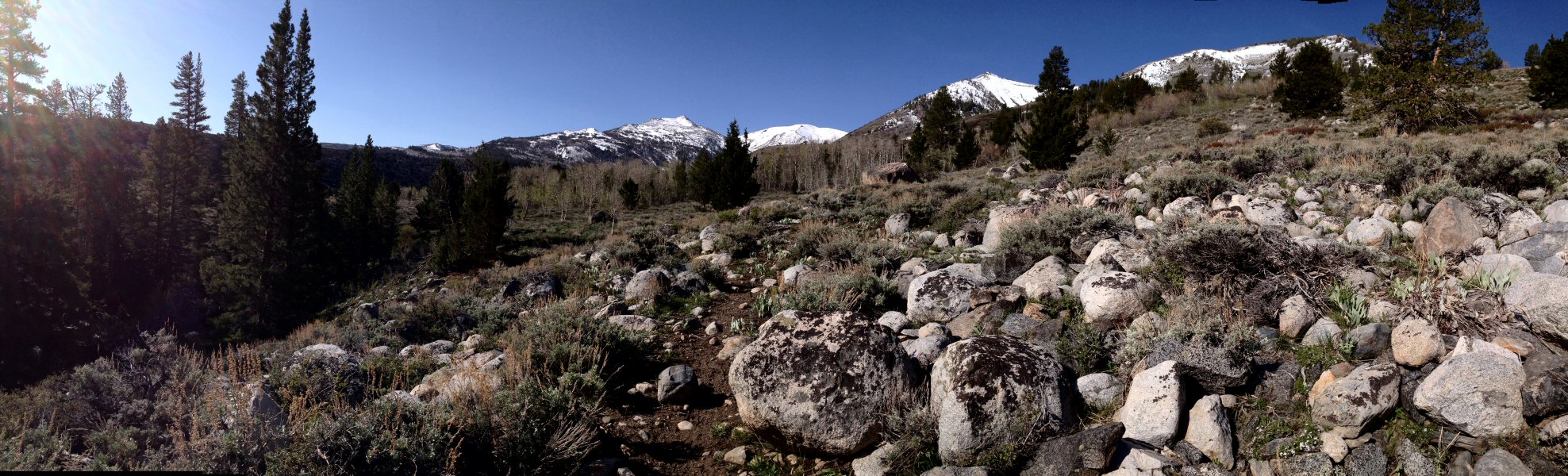
After about an hour I emerged from the canyon to find the wide-open expanse of Burt Canyon. Here the Little Walker meanders through stands of willows. The mountains that looked so far away when I started at about 7,400 feet seemed to be within reach. That was clearly an optical illusion as I was at about 8,600 feet and those mountains scraped the sky. The hiking was easy here and I continued on for about another hour.

I find solitude to be refreshing, so I pulled up a boulder and sat. Handfuls of raisins fed my body. The silence of the mountains, the sound of birds and gurgling water, and the unfathomable history of this place, fed my mind and soul. It was as if I was one of only few humans to pass this way.

The view in Burt Canyon, where I turned around.

The view in Burt Canyon, where I turned around.

Shaking off such romanticism, I rigged up the 3 wt. rod. This is the type of water that begs for a dry fly, with the usual small dropper. I fished suspect water, sneaking through willows as best I could, but apparently not well enough. I re-entered the narrow canyon of the Little Walker River with only a single rise so far.

It took a combination of hiking, climbing and crawling to follow the course of the creek, which wound around boulders, under fallen trees, sometimes cascading ten feet. The water was indeed high. Side arm casting, parallel to the creek was the best option. The fish were there, and a few rose to my fly, but none with enough an appetite to bite. If you fish, you know that there are those special spots that you know must hold fish. During high water flows, those locations change, and observation is the name of the game.

I had taken to hiking above the narrowest sections of the canyon and noticed one such spot. A large boulder was forcing the creek to bend almost ninety degrees, so that even at high flows, a pool was created. A large pine offered shade and security.

Hugging the conifer to hide my profile, my first cast fell into place and the fly slipped along a seam. I let it flow around the boulder until out of sight but before my fly line could spook any fish higher up in the pool. On the third or fourth cast a fish slammed the dry. This wasn’t a long pool, so the fish was resigned to head shaking and circling, but it did stress my little rod. I hadn’t expected to find a thirteen-inch holdover rainbow, but that’s what I was looking at in the net. That pool gave up a few more small fish, wild rainbow and brook trout of no more than eight inches, before I moved on.

Confident these fish could be fooled, it was time to stop for lunch in a small meadow passed on the hike upstream. The entrée was a jelly sandwich — I forgot to buy peanut butter at Twain Harte Market — accompanied by pretzels and raisins for dessert. During this repast, telltale rises in a slow bend caught my attention.

Lunch finished, I crept up to the edge of the creek. I made my first casts while still a few feet away; the high water had fish hugging the banks. The fish landed was a bright wild rainbow. A cast to the far bank brought up a couple of brilliantly colored brook trout. Feeling accomplished, I started to hike back to the car.
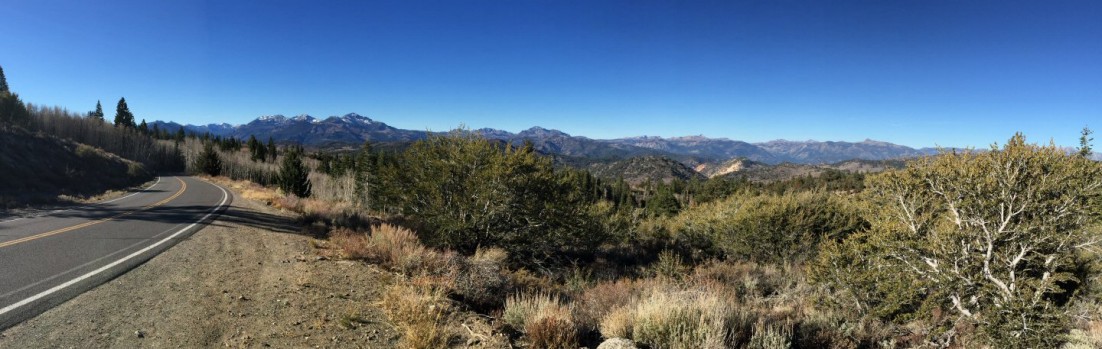
Panorama from a stop along the Little Walker.

Panorama from a stop along the Little Walker.

The bridge where I had parked came into sight, and below another fly fisherman, dappling a small pool. In short order he had hooked a big hatchery rainbow. His problem was getting it in the net. The pool was at the limit of the reach of his 5 wt., maybe nine feet, and the skinny water in this wide spot of the creek meant the rod often had to manage the full weight of the struggling fish. It wasn’t until I was on the bridge and ready to render aid, that he had the fish in the net. We chatted briefly before he headed off to clean his lunch.

That morning, in my focus on the adventure ahead, I hadn’t taken a good look at the water around this bridge. Now I could see that, directly underneath, it offered some interesting water. I clambered down. Fish hit my flies cast after cast. The hatchery rainbows were numerous and hooking one was a non-event. It was the occasional brook trout that made it fun. The challenge was getting my flies past the rainbows at the top of the run so the brookies at the bottom could get a look. I’m not complaining about having a chance at numerous fish, but I had come here for the wild ones.

On my way to the Little Walker, a quick look at the West Walker revealed it was running high, but clear. Knowing that time was limited if I was to get back over the pass before dark, I packed up and headed to Pickel Meadow. During the regular season the Pickel Meadow dirt parking lot would have half a dozen cars in it. This early in the season there were only two cars and three fly fisherman.

They had been fishing all morning and had found fish stacked up in a few bends. High-stick nymphing had worked best. And clearly, these guys have a more class than I; they were setting up a table and chairs for lunch, with all the fixin’s for Dagwood sandwiches. They also gave me explicit directions on how to get to the best spots (walk to the second willow and cast downstream) and told me to have at ‘em.

Perhaps it was laziness, but I decided to stick with a dry dropper. The fish were easy to spot, and I’m sure I was from their point of view, so I tried to hide behind a third willow while casting upstream. Helped by a twelve-foot leader, good drifts prompted rises to the dry fly. Proving that hatchery fish tend to be dumber, I had landed almost a dozen in less than an hour.

About then, one of the gentlemen from the parking lot walked up and asked what I was doing to hook so many fish. He was new to fly fishing, but enjoying it so far. We talked tactics and I again found myself in the role of teacher. I shared some flies with him and recommended other nearby waters. Then it was time to head back to the cabin.

It’s taken me seven-plus years to take “catching” out of the equation of fishing. Now I’m able to hike, if not with the energy of my teenage self, at least without getting (too) winded or an aching knee.

Mission accomplished.


1 Comment

shaking the skunk off and paying it forward

There was a lot of fishing and more hiking crammed into last weekend that originally envisioned. Much of the time, there was more of a focus on adventure and exploration than catching. Perhaps it’s maturity.

Lessons have been learned the last few years and avoidance of the Bay Area commute dictates my departure time. Shoving off during the late morning and making a few stops along the way lead to a late afternoon arrival in Twain Harte. Being the Thursday before Memorial Day weekend, the town still had that hushed, pre-summer feel.

With gear stowed and a few hours of sunlight left, it was time to preemptively get the skunk off. Fifteen minutes up the highway and ten minutes down a Forest Service road is a stretch of a fork of a relatively well-known Sierra Nevada river that offers prototypical put-and-take habitat with all the conveniences. It’s easily accessed, offers a picnic area and toilets, and the makeup of the river in this area naturally corrals the hatchery brood into three pools.

The artificial twilight created by towering pines made it difficult to see into the water, but the occasional slurp confirmed they were there. This fork is just above 5,000 feet elevation, and generally doesn’t contain much water. Even less this year, compared to the same time last year.

It seems to me that even factory fish retain a natural skittishness, which this day warranted a dry/dropper setup with a light touch. Half a dozen rainbow trout made it to the net in the following forty minutes. During that time, a couple of other folks had arrived to try their luck. The skunk off, it was time to head upstream.

This is a place I usually think of as a quick venue to resurrect skills left unpracticed during the winter and to work the rust out. The spirit of this weekend, however, was to challenge myself.

Hatchery fish clearly abide by that movie utterance that “…life will not be contained” and I was counting on this. About 100 feet upstream, this river is marked by pocket water winding through thick brush. The burble of plunge pools hinted at possible places where any wild offspring might be found. Dappling more than casting, I found a surprising number of the more attractive progeny. None were longer than six inches, making me wish for much smaller rod.

Emigrant Pass

Sonora Pass (@Emigrant Pass): Where I’d be headed the next day.

There’s a feeling altogether different about fooling wild trout. Granted, they are hungry and more opportunistic, and high-Sierra trout will take most any well-presented fly; but they require a stealthy approach. Over-lining these fish guarantees they’ll scatter. Every suspect pool — successfully approached — yielded a fish. After about an hour, I returned downstream. There still being light and good water available, there was time to make a few more casts.

It’s fair to say, fly fishing, fully embraced, tends to permeate one’s life. Two years after attending a fly fishing class I had become the fly fishing club’s secretary, webmaster and was leading an annual outing. Later I was enlisted to help with that same class. One could have a long debate as to whether the hobby attracts those predisposed or the hobby itself engenders the idea, but paying it forward, it seems to me, is part and parcel with fly fishing.

So it was, after a few minutes of hearing the crack of a fly line that I wandered downstream to find a woman waving a rod around in a most inelegant manner. Greetings were tentatively exchange with the question if she’d like a bit of advice. The next hour I offered a condensed version of fly fishing basics, kept within my limited sphere of knowledge. She had whipped the fly off her leader, so I gifted her a couple of flies and used the opportunity to demonstrate a dry/dropper rig.

By then, the sunlight was fading, and having reassured myself that I could still manage to bring up a few fish after a winter away from fishing, it was time to head back to the cabin for dinner and an early bedtime. The morning would come early as my plan was to head over Sonora Pass and hike up the Little Walker River — despite warnings it was high and muddy earlier in the week.

But as I said, this trip was more about adventure than catching.


1 Comment

my opening day…five weeks late

January’s promise to get out and fish earlier, more often and in different places now echoes with so much emptiness that the unthinkable is the only resolution.

Yes, I will be chasing trout this weekend. Memorial Day weekend.

The events and circumstances that kept me closer to home haven’t been unpleasant. They just didn’t include trout. Staying home last weekend included free and unrestricted quantities of barbecue and wine, not really a bad thing.

This is the first and possibly one of the few times to get to the cabin this summer, and despite the Sierra Nevada and its foothills being infested with a couple thousand campers and anglers, I’m going. With fishing reports read and flows checked, plans are firming.

An eyewitness account from a fellow fly fisherman suggests that a target river and one of its tributaries will still be high and muddy for a few days. But that bad news lends some optimism that little R Creek may have the water needed for guilt-free fishing for its wild rainbows. It’s a ten-mile dirt road drive to this little gem, so while in the area it’ll make sense to explore other blue lines on the map and not too far away.

It’s a certainty that a few high mountain streams will be walked, likely with the oldest son. A few will be familiar, others offering an opportunity to explore. Generally, this trip will be characterized by a philosophy that hiking a few thousand feet, maybe a mile or two, will leave the crowds behind.

Hopefully I’ll be the guy you won’t see this weekend.


1 Comment

on being a more imaginative fly fisher

There’s a fear that can creep over me in the company of other fly fishermen. Those who know me personally are likely to agree there’s a touch of restraint in my personality. Blending into a crowd is specialty learned during middle school; let’s spin it as a well-honed survival skill. Thankfully, in the years since, I have been able to put myself out there with the backing of friends and colleagues, though I still haven’t totally abandoned my introversion.

It was a recent podcast that made me realize that perhaps that fear coincides with the niggling thought that I may be a lazy fly fisher.

But I will hike to the fish. There was no hesitation last summer to march three miles into high-altitude lakes for brook trout no longer than the spread of my hand. I also tie flies. I built a fly rod. And it’s no problem getting up early to spend the day driving the 240-mile loop that takes me over Tioga Pass and Sonora Pass, alongside high-elevation streams and lakes as well as high-desert rivers.

I still feel a bit unworthy among my fly fishing peers. When others are describing the physical skill it took to lay a dry fly in front of a big trout 40 feet away, across four different currents and through 30 mile-per-hour crosswinds, I have no response. Oh, I’m catching fish to be sure. Just with less effort. It’s called nymphing; often under an indicator or dry fly.

It’s not that I’m apprehensive of trying different techniques. I’ll swing small wet flies, cast dries as far as I can — maybe 20 feet accurately — and chuck streamers when an opportunity presents itself.

Thinking about it, after being hammered by messages in blogs, podcasts and online forums that nymphing is inelegant (it is), too productive to be considered a real challenge and more akin to lure fishing than fly fishing, it occurs to me that nymphing, in fact, requires a bit more creativity than other tactics.

Why?

Nymphing often requires visualizing where your fly is and what its doing; rarely can you see it like a dry fly. It takes some thinking to set the depth at which that bead-head fly might be presented to fish hugging the stream bottom.

Observational skills are much more important. With dry flies you can rely on visual cues. When swinging flies, the take is abrupt and obvious. Nymphing, however, requires keen observation of subtle clues: the movement of the rod tip, the twitch of a strike indicator, even a suspicious flash of color. It takes skill to discern a take from your fly bumping simply into a rock or snag or hanging up on weeds.

What I’m trying to imply is that there’s another level of mental dexterity involved in nymphing and not required of other tactics. All tactics benefit from some knowledge of fish habits, hydrology and entomology and basic situational awareness.

Nymphing, however, requires imagination.

Guess that’s why it works so well for a day dreamer like me.


1 Comment

no longer just fair-weather fishing

I’d never thought of myself as a fair-weather fisherman until last month. The truth is that the timing of my fishing trips — most of which take place within a few hours drive of our cabin in the Sierra foothills — is more often dictated by the level of water and the appetites of the trout in it. There are plenty of sources for information that will give you an idea of what might be expected when you get where you’re going, but usually doesn’t match up with the reality of being there.

Last month I had left the cabin on an outing that began like any other early-morning trip over Sonora Pass. I left before sunrise, the roads were vacant and it was about 40 degrees F. The general idea was to visit previously unvisited areas of a nearby watershed, with no specific plan in mind.

The elevation of the cabin is about 3,600 feet, where autumn is generally makes its presence known in a pleasant manner. Leaves are beginning to change and there’s a nip in the air. Short sleeves are still comfortable most of the now shorter daylight hours.

The temperature fell as I began to climb toward the pass, and blotches of yellows and reds more frequently peeked out from behind the evergreens. By the time I arrived at Kennedy Meadows (elevation 6,700 feet), it was about half an hour past sunrise, but in the shadows of this piñon-juniper forest, it was 27 degrees. In 10 more miles I climbed another 3,000 feet, emerged from the tree line, and the temperature would rise about 25 degrees.

I have a fondness for the high country — because its beauty is one of stark contrasts, in some ways harsh but fragile in others, with dwarfed pines scrapping out an existence against a background of granite — and this dramatic variation in temperatures is one of the most observable influences on that beauty. The simple expansion of water as it becomes ice slowly breaks down granite. The melting of that ice, and snow, as well as a general weathering of the landscape, breaks that granite into pieces that, through weather and the activities of insects and animals, can be mixed with decomposed plant matter to create a thin and rocky soil. It’s truly amazing that such infertile soil supports numerous conifers of all shapes and sizes.

The descent on the east side of the mountains leads down to the high desert, where desolation of this shrubland is interrupted by strings of trees, usually aspens in the canyons and pines elsewhere, following the course of the rivers and streams of the Walker watershed. The sun gathers strength here, but this morning its power would be contested by a layer of cold air that had established a foothold during the night.
River-Side Ice

River-side ice at 26 degrees that morning.

There’s always that time, between emerging from the artificial environmental cocoon of a vehicle and before the cold really starts to bite, that the air temperature never seems that cold. When I pulled alongside likely looking water, it was 26 degrees. I had given serious consideration to the idea it would be chilly, but now worried I hadn’t considered it seriously enough.

So with the thought that I had come too far and retreat wasn’t an option, I began the layering that I hoped would suffice. This was comprised of fleece pants under the waders, a wind-proof wading jacket over a fleece sweatshirt that was on top of my long sleeve shirt, and a well-worn, wide-brim canvas hat. Later I’d realize that my fingerless fishing gloves would have been a welcome addition.

As long as I kept moving, I avoided the long shadows that persisted as the sun hung low along its autumnal path. The water was 58 degrees, at the low end at which trout will be active, so I didn’t linger too long in one spot and moved frequently to cover as much water as possible.

This was an entirely new experience. My breath hung in the air, lingering as puffs of white. Skim ice crunched underfoot. My guides iced up within fifteen minutes. It was cold. So cold that I almost — almost — hoped that wouldn’t have to plunge my hand into the water to unhook a fish.

I would leave this first spot about an hour later, skunked but feeling that for that brief time, more than ever, that I couldn’t escape being part of nature.


2 Comments

when every leaf is a flower

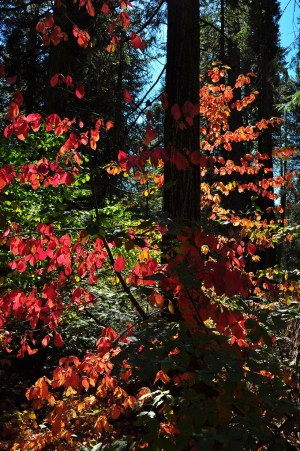
Big Trees & Fall Color

Big Trees & Fall Color

I, for one, believe the best adventures of childhood were often found in the backyard or within one’s immediate neighborhood. As adults we learn of the wider world, of places that are ancient and historical, mysterious, full of wild lands and animals. It’s true, but a life lived yearning to visit these places can let the wonder right outside our door slip away unnoticed.
It was expected that this week at the cabin would entail local exploration, the type of exploration allowed only by ignoring the clock and following a path chosen in the few moments before our next step.

So it was that Karen and I found ourselves at Calaveras Big Trees State Park, after, of course, stopping along the way to pick up seasonal favorites: apple cider donuts and fresh-pressed cider. I was familiar with the area, which is about an hour away from the cabin, but only as an extension of my search for new fishing waters, namely Beaver Creek and the North Fork of the Stanislaus River. To explain briefly, Calaveras Big Trees was created to preserver two groves of some of the most massive giant sequoia trees. (Not always the tallest, but volumetrically the world’s largest trees.) These are Sequoiadendron giganteum, the inland relative to the perhaps more familiar coast redwood (Sequoia sempervirens.

The morning was spend wandering among these enormous trees, looking upward until our neck muscles complained during a hike that covered a few miles. But if the sequoias were the big stars of the show, big leaf maples and dogwoods were the flashy supporting players; this time of year decked out in shades of red, yellow and orange. Their dazzling colors proving that “Autumn is a second spring when every leaf is a flower.”1

Pictures are worth more words than I could possible write, so below is a gallery, a glimpse of what we saw.

1 Albert Camus


Leave a comment

the 2013 Eastern Sierra Expeditionary Force, part 2

I think the most rewarding fish I ever caught was vivid wild rainbow from Hot Creek, one cold fall morning a few years ago. It wasn’t the biggest fish and it wasn’t the first. It was the one that confirmed I was doing something right. There have been quite a few fish since then, but this is one that stands out.

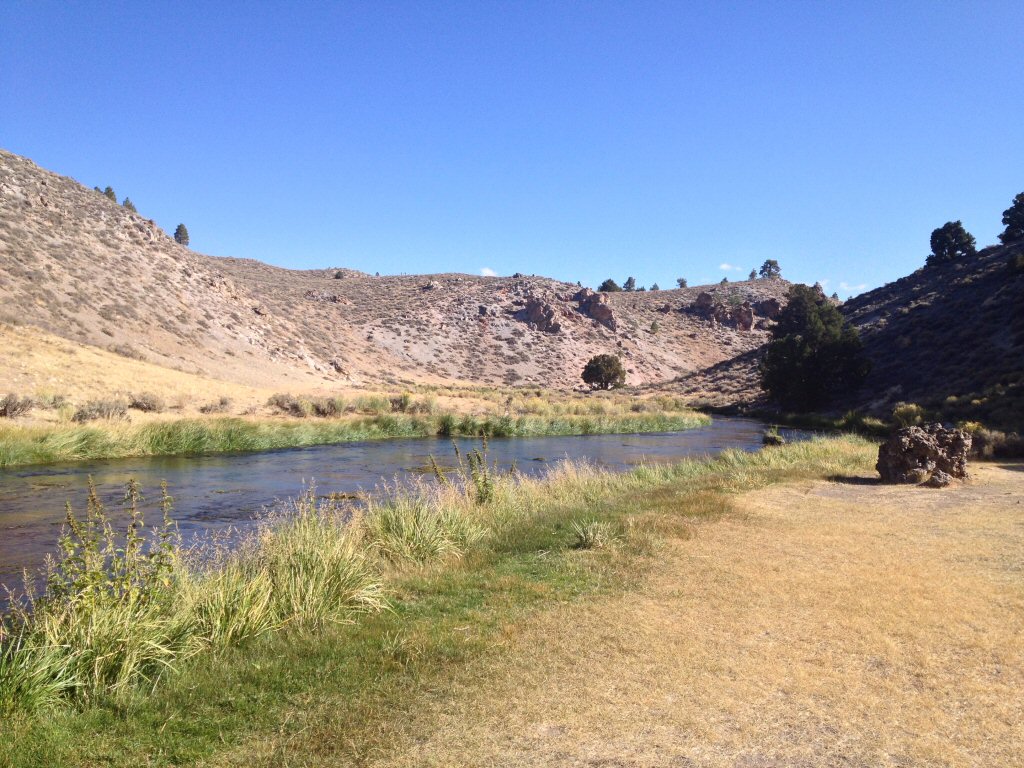
Early morning on Hot Creek, looking west to the Sierras.

Early morning on Hot Creek, looking west to the Sierras.

I’ve described Hot Creek as a personal crucible that draws me back whenever I’m near. It’s the kind of place you’d return to regardless of the fishing. Early in the morning, before the sun rises above the canyon walls and less hardy fisherman show up, it can be a meditative place. The last four years I’ve been alone during this time, at least without human company. Deer will eye me while slowly munching on weeds from the creek. Birds of all shapes and sizes fly over and flit about the stream as caddis begin to hatch. Dark shadows of trout slip between the weeds.

Hot Creek is a gift plunked down in the middle of some of the most gorgeous country. It flows for about 3 miles through a huge meadow of wildflowers and tall grasses — which has been under the private ownership of Hot Creek Ranch for decades — and is surrounded on one side by the Sierra Nevada Mountains and on the other by the high desert of the Long Valley Caldera, which stretches about 10 miles to the Glass Mountain Ridge. The most fished public stretch flows through Hot Creek Gorge, below the ranch.

This year the creek offered a special challenge: low water and weeds. Hot Creek is known for the weeds that make it such a prolific stream; weeds that necessitate good casts to small lanes if one is to expect a decent drift.

This year those lanes seemed to be half as wide and half as long. Most of the fish where either hovering at the beginning or the end of these lanes, or just at or under the edges of the weeds. Some could be seen. Others were revealed as they fed on something too small be seen.

Solitude on Hot Creek.

Solitude on Hot Creek.

If there’s one consistency at Hot Creek, at least during the fall, it’s the size of the flies that work best. A favorite among our group this year was a small Zebra Midge, but for me it was a size 20 CDC Caddis. I needed help seeing a fly that small, so this day it would trail a decent sized grasshopper pattern.

These days I tend to use dry flies more often as indicator in slower moving waters. I did so during my first visit to Hot Creek. Not because I wanted to, but because everything I had read and been told about this stream deemed it “highly technical.” I still don’t really know what those words mean when used to describe a river, stream or creek, but they were scary at the time.

These days, Hot Creek treats me fairly. Choosing the proper fly, casting well to the right spot and getting a good drift is generally rewards one with a strike. Whether or not that fish makes it to the net is up to me. This year, of about a dozen fish hooked, I’d lose half of them in the weeds. Others would throw the hook after going airborne. Only three would make it to hand for quick release.

I spent all of the morning and much of the afternoon fishing and exploring, visiting a lower section of the creek for the first time, and eating lunch about 30 feet above the creek while watching rising fish and mesmerized by the vivid landscape around me. It took more effort than usual to leave.

Somewhere along the line I read about a guy who fishes the Eastern Sierra, and on his vehicle is a bumper sticker that reads, “Don’t believe everything you think.” Appropriate for Hot Creek.


2 Comments

the 2013 Eastern Sierra Expeditionary Force, part one

Ask anyone who attended my club’s Eastern Sierra trip about the fish that made it to the net, and he’s likely to tell you it was about 18 inches. And that will be the truth.

For some of our group that was the length of one rainbow trout. For others, that total of 18 inches was the cumulative length of six brook trout. That’s just how it can play out in the Eastern Sierras.

The nice thing about an annual trip is that there always seems be to a landmark at which everyday life melts away and the focus shifts and sharpens to living in the present.

Morning above the West Walker River.

Morning above the West Walker River.

In this case, it occurs once the descent from Sonora Pass begins and the high desert stretches out in front of me. The route of choice this year was Hwy 108, as Hwy 120 (Tioga Road) was closed through mid September due to the Rim Fire. The usual commute traffic was there. Twice I would weave between cows meandering on the asphalt.

There are two maxims that apply to my fly fishing: (1) Get the skunk of as quickly as possible and (2) shaving serves no purpose. To address the first adage, I stopped at the West Walker River earlier than most fly fisherman would even take their first sip of coffee. Early enough to enjoy the stirring experience of hearing reveille echoing from the Marine Corps Mountain Warfare Training Center before my first cast.

Most people head for “the bend,” knowing that pods of planted trout can be found and, occasionally, a bigger fish might be found under a cut bank. But upstream, pocket water is a bigger draw for me.

West Walker Wild Rainbow

West Walker Wild Rainbow

Pocket water slows me down considerably, and it’s a good thing. Besides the obvious, avoiding a fall and at least a sprain if not a broken bone or two, the pocket water in the Sierras tends to be favored by the better-looking wild fish, and they need to be stalked. With a slow and low approach, I found plenty of wild rainbows willing to play.

When the sun was high in the sky and hiding my profile consigned me to shade and leg cramps, it was time to head down Hwy 395 to Tom’s Place Resort, , which if you’ve ever been, is a bit more basic than the name implies. But the price is right. The rest of our group, totaling 12, would filter in throughout the afternoon.

After that, the real fishing would begin, to be followed by free flowing homemade beer, good food and plenty of lies.


Leave a comment

don’t know what to expect this trip

It’s been a bad year for water in California. The April opener was one of the best in years thanks to low water levels.

Next week we’ll see for ourselves what Eastern Sierra rivers and lakes look like four months later.

One guide recently referred to Bridgeport Reservoir as a “pond.” Bridgeport is so low that its outflow into the East Walker River has been tainted by algae — algae that usually floats closer to the surface of the reservoir — and now the river is regularly off color and weedier than usual. Lake Sabrina in the Bishop area is so low that the front (manmade) lake no longer exists. The level of Crowley Lake is better than might be expected, but low enough to concentrate fish in the deepest areas.

The route taken by myself and guys from the club will be dictated by the Rim Fire. Hwy 120 remains closed. An expectation that the fire might not be fully contained until Sept. 20 doesn’t lend any clarity as to when it might open.

That’s not a big issue for me. I usually head over Sonora Pass via Hwy 108, with stops at the West Walker River, Little Walker River or Molybdenite Creek.

Thankfully, there will be water to fish when we settle in at Tom’s Place Resort (which certainly isn’t the resort you might think it is). The Upper Owens is supposed to be in good shape. The Middle Owens is flowing at an unseasonably high level. I may head to the high country, visiting alpine lakes and streams where I hope the fish are already preparing for a long winter.

However it works out, there will be lies told over beer and good grub.


2 Comments

hiking through history

We snuck out of the Bay Area on the Thursday a week ago for long weekend, planning to cram a bit of everything into the time we had.

Railroad ties at the West Side Rail Grade trail head.

Railroad ties at the West Side Rail Grade trail head.

In a new spirit of exploring unknown parts of familiar territory, we ended up on the West Side Rail Grade the next morning. The trail — really a former narrow-gauge railbed — begins on Buchanan Road in Tuolumne City and is carved into the hillside above the North Fork Tuolumne River, on the north side of the canyon. It was christened in 1898 as the Hetch Hetchy & Yosemite Valley Railroad under the ownership of the West Side Lumber Co., which used narrow-gauge railroads in the Sierra Nevada Mountains until the 1960s. The HH&YV was primarily employed to haul fresh-cut logs from the sugar pine forests of eastern Tuolumne County to the West Side Lumber Mill in Tuolumne City.

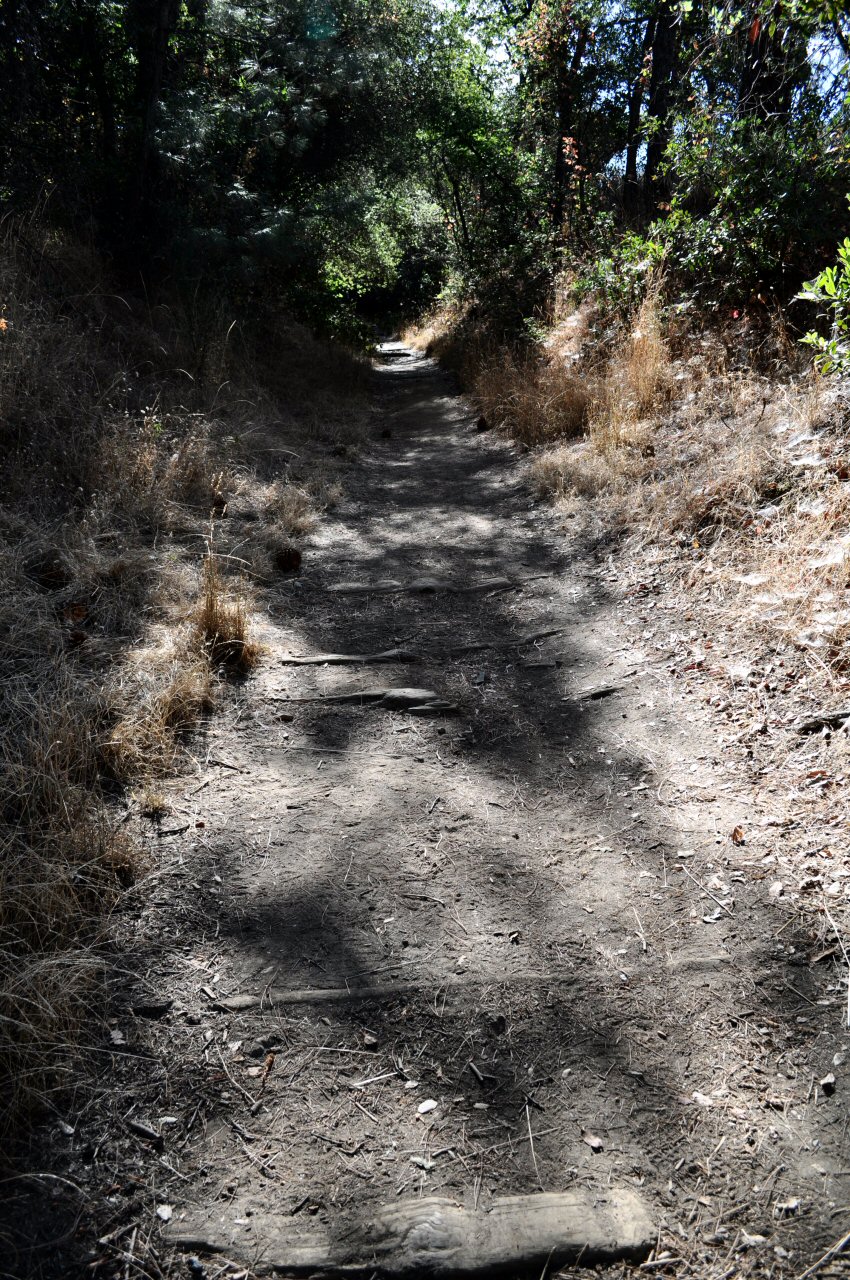
The trailhead is just outside of town, and the first 100 yards are marked by decomposing railroad ties that look like worn steps. After that, most of the trail is exposed, which left us to bake in a remarkably hot morning sun. There are a couple places where benches and tables allow for a break in the shade, and a sprinkling of poison oak along the trail encourages one to stick to the well-worn path.

Though I’m not a history buff, per se, it’s a pleasant surprise to find remains of history in situ. About a mile down the trail we came across long portions of ties and rails, with the trail occasionally shifting from one side of the tracks to the other.

Rails of the Hetch Hetchy & Yosemite Valley Railroad.

Rails of the Hetch Hetchy & Yosemite Valley Railroad.

The grade slopes gently downward, at least for as far as we hiked, and it would be a great place to break in some new boots. Had we continued the full 4½-plus miles, we could have soaked our toes in the North Fork of the Tuolumne River, near Basin Creek. (I originally discovered part of the West Side Rail trail while exploring Forest Service land above Long Barn, and while fishing an upstream portion of the Tuolumne, but have since determined that was another section of the trail that stretches from Hull Creek to the Clavey River, that that’s another hike for another time.)

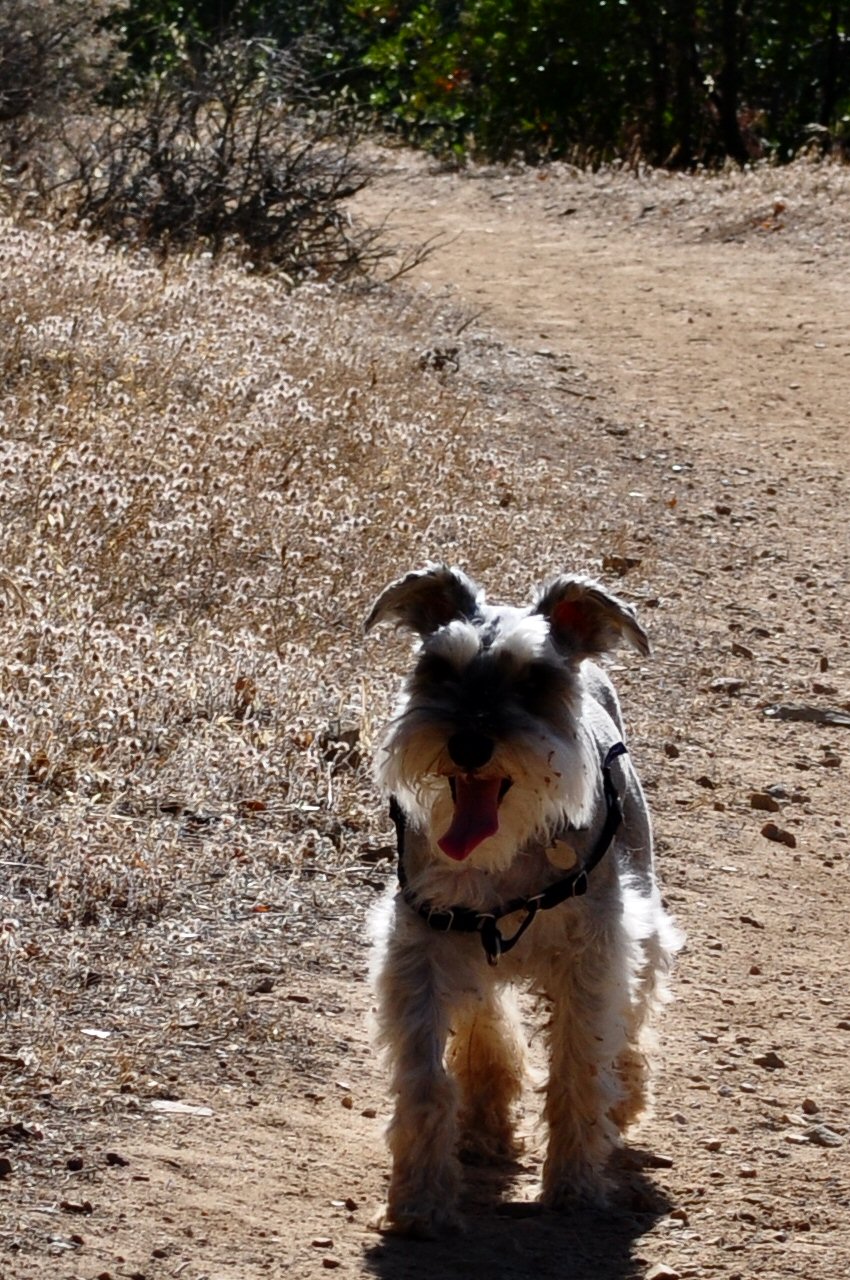
Hot and happy dog.

Hot and happy dog.

We met a few folks along the way: an overachiever who was jogging uphill and a few women who walk it almost every day, one of whom had made a dramatic move from the northern California coastal town of Bolinas to the much drier Sierra foothills.

With the full heat of the sun soon approaching, we left the exploration of a last blind curve for another time, and headed back. This day we had the dog with us and I don’t know if it was he or I who was panting more in the heat.

I have a feeling, though, that we’ll see more of this trail in the spring.