fishing for words

(and tossing out random thoughts)


Leave a comment

will travel for food: Show Dogs & Cellarmakers Brewing

I do enjoy living in California. I love our many outdoor options. I live in a suburb of the Bay Area, in a balance of choice and means. But I have a love/hate relationship with our “big city,” San Francisco.

San Francisco was the seventh most visited city in the United States last year, for good reason — cool summers of fog-kissed sunshine, a history that lives on through landmarks such Golden Gate Bridge, Alcatraz Island, Coit Tower and Fisherman’s Wharf. Lending to its picturesque quality are steep rolling hills patrolled by cable cars and dotted by a mix of architecture styles such as Italianate, Mission, Queen Anne, Stick/Eastlake, Craftsman, Art Deco and Streamline Moderne. Parks are sprinkled about, including the Conservatory of Flowers, Japanese Tea Garden and the San Francisco Botanical Garden. Culture abounds with art museums and performing arts. The sciences are represented at the California Academy of Sciences, the Morrison Planetarium and Steinhart Aquarium.

Wandering through neighborhoods like North Beach, Chinatown, Telegraph Hill and SoMa on a sunny day rank among some of my favorite experiences in The City. Christmas can be made more special with a visit to Union Square and a walk by Macy’s holiday windows displaying SPCA cats and dogs looking for forever homes. Personally, I enjoy carspotting and rarely is there not a sighting of a Ferrari or Tesla or the occasional Aston Martin, Bentley, Rolls Royce or Pagini. (BMWs, Audis, Mercedes-Benzes and Porsches are too commonplace.)

San Francisco is also most densely inhabited large city in our state and the second-most densely populated major city in the United States; second only to New York City. High-rise office buildings blot out the sky and create dark canyons that can be 10 degrees cooler. Our visit last weekend was marked by warmish temperatures, which likely gave rise to the rather pungent odors one might expect during a rainless winter.

Some people wanted champagne and caviar when they should have had beer and hot dogs. - Dwight D. Eisenhower

Some people wanted champagne and caviar when they should have had beer and hot dogs.
– Dwight D. Eisenhower

But we will travel for food, which lured us once again across the Bay. Intellectually, I understand the need for and benefits of mass transit; but deep inside I harbor an irrational fear of missing a scheduled stop. (Yes, I know there will be another bus or train, but that means giving up control of my schedule.) However, I’ve become accustomed to the hour-long ferry ride and have recently adopted the mantra “walking is good.”

Walk we did. To get where we were going, we’d skirt the Tenderloin just above SoMa. The situational awareness I’ve been working on, unfortunately, meant I wouldn’t miss that guy relieving himself in the gutter on Turk Street. More than once we walked through a repellent cloud of “skunk” originating from green stuff, not the black and white animal.

In truth, it was more akin to hiking for food and beer, and lunch at Show Dogs Fine Sausages was the reward on the first leg. House-made hot dogs, sausages and condiments, and beer on tap. What’s not to love? And love it we did. Maximizing our opportunity to taste Show Dogs’ offerings, we split a House Maple Pork sausage and Fried Chicken Sandwich, a pint of 21st Amendment’s seasonal Fireside Chat — a nice, rich and semi-dark English-style ale tweaked with spices — and a side of fries. The maple pork sausage was an experience I’d gladly repeat, even without the sprinkling of bacon. The proportion of maple to pork was perfect. Think of that time at breakfast when your sausage rolled into a bit of syrup. The twist for me was the deliciousness of the fried chicken sandwich, it was outstanding. Sure, it’s fried, but the house-made lemon cayenne aioli, coleslaw, pickled ginger and well-matched bun make it something quite special. The fries weren’t as special, but were perked up by the house-made habanero ketchup.

We’d walk another mile or so to pick up something Karen had ordered, then it’d be another mile to Cellarmaker Brewing Co.’s taproom. But it was one o’clock, and the taproom wouldn’t open until two. So, without thinking, began to head to the Ferry Building.

A few blocks later Karen thought to check the ferry schedule. The next ferry wouldn’t leave until 3:45 p.m. Apparently, God wants us to have beer. And Cellarmaker delivered.

Cellarmaker is small, with a ten-barrel brewery and a twelve-tap tasting room inside a former garage in SoMa. It opened last October with four beers and has since expanded it lineup with a rotation of beers. We settled into the cozy taproom and upon learning that some taps were dry, ordered up five ounces of each available beer. It was nice to see that each glass was pre-wetted with chilled water before filling (I expect that it was distilled water).

We ended up with glasses of Coquette, Simcoe Galaxy IPA, Jagged Little Pale Ale, Coffee and Cigarettes and Kelly’s Blackout Stout. All were good enough to order again, but I fell in love with piney goodness of the Simcoe Galaxy. It reminded me of Skagway Brewing’s Spruce Tip Blonde, which is brewed with spruce tips. The Simcoe Galaxy is not, but the herbal, piney and almost earthy fragrance (of the Simcoe hops?) comes forward and lingers. This is an aroma-heavy beer with a light hazy yellow color and a surprising lightness. Karen was fonder of the easy-drinking Jagged Little Pale Ale, a clean almost-IPA. Coffee and Cigarettes stood out for its aggressive aroma of espresso and burnt malt backed up by a lingering smokiness.

I’m a fan of saisons/farmhouse ales, but Cellarmakers Saison Francisco wouldn’t be released for another week; however the Coquette, a grisette, was a good stand-in. This is in the style of a working-class beer: a light, slightly tart, low alcohol wheat saison about as pale as it comes. Envision sitting down and enjoy a pint after mowing that one-acre lawn on a hot summer day.

We ended up walking just over six miles this day. Nothing like enjoying good food and all that beer without gaining too much weight.


1 Comment

a tacky fly box, almost what I need

So this week my news feed coughed up an item about a Kickstarter campaign to fund the development of newfangled Tacky Fly Boxes.

Reading the Tacky Fly Boxes vision statement it seemed to me that it’s not fly retention that’s my problem; it’s retention of the entire box. The entire box should be coated in tacky stuff.

About seven years ago I stumbled upon a stretch of river that wasn’t more than 30 minutes away from the cabin by road, but in the early trout season offered an opportunity to fish in solitude. It’s an area deep within a canyon where dogwood and pines filter the sunlight. Only occasionally is the shade is broken by shafts of light, lending an emerald-green cast to the air. The river is lined by boulders much of its length here, and stepping from rock to rock is necessary.

The excitement that comes with discovering new water was amplified by the willing rainbows. It was the kind of catching that’s so good you purposely slow down to savor each cast, hookset and fish itself. But this was my early days of fly fishing. I hadn’t yet acquired any habits or routines.

A sampling of our likely weapons of choice.

At $1 or more each, they add up.

The plan that day was to fish one river in the morning and another in the afternoon. When I arrived at the second river I reached into my vest pocket, unzipped and now empty. No fly box. It’d be a lie to say there was no panic. To those who say fly fishing really isn’t that expensive, try losing an almost full fly box. Buying a few flies at a time doesn’t seem like much; add them up and it can be tidy sum.

After only a short internal debate I headed back to the first river. It should have been a futile search. More than likely, the fly box was about five miles downstream by now.

Retracing my steps, on the last boulder, nestled in moss, was my fly box.

I’ve adopted on-the-water rituals since then. I have lost a net to some trees while hiking through thick bush. One rod’s been broken. That fly box, however, was the one lost item that made me question taking up this hobby.

I didn’t give up. It’s all been downhill ever since.


Leave a comment

is anybody home?

The excuses could include the fact that it’s the holiday season, it’s too doggone cold and that the general trout season is closed. Simply, I’ve been busy. Funny thing, though, is that I’m okay with not fly fishing for a while.

It struck me this week how I often remain oblivious to many of the changes in my life. It’s nothing I’m concerned about, and actually pleasant to know that our now kid-less life is evolving into an adventure.

The world is full of books, blogs and articles addressing what one might or should do when the next is inevitably empty. Free time can become something to be filled. Rooms may remain vacant and unused. Hours or days can be occupied reading those books, blogs and articles, or that time can be devoted to doing something that’s enjoyed.

Our time has been spent exploring, taking on a new hobby, re purposing space throughout the house; most of the time doing so together. Last fall’s adventure discovering new places not too far from the cabin will hopefully become part of all of our future visits. One new(ish) hobby is target shooting, something that hearkens back to my growing up years, but has grown to encompass a refinement of skills. Karen took up a new course of study a while ago; I’m exploring — more formally — certain interests, including Javascript and creative writing. I hope to get out on the motorcycle a bit more.

Sure, I turned 50 this year, but like many birthdays it was like every day of my life so far; marked by subtle transition rather than a sudden transformation.

The preceding years were largely artificially constrained by scheduling imposed by schooling, not something I resent, but impactful nonetheless.

Now, I’m looking forwards to more closely following the rhythms of nature.


Leave a comment

a different type of enrichment

In my newsfeed this morning was a refreshing article about a kind of cool plan for Native Americans to take ownership of a section of land in Northern California through which flows a wild trout stream. According to the Sacramento Bee:

A group of Maidu Indians has succeeded in its quest to be named the official owner of Humbug Valley, a 2,325-acre area in Plumas County that is the last remnant of their once vast homeland still in relatively pristine condition.

The Pacific Forest and Watershed Lands Stewardship Council unanimously recommended that the Maidu Summit Consortium hold title “in perpetuity” to the grassy meadow laced by a wild trout stream seven miles southeast of Chester.
Sacramento Bee

Nice.

I really don’t have much of an opinion on Native American gaming, but more than once, almost in the middle of nowhere, I’ve passed huge Native American casinos on my way to a trout stream. (I do hope that the parking garages are designed to capture any runoff tainted by the drippings from the Buicks, Cadillacs, Lincolns and Crown Vics.)

While I wouldn’t lump myself in with tree huggers, I am also aware of the fact that modern remediation isn’t always as successful as might be hoped. What’s encouraging is a plan to use indigenous understanding and traditional techniques to restore this land.

The Maidu will work with the California Department of Fish and Wildlife to develop a comprehensive land management plan that includes restoration of forest and meadow habitat as well as Yellow Creek, a state-designated wild trout stream. Earlier this year, the two groups were partners in a project designed to restore wet meadows in Humbug Valley.

Charlton H. Bonham, agency director, was part of that project and has publicly endorsed Maidu ownership of the valley. Humbug Valley presents a historic opportunity to demonstrate how traditional ecological knowledge can complement the modern scientific approach brought by state agencies, he said.

I fished Yellow Creek in solitude a couple of years ago and consider it one of my best experiences on a wild trout stream. It’s an intimate creek marked by undercut banks, with numerous twists and turns that reward stealth.

It’ll be interesting to see what happens next.


1 Comment

no longer just fair-weather fishing

I’d never thought of myself as a fair-weather fisherman until last month. The truth is that the timing of my fishing trips — most of which take place within a few hours drive of our cabin in the Sierra foothills — is more often dictated by the level of water and the appetites of the trout in it. There are plenty of sources for information that will give you an idea of what might be expected when you get where you’re going, but usually doesn’t match up with the reality of being there.

Last month I had left the cabin on an outing that began like any other early-morning trip over Sonora Pass. I left before sunrise, the roads were vacant and it was about 40 degrees F. The general idea was to visit previously unvisited areas of a nearby watershed, with no specific plan in mind.

The elevation of the cabin is about 3,600 feet, where autumn is generally makes its presence known in a pleasant manner. Leaves are beginning to change and there’s a nip in the air. Short sleeves are still comfortable most of the now shorter daylight hours.

The temperature fell as I began to climb toward the pass, and blotches of yellows and reds more frequently peeked out from behind the evergreens. By the time I arrived at Kennedy Meadows (elevation 6,700 feet), it was about half an hour past sunrise, but in the shadows of this piñon-juniper forest, it was 27 degrees. In 10 more miles I climbed another 3,000 feet, emerged from the tree line, and the temperature would rise about 25 degrees.

I have a fondness for the high country — because its beauty is one of stark contrasts, in some ways harsh but fragile in others, with dwarfed pines scrapping out an existence against a background of granite — and this dramatic variation in temperatures is one of the most observable influences on that beauty. The simple expansion of water as it becomes ice slowly breaks down granite. The melting of that ice, and snow, as well as a general weathering of the landscape, breaks that granite into pieces that, through weather and the activities of insects and animals, can be mixed with decomposed plant matter to create a thin and rocky soil. It’s truly amazing that such infertile soil supports numerous conifers of all shapes and sizes.

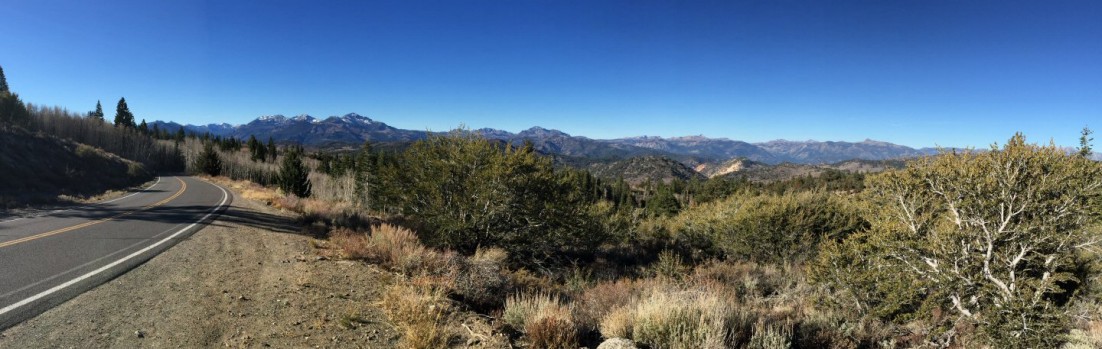
The descent on the east side of the mountains leads down to the high desert, where desolation of this shrubland is interrupted by strings of trees, usually aspens in the canyons and pines elsewhere, following the course of the rivers and streams of the Walker watershed. The sun gathers strength here, but this morning its power would be contested by a layer of cold air that had established a foothold during the night.

River-Side Ice

River-side ice at 26 degrees that morning.

There’s always that time, between emerging from the artificial environmental cocoon of a vehicle and before the cold really starts to bite, that the air temperature never seems that cold. When I pulled alongside likely looking water, it was 26 degrees. I had given serious consideration to the idea it would be chilly, but now worried I hadn’t considered it seriously enough.

So with the thought that I had come too far and retreat wasn’t an option, I began the layering that I hoped would suffice. This was comprised of fleece pants under the waders, a wind-proof wading jacket over a fleece sweatshirt that was on top of my long sleeve shirt, and a well-worn, wide-brim canvas hat. Later I’d realize that my fingerless fishing gloves would have been a welcome addition.

As long as I kept moving, I avoided the long shadows that persisted as the sun hung low along its autumnal path. The water was 58 degrees, at the low end at which trout will be active, so I didn’t linger too long in one spot and moved frequently to cover as much water as possible.

This was an entirely new experience. My breath hung in the air, lingering as puffs of white. Skim ice crunched underfoot. My guides iced up within fifteen minutes. It was cold. So cold that I almost — almost — hoped that wouldn’t have to plunge my hand into the water to unhook a fish.

I would leave this first spot about an hour later, skunked but feeling that for that brief time, more than ever, that I couldn’t escape being part of nature.


1 Comment

being forced to slow down and take the road less stressful

It was shaping up that this week might be the last rain-free week in which I could ride the Honda to work every day. I’d not ridden enough this year and winter was closing in.

My commute is 27 miles, mostly on highway, and the traffic’s generally moving at the speed limit when I’m headed to work. This time of year the mornings are chilly enough to prompt a wish for heated grips but the afternoons usually offer perfect riding weather.

Nearing the off ramp that’d put me on city streets for about a mile before reaching the office, my CB750 started to get a little squirrelly; just enough to convince me to slow down. The last turn before the office required too much effort and I knew from previous experience that the rear tire was losing air. It turned out my year-old rear tire was going flat.

I’d made it to the office and there was nothing that could be done immediately. I’d later learned that it was puncture about the size of a 30-penny nail (that’s pretty big). I called a few shops near the office and tried Fix-a-Flat, but in the end my son — who luckily had the day off — was willing to provide transportation home and pick up the bike the next day.

The response to this event, mine and of those around me, was interesting, particularly when others realized that you usually don’t carry a spare tire on a motorcycle. My calmness in the face of this dilemma surprised me. Perhaps it was the friendless of the people at the local shops, who despite being unable to help me, wished me good luck (in a sincere manner).

Riding a motorcycle is a choice. Hopefully a conscious choice that include being safe. For me a choice that’s been about slowing down and worrying less; taking it slow not only when it’s prudent but also knowing that the places I’m going will probably be there whenever I arrive.


2 Comments

go big(ger) or go fishless

The reality of my fly fishing outings is that more time is spent preparing and getting to the designated spot than is spent in considering the fish I might hook and, hopefully, land. Most of the time, this isn’t an issue. Then there’s the one time of year when it is.

Like most fly fisherman, I have my usual haunts; some more wild, some more convenient. Some of these places require a lot of planning: the scheduling of vacation time, packing the gear and more food than I’ll ever eat, and longish driving times. The more convenient places are usually less an hour away from my base of operation, usually the cabin.

That’s where I was a couple of weeks ago when I set out for Sure Thing Creek. It’s not the most wild stream, but in the fall it’s usually quiet. This time of year most of the fish left in the creek — mostly stocked rainbows — are the smartest, which didn’t fall for less refined presentations of hardware, bait and even flies. (At least that’s what I like to tell myself.) I’m familiar with the general ebb and flow of nature here, which usually dictates nymphs at sunrise then a dry/dropper set up about midmorning, which can give way to decent dry fly fishing about midday.

This day I was alone on the creek, which is actually a small tailwater, and the pattern of fishing was much of the same, though everything was delayed about an hour because of the coolness of fall. I spent most of the morning moving through three prime lies, with an embarrassing number of fish to the net. I switched to a dry/dropper with a #20 Red-Butt Zebra Midge hanging on 6X tippet about 12 inches below a #16 Stimulator with a yellow-green body.

Eventually, the number of strikes on either fly suggested a move downstream to a new pool that had been created over the last year when a tree that used to lean over the stream toppled during the winter and higher flows ate away at the bank previously held in place by its roots. The water cascaded over rocks, bubbles bringing oxygen into the pool, which was now wider and longer, and enticing.

I was pretty confident there’d be fish at the top of the pool, out of sight under the bubbles. A prominent seam about foot off the opposite bank also offered promise. I stood at the edge, and where the water immediately in front of me was about three feet deep and I could see the bottom. I cast about 20 feet to the head of the pool and let the flies drift.

It wasn’t until after I had passed my flies through the pool about half a dozen times that my suspicions were confirmed. The first sign was a strike on the nymph, though my hookset was too slow the fish too quickly spit out the fly. A few more casts offered another chance and with a good hookset, and carefully playing the fish, I had a rainbow trout of about 13 inches to the net.

In that moment, I had it all right: the fly, the cast and the presentation. I cast a few more times. The dry fly stopped. I set.

The rod bent more than it should. The first thought was “snag.”

Then the snag moved; slowly at first, but with purpose. Then the fish shook its head. Not the short, rapid shakes of a smaller fish, but the firm, powerful strokes of something larger. Then it shot upstream. Gentle pressure briefly brought back to the middle of the pool before it torpedoed downstream. More pressure, in the opposite direction, turned it around. We danced this way about four times.

Then it surprised me by charging toward me, angling downstream slightly. Stripping loose line, I regained leverage and applied pressure. Slowly the fish began to swing back upstream, paralleling the pool’s edge at my feet. It was a BIG fish. A salmon-sized trout.

With only a quick look, it could have been described as an Atlantic salmon — big spots on a pale background. Stunned, I didn’t respond fast enough to keep it out of the weeds, where it rolled, leaving about 2 lbs. of vegetation on my leader.

The world seemed to move slower than it should at this point, allowing my brain to process every sensory input. It was likely a big brown from the lake below. And between it and me was a foot of monofilament with a diameter of only five hundredths of an inch.

Maybe those thoughts took too much time to process, or maybe it was the fear that arose after realizing the size of my tippet, but a few second later that fish snapped my line with one big surge.

It was only after recovering from my deep momentary despair that I realized that my fault was not considering that I might meet up with a bruiser brown that day, pushed by the urge to spawn out the lake and into this small creek — even though I had landed a few over the years.

I’m just hoping there’s a next time, and that I’m better prepared.


2 Comments

practicing for retirement

From the start, we knew it’d require a different mindset. Not since our honeymoon 10½ years ago had Karen and I spent more than three or four days at the cabin. Eight days, however, clearly presented an opportunity for adventure; exploration at our own pace.

Potty-Mouth Wine

Potty-Mouth Wine

I did spend a couple of days fishing, but our destinations most days were only decided the evening before and sometimes only that morning. Our internal alarm clocks — or at least mine — meant I was up by oh-dark-thirty every morning, but that left plenty of time for a full breakfast if desired.

More than anything, we wandered; around town (Twain Harte) and through hill and dale. The higher elevations were colored by fall foliage while below 2,000 feet the grass of the oak woodlands was a pale gold.

Our day-long loop through Copperopolis, Angles Camp and Columbia took us through these distinctly different habitats, past the Sierra Conservation Center (aka prison) and over the very low New Melones Reservoir. In all my years in the area, never has New Melones looked less like a lake and more like a canyon than it did last week.

A map won’t tell you that Copperopolis has something of a split personality. The “real” Copperopolis — near Reeds Turnpike — was established in the 1860s and is a bit unique in that it was founded near a copper mine, not gold. But just north, near Hwy 4, is what looks like a Hollywood set plopped down in the middle of nowhere. It reminded me of the town of Lago, in High Plains Drifter; without the red, of course.

The buildings in Copperopolis Town Square tap historical architectural design of the mid and late 1800s, with retail shops and restaurants surrounding a small park with a gazebo, landscaped fountain and flag pole. Allowing for the fact that we were visiting on a Wednesday, during the fall, it was still quite vacant. It’s clearly designed with a pedestrian focus, including park benches, stone masonry walls and faux old-fashioned gas lamp posts. It was a nice enough place for a leisurely walk, with a stop for a root beer float in an old-style ice cream parlor.

The town square is nice enough, but peeking behind the curtain — actually one block off the main street — reveals paved streets complete with sidewalks and lightposts but devoid of homes; just dirt lots. While folks there will tell you Copperopolis Town Square is a phased development, I couldn’t help but wonder if these vacant lots were remnants of the recession. After all, developer Castle & Cooke did break ground on Copperopolis Town Square in April 2006.

Our loosely outlined plan was to stop in Angels Camp and Columbia before returning to the cabin. One suggestion: Don’t visit Angels Camp on a Wednesday; it seems as if half the businesses were closed.

The drive from Angels Camp to Columbia was interrupted, however, by my sudden veering on to Red Hill Road near Vallecito. During the summer I met a young man dispensing tastes at Mammoth Brewing Co. and learned in the course of conversation that his family owned Twisted Oak Winery. He was taking a break from the wine business to learn about beer, and after I mentioned the cabin in Twain Harte, he suggested a stop at the Twisted Oak tasting room in Murphys. I didn’t know the winery was in Vallecito until I saw the sign.

It was clear this was a place where the folks didn’t take themselves too seriously; the posted speed limit on the driveway is 9 mph. One wine label says it all: “*%#&@!” (described as a potty-mouth Rhone-style red blend). It’s a friendly place, and laughter pairs well with wine, so we lingered, bought some wine then headed on down the road.

We covered about 80 miles that day, agreeing to expand the circumference of our exploration the next time we can take the time to slow down.

It became clear we were enjoying ourselves and spending our time wisely when my sister emailed to ask if we had retired and not told her.

Not yet. But it sure was nice to spend a week acting as if we have.


2 Comments

when every leaf is a flower

Big Trees & Fall Color

Big Trees & Fall Color

I, for one, believe the best adventures of childhood were often found in the backyard or within one’s immediate neighborhood. As adults we learn of the wider world, of places that are ancient and historical, mysterious, full of wild lands and animals. It’s true, but a life lived yearning to visit these places can let the wonder right outside our door slip away unnoticed.

It was expected that this week at the cabin would entail local exploration, the type of exploration allowed only by ignoring the clock and following a path chosen in the few moments before our next step.

So it was that Karen and I found ourselves at Calaveras Big Trees State Park, after, of course, stopping along the way to pick up seasonal favorites: apple cider donuts and fresh-pressed cider. I was familiar with the area, which is about an hour away from the cabin, but only as an extension of my search for new fishing waters, namely Beaver Creek and the North Fork of the Stanislaus River. To explain briefly, Calaveras Big Trees was created to preserver two groves of some of the most massive giant sequoia trees. (Not always the tallest, but volumetrically the world’s largest trees.) These are Sequoiadendron giganteum, the inland relative to the perhaps more familiar coast redwood (Sequoia sempervirens.

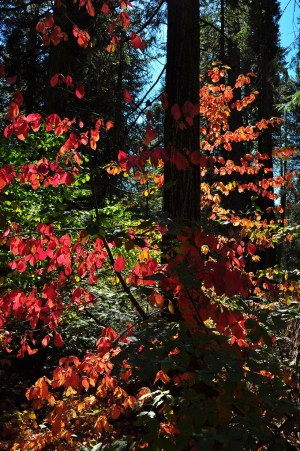
The morning was spend wandering among these enormous trees, looking upward until our neck muscles complained during a hike that covered a few miles. But if the sequoias were the big stars of the show, big leaf maples and dogwoods were the flashy supporting players; this time of year decked out in shades of red, yellow and orange. Their dazzling colors proving that “Autumn is a second spring when every leaf is a flower.”1

Pictures are worth more words than I could possible write, so below is a gallery, a glimpse of what we saw.

1 Albert Camus


2 Comments

the 2013 Eastern Sierra Expeditionary Force, part 3

My last full day in the Eastern Sierra was planned around a mid-afternoon visit to Mammoth Brewing. John — a multi-year attendee of this outing — was keen on the idea, so we planned to spend the morning fishing and the afternoon…um…let’s call it “beering.”

We got an early start driving up Rock Creek Canyon to the Mosquito Flats trailhead, at about 10,000 feet. It was a typically crisp fall morning when we geared up and begin hiking, which for stretches was more akin to climbing. It stopped every once and a while to catch my breath admire the scenery.

Looking downstream (east) as Rock Creek exits Heart Lake.

Looking downstream (east) as Rock Creek exits Heart Lake.

We had no particular goal, so about an hour in we departed the trail and headed to the inlet of Heart Lake, which is about a mile and quarter so up the trail. John dropped down to the trail-side of the inlet; I hiked to the opposite side of the lake. Quite a few years ago I hiked this trial, a bit further, fishing the lakes along the way. That year I caught nothing. I know now that it had been too late in the day.

This early morning, however, there was plenty of interest, particularly if I could cast my orange humpy (dry fly) within a foot or so of the reeds lining the lake. There were spots, near inlets and outlets, where I would land half a dozen brookies, most colored up for the fall spawn. Most would slowly emerge from the depths or from behind a submerge log, and either lunch at my fly or flamboyantly refuse it.

Typical brook trout, one of many, caught in Rock Creek and its lakes.

Typical brook trout, one of many, caught in Rock Creek and its lakes.

We’d fish Rock Creek between two other lakes as we descended with the creek. I’d hook an occasional brown trout and stop often to just enjoy where I was. It was a beautiful day, with an ever-present breeze that kept things cool. The sun would be obscured every once and while by dark clouds; the almost black clouds I’ve only seen in the high country. John’s movement would mirror mine for the most part, though he did have to return to the trail to hike over a huge granite outcropping that prevented his following the edge of one lake.

Throughout the morning we met other folks, mostly hikers with a few fly fishermen among them. There was a noticeable absence of hardware or bait fishermen. While the casting is easy on the lakes, greater stealth was required in the close quarters of the creek. Most of the time I would cast downstream about ten feet, piling up some line to allow for a relatively drag-free drift for another five to ten feet. Any closer and my footfall would spook any unseen fish.

By the time we returned to the trailhead, it was time for lunch. My plan included a quick shower — I was going into town after all — and to meet John in Mammoth. We arrived just about the same time and it was easily decided to share a flight of regular beers as well as one of the seasonals. We had a good time talking with a server who worked the summer at Mammoth Brewing and would be heading back to Murphys (where The Wife and I enjoy the fruits of local winemaking), where he’s help with the grape harvest at his family’s winery. I walked out the door with a growler of Floating Rock Hefeweizen and one of Imperial Root Beer.

Both the beer and root beer (which, to my taste buds, is easily one of the best root beers around) are long gone. The fish have forgotten who I am. This just means I’ll have to return.