Word came from Pleasanton last week that a 13-year-old boy had landed a record 18-pound, 9-ounce largemouth bass at Shadow Cliffs Lake. It seemed too good to believe. Unfortunately, it was.
At Shadow Cliffs, park rangers say several people saw the boy wade into the lake and scoop up a large dead fish. Park officials said they do not acknowledge the fish as a record.
When the story first emerged, the boy said he caught the fish with a lure, that the giant bass did not fight much, and he gave it to a friend to eat. A photo of the fish I was provided showed that its eyes had turned white and its body had a layer of slime, similar to that of a fish that has been dead for some time.
This is yet more proof that, while all people are born honest, by the time they go fishing they usually get over it.
In all fairness, my dad didn’t see it coming. I blame it on the thin air or the simple joy of being outdoors in God’s country.
For more than a few years, my brother, my sister, and I eagerly anticipated a week or more of camping in the Tuolumne Meadows campground. These trips were filled with hiking, fishing, campfires, hiking that was sporadically interrupted by fishing, and that general freedom engendered by nature’s wide-open spaces.
Many hikes started in the campground or nearby, which meant a starting elevation of at least 8,500 feet and often closer to 9,500 feet. Many of the trails were obvious or followed rivers or streams, and were usually marked on the USGS maps dad packed with the space blankets, water, lunches, snacks and other supplies. Some hikes were long and generally flat, others shorter but a bit tougher on the shorter legs of kids. The trail to Lake Elizabeth gained about 1,000 feet in elevation over 4.5 miles. Getting to Gaylor Lakes required rising 600 feet in what seemed like the first mile of the three. (Gaylor Lakes supposedly offered great fishing, but the inhalation of swarms of mosquitoes that rose with every step on the surrounding marshes cut the trip short.)
Lembert Dome — a 900-foot tall mass of granite — towers above the nearby Tuolumne River. From the meadows one can often see tiny people standing on top. Then, one summer, me, my dad, my brother and my sister saddled up and began an ill-fated hike that would take us to the top of the dome on a relatively easy trail, but one that grows steeper as it ascends the backside.
The trail cut through a forest and over a few streams as it traced the lower edge of the dome, then looped toward the back the dome. All the while we gained elevation, but it’s the last fourth of the 2.8 miles that asked the most of our legs. This climb started with a clear demarcation of the alpine zone. Trees became fewer and shorter, some stunted, and soon we stood on granite. Then it got a bit tricky, with some rock scrambling and careful footwork required before we reached the top.
Yes, we made it... (This is the original, unaltered photo. Scroll down for a better colorized version. And where the heck did I get that belt buckle?)
Standing on top of this massive granite dome, where the air seems just slightly thinner, the deep greens of the meadows and trees contrast with a sky of eye-straining blues and snow-capped mountains reaching 11,000 feet or more. We lingered and marveled; maybe a bit too long.
Not exactly the best boots for hiking.
The hike had taken a little bit longer than expected and dad was a tad anxious about getting back to camp dome before dark. From where we stood, the face of the dome didn’t look too steep. It also looked like a shortcut.
We didn’t know that there was a surprising amount of glacial polish and exfoliation, cracks parallel to the surface that develop with expansion and contraction‡. Our Sears Roebuck and Co. boots would have been more at home on a flat construction site and offered limited grip. (You might know these boots; versions are still sold today under the Diehard brand — the ones with white leather crepe sole with a tread best described as small rolling hills.) Baseball-sized rocks and small BBs of decomposed granite tumbled beside us as we picked our way down.
We’d also find out that the stitching and rivets in our jeans didn’t offer much traction. It wasn’t easy to walk down the steep granite, so we controlled much of our descent with the seat of our pants. Literally. We slid on our bums. I think our pants gave up their last threads that day.
We did make it down Lembert Dome that afternoon and my brother and I hiked back to camp with just a bit of bravado. Dad, no doubt, and probably my sister, were relieved.
We were too young to be appropriately terrified worried that day. Now that age has tempered my bravado, when I think about this, I’m suitably scared for that young man. But I’m always glad that he had this adventure.
...and here we are with the color slightly adjusted. (Forgot that Mark was ever so small.)
Us kids looking out from atop Lembert Dome. Not so scary...
My brother, my son, and I made it back in 2011. This time there'd be no sliding down Lembert Dome's face.
† This prompt was issued a few days ago, but nothing immediately think came to mind, which I chalk up to a lack of adventurousness the preparedness taught to me by the Boy Scouts.
‡ There is no general agreement among geologists as to the exact cause of this phenomenon.
I’ll be on the road to the Sacramento edition of the International Sportsmen’s Exposition this morning and, according to forecasts, should be slogging through welcome but heavy rain. Don’t get too excited for me: it’s going to be a bit more like torture.
I’m leaving the checkbook and credit cards at home, carrying only enough cash for lunch.
I’m taking a cheaper simpler approach to the coming year that will be reflected in my fly fishing, though stopping short of tenkara. Last year didn’t go well, fishing wise, and changes on the job this year will bring incessant deadlines and blank pages in need of words. Anyone with a job today should be grateful, and I am, but it’s going to be tough to string together more than a few days off without risking some kind of pre- or post-vacation penalty. Big hopes for 2013 require planning. The fiscal reality is that dollars can stretch only so far. (Yes, I do feel some guilt that I won’t be helping a great deal to lift the fly fishing industry out of its apparent struggles, so it’ll be up to the rest of you this year.)
Much of the change this year can be blamed on my brother. Our conversations of late reminded me that what sticks with us most are the experiences of our life: riding our bikes as kids to the five ‘n dime or hiking the Sierra Nevada high country during family vacations. I don’t think we truly appreciated it at the time. The considerable value we now place on these experiences seemed to swell as our own children grew up.
So my visit to the ISE will be maddening, comprised of gear I won’t buy and guide trips I won’t take. There will be a visit with Derek Young, who I got to know as an unassuming and friendly guy before he was named 2011 Orvis Guide of the Year, some milling about various seminars, and likely encounters with other folks I’ve fished with.
My plans entail simplifying and diversifying. Much of my fishing will be refocused to waters near and not-too-far-from the family cabin in the Sierra foothills, something that’s long overdue. I’ll “make do” with gear I have and spend at least two long weekends there each month of the trout season. (My budget may allow for a very nice net handcrafted by a fly fishing club member and up for auction in April.)
It’ll be more about an exploration; a more mature approach in which satisfaction doesn’t hinge on numbers worth bragging about. There’s too much ground to cover in a single year, but the goal will be to cast flies to waters along the Highway 4 corridor, further up Highway 108, and on new stretches of the various forks of the Stanislaus River. All of those weekends should provide plenty of opportunity to spend more than a few days in the Walker River Basin; it’s only two hours away. There’s only one guide trip on the books (with Derek), and that may be the only one this year.
Dates have also been cleared on the cabin calendar for visits by my brother’s and sister’s families. And it’ll be darn nice if the wife — who recently rediscovered the detachment and contentment that can be found in the foothills — joins me more than a few times.
Diversification will mean revisiting diversions that aren’t enjoyed enough. Acting like tourists in our backyard, something started with our visit to Alcatraz last month. I’ll send the motorcycle seat out for a custom fitting more suited to longer rides. Rides that may or may not include fishing, and some that may include the wife.
You can chalk all of this up to wisdom gained with age, or — like me — simply decide to make the most with what you’ve got while you can.
For Karen’s birthday, we played tourist and visited Alcatraz Island. I’d visited years ago, but this was Karen’s first trip, and we couldn’t have had better weather. I’ll let the pictures tell the story…
It didn’t take long after high winds brought an early end to our adventures on Crowley Lake to decide that it was the perfect afternoon to introduce Willy to the wonderfully willing brook trout in an upper section of Rock Creek, just below the lake.
Caddis on Rock Creek.
It was late when we arrived, but nearly magic hour on this wide spot. In a voice hushed for no other reason than wonderment at the beauty of where we were, I described what to expect. Every pool, tailout, rock and bend prompted a memory of a fish that rose to a fly in the seasons before. Colors grew more vivid as I described the 13-inch wild rainbow that surprised me and my 3 wt. rod during the spring a year ago. Willy headed downstream, I went up.
Fall in the eastern Sierras is a feast for the eyes; the low sun filters through the yellow and orange leaves of the quaking aspens, the evergreens seem to take on a darker hue, and through a bleak and gray winter may be nearing, for now the sky is a brilliant blue.
It’s that time of year when small brook trout flame with spawning colors. Willy, a striped bass fisherman of note who’s landed big fish of many species, broadly smiled while cradling one of these gems in his hand; reminded of how fun and beautiful these trout can be.
The numbers of fish we landed was lost in concentration as we targeted specific fish. I’d started with a dry/dropper combination, but soon opted for only a small humpy, for no other reason than the excitement of surface grabs. I’d end up climbing, literally, upstream, targeting small whirlpools tucked between the rocks. Nearly every one gave up a fish.
This time of year just as colorful as the trees…
With the tops of the tree shadows reaching the far side of the creek, we both ventured upstream, where Willy pulled a few fish out of a plunge pool that offers a small, but textbook example of the effect of currents on the drift of a fly, with almost intimate takes from fish less than three feet away.
Thinking we’d already had too much fun, we found our way back to the road, from which Willy could get a good look at the lake. The plunge pool we’d been fishing was the outlet for the lake, and as if an illustration from any good fly fishing book, signs of rising fish dotted what was in essence the tailout for the lake. This was feeding activity that couldn’t be passed up by any fly fisherman.
The wind, accelerating down the canyon, made casting difficult, at least for me, but we both got flies out far enough and every decent presentation earned at least a strike, and a few rainbows were landed.
It has been a textbook day, and the trout did everything they were supposed to do. It’s the best way to learn.
When you mention stillwater nymphing to a group of fly fishermen, you can’t expect more than a quarter of the group to stick around. Certainly, it’s not for everyone. It just happens that a lake offered my most productive fly fishing day ever entre into the sport.
After the drive over Tioga Pass last month, the plan was for Willy, Bill and me to spend that Wednesday with a guide, learning the specifics and generalities of Crowley Lake. Learn we did. Catching, not so much.
The high water this year had the Los Angeles Department of Water & Power monkeying around with the lake level, which, combined with warmer-than-usual fall weather, led to heavy weed growth. Not only were weeds growing up from the bottom, algae floated on top. We’d be parking the boat over a channel created by McGee Creek in search of a literal window through which we might present our flies.
Doug would be more than our guide that day. He would be teacher and cheerleader. Questions wafted through the air with the midges. Discussions centered around the fly(ies) of the day, casting, adjusting the depth of flies, and reading the fish finder to determine boat position.
Unlike most of my experiences on Crowley, conversations went on uninterrupted. The fish were there. Willy hooked a couple of decent rainbows early in the day, but strikes were few. Bill landed a nice brown later in the day, as did I. Violating the rule about moving away from fish, we did, wetting our lines at Green Banks, near Leighton Springs and Alligator Point, only to end up back at McGee.
That learning was put to the test Thursday, when Willy and I spent the day in his boat, searching for open channels and properly positioning the boat. Eight hook ups, with one beefy brown to the net and three rainbows lost — big fish that jumped and cleared the water by a body length or more — suggested we’d done well.
Willy on a fish…
Day two entailed my learning how to launch a boat on a rather shallow ramp, and soon enough we would be on the way. Unlike the previous morning, a nice breeze rippled the water; perhaps the same breeze that pushed the top-water algae to the opposite side of the lake. It was one of those clear, crisp high Sierra mornings when the mountains seem that much closer.
Willy and I had discussed strategy while slowly cruising through the marina with a probably misguided reliance upon my previous experience — five years worth — at Crowley. We’d end up agreeing to revisit the McGee Creek channel, but with my suggestion, which had no basis in any empirical evidence, that we’d push closer to shore and fish in about 10 feet of water.
A few boats and float tubers were already in the vicinity when we both began to carefully watch the depth finder for the edges of weeds and the telltale dip of the creek channel. We crossed it a few times and when we finally anchored, it had taken longer to get into position a few feet away from the channel (so we could cast to it) than it did to make the run from the marina to our destination. We were set to cast.
I felt a bit of a dorky tingle as I locked forceps to my bottom fly — I’d seen guides do this, but never myself — and lowered it over the gunwale to gauge the depth as which to set my indicator. I nervously cast out to where we hoped to intercept cruising fish; thinking that this was a test that would be graded by the fish we landed, or didn’t.
My big shouldered brown.
As often happens on this lake, it wasn’t too long before Willy’s indicator went subsurface. Once the hook was set (and the fish obviously felt it), a big, beautiful rainbow cleared the water by a body length of at least 18 inches, if not 20, and threw the hook. Willy and I gawked at each other in disbelief. For me it wasn’t so much because Willy didn’t land the fish, but for the simple reason that this fish clearly demonstrated that we, on our own, had done something right.
Willy would hook (and lose) another big rainbow later than morning, and we’d both elicit strikes when raising our rods (and flies) to cast, with one fish hitting Willy’s fly just a few feet from the boat. There were a few other fish for me, including one huge brown…not long, but linebacker big, with shoulders and a head big enough to give me pause before reaching into the net.
It wasn’t the wide-open fishing, or even the hot and heavy fishing, that I’ve previously seen on Crowley. It’s not always a numbers game and the difference this time — a huge difference in fact — was that we did it on our own and that the fish seemed to agree that we did something right.
About a month ago, Willy and I loaded up at his house and left just before 7:00 a.m. and headed east, skipping from one highway to another, toward Toms Place, Calif., the annual fall destination for the club’s Eastern Sierra outing. It’d be my fourth. Along the way we’d be travelling through the Sierra foothills and Yosemite*, stopping at the Crowley Lake Marina for a quagga mussel inspection of Willy’s Bay Ranger.
Over the last eight-plus years I’ve had multiple opportunities to drive Hwy 120, up along scrubland bordering Priest Grade to where the highway becomes Big Oak Flat Road and winds through the sparse foothill woodland surrounding Groveland and much of the roadway, then finally rising into heavier stands of conifers — more correctly a lower montane forest — before the Yosemite entrance station at about 5,000 feet. My past trips encompassed ambitious one-day, 225-mile fishing trips with stops to cast a line at four or five different creeks or rivers as well as motorcycling over Sonora and Tioga passes shortly after opening, when snowdrifts 10-plus feet high line the high-country portions of the road.
It’s a fantastic road trip, to be sure, but on this drive I found that the view was very different from the passenger’s seat of Willy’s Cadillac Escalade.
The motley crew that would comprise the 2011 DVFF Eastern Sierra Trip.
The road welcomed us with limited traffic, and only a few miles of road construction slowed our progress. Anyone who’s driven through Tracy, Manteca and Oakdale — perhaps headed to Two Mile Bar or Goodwin Dam on the Stanislaus River — know that there’s plenty of nothing to look at. It’s here that the road seems to drone on between orchards and field crops, time seems to slow and I’m thankful that the highway is now three lanes through Tracy, once a bottleneck no matter the time of day.
It’s outside of the appropriately named Oakdale that the oak woodland takes hold. The oak trees and an occasional gray pine break up the monotony of the now golden grasses. Then there’s the always subtle shock of the “girls, girls, girls” sign that appears out of nowhere, perched above a rundown hotel and shadowy outbuilding truly in the middle of nowhere, all of which is enclosed by a substantial not-so-ornamental iron fence. That sign is also a landmark signaling the last mile or so before the right turn toward Yosemite.
The history of the Sierra foothills comes to life driving through Big Oak Flat and Groveland in the form of vacant stone buildings adorned with iron shutters and doors that recognize the danger of fire during the hot summers. Jeffery, Yellow and Ponderosa fight for space between buildings. The road here barely allows the passing of two motorhomes, forcing life to slow to a crawl. Not necessarily a bad thing.
As we approached the national park border the density of the forest was more imposing than my long held impression resulting from occasional glances from the driver’s seat. I’d seen these trees before, but details now stood out. A thick green canopy blocks any view of the sky and despite a distinct lack of branches from the ground to a few feet above the average man’s head, there were so many trees that the concentration of trunks cut the range of visibility to a couple hundred yards. As the miles slide by, the undergrowth grows lush.
More than just a stop to hit the restrooms, the Big Oak Flat entrance to Yosemite marks the start of a big change in vegetation and terrain. After another half hour and a left turn toward Tuolumne Meadows, Western Juniper, Red Fir and Lodgepole Pine dominate the view, indicators of the upper montane forest. Meadows of unreal green — in essence nature’s sponges for snowmelt — occasionally come in to view, edged by skunk cabbage and corn lily. In another hour, slabs of granite and collections of boulders begin to replace meadows.
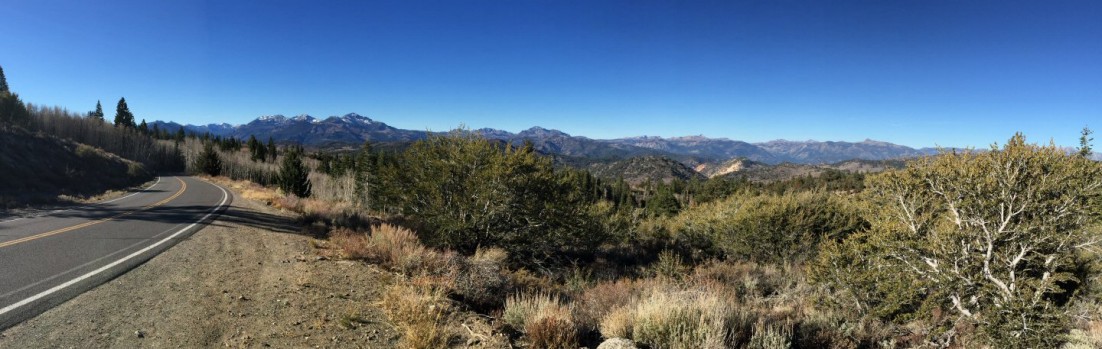
Then, unexpectedly, the view opens up to vast expanses of what I’ve always known as granite and that, in all of my limited travels, seems to be the unique calling card of the Yosemite high country. A less brilliant white, I’d later learn that it’s actually a mix of granitoids and in many cases leans toward granodiorite, which is darker, almost moody and reflective of the changeable weather. It also marks the march into the subalpine forest as one nears 9,000 feet in elevation.
This day was clear and the only distraction was a fuel gauge needle too close to “E” for comfort. Since I tend to measure distance by time instead of mileage, I guessed that the gas station in Tuolumne Meadows would arrive at least a few comfortable miles before the needle was pegged. I grimaced a bit with each incline and hoped I was right.
The East side of the Sierra Nevada mountains. (Photo courtesy Fed Glaser.)
My concerns were alleviated by the sight of the sapphire-blue waters of Tenaya Lake, probably one of the most photographed bodies of water within the borders of Yosemite National Park. The beauty of Tenaya belies the fact that it’s a barren, fishless lake. Thankfully, I knew it was less than 10 miles to the Tuolumne Meadows gas station, one of the few Chevron stations with a mini-store that offers rock climbing equipment for sale and rent. We’d done alright so far. It was 11:00 a.m., putting us on schedule to stop for lunch in Lee Vining.
This time the appearance of Tuolumne Meadows and its namesake river was a far cry from a visit in June with my brother and one son. The river was no longer near flood stage; the water had receded and the meadow was again grass. Lembert Dome loomed above us, sheer peaks watched from the southeast and the now fishable Dana Fork of the Tuolumne River teased us from alongside the road. Soon we reached Tioga Pass station and began a descent that would take us past Tioga and Ellery lakes, and into Lee Vining Canyon.
This 9-mile stretch of road harbors the majority of my childhood memories of family vacations. Scattered about are small meadows dotted with small stands of Lodgepole and other pines, and laced by small streams with small, willing wild brook and brown trout. Tioga Lake recalls a day of crazy fishing, when my sister, brother, dad and I stood on rocks a few feet above the lake casting spinners and watching the (stocked) rainbow trout chase our lures, only to strike at the last minute.
It all changes after Ellery Lake. Sheer rock is the predominate feature. Only small plants and hardy trees cling to crevices. Only on the canyon floor, the eventual destination of Lee Vining Creek after its exit from Ellery Lake, offers any great expanse of green. The Eastern Sierra high desert — a Pinyon pine-Juniper woodland — begins near the canyon floor, offering a stark contrast, beautiful in its own way, to the forest passed through to get there.
We had about 12 more miles to Lee Vining and sat down for lunch on the patio at Bodie Mike’s Barbeque just after noon. With the seasoning that comes with eating out-of-doors, we dug in, enjoying the view toward Mono Lake between bites. It was a quick drive to Crowley Lake Marina to surprise the marina attendant with a bone-dry boat. It took longer to affix the tag than conduct the inspection.
A few minutes later we tucked our stuff into the cabin to find ourselves with more time than expected on our hands. The afternoon sun was still well above the mountains to the west. We were there to fish, so took a short stroll to the nearby Rock Creek to cast a few flies.
Rock Creek isn’t too big, but usually heavily stocked and fished just as much. Willy and I split up. I would find a few rising fish willing to strike my offerings, but the kicker was Willy’s first fish — his first post retirement trout. A not-too-shabby brown trout of about 14 inches.
We spent a bit more time casting to rising fish, next to the opposite shore, of course. A few took our offerings, fewer were landed, but it was good to spend a few hours getting the “skunk” off before dinner.
Looking back, it was a good start to what would be a trip that was great for reasons I didn’t expect.
*Not through Yosemite Valley, however. The road to the valley dead ends near the Happy Isles Visitor Center. Hwy 120 passes the valley and heads through the high country and Tuolumne Meadows, then over Tioga Pass.
Cruising, for most people, invokes images of passengers in deck chairs with umbrellas drinks in hand.
That’s not the case with me. At least not yet.
For me, when in port there’s sightseeing to be done and the bustle that arises from acting every bit the busy tourist.
But one unique aspect about a cruise vacation is that — though already having “wound down” away from everyday life — one can take time to wind down between ports.
That’s what we did the day after leaving Skagway. We were at sea, steaming toward Victoria, B.C. Without conscious thought, we made it somewhat of a quiet day. Almost winning a passenger trivia game in the morning, a leisurely lunch, and time spent in a hot tub with a view astern to the ocean; a quiet pause in the closing days of a superb vacation.
Sunshine greeted us the next morning in Victoria, where what is regularly referred to as “High Tea”* awaited at The Empress Hotel. More accurately, The Empress refers to it as “Afternoon Tea.” To be polite, I’d practiced the proper pinkie curl.
Gwendolyn’s little finger would be curled under and away from the heat of the cup which might otherwise inflict a burn on her delicate skin. The little finger would never be arched upward. Arching would be deemed a sign of extreme arrogance. Should you know of moments extreme enough to demand an arched pinkie, contact us immediately.
— from The Importance of Being Earnest, by Oscar Wilde
There was a remarkable consistency to the extraordinary knowledge imparted by tour guides and bus drivers we met during this trip, and our driver in Victoria was no exception. He filled our nearly hour-long drive to, in and around the city with history, trivia and pop culture references. Soon enough we disembarked in front of the impressive Empress Hotel.
Above the commoners' side entrance to the Empress Hotel.
The 103-year-old hotel near Victoria’s waterfront can’t be missed, and there’s a story that for many years it did not have sign out front because of local sentiment that anyone who didn’t know it was The Empress shouldn’t be staying there. It is an imposing structure that’s hosted kings and queens and a fair share of celebrities.
Wondering if we weren’t worthy of a public arrival, we entered through a side door to find the Tea Lobby. With everyone seated on sofas upholstered with richly patterned chintz or in wing back chairs, our hostess set about placing tiered stands stacked with traditional tea sandwiches, pastries and cakes. Our starter was a bowl of big, tasty blueberries, certainly not an everyday occurrence for me, but something I could get accustomed to. Our cups were filled with The Empress’ tea (a blend of teas from Kenya, Tanzania, South India, Assam, Sri Lanka and China), and though I’m not a big tea drinker, it was tasty (and fun—how often does one get to say “I’ll take two lumps” without ending up with a headache?).
I don’t pretend to be a gourmand but found great pleasure in the tea sandwiches and cakes served at The Empress. Even the cucumber and watercress sandwiches were good. My personal favorite was the smoked salmon and cream cheese sandwich. Our gastronomic climb up the stand found a second tier filled with some of the best-ever fresh scones and preserves, and ended with the top tier’s assortment of light pastries. It was all good, but I was left wondering how such dainty sandwiches and pastries could be so filling.
We’d have another day at sea before arriving home, and there’d be whales, porpoises, and a special dessert courtesy our maître’d. But Victoria was the last big “hurrah” for me on this fantastic trip.
A last sunset at sea…
*It’s interesting to note that what’s often referred to as “High Tea” (in the U.S. at least) may in fact be “Low Tea” or “Afternoon Tea”, and I’ll bet that most of my six readers didn’t know that there were two types of “Tea.” Gleaning the Internet will tell one that High Tea ttraditionally was a working-class meal served on a high table at the end of the workday and comprised of heavy dishes (such as steak and kidney pie, pickled salmon, crumpets, onion cakes, etc.). Afternoon Tea or High Tea was more of an elite social gathering with assorted snacks and tea. But in the end, who’d really want to go to “Low Tea?”
My parents celebrated their fiftieth wedding anniversary last weekend. They didn’t want a big bash, but wanted the family to get together. And, for the first time in quite a few years, we gathered, with my wife and I, and my sister and her family, flying from San Francisco to Seattle-Tacoma International. Being short on vacation time it was a quick trip for us, flying up Friday and leaving Sunday.
The reason we all gathered in Duvall, Wash.
It was the type of low-key celebration that is more common in my immediate family (except, maybe, for my brother). It started Saturday morning at mom and dad’s house with a get-what-you-want breakfast. There was a lot of catching up and joking around. The nephews got reacquainted.
About mid morning, dad presented mom with an anniversary gift; a communal effort that brought together a heartfelt quotation chosen by dad with a cross-stitch put together by my wife, with the matting and framing coordinated by me. Yes, tears glistened in mom’s eyes, and dad’s voice crackled during his presentation.
That afternoon, in typical Konoske fashion and joined by my wife’s parents, we continued the celebration with a hearty “main meal.” (I’d call it either late lunch or early dinner, as the rest of the family well knows by now.)
At Sunday morning mass, mom and dad’s marriage was blessed at Holy Innocents Catholic Church, with the family in attendance. It was nice, and like our parents, low key. After mass and before some of us had to leave, we enjoyed too much breakfast at Duvall Grill.
But I do think I heard something about mom being up for sainthood.
Below is a slide show of photos from the weekend, or you can visit the album here.


 fishing for words