fishing for words

(and tossing out random thoughts)


2 Comments

practicing for retirement

From the start, we knew it’d require a different mindset. Not since our honeymoon 10½ years ago had Karen and I spent more than three or four days at the cabin. Eight days, however, clearly presented an opportunity for adventure; exploration at our own pace.

Potty-Mouth Wine

Potty-Mouth Wine

I did spend a couple of days fishing, but our destinations most days were only decided the evening before and sometimes only that morning. Our internal alarm clocks — or at least mine — meant I was up by oh-dark-thirty every morning, but that left plenty of time for a full breakfast if desired.

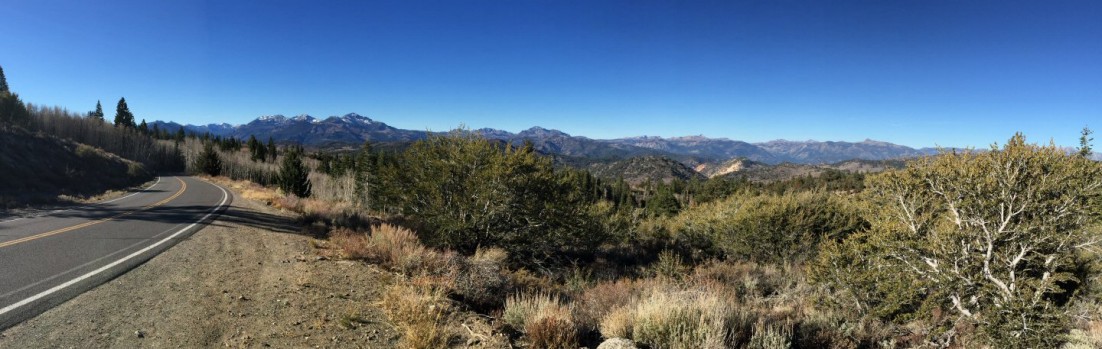
More than anything, we wandered; around town (Twain Harte) and through hill and dale. The higher elevations were colored by fall foliage while below 2,000 feet the grass of the oak woodlands was a pale gold.

Our day-long loop through Copperopolis, Angles Camp and Columbia took us through these distinctly different habitats, past the Sierra Conservation Center (aka prison) and over the very low New Melones Reservoir. In all my years in the area, never has New Melones looked less like a lake and more like a canyon than it did last week.

A map won’t tell you that Copperopolis has something of a split personality. The “real” Copperopolis — near Reeds Turnpike — was established in the 1860s and is a bit unique in that it was founded near a copper mine, not gold. But just north, near Hwy 4, is what looks like a Hollywood set plopped down in the middle of nowhere. It reminded me of the town of Lago, in High Plains Drifter; without the red, of course.

The buildings in Copperopolis Town Square tap historical architectural design of the mid and late 1800s, with retail shops and restaurants surrounding a small park with a gazebo, landscaped fountain and flag pole. Allowing for the fact that we were visiting on a Wednesday, during the fall, it was still quite vacant. It’s clearly designed with a pedestrian focus, including park benches, stone masonry walls and faux old-fashioned gas lamp posts. It was a nice enough place for a leisurely walk, with a stop for a root beer float in an old-style ice cream parlor.

The town square is nice enough, but peeking behind the curtain — actually one block off the main street — reveals paved streets complete with sidewalks and lightposts but devoid of homes; just dirt lots. While folks there will tell you Copperopolis Town Square is a phased development, I couldn’t help but wonder if these vacant lots were remnants of the recession. After all, developer Castle & Cooke did break ground on Copperopolis Town Square in April 2006.

Our loosely outlined plan was to stop in Angels Camp and Columbia before returning to the cabin. One suggestion: Don’t visit Angels Camp on a Wednesday; it seems as if half the businesses were closed.

The drive from Angels Camp to Columbia was interrupted, however, by my sudden veering on to Red Hill Road near Vallecito. During the summer I met a young man dispensing tastes at Mammoth Brewing Co. and learned in the course of conversation that his family owned Twisted Oak Winery. He was taking a break from the wine business to learn about beer, and after I mentioned the cabin in Twain Harte, he suggested a stop at the Twisted Oak tasting room in Murphys. I didn’t know the winery was in Vallecito until I saw the sign.

It was clear this was a place where the folks didn’t take themselves too seriously; the posted speed limit on the driveway is 9 mph. One wine label says it all: “*%#&@!” (described as a potty-mouth Rhone-style red blend). It’s a friendly place, and laughter pairs well with wine, so we lingered, bought some wine then headed on down the road.

We covered about 80 miles that day, agreeing to expand the circumference of our exploration the next time we can take the time to slow down.

It became clear we were enjoying ourselves and spending our time wisely when my sister emailed to ask if we had retired and not told her.

Not yet. But it sure was nice to spend a week acting as if we have.

2 Comments

when every leaf is a flower

Big Trees & Fall Color

Big Trees & Fall Color

I, for one, believe the best adventures of childhood were often found in the backyard or within one’s immediate neighborhood. As adults we learn of the wider world, of places that are ancient and historical, mysterious, full of wild lands and animals. It’s true, but a life lived yearning to visit these places can let the wonder right outside our door slip away unnoticed.

It was expected that this week at the cabin would entail local exploration, the type of exploration allowed only by ignoring the clock and following a path chosen in the few moments before our next step.

So it was that Karen and I found ourselves at Calaveras Big Trees State Park, after, of course, stopping along the way to pick up seasonal favorites: apple cider donuts and fresh-pressed cider. I was familiar with the area, which is about an hour away from the cabin, but only as an extension of my search for new fishing waters, namely Beaver Creek and the North Fork of the Stanislaus River. To explain briefly, Calaveras Big Trees was created to preserver two groves of some of the most massive giant sequoia trees. (Not always the tallest, but volumetrically the world’s largest trees.) These are Sequoiadendron giganteum, the inland relative to the perhaps more familiar coast redwood (Sequoia sempervirens.

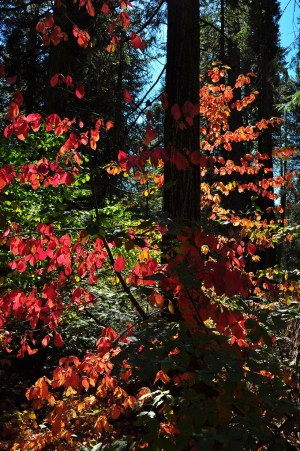
The morning was spend wandering among these enormous trees, looking upward until our neck muscles complained during a hike that covered a few miles. But if the sequoias were the big stars of the show, big leaf maples and dogwoods were the flashy supporting players; this time of year decked out in shades of red, yellow and orange. Their dazzling colors proving that “Autumn is a second spring when every leaf is a flower.”1

Pictures are worth more words than I could possible write, so below is a gallery, a glimpse of what we saw.

1 Albert Camus


Leave a comment

don’t know what to expect this trip

It’s been a bad year for water in California. The April opener was one of the best in years thanks to low water levels.

Next week we’ll see for ourselves what Eastern Sierra rivers and lakes look like four months later.

One guide recently referred to Bridgeport Reservoir as a “pond.” Bridgeport is so low that its outflow into the East Walker River has been tainted by algae — algae that usually floats closer to the surface of the reservoir — and now the river is regularly off color and weedier than usual. Lake Sabrina in the Bishop area is so low that the front (manmade) lake no longer exists. The level of Crowley Lake is better than might be expected, but low enough to concentrate fish in the deepest areas.

The route taken by myself and guys from the club will be dictated by the Rim Fire. Hwy 120 remains closed. An expectation that the fire might not be fully contained until Sept. 20 doesn’t lend any clarity as to when it might open.

That’s not a big issue for me. I usually head over Sonora Pass via Hwy 108, with stops at the West Walker River, Little Walker River or Molybdenite Creek.

Thankfully, there will be water to fish when we settle in at Tom’s Place Resort (which certainly isn’t the resort you might think it is). The Upper Owens is supposed to be in good shape. The Middle Owens is flowing at an unseasonably high level. I may head to the high country, visiting alpine lakes and streams where I hope the fish are already preparing for a long winter.

However it works out, there will be lies told over beer and good grub.


7 Comments

first time fly fishing with the wife (or, rolling the dice on being out-fished)

I never pushed fly fishing on my wife, but she’s always supported my pursuit of the sport and listens attentively to accounts of all my adventures. She usually believes the fish are as big as I say.

Then, a few months ago she took me by surprise, asking if I would show her how to cast a fly rod. I’ve had welcome opportunities over the years to help teach, or at least acquaint, a few folks with fly fishing. In addition to assisting with the club’s novice class, it could be said I didn’t teach too many bad habits to my brother and my son, both of whom went on to have some success.

After an involuntary thought that “those who can, do, but shouldn’t necessarily teach,” I agreed to take my wife out for some casting. Good weather offered an opportunity and we spent just under an hour going through the basic motions.

A few weeks later, during a discussion of our weekends, I reminded her that I’d be teaching the novice class on an upcoming Saturday. She asked if there might be room. There was, and soon she had reserved a spot. She learned a lot and suffered through some frustration.

It is nice to have someone to take a photo.

Sure is nice to have someone along to get photographic evidence.

We’d be at the cabin a week after the class, and while a friend would be with us and side trips were planned, it was expected that I’d slip away to chase a few trout. Although we packed extra rods, reels and my spare waders and wading boots, it wasn’t until we stopped at Bass Pro and purchased a license for my wife did the reality sink in that she actually might join me.

Firmly believing that the best way to hook someone on fly fishing is to get into a fish on a fly rod, our destination the next morning was a stocked stream not too far from the cabin. We test-fit the waders at home and knew they would work well enough. My wife set up the rod and reel on her own, we clipped on our wading staffs and headed to the stream. I think it was after a dozen steps or so that my wife began referring to my old wading boots as “clown shoes.” (Admittedly, they were a bit big, but did the job that day.)

My wife doesn’t much like water — it’s for drinking and bathing and that’s about it — but she didn’t flinch much when we began wading. While waders provide a barrier between the wearer and the wetness of the water, one still “feels” the water. I reassured her that in water this cold, after a bit of time, she’d be too numb to notice.

Just before the first strike...

Just before the first strike…

This is a stream best nymphed, with limited dry fly action some afternoons. Offering a running commentary on what I was doing, I rigged up two standard nymphs below an indicator. I explained and demonstrated where to cast (and hooked a fish in the process), and talked about how the trout would be looking for a close approximation of a real insect drifting near a current seam.

The morning was sprinkled with encouragement and advice. My wife’s casting, more like lobbing under the tree limbs above, improved. Her patience was impressive. After the first take of the day, it was more than an hour before a second bump. She wasn’t the only one casting to ghosts. I could count my strikes on one hand.

About midmorning we shifted downstream about 10 feet. The fish in this stream, though raised in a hatchery, move throughout the day, typically following the movement of the shadows. Close to noon, there’s more sunlight than shadows on the water, forcing any trout in the area into a narrow and definable seam. Downstream, I switched to a dry/dropper setup and was sight casting to a decent looking fish. Good placement and presentation earned a solid strike, and I landed my second and last fish of the day. Photo taken and trout released, the focus returned to getting the wife on a fish.

There’s no telling what changed — the temperament of the fish, the depth or general presentation of the flies — but suddenly my wife could lay out a cast, manage the line and fool a fish. A trout was hooked on the second or third strike, offered a dramatic leap and was gone. In between a few more strikes we worked on line management and talked about setting the hook. A few more strikes were missed.

Karen's First Fly Fish

Getting the “hero shot” took some dedication with an uncooperative, slippery fish. But she did it.

Then it all came together.

It was good to get excited about a fish on the line, even if it wasn’t my line. Limiting my advice to keeping the rod tip up and letting out line when the fish demanded it, I set my rod down and carefully moved downstream of the missus. I calmly instructed her to bring the fish head first into the net. For one heart-stopping moment the 12-inch rainbow would have flopped out were it not for my cat-like ninja reflexes luck.

Yes, my wife did receive a proper fly fishing baptism, falling into the water a few times. (No water over the waders and nothing broken.) Tangles were minimal and, amazingly, not one fly was lost the entire day. I do worry, however, that had she hooked (and landed) all the fish that hit her flies, she would have out-fished me.

Ask my wife why she stepped up to try fly fishing and you’ll get some sentimental nonsense that it’s another way to spend time with her husband. That day, in a cool stream away from everyday worries, after landing a trout, she told me of a new understanding of why I enjoy fly fishing.

While we’re not running out to buy her new gear, I’m now optimistic that there’s a greater chance of fly fishing any suspect water we pass during our travels.


3 Comments

on becoming one of those guys

Opening day of the general trout season in California is this Saturday.

But I won’t be on the water. I will instead sacrifice the first opportunity to be skunked on my favorite stream for the greater good. (Very Vulcan of me, right?)

The first two years after I picked up a fly rod — some seven years ago — I would start preparing for the new trout opener a few weeks after the closing of the previous season.

I do still care about the trout opener. It opens wading access on the west slope of the Sierra usually long before the passes to the eastside are cleared. Being on the water at the earliest legal minute had become tradition. Even back when I was throwing hardware, it wasn’t about filling the freezer; it was simply about being out there, working the rust out of skills unused during the winter. Four seasons ago I accepted the invite of a fellow forum contributor to join him opening day in chasing down backcountry trout. He would provide the four-wheel drive truck, I provided flies. It was a day filled with good friendship, great weather and beautiful country unseen by most. Unfortunately, any trout that may have been in the half dozen streams we visited remained unseen.

The biggest influence in my changed opening day perspective is also one of the bigger rewards that have come with fly fishing. Notwithstanding the excitement of a big Eagle Lake rainbow taking me into my backing, I’ve find an unquantifiable pleasure in helping bring others into the sport. My contributions to the club’s novice fly fishing class aren’t huge, but the enthusiasm imparted by the instructors, including myself visibly, sparks something in the students. The payoff often comes a few weeks or months later, when one of those students, all smiles, presents a photo of the fish caught because of something learned in class.

So, while I’m not retired, but I’ve become one of those guys for whom the trout opener only marks the point in time that most trout water is wide open to fishing. I’m lucky enough to have a place in the Sierra foothills available to me most any time, and I have grown content to head up the week after the opener, often to find welcome solitude on most rivers and streams. I have also taken to the challenge of finding the ‘smarter’ fish left behind after the crowds of opening day.

When I finally do make that first cast for trout this year, it’ll be later, but for good reason.


2 Comments

(relatively) word-free Friday

Since pictures are worth a thousand words, and it would take many thousands to tell of the adventure and fun enjoyed last week with my brother’s family, below is a gallery of photos that tell the story than I could. The days were filled with swimming at the local lake, visiting a historic gold rush town and panning for gold, more fun — swimming, sliding, diving, building sand castles — at the lake, hiking, mini golf and a trip to Yosemite. Enjoy!

Due to loading issues, the gallery has been moved here.


6 Comments

the excuse for no post

My brother and I were here…

A Skykomish River Tribtutary

Mid morning on a Skykomish River tribtutary, with lots of fishy water.

…fishing…

Brother fish a tributary of the Skykomish.

My brother fishing…

…with Kirk “Unaccomplished Angler” Werner and Orvis guide Derek Young, for this…

Wild Rainbow on Skykomish Tributary

Healthy wild rainbow, who was right where he should have been.


3 Comments

how to know you’ve taught a son well (and he’s thinking, “When I left you I was but the learner. Now I am the master.”)

We knew the weekend warriors were gone. We also knew they’d have hit hard a creek that’s always fun in terms of catching. Our plan was to find all the fish too smart for everyone else.

As we geared up that morning, the count favored Sean, and I trailed by a considerable margin but refused to bring up the excuse that I had relied on a dry fly for much of the previous day while he took the easy way out used nymphs.

We go to this creek when we want to catch something, enjoying our tax (and licensing) dollars at work. The rainbow trout stocked here are generally of the Eagle Lake strain, a hard fighting fish that often entertains with acrobatics. Fishing here stacks the deck if you’re measuring success by the number of fish caught. I’ll admit to also enjoying the look of astonishment on the faces of other fishermen, the ones not using flies, when in 15 minutes Sean or I pull out three fish to their one. So, please, shelve any debate about “missing the point,” this is a place of pure fun.

As we walked down to the creek, it was clear that we’d have it to ourselves. Sean headed upstream. We’d both be nymphing — I’ve not known stocked trout to look up much — and this section offered plenty of deeper runs and pools. It didn’t take long for either of us to hook up.

With the intensive fishing over Opening Day weekend, I expected the catching to be a bit slower. I wasn’t disappointed. With a bit of work and a change to a favorite red chironomid, I regularly elicited strikes, particularly with a slow lift at the end of a drift. Catching had slowed for Sean, so he headed downstream to a fast run.

[singlepic id=1199 w=300 h=225 float=right]

Sean's first big Opening Day trout.

Though a bit later I saw Sean’s rod go “bendo,” I knew the water he was fishing was fast and a fish of nearly any size would have an advantage in the current. I had no worries. Over the years during the too infrequent trips with me, Sean has become a better fly fisherman, enough to venture out on his own last year to find success on some streams in Yosemite’s high country. (There’s some fondness in my memory of a Reno telephone number showing up on my caller ID, only to find it was Sean resorting to a pay phone to call me with the news that he had landed his first wild brown on a fly.) After I saw him bend down with the net, I refocused on my fishing.

In the meantime, Sean had started upstream, and when I finally looked up, even at a distance I could see that the fish on his stringer wasn’t a cookie cutter stocker. With a grin to match, he held up a rainbow that measured an honest 18 inches. After the obligatory photo, he headed back downstream.

As often happens, I became lost in the fishing. Testing every edge and riffle, rewarded with strikes where expected and others that came as a total surprise. A bait fisherman took a seat on the opposite bank, asked about the fishing, then, after telling him it had slowed down, I landed three decent fish in less than ten casts.

Sean had returned while I was distracted. Suspiciously happy, he announced that he decided that first fish wasn’t big enough and hoisted up a 20-incher that had been added to the stringer.

[singlepic id=1200 w=600 h=800 float=left]

Sean with a fine mess o' trout.

If our little father-son competition was to be measured by inches, those last two fish would put Sean over the top.

However, we weren’t measuring in inches, and my count had long ago surpassed Sean’s. Nevertheless, this was probably Sean’s best Opening Day. Ever.


[nggallery id=83]


4 Comments

ignored fish can be the best (or, how to not to spend opening day elbow to elbow with other fishermen)

If we were counting — and my son and I certainly don’t — we were both winners this delayed Opening Day weekend.

Mostly, it was great just to get outdoors and chase trout once again. And get out we did, and away from any crowds.

Eleven miles out, to be exact. R. Creek is a tiny thing, a small stream I am sure is barely given any notice by the few folks crossing the small stone bridge. We’d certainly have never taken note of it, much less visited, were it not for two older fishermen who took a liking to our catch-and-release ethic and, in a quiet whisper, described this crick full of small wild and willing rainbows.

We made to R. Creek sometime after eight o’clock. It was one of those so-called ‘bluebird days’ of a California spring, when everything is still green. Just as expected and hoped, we were the only ones on the creek.

The water was running a bit high, but it still looked about as inviting as a small creek can be. A few casts in the usual spots suggested that like the fish, we’d have to adjust to the higher flow if there was to be any catching.

We headed upstream, testing each pocket, pool and riffle. Sean was nymphing. It was a dry/dropper combination for me; a size 20 Parachute Adams trailing a similarly sized Flashback Pheasant Tail.

A bit of strategic thinking is required when it comes to accessing this creek through thick stands of pine, oaks and streamside blackberry bushes. Felt-soled wading boots don’t help and my elbow can attest to the lack of traction afforded on a mat of pine needles and oak leaves.

Then I found it. That picture perfect bend, with a half sunken log offering shade and shelter to a small pod of trout. It was a deeper pool than usual on this creek, about three feet deep. My first cast revealed that depth wasn’t an issue when a six-inch rainbow rocketed from the depths to grab the Parachute Adams.

[singlepic id=1196 w=600 h=450 float=left]

R. Creek rainbow on a dry. Beauty!

Now, I’m still very much in touch with my inner caveman when it comes to fishing — I like to catch — and will use what works. But when a dry fly works, there truly is nothing like an aggressive take on the surface, regardless of the size of fish.

I had landed a beautiful ten incher and missed a few more strikes by the time Sean found me. We let the pool rest and ventured upstream. We would return later and we both hooked a couple of fish.

As happens with days during which the fishing and catching are good, time lost meaning and any argument to leave quickly fell away amid furtive glances to promising water. We decided to venture downstream into unexplored territory. Dismissed two years ago as a fool’s errand, it was clear we were mistaken. The shallow braided water soon regained the manner of a proper stream offering countless possibilities.

Sticking with the dry/dropper combo — it was too much fun to not try a dry — I found a long run of riffles that again offered the shelter of a fallen log. Shadows darted after my fly as it rushed downstream. There was no false casting here, just a quick whip to get the fly back upstream.

Sean and I would leapfrog one another as we explored further downstream. Sean would end up landing more fish, but I daresay that I was one who had the most fun. R. Creek is becoming a favorite place.

We fished another creek, learning after the fact but evidenced by our catching, that it had been hit hard, legally and otherwise, on and perhaps before Opening Day. A detour on the way home secured some half growlers from Snowshoe Brewing Co.

It was a good day. And the next day would be even better for Sean.

[nggallery id=83]


3 Comments

gear that won’t be bought, trips that won’t be taken

I’ll be on the road to the Sacramento edition of the International Sportsmen’s Exposition this morning and, according to forecasts, should be slogging through welcome but heavy rain. Don’t get too excited for me: it’s going to be a bit more like torture.

I’m leaving the checkbook and credit cards at home, carrying only enough cash for lunch.

I’m taking a cheaper simpler approach to the coming year that will be reflected in my fly fishing, though stopping short of tenkara. Last year didn’t go well, fishing wise, and changes on the job this year will bring incessant deadlines and blank pages in need of words. Anyone with a job today should be grateful, and I am, but it’s going to be tough to string together more than a few days off without risking some kind of pre- or post-vacation penalty. Big hopes for 2013 require planning. The fiscal reality is that dollars can stretch only so far. (Yes, I do feel some guilt that I won’t be helping a great deal to lift the fly fishing industry out of its apparent struggles, so it’ll be up to the rest of you this year.)

Much of the change this year can be blamed on my brother. Our conversations of late reminded me that what sticks with us most are the experiences of our life: riding our bikes as kids to the five ‘n dime or hiking the Sierra Nevada high country during family vacations. I don’t think we truly appreciated it at the time. The considerable value we now place on these experiences seemed to swell as our own children grew up.

So my visit to the ISE will be maddening, comprised of gear I won’t buy and guide trips I won’t take. There will be a visit with Derek Young, who I got to know as an unassuming and friendly guy before he was named 2011 Orvis Guide of the Year, some milling about various seminars, and likely encounters with other folks I’ve fished with.

My plans entail simplifying and diversifying. Much of my fishing will be refocused to waters near and not-too-far-from the family cabin in the Sierra foothills, something that’s long overdue. I’ll “make do” with gear I have and spend at least two long weekends there each month of the trout season. (My budget may allow for a very nice net handcrafted by a fly fishing club member and up for auction in April.)

It’ll be more about an exploration; a more mature approach in which satisfaction doesn’t hinge on numbers worth bragging about. There’s too much ground to cover in a single year, but the goal will be to cast flies to waters along the Highway 4 corridor, further up Highway 108, and on new stretches of the various forks of the Stanislaus River. All of those weekends should provide plenty of opportunity to spend more than a few days in the Walker River Basin; it’s only two hours away. There’s only one guide trip on the books (with Derek), and that may be the only one this year.

Dates have also been cleared on the cabin calendar for visits by my brother’s and sister’s families. And it’ll be darn nice if the wife — who recently rediscovered the detachment and contentment that can be found in the foothills — joins me more than a few times.

Diversification will mean revisiting diversions that aren’t enjoyed enough. Acting like tourists in our backyard, something started with our visit to Alcatraz last month. I’ll send the motorcycle seat out for a custom fitting more suited to longer rides. Rides that may or may not include fishing, and some that may include the wife.

You can chalk all of this up to wisdom gained with age, or — like me — simply decide to make the most with what you’ve got while you can.