fishing for words

(and tossing out random thoughts)


2 Comments

fishing, learning and getting graded by trout

When you mention stillwater nymphing to a group of fly fishermen, you can’t expect more than a quarter of the group to stick around. Certainly, it’s not for everyone. It just happens that a lake offered my most productive fly fishing day ever entre into the sport.

After the drive over Tioga Pass last month, the plan was for Willy, Bill and me to spend that Wednesday with a guide, learning the specifics and generalities of Crowley Lake. Learn we did. Catching, not so much.

The high water this year had the Los Angeles Department of Water & Power monkeying around with the lake level, which, combined with warmer-than-usual fall weather, led to heavy weed growth. Not only were weeds growing up from the bottom, algae floated on top. We’d be parking the boat over a channel created by McGee Creek in search of a literal window through which we might present our flies.

Doug would be more than our guide that day. He would be teacher and cheerleader. Questions wafted through the air with the midges. Discussions centered around the fly(ies) of the day, casting, adjusting the depth of flies, and reading the fish finder to determine boat position.

Unlike most of my experiences on Crowley, conversations went on uninterrupted. The fish were there. Willy hooked a couple of decent rainbows early in the day, but strikes were few. Bill landed a nice brown later in the day, as did I. Violating the rule about moving away from fish, we did, wetting our lines at Green Banks, near Leighton Springs and Alligator Point, only to end up back at McGee.

That learning was put to the test Thursday, when Willy and I spent the day in his boat, searching for open channels and properly positioning the boat. Eight hook ups, with one beefy brown to the net and three rainbows lost — big fish that jumped and cleared the water by a body length or more — suggested we’d done well.

Willy on a fish…

Day two entailed my learning how to launch a boat on a rather shallow ramp, and soon enough we would be on the way. Unlike the previous morning, a nice breeze rippled the water; perhaps the same breeze that pushed the top-water algae to the opposite side of the lake. It was one of those clear, crisp high Sierra mornings when the mountains seem that much closer.

Willy and I had discussed strategy while slowly cruising through the marina with a probably misguided reliance upon my previous experience — five years worth — at Crowley. We’d end up agreeing to revisit the McGee Creek channel, but with my suggestion, which had no basis in any empirical evidence, that we’d push closer to shore and fish in about 10 feet of water.

A few boats and float tubers were already in the vicinity when we both began to carefully watch the depth finder for the edges of weeds and the telltale dip of the creek channel. We crossed it a few times and when we finally anchored, it had taken longer to get into position a few feet away from the channel (so we could cast to it) than it did to make the run from the marina to our destination. We were set to cast.

I felt a bit of a dorky tingle as I locked forceps to my bottom fly — I’d seen guides do this, but never myself — and lowered it over the gunwale to gauge the depth as which to set my indicator. I nervously cast out to where we hoped to intercept cruising fish; thinking that this was a test that would be graded by the fish we landed, or didn’t.

My big shouldered brown.

As often happens on this lake, it wasn’t too long before Willy’s indicator went subsurface. Once the hook was set (and the fish obviously felt it), a big, beautiful rainbow cleared the water by a body length of at least 18 inches, if not 20, and threw the hook. Willy and I gawked at each other in disbelief. For me it wasn’t so much because Willy didn’t land the fish, but for the simple reason that this fish clearly demonstrated that we, on our own, had done something right.

Willy would hook (and lose) another big rainbow later than morning, and we’d both elicit strikes when raising our rods (and flies) to cast, with one fish hitting Willy’s fly just a few feet from the boat. There were a few other fish for me, including one huge brown…not long, but linebacker big, with shoulders and a head big enough to give me pause before reaching into the net.

It wasn’t the wide-open fishing, or even the hot and heavy fishing, that I’ve previously seen on Crowley. It’s not always a numbers game and the difference this time — a huge difference in fact — was that we did it on our own and that the fish seemed to agree that we did something right.


3 Comments

the view’s better from the passenger seat

It seems that I don’t drive distracted.

About a month ago, Willy and I loaded up at his house and left just before 7:00 a.m. and headed east, skipping from one highway to another, toward Toms Place, Calif., the annual fall destination for the club’s Eastern Sierra outing. It’d be my fourth. Along the way we’d be travelling through the Sierra foothills and Yosemite*, stopping at the Crowley Lake Marina for a quagga mussel inspection of Willy’s Bay Ranger.

Over the last eight-plus years I’ve had multiple opportunities to drive Hwy 120, up along scrubland bordering Priest Grade to where the highway becomes Big Oak Flat Road and winds through the sparse foothill woodland surrounding Groveland and much of the roadway, then finally rising into heavier stands of conifers — more correctly a lower montane forest — before the Yosemite entrance station at about 5,000 feet. My past trips encompassed ambitious one-day, 225-mile fishing trips with stops to cast a line at four or five different creeks or rivers as well as motorcycling over Sonora and Tioga passes shortly after opening, when snowdrifts 10-plus feet high line the high-country portions of the road.

It’s a fantastic road trip, to be sure, but on this drive I found that the view was very different from the passenger’s seat of Willy’s Cadillac Escalade.

The motley crew that would comprise the 2011 DVFF Eastern Sierra Trip.

The road welcomed us with limited traffic, and only a few miles of road construction slowed our progress. Anyone who’s driven through Tracy, Manteca and Oakdale — perhaps headed to Two Mile Bar or Goodwin Dam on the Stanislaus River — know that there’s plenty of nothing to look at. It’s here that the road seems to drone on between orchards and field crops, time seems to slow and I’m thankful that the highway is now three lanes through Tracy, once a bottleneck no matter the time of day.

It’s outside of the appropriately named Oakdale that the oak woodland takes hold. The oak trees and an occasional gray pine break up the monotony of the now golden grasses. Then there’s the always subtle shock of the “girls, girls, girls” sign that appears out of nowhere, perched above a rundown hotel and shadowy outbuilding truly in the middle of nowhere, all of which is enclosed by a substantial not-so-ornamental iron fence. That sign is also a landmark signaling the last mile or so before the right turn toward Yosemite.

The history of the Sierra foothills comes to life driving through Big Oak Flat and Groveland in the form of vacant stone buildings adorned with iron shutters and doors that recognize the danger of fire during the hot summers. Jeffery, Yellow and Ponderosa fight for space between buildings. The road here barely allows the passing of two motorhomes, forcing life to slow to a crawl. Not necessarily a bad thing.

As we approached the national park border the density of the forest was more imposing than my long held impression resulting from occasional glances from the driver’s seat. I’d seen these trees before, but details now stood out. A thick green canopy blocks any view of the sky and despite a distinct lack of branches from the ground to a few feet above the average man’s head, there were so many trees that the concentration of trunks cut the range of visibility to a couple hundred yards. As the miles slide by, the undergrowth grows lush.

More than just a stop to hit the restrooms, the Big Oak Flat entrance to Yosemite marks the start of a big change in vegetation and terrain. After another half hour and a left turn toward Tuolumne Meadows, Western Juniper, Red Fir and Lodgepole Pine dominate the view, indicators of the upper montane forest. Meadows of unreal green — in essence nature’s sponges for snowmelt — occasionally come in to view, edged by skunk cabbage and corn lily. In another hour, slabs of granite and collections of boulders begin to replace meadows.

Then, unexpectedly, the view opens up to vast expanses of what I’ve always known as granite and that, in all of my limited travels, seems to be the unique calling card of the Yosemite high country. A less brilliant white, I’d later learn that it’s actually a mix of granitoids and in many cases leans toward granodiorite, which is darker, almost moody and reflective of the changeable weather. It also marks the march into the subalpine forest as one nears 9,000 feet in elevation.

This day was clear and the only distraction was a fuel gauge needle too close to “E” for comfort. Since I tend to measure distance by time instead of mileage, I guessed that the gas station in Tuolumne Meadows would arrive at least a few comfortable miles before the needle was pegged. I grimaced a bit with each incline and hoped I was right.

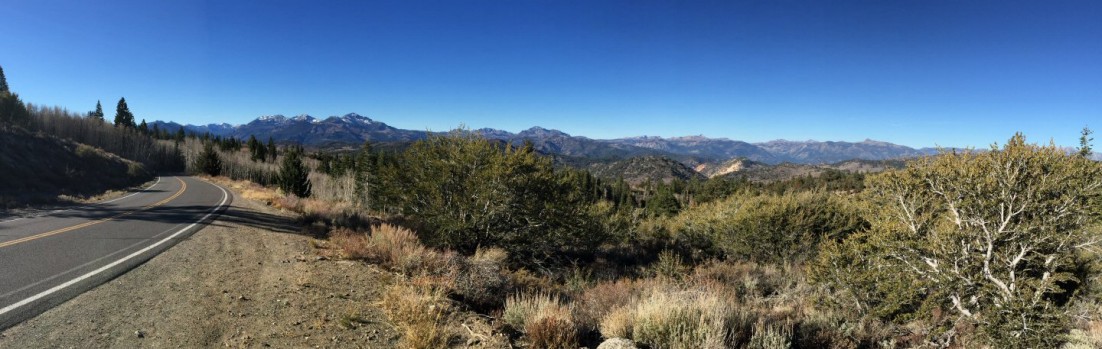
The East side of the Sierra Nevada mountains. (Photo courtesy Fed Glaser.)

My concerns were alleviated by the sight of the sapphire-blue waters of Tenaya Lake, probably one of the most photographed bodies of water within the borders of Yosemite National Park. The beauty of Tenaya belies the fact that it’s a barren, fishless lake. Thankfully, I knew it was less than 10 miles to the Tuolumne Meadows gas station, one of the few Chevron stations with a mini-store that offers rock climbing equipment for sale and rent. We’d done alright so far. It was 11:00 a.m., putting us on schedule to stop for lunch in Lee Vining.

This time the appearance of Tuolumne Meadows and its namesake river was a far cry from a visit in June with my brother and one son. The river was no longer near flood stage; the water had receded and the meadow was again grass. Lembert Dome loomed above us, sheer peaks watched from the southeast and the now fishable Dana Fork of the Tuolumne River teased us from alongside the road. Soon we reached Tioga Pass station and began a descent that would take us past Tioga and Ellery lakes, and into Lee Vining Canyon.

This 9-mile stretch of road harbors the majority of my childhood memories of family vacations. Scattered about are small meadows dotted with small stands of Lodgepole and other pines, and laced by small streams with small, willing wild brook and brown trout. Tioga Lake recalls a day of crazy fishing, when my sister, brother, dad and I stood on rocks a few feet above the lake casting spinners and watching the (stocked) rainbow trout chase our lures, only to strike at the last minute.

It all changes after Ellery Lake. Sheer rock is the predominate feature. Only small plants and hardy trees cling to crevices. Only on the canyon floor, the eventual destination of Lee Vining Creek after its exit from Ellery Lake, offers any great expanse of green. The Eastern Sierra high desert — a Pinyon pine-Juniper woodland — begins near the canyon floor, offering a stark contrast, beautiful in its own way, to the forest passed through to get there.

We had about 12 more miles to Lee Vining and sat down for lunch on the patio at Bodie Mike’s Barbeque just after noon. With the seasoning that comes with eating out-of-doors, we dug in, enjoying the view toward Mono Lake between bites. It was a quick drive to Crowley Lake Marina to surprise the marina attendant with a bone-dry boat. It took longer to affix the tag than conduct the inspection.

A few minutes later we tucked our stuff into the cabin to find ourselves with more time than expected on our hands. The afternoon sun was still well above the mountains to the west. We were there to fish, so took a short stroll to the nearby Rock Creek to cast a few flies.

Rock Creek isn’t too big, but usually heavily stocked and fished just as much. Willy and I split up. I would find a few rising fish willing to strike my offerings, but the kicker was Willy’s first fish — his first post retirement trout. A not-too-shabby brown trout of about 14 inches.

We spent a bit more time casting to rising fish, next to the opposite shore, of course. A few took our offerings, fewer were landed, but it was good to spend a few hours getting the “skunk” off before dinner.

Looking back, it was a good start to what would be a trip that was great for reasons I didn’t expect.


*Not through Yosemite Valley, however. The road to the valley dead ends near the Happy Isles Visitor Center. Hwy 120 passes the valley and heads through the high country and Tuolumne Meadows, then over Tioga Pass.


4 Comments

photo prompt: Ketchikan, a bug, a brother’s visit on granite dome and a couple of sunsets

This post brought to you by the photo prompt
Goodbye Summer…” from the Outdoor Blogger Network (OBN)

It had seemed that summer slipped away, but in these photos is found evidence of time well spent…

At the Top of Lembert Dome

Me, my brother Mark & son Sean a the top of Lembert Dome. (After Mark and I rested for half an hour just a few minutes.)

Promise in the early morning over Ketchikan, Alaska.

Caddis on leaf over Rock Creek, Calif.

Sun Setting west of Juneau, Alaska, above Douglas Island.

Sunset somewhere off the coast of Canada.


2 Comments

cruising Alaska, part two: Ketchikan and surprise

I was reminded of my childhood when the ship began to dock the third morning of our Alaskan cruise. Years ago my sister and brother and I, still sleeping, would be packed into the car, and we’d wake us up numerous miles down the road. This time it was our captain announcing the successful mooring of the ship and clearance to disembark passengers.

Early morning over Ketchikan, Alaska.

Ketchikan greeted us with sunshine and colorful waterfront shops. The rest of the town huddled between mountains and the sea. Our half-day shore excursion would take us to visit the Deer Mountain Tribal Hatchery and Eagle Center, the nearby Totem Heritage Center, the Saxman Village and the Southeast Alaska Discovery Center.

Though it’s no secret that Ketchikan, as well as Juneau and Skagway, owes much of its financial survival to tourism, our guide/driver that morning exemplified the tourist-friendly attitude that would greet us during all of our on-shore travels.

The collection area for salmon returning to the Deer Mountain Tribal Hatchery.

The Deer Mountain Tribal Hatchery and Eagle Center is within a relatively easy walk east of the dock. Our guide walked us through a town park to the entrance of center, next to a creek in which numerous pink salmon milled about. We were greeted by a docent and resident owl, and entered the eagle habitat. To be honest, I was hoping for something, well, a bit more. However, it did offer an up close look at two of these amazing birds, which haven’t been released into the wild due to injuries. A creek running through the small habitat allows them to hunt spawning salmon.

The Deer Mountain Tribal Hatchery is just as small in keeping with its mission to ensure the survival of various salmon species rather than supply fish for a fishery. Its operation was well described by the docent, though the distraction of big salmon in a holding pen interfered with my hearing everything she had to say.

Perhaps more remarkable was the Tlingit and Haida totems, moved from islands throughout the Inside Passage and now housed a short walk away in the Totem Heritage Center. The unrestored appearance of the totems housed in the center — each 100-plus years old — lend a sense of history. Small, surrounding exhibits cover Tlingit and Haida history and traditions.

Totem in Saxman Village on a nice sunny Alaskan day.

We next visited Saxman Village, a tour highlighted by a carving demonstration and nearby totems. Of note is the Seward Shame totem built to shame the former U.S. Secretary of State for not repaying a Potlatch (a gift-giving festival) to the Tlingit people. While the color red is used to indicate shame, indicating stinginess, red also figures prominently on the nearby pole built out of respect for Abraham Lincoln* and commemorating the U.S. Revenue Cutter Lincoln in its role in helping two rival Tlingit clans establish peace.

Back in downtown Ketchikan, we were dropped off at the U.S. Forest Service’s Southeast Alaska Discovery Center. Worth a visit, the Discovery Center offers displays and information covering a wide swath of the area’s natural and human history, and might have offered a better starting point.

Lunch in Alaska is simple for me: various versions of halibut fish and chips, this time in view of Ketchikan’s Thomas Basin Harbor, at the south end of town.

We’d been warned that all three of our ports of call had been invaded by jewelers who typically started their businesses in other, more tropical cruise ship destinations. My wife, in fact, already wanted to look at a particular ring.

We oohed and ahhed along while strolling diamond row, picking up a few of the compulsory t-shirts along the way. Our last stop was to see “The Ring.”

I hadn’t been warned about the sales folks. They are smooth and slick. It all starts with an innocent question: “What do you think the price is?” Let’s just say it was too much, even with the initial offer of a discount, but it must have been apparent — in our eyes or maybe our body language — that we had no plans to buy. Another substantial discount raised my eyebrow.

Carver at work in Saxman Village. (A totem carved by a master carver can cost up to $4000 per linear foot.)

I’m terrible at picking out jewelry and recently began an early search for a suitable ring for our 10th anniversary, which is not too far off. I was having a heck of a time. But again, I went into a defensive huddle with my wife, shaking my head with such exaggeration that another offer was made. Earrings were thrown into the deal. The sales manager stepped up with calculator in hand. I’d even go so far as to say we had the original salesman sweating, just a bit. Another huddle, another offer, the incorporation of sales tax into the offered price, and a deal was struck.

I was hoping to see ice in Alaska, and I thought it would be in a glacier, but regardless of the profit earned on the sale, we walked back to the ship feeling we’d done okay.


* This one is different from the Lincoln Totem in the Alaska State Museum.

A photo slideshow, already playing. (I’ve added photos since last posting the album):

https://picasaweb.google.com/s/c/bin/slideshow.swf

(You can directly access the Picasa album, with captions, by clicking here.)


2 Comments

cruising to Alaska, part one: getting up steam

There are a few notable things about taking a cruise that make me feel good: massages, a disconnection from everyday demands and the fact that it’s relatively certain I’ll be part of the younger crowd. Lump in the fact that your hotel room is hauled from port to port while that someone else does the driving, often while you’re asleep, and it’s a pretty sweet deal.

Fueling this allure of cruising is the old-school mode of conveyance, a reminder of less hurried days. The big ships today don’t move any faster than their counterparts of the early 1900s.*

One has to step away from the food, onboard boutiques, entertainment and the Internet café to truly experience this timelessness of travel by ship. My wife and I found ourselves relatively undisturbed during a long, afternoon walk on a lower deck, much of that time watching the ship’s prop wash disappear over the horizon.

Leaving San Francisco Bay

We embarked in San Francisco after a short ride from home, courtesy of the in-laws. One overriding factor in choosing this longer cruise — my dear wife will tell you I wasn’t initially convinced it was worth the extra cost — was that it didn’t require violation screening by the TSA or limits on luggage…we could’ve have taken a ferry across the bay, then walked from the San Francisco Ferry Building to the cruise terminal.

Checked in and familiar with our stateroom’s location on Aloha Deck (11), we familiarized ourselves with the ship courtesy a scavenger hunt. It was helpful to my waistline that our stateroom’s location would require going up or down at least two and often four or five flights of stairs to reach most destinations.

The weather was fantastic for our departure; a bluebird sky, sunshine and wisps of clouds over the bay…at least until we got to the Golden Gate Bridge. Very little of the bridge was visible, but no matter how little of the bridge we saw, it was from a unique perspective. With the ship headed out to an overcast sea, we unpacked, settled in and prepared for dinner. My wife was most excited that evening to receive her Princess Patter, the ship newsletter, which offers a list of shipboard activity the next day and a column written by various ship’s crew.

Our first two days would be at sea, something that’d be unremarkable without knowing that I’ve been prone to seasickness. While Sea Princess — with a length of 856 feet, beam 106 feet and gross tonnage of 77,000 tons — is big ship, 11-foot swells can give a slight pitch to the deck. My apprehension faded away the morning of the second day, when I seemed to have gotten my sea legs. Even so, I still find it a bit disconcerting to jump on a treadmill in the morning to see the sea go by in a direction perpendicular to the direction you’re walking.

That second day I planned to meet with the maître d’hôtel in the morning regarding our dining arrangements. Our original reservations provided for anytime/flexible dining, but before embarking we had requested a switch to traditional dining. The first evening we were reminded that anytime dining really isn’t that flexible, not being served until well after 6:30 p.m. Apparently I made the maître d happy. My request to change to traditional dining came without caveats and with a willingness to share a table with others. Yes, my wife and I dine well with others.

We filled that second day visiting the gym, learning the ship’s layout, confirming spa appointments and attending seminars; some informative, others part of the up-selling that comes with cruising.

During a visit to the cabin in the late afternoon it was learned that I’d be wearing long pants to dinner. We had been moved to the first seating (5:30 p.m.) in the traditional dining room. We didn’t know that fate had a surprise in store.

Sunset somewhere along the California coast…

We were seated at our table, with room for six, before anyone else. Eventually, a couple sat down with their daughter and son-in-law, and introductions commenced. Shortly, however, it grew clear that they had expected another daughter and her husband to occupy the seats now filled by us. Speculation that the daughter hadn’t been able to get her dining assignment changed was soon rendered moot when she appeared, revealing that she did secure a change to traditional dining but hadn’t been able to get an assignment to their table. With a little push from my wife and I, and agreement from the head waiter, the daughter accepted our offer to switch table assignments.

We were presented to our new tablemates, among whom, as luck would have it, was a gentleman my wife had come to know on cruisecritic.com. It quickly became clear we’d all get along when John commented that had he seen us coming, he’d have said “no” to new tablemates. We’d end up spending every dinner and many evenings with John and his wife Connie, and Gene and his wife Maydean.

Our third night was a special occasion: it was the first time in years I’d worn long pants, much less a suit formal night. Adhering to tradition, it was suit and tie for the men, a dress or nice pant suit for the women. Well, some of the men and some of the women. There was a mix of attire, with tuxedoes at the top, plenty of suits, a smattering of polo shirts and khakis, and others who just should’ve order room service in. (This is one of those times that I tend to show my age, expecting that honoring a tradition means making a real effort.)

That was also the evening that we began an eight-night tradition of evening entertainment courtesy of cabaret singer/pianist Sammy Goldstein.

With an excellent start to this cruise, I was looking forward to our first stop: Ketchikan, Alaska.


* There was a contest among ocean liners to capture the trans-Atlantic speed record that led to a top speed of 43 knots (held by the SS United States), but the line is now blurred between ocean liners and cruise ships, and most maintain a cruising speed closer to 20 knots. The only ship comparable to an ocean liner of yore is Cunard Line’s Queen Mary 2, which has a top speed of 30 knots but typically cruises at 20 to 26 knots.


Leave a comment

north to Alaska…

It’s not that we’re abandoning the six regular readers out there, but three-hundred and fifty-nine days have passed since plans were laid and, finally, we’ll be cruising to Alaska just about 14 hours from now. There’s no fishing in the plans, but that’s not to say it won’t come to pass. (The Wife’s never put the kibosh on fishing and is even encouraging I do so this trip.) Regardless, there will be thoughts of fishing…in the suitcase is what’s needed to tie the flies I lose in trees use most.

It’s been a crushing week lining up the ducks. Everything’s been done that could be done at work, and whatever’s undone at home will be left that way.

Relativity being a real thing, the next 10 days will likely fly by. And human nature being what it is, I’m selfishly looking upon this as an extension of the birthday that crept up on me today. (Feel free to send any fly fishing gear, a Ferrari or cash.)

It’s not that I’m truly selfish and don’t appreciate those who spend a few seconds minutes stopping by, but don’t expect much in the coming week and a half. It’s just that there’s no guarantee that there’ll be a connection to the Interwebs or willingness to step away from the buffet or bar long enough to write.

I do promise to wave from under the Golden Gate.


Leave a comment

a milestone and 10,000 miles wiser

By the time you read this it’ll be official. I’ll have ridden 10,000 miles on two wheels.

There are those who’ll say I was getting in front of a possible midlife crisis with the purchase of my first motorcycle just about four and a half years ago. I’d disagree. The idea of riding has bounced around my brain since riding a friend’s off-road bike, so long ago as a kid.

Like fly fishing, riding was one of those things that looked fun, but something I never truly could envision myself doing. And like fly fishing, choosing to ride any particular day influences planning, gear and even the pace.

To be clear, in both cases I favor a slower pace.

This pace was reflected in the process that led me to motorcycling, starting with a Motorcycle Safety Foundation class, just to see if I might possess the skills to ride and to determine — taking into account the possibility of dropping someone else’s motorcycle — whether it still offered the enjoyment I remembered from years ago.

I’d be remiss to not give credit to my wife, who works in the healthcare field and often used the term “donor-cycle,” for supporting my desire to at least try motorcycling. Even knowing that my dad had a decidedly unpleasant motorcycling accident that led to his not riding, I went ahead with registration for the class — with my oldest son joining me — with no particular plan to purchase a motorcycle. That’s not to say I didn’t have thoughts about something in the Honda CB series… Sean and I both passed the class with flying colors and by early December 2007 our driver’s licenses carried an M1 endorsement.

[singlepic id=297 w=368 h=275 float=center]

The first bike.

Though I had no immediate plan buy a motorcycle, the universe had something else in mind. Only four weeks after getting my M1 endorsement I became the owner of a venerable 1982 Honda CB650SC with about 8,000 miles on it. Now owned by my son, this vintage Nighthawk gently taught me the basics. It was a great starter bike; easy and fun to ride. It also taught me that two-wheeled transportation, while giving one a true appreciation for highway speeds, can make one feel more connected to the world. Maybe it’s the safety-conscious swiveling of my head, but I seem to see more when riding.

I definitely feel more when riding. My commute is about 30 miles one way on a state highway that passes through reclaimed marshland of the San Pablo Bay National Wildlife Refuge, farmland and by a cattle ranch, all the time skirting the upper edge of San Francisco Bay. (Technically it’s San Pablo Bay.) Despite protective riding gear, the microclimates are readily apparent. When the weather’s warmer, the water of the marshes retain enough heat to create a “banana belt” that makes my early morning ride more comfortable. But once I drop over a small ridge, heading closer to the coast, the air temperature invariably drops 5 to 10 degrees.

Over a year and a half with the 650, I learned basic repairs, added a vintage luggage rack, overcame a fear of riding in the rain and took a good number of local trips.

[singlepic id=890 w=368 h=275 float=center]

Two bikes, two fly rods, two reels and an extra gallon of gas.

It was sad to see that first bike go, but nice to know it’d still be in the family. Even more exciting was the fact that on July 24, 2009, I took possession of a motorcycle that through its production years (1992-2003) had been my favorite: the Honda CB750F/Nighthawk 750. Mine’s from ’97 and had less than 4,000 miles on it when purchased. It’s now fitted with a windscreen, luggage and risers. I like it and its average of nearly 50 mpg.

Sean and I took our first long motorcycle trip after I bought the 750, heading over familiar roads and fly fishing along the way.

So here I am, 10,000 miles later. Yes, there have been two close calls, both due to inattentive drivers. (And yes, my wife knows about them.) I’m thankful that whomever is watching over me is doing so and I’ve learned to ride within my limits. I’ve come to grudgingly accept that the buffer I put between myself and the car in front of me is often instead seen by “cagers” (car drivers) as an opportunity.

Those who know me know I take care of my vehicles. But the motorcycle is unlike the cars. Once and a while I find myself simply staring at the motorcycle, an old-school symbol of freedom, still not fully believing I own and regularly ride one.


Leave a comment

fantastic images of wonderful places to fish

It’s certainly better to be there in person, but these time-lapse images of great places illustrate why one can love the Sierra Nevadas…


Eastern Sierra Time Lapse HD from Jeff Chen Kuo Chih on Vimeo.


Eastern Sierra Time Lapse 2 from Jeff Chen Kuo Chih on Vimeo.


Eastern Sierra Time Lapse 3 | Milky Way | Via Lactea from Jeff Chen Kuo Chih on Vimeo.


7 Comments

the younger brother’s first fly fishing experience (and when “it’s not all about the fishing” becomes a truism)

Teaching fly fishing requires enthusiasm. Teaching it well requires a bit more. A little curiosity helps.

It was my brother who provided the curiosity. Not openly, but in that tone of voice we’ve all heard before.

We were discussing ideas for his first visit to California in eight years and our trip to, up and over the Sierra Nevadas. “I’d be willing to try fly fishing if you have some gear I could use,” he said over the phone.

I’d thought plenty about offering such an opportunity but hadn’t mentioned it. Everyone has a story about how they were introduced to the sport. Mine surely isn’t unique, but it did imbue me with a belief that a curious mind opens the door to the best first fly fishing experience.

Along with the gear, I’d bring considerable enthusiasm. (It’d help to understand that my sister’s family has given me the nickname of “The Herring Merchant.”*)

That’s how Mark, Sean and I found ourselves on “Hatchery Creek,” not too far away from the cabin, just as sunlight touched the top of the hills. With borrowed waders, boots and a wading staff but minus an overloaded vest, Mark looked just about as silly as I. (It’s a tenant of fly fishing that fish don’t care how one looks.)

[singlepic id=1188 w=325 h=244 float=center]

Mark on a fish.

This creek tucks against a hillside and, controlled by a powerhouse, is nearly always fishable regardless of spring runoff. Though near a main highway, it’s sheltered by heavily treed banks, and — except for the occasional burps of a Jake brake — the outside world is easily left behind. Though the outcome of our day had yet to be determined, the absence of other fisherman was a welcome sign.

After gearing up and giving a primer on the creek, I led Mark toward one of my favorite runs. It’s the same piece of water on which I educated both sons as to the nuances of hydrology. On the surface it looks fast, and most would call it too fast for fish. The most obvious (and dependable) spot for trout here is near the far bank, where the water’s velocity is slowed by friction. Perhaps because of constant shadows and the lack of light, it’s difficult to see the nearer telltale seams that suggest hidden trout. As both sons learned years ago, a little bit of patience and a passable drift in the proper location will surprise you. It’s also a great spot to swing a fly at the end of the drift.

We were rigged up with nymphs under an indicator. It was too early for dry flies, and to my knowledge this creek is devoid of any real insect hatches, with only occasional dry fly takes in the afternoon.

There’s nothing more conducive to learning than doing, and my strategy was simple: talk, walk, fish and hope that Mark would get into at least one fish while doing so. I would take on the role of guide. I’d assemble leaders, tie knots and select flies. It would be Mark’s “job” to focus on hooking and landing a fish.

It Ain’t Pretty, But Works

For those who haven’t fly fished, casting nymphs (often heavier, underwater flies) with an indicator (yeah, like a bobber) is an inelegant affair. In this case it was more of a lobbing action. After a bit of discussion about this technique and a quick demonstration, Mark made his first casts. Occasionally I’d offer a bit of advice. The suggestion of a casting target that’d offer a better drift into a good trout lie. A recommendation to keep a tight line between the rod to the indicator, then a gentle admonishment to keep an eye on the indictor for any movement that didn’t seem “normal.” A description of the slight lift the rod should be given at the end of every drift.

It was that last piece of advice that gave Mark his first surprise. He’d made a good drift with no takers. Toward the end of the run, the rod tip was raised, the movement of the indicator slowed, and the flies below rose toward the water’s surface, as an emerging insect might do.

That’s how Mark hooked his first trout on a fly rod. Just as quickly as it was on, it was off.

It didn’t matter that we didn’t land that fish. It’s the confidence and faith that washed over Mark’s face that mattered. His big brother wasn’t just blowing smoke. An unseen fish had risen to take a fly presented just as he had advised. Without any encouragement from me, the training wheels were off.

Heading upstream, Mark stopped at a suspect pool while I ventured toward a stretch where riffles tumbled into a long, deep run that abutted a boulder, which in turn created a pool that offered a long tailout. Sean had fished the area earlier, but had since headed downstream.

When Mark moved to the pool behind that boulder, just below me, I futilely tried to keep an eye on my indicator as well as Mark’s. I needn’t have. Before I knew it Mark had set the hook. Encouraging him to keep the rod tip up, a bend in the rod and to allow the fish to tired ever so slightly, I dropped set aside my rod, grabbed my net, and headed downstream.

Mark was broadly smiling as the rod tipped danced. Not an acrobatic fish, it splashed enough to put on a bit of a show. Soon Mark turned its head and we had a decent trout in the net.

[singlepic id=1189 w=480 h=640 float=center]

Mark and his first fly rod fish.


Mark waded over for the obligatory fish photo. Excitement shifted to quiet contemplation. We talked of wetting hands before handing trout, the ease of removing a barbless hook, and keeping the fish in the water until all were ready for the photo. Photo taken, we let it rest in the net. It was a remarkably clean, deep bellied and heavily dotted hatchery rainbow trout measuring an honest 13 inches; a admirable first fly rod fish.

It quickly recovered and, as discussed, Mark softly cradled the trout as I lowered the lip of the net. Often, it seems to me that time slows in the minute or so before a trout finally swings its tail and darts for the familiar safety of deeper water. I never asked Mark if he felt that same sensation, but the look on his face confirmed that he had discovered the magic of catch and release fishing.

The Lesson Learned

At that moment I got it. A curtain parted ever so slightly, giving me privileged insight into why fly fishing guides, those who truly enjoy what they do, do what they do.

More could be written about that day. About the other fish that Mark stalked, hooked and landed, and his amazement that he could do so while hardware and bait fishermen struggled for even a single fish. About Mark’s discovery of trout in places he previously might have dismissed as holding fish. About a simple enjoyment in finding that sharing of one’s love of fly fishing can spark the beginnings of such a passion in another.

But looking above, there’s not much else to worth writing about Mark’s first fly fishing experience and how it rekindled in me renewed appreciation for the little things, beyond the fishing, that bring such joy to the sport.


* From “the Valve: A Literary Organ” blog —

[In the movie “Love and Death”] Boris is in love with Sonja, but she is unhappily married to Voskovec the Herring Merchant (“his mentality,” she complains, “has reduced all the beauty of the world to a small pickled fish“). She takes lovers. (“She takes uppers?” Boris repeats, incredulous, when he hears this news). Voskovec, preparing his pistols to fight a duel in defence of his wife’s honour, accidentally shoots himself. Sonja goes to his deathbed in the company of a couple of doctors. In what is, I think, my favourite exchange in all film, Sonja talks to the expiring man…Here’s the tender deathbed scene:

SONJA: You were a kind and loving husband. Generous and always considerate. (To doctors) What’s he got? About eight minutes?

DOCTOR: (consulting his watch) I think I’m slow. He’s got about three.

VOSKOVEC: Swimming out! Swimming out to the open sea like the great … wild … herring! [Dies]


(You can find more photos here under “The Brother’s Visit – Tuolumne Meadows, Eastern Sierra, First Time Fly Fishing”.)


6 Comments

making man time and acting like boys

I’ve no way of checking, but I’m pretty sure hell’s frozen over.

After eight years since his last appearance in the Golden State, my brother showed up with no specific plans. That’s where I stepped in as travel agent, outfitter and guide; apparently a role that suits me better than might be expected.

Lembert Dome

Lembert Dome viewed from the Tuolumne Meadows Campground, and where we'd be going.

A visit to the cabin is akin to establishing a base camp. In our case, a base camp stocked with beef jerky, beer and an XBox. One might be inclined to think it was something like a “man cave,” but there’s an irony to my brother and I spending quality man time together. Those who’ve been in the proximity when we get together know that we quickly prove the adage that you can’t take the boy out of the man.

Mark lives in the Evergraygreen state and while he said he’d enjoy seeing California family members, it became clear that he perhaps more happy to see the sun. I swung by the airport to him pick up Wednesday evening and we met up with my oldest son, Sean, at the Bass Pro Shop in Manteca. We secured a two-day nonresident fishing license, grabbed dinner and headed up the hill.

Weather-wise, we’d hit it right. Temperatures had peaked that day and would be still warm but slightly lower the next few days, meaning it would cool off at night; something important for a good night’s sleep in a cabin that has no insulation and no air conditioning.

Before Mark or Sean posts a comment below, I will admit that I was adamant that I would I had expected to wake up and hit the road for Tuolumne Meadows early the next morning. I did wake up at 5:00 a.m. But I rolled over and caught a few more winks.

Mark had asked if we might be able to hike up Lembert Dome. He and I had done so back when we were boys, with my sister and dad. It’s a pretty easy drive from the cabin to Tuolumne Meadows, just about 2½ hours. Since Tioga Pass had opened the week before, we would circle our way back over Sonora Pass.

Olmstead Point Marmot

Mark's friend, the Marmot, at Olmstead Point.

It’s been said many times before, but the blue of the sky is remarkable at higher altitudes, and we weren’t disappointed. With only a few clouds in the sky, we passed through the entrance station and soon arrived at Olmstead Point. Reinforcing that he boy stills lives within the man, Mark was all about seeing and getting photos of the marmots of our childhood at Olmstead. A few marmots obliged.

We next stopped at the Tuolumne Meadows Campground, where we spent many a family vacation camping. Sure, some things have changed — mostly manmade things — but nearly everything was recognizable and Mark and I soon agreed upon the location of “our” campsite, partially based on its position relative to the Tuolumne River, which itself was nearly unrecognizably high. I’m sure Sean was somewhat amused by our reminiscing.

Just down the road we pulled into the parking lot at the Lembert Dome trailhead and loaded up. The trail begins with a modest incline, but starting at about 8,600 feet and rising another 800 feet to the dome’s summit, it was soon clear that our lungs would get the kind of workout not seen in years. The gradient seemed to increase every 100 feet, and even if we were on the trail (we weren’t), it would be covered by extensive snow fields that made the hiking more difficult. At one point, Mark fell through the snow into a waist-high air pocket. Undaunted but pausing more often that we’d care to admit to catch our breath, we pressed on. I’m sure it took a lot of patience for Sean to not charge ahead. (I don’t think he broke a sweat or even breathed hard.)

It’s said that the memory grows hazy over time and Mark and I didn’t remember the last stretch up the back of Lembert Dome being so steep or requiring so much climbing. But climb we did, reaching the top. The view was made a tad more incredible by the fact that we had it to ourselves.

At the Top of Lembert Dome

Me, Mark & Sean a the top of Lembert Dome. (After Mark and I rested for half an hour just a few minutes.)

It was hoped that we’d also find some water to fish. Without much browbeating Mark had asked if he might get a chance to try fly fishing, and I had plenty of gear he could use. We rigged up and flogged the no-so-high-but-higher-than-usual Lee Vining Creek. It was tough going. I was the only one to get two strikes, but missed both fish.

We refueled our egos with some good barbecue at Bodie Mike’s, then headed north to Bridgeport, and I pointed out all of the water that we might have fished. Every single river was the color Yoo-Hoo.

Traveling creates memories, and traversing the Sierra Nevada Mountains can make for some of the most vivid memories. Then there are other things that one doesn’t soon forget.

Our return to the cabin meant a few preparations for the next day, when we’d get out on “Hatchery Creek,” hoping to get Mark into his first trout on a fly rod. Mark looked to verify that his fish license was in his wallet. It was. His driver’s license wasn’t. He searched through my car. Sean looked through his car. I looked around the cabin. Mark began to go through his suitcase. After thinking about it a bit, I called Bass Pro Shop. The customer service rep went through the lost and found, looking for a Washington license with the appropriate name and a goofy looking photo.

Soon we were making the 1½-hour drive back to Manteca. Only a few miles went by without Sean or I reminding Mark of his snafu.

There was an upside to this. We enjoyed a manly dinner at the House of Beef.

Back at the cabin, assurances were made that I’d not linger in bed the next morning as there’d be fish to catch. And I did not.

But Mark’s First Fly Fishing Experience is a story unto itself, and for next week.


(You can find more photos here under “The Brother’s Visit – Tuolumne Meadows, Eastern Sierra, First Time Fly Fishing”.)