fishing for words

(and tossing out random thoughts)


Leave a comment

the 2013 Eastern Sierra Expeditionary Force, part 2

I think the most rewarding fish I ever caught was vivid wild rainbow from Hot Creek, one cold fall morning a few years ago. It wasn’t the biggest fish and it wasn’t the first. It was the one that confirmed I was doing something right. There have been quite a few fish since then, but this is one that stands out.

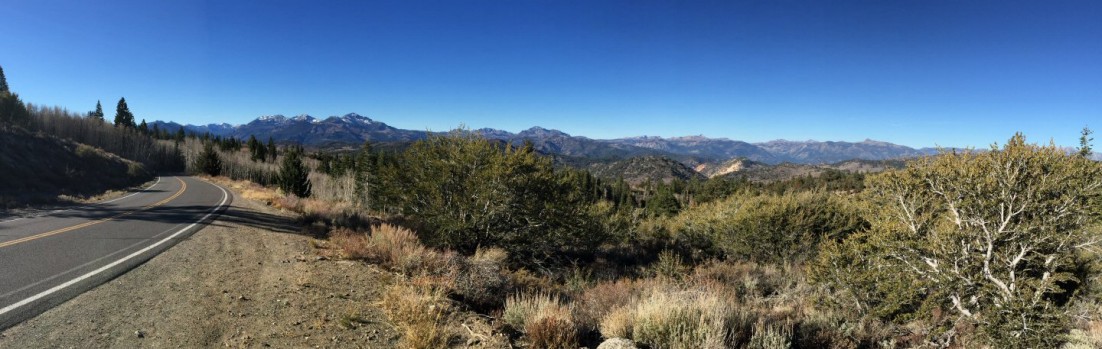
Early morning on Hot Creek, looking west to the Sierras.

Early morning on Hot Creek, looking west to the Sierras.

I’ve described Hot Creek as a personal crucible that draws me back whenever I’m near. It’s the kind of place you’d return to regardless of the fishing. Early in the morning, before the sun rises above the canyon walls and less hardy fisherman show up, it can be a meditative place. The last four years I’ve been alone during this time, at least without human company. Deer will eye me while slowly munching on weeds from the creek. Birds of all shapes and sizes fly over and flit about the stream as caddis begin to hatch. Dark shadows of trout slip between the weeds.

Hot Creek is a gift plunked down in the middle of some of the most gorgeous country. It flows for about 3 miles through a huge meadow of wildflowers and tall grasses — which has been under the private ownership of Hot Creek Ranch for decades — and is surrounded on one side by the Sierra Nevada Mountains and on the other by the high desert of the Long Valley Caldera, which stretches about 10 miles to the Glass Mountain Ridge. The most fished public stretch flows through Hot Creek Gorge, below the ranch.

This year the creek offered a special challenge: low water and weeds. Hot Creek is known for the weeds that make it such a prolific stream; weeds that necessitate good casts to small lanes if one is to expect a decent drift.

This year those lanes seemed to be half as wide and half as long. Most of the fish where either hovering at the beginning or the end of these lanes, or just at or under the edges of the weeds. Some could be seen. Others were revealed as they fed on something too small be seen.
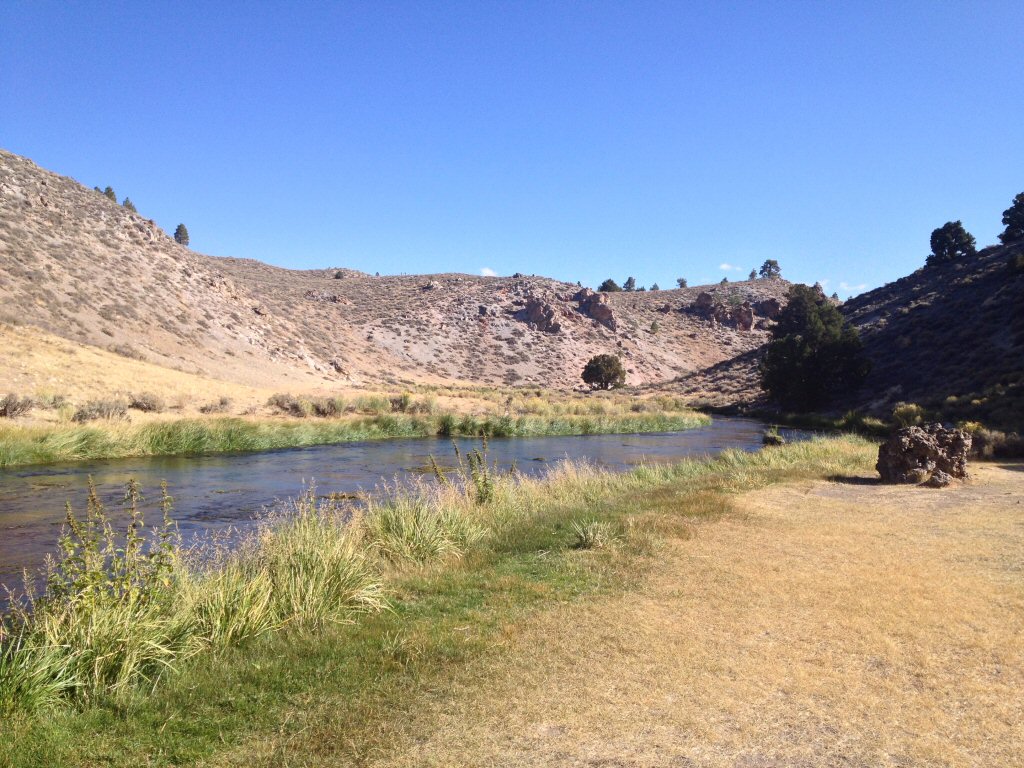
Solitude on Hot Creek.

Solitude on Hot Creek.

If there’s one consistency at Hot Creek, at least during the fall, it’s the size of the flies that work best. A favorite among our group this year was a small Zebra Midge, but for me it was a size 20 CDC Caddis. I needed help seeing a fly that small, so this day it would trail a decent sized grasshopper pattern.

These days I tend to use dry flies more often as indicator in slower moving waters. I did so during my first visit to Hot Creek. Not because I wanted to, but because everything I had read and been told about this stream deemed it “highly technical.” I still don’t really know what those words mean when used to describe a river, stream or creek, but they were scary at the time.

These days, Hot Creek treats me fairly. Choosing the proper fly, casting well to the right spot and getting a good drift is generally rewards one with a strike. Whether or not that fish makes it to the net is up to me. This year, of about a dozen fish hooked, I’d lose half of them in the weeds. Others would throw the hook after going airborne. Only three would make it to hand for quick release.

I spent all of the morning and much of the afternoon fishing and exploring, visiting a lower section of the creek for the first time, and eating lunch about 30 feet above the creek while watching rising fish and mesmerized by the vivid landscape around me. It took more effort than usual to leave.

Somewhere along the line I read about a guy who fishes the Eastern Sierra, and on his vehicle is a bumper sticker that reads, “Don’t believe everything you think.” Appropriate for Hot Creek.


2 Comments

the 2013 Eastern Sierra Expeditionary Force, part one

Ask anyone who attended my club’s Eastern Sierra trip about the fish that made it to the net, and he’s likely to tell you it was about 18 inches. And that will be the truth.

For some of our group that was the length of one rainbow trout. For others, that total of 18 inches was the cumulative length of six brook trout. That’s just how it can play out in the Eastern Sierras.

The nice thing about an annual trip is that there always seems be to a landmark at which everyday life melts away and the focus shifts and sharpens to living in the present.

Morning above the West Walker River.

Morning above the West Walker River.

In this case, it occurs once the descent from Sonora Pass begins and the high desert stretches out in front of me. The route of choice this year was Hwy 108, as Hwy 120 (Tioga Road) was closed through mid September due to the Rim Fire. The usual commute traffic was there. Twice I would weave between cows meandering on the asphalt.

There are two maxims that apply to my fly fishing: (1) Get the skunk of as quickly as possible and (2) shaving serves no purpose. To address the first adage, I stopped at the West Walker River earlier than most fly fisherman would even take their first sip of coffee. Early enough to enjoy the stirring experience of hearing reveille echoing from the Marine Corps Mountain Warfare Training Center before my first cast.

Most people head for “the bend,” knowing that pods of planted trout can be found and, occasionally, a bigger fish might be found under a cut bank. But upstream, pocket water is a bigger draw for me.

West Walker Wild Rainbow

West Walker Wild Rainbow

Pocket water slows me down considerably, and it’s a good thing. Besides the obvious, avoiding a fall and at least a sprain if not a broken bone or two, the pocket water in the Sierras tends to be favored by the better-looking wild fish, and they need to be stalked. With a slow and low approach, I found plenty of wild rainbows willing to play.

When the sun was high in the sky and hiding my profile consigned me to shade and leg cramps, it was time to head down Hwy 395 to Tom’s Place Resort, , which if you’ve ever been, is a bit more basic than the name implies. But the price is right. The rest of our group, totaling 12, would filter in throughout the afternoon.

After that, the real fishing would begin, to be followed by free flowing homemade beer, good food and plenty of lies.


1 Comment

the outdoor apocalypse: boobies everywhere

Settle down, it’s not what you think.

Blue-footed boobies have apparently adapted decided to move north, showing up north of San Francisco for the first time in almost 30 years.

From the Los Angeles Times

Blue-footed boobies, which rarely venture north of Imperial County’s Salton Sea, are suddenly “all over the place,” said Kimball Garrett, manager of the ornithology collection at the Natural History Museum of Los Angeles County.

But like Hitchock’s film, this boobies invasion could be an ominous warning:

Some scientists are wondering if the visiting boobies are somehow related to a recent series of distressing biological mysteries in Southern California’s coastal waters.

“There’s a lot of weird things happening out there,” Dan Anderson, a professor of wildlife biology at UC Davis, said. “No one is sure of what the cause is.”

If a species moves of its own accord, is it invasive?

Blue-Footed Boobies


Leave a comment

a confession

To be honest, I left home yesterday (actually left from the office) not as fired up as usual about the annual club fishing trip to the Eastern Sierra.

Now that I’ve been on “the Eastside” for about 16 hours I know why.

I didn’t get out with the fly rod often enough this year. I had forgotten what it meant to be standing in the clear water of a mountain stream so intensely focused on fooling that one fish that every other concern or worry melted away.

Leading up to this re-realization was a pretty unique — or special — morning.

The traffic ran into during my commute was entire comprised of bovines. Yes, I had to move into the other lane to pass cows.

My first stop was at the West Walker River, and as I contemplated the river, reveille echoed over the meadow, marking the start of the day at the Marine Corps Mountain Warfare Training Center. (To quote a Facebook friend, “Hoo Ahh to that! What a great day to be fishing in the USA!”

It was.

20130912-210327.jpg

P.S. This entire post was composed on my iPhone, so please excuse any sloppiness. And I really don’t know how I feel about being able to do so.


Leave a comment

don’t know what to expect this trip

It’s been a bad year for water in California. The April opener was one of the best in years thanks to low water levels.

Next week we’ll see for ourselves what Eastern Sierra rivers and lakes look like four months later.

One guide recently referred to Bridgeport Reservoir as a “pond.” Bridgeport is so low that its outflow into the East Walker River has been tainted by algae — algae that usually floats closer to the surface of the reservoir — and now the river is regularly off color and weedier than usual. Lake Sabrina in the Bishop area is so low that the front (manmade) lake no longer exists. The level of Crowley Lake is better than might be expected, but low enough to concentrate fish in the deepest areas.

The route taken by myself and guys from the club will be dictated by the Rim Fire. Hwy 120 remains closed. An expectation that the fire might not be fully contained until Sept. 20 doesn’t lend any clarity as to when it might open.

That’s not a big issue for me. I usually head over Sonora Pass via Hwy 108, with stops at the West Walker River, Little Walker River or Molybdenite Creek.

Thankfully, there will be water to fish when we settle in at Tom’s Place Resort (which certainly isn’t the resort you might think it is). The Upper Owens is supposed to be in good shape. The Middle Owens is flowing at an unseasonably high level. I may head to the high country, visiting alpine lakes and streams where I hope the fish are already preparing for a long winter.

However it works out, there will be lies told over beer and good grub.


Leave a comment

tweet


2 Comments

on the Rim Fire (and why it might be better find other places to fish, for now, and let nature heal, undisturbed)

It was long ago decided that this blog was to be guided by a few simple rules; that it would be family focused and friendly, devoid of rants or advice, and mostly my space to write about the misadventures of my life.

Today, however, things are bit somber.

CalFire Rim Fire Incident Report

CalFire Rim Fire Incident Report

California’s fire season is shaping up to be one of historic proportions. The Rim Fire still raging near Yosemite Valley is one of 11 major fires currently burning in our bone-dry state. Those are only “major” fires. During the last few weeks, about 150 fires were sparked by lightning strikes. CalFire figures show that through the middle of August, 4,715 separate fires have burned the state — beating by a wide margin the historical annual average since 2008 of 3,000 fires. The Rim Fire is now the largest fire in the recorded history of the Sierra Nevada and, as of today, the 5th largest wildfire in California’s history.

In this moment, all eyes are understandably on the immediate danger to lives and property. Prayers are being said for the firefighters. This is devastation on an unimaginable scale.

As a fly fisherman, I can’t help but ask questions about the long-term impact on the many streams and rivers now stripped of bankside vegetation, and the fish in their waters. The extent of ecological damage won’t be understood for a long time. The intensity of the blaze — flames reportedly reached 100 to 200 feet as they shot up canyons — left nothing behind. While the Groveland Ranger District of the Stanislaus National Forest, the area predominately affected by the Rim Fire, has gone through cycles of intense wildfires, those fires have burned only small areas. (Decades of fire suppression and logging can be blamed.) Conjecture is that the Rim Fire, however, may have denuded up to a 1,000 acres.

The northern edge of the Rim Fire crossed the Clavey River, one of the longest undammed rivers in the Sierra Nevada, a designated wild and scenic river, and home to native coastal rainbow trout. The fire burned along extended stretches of the South and Middle Fork of the Tuolumne River as well as Cherry Creek, all waters known for fishing, whether stocked or wild fish. Many other but lesser known streams, streams I’ve found wild populations of trout, also fall within the boundaries of the Rim Fire.

The Clavey River

The Clavey River

Relatively little is known about the effect of fire on fish populations. An admittedly hasty search of the Internet offers some insight. It’s clear that the effects of fire on fish populations can be complex, with dependency on the length of the event, size of the habitat, the home range of the fish, specialization of spawning habitats and the type of fish. Of course, most studies cite salmonid fishes (trout, salmon, chars, freshwater whitefishes and grayling) as the taxonomic group slowest to recover after a fire.

That said, the effect of fire on native salmonid populations can be highly variable, with extinctions observed in some isolated small headwater streams, but a quick rebound when a species’ home range extends to multiple tributaries within a single watershed.

In affected rivers, streams and lakes, fires can most notably affect water temperature and water chemistry as well as the local invertebrates, amphibians and fish. No longer shaded by trees and brush, water temperature can rise, reducing the solubility of dissolved oxygen. Absorption of ash can increase the water’s pH and impact nutrient levels in aquatic systems. Studies document five- to 60-fold increases in phosphate, nitrate, and ammonium concentrations in streams affected by fires that have swept through larger watersheds. Conditions in these waters returned to normal with a few weeks, but were later impacted by rain flushing additional ash and soil through the watershed.

It’s likely that the smallest streams will have most dramatically impacted by the fire. Though most people dance around the issue, this has been another drought year for California, and water levels are so low that any longish exposure to the fire may have “cooked” many of those small streams.

Nature, however, can be resilient; as long as we don’t get in the way. Anyone who’s visited Mt. St. Helens National Volcanic Monument can attest to that.

A beetle native to the Sierras, which has infrared receptors allowing it to detect fire, could be first on scene to feast on the blackened trees. They, in turn, will draw birds. New growth will sprout, creating forage for small mammals and, eventually, deer and bears.

It just takes time. Though it may not look the same.

For a while, though, many Tuolumne County fisheries will probably be best left alone.


2 Comments

hiking through history

We snuck out of the Bay Area on the Thursday a week ago for long weekend, planning to cram a bit of everything into the time we had.

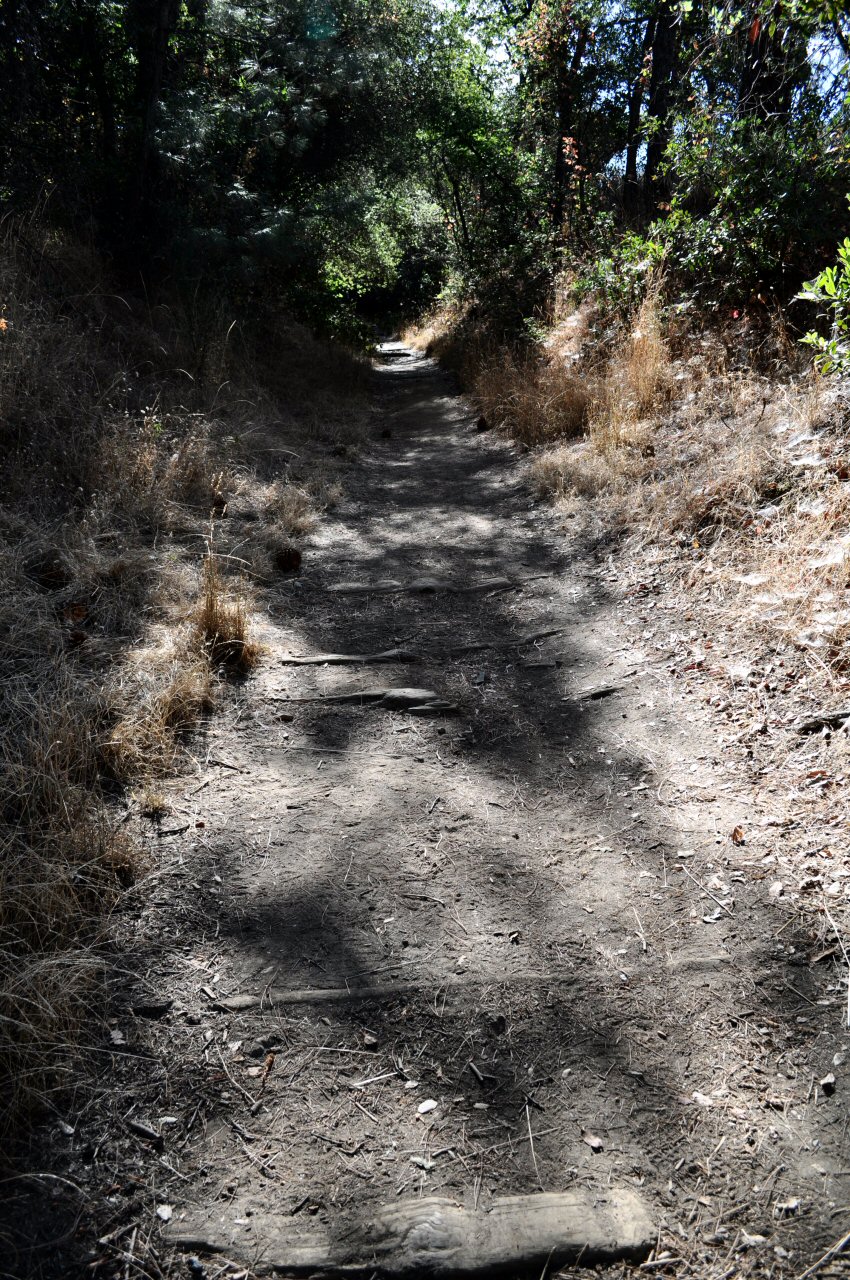
Railroad ties at the West Side Rail Grade trail head.

Railroad ties at the West Side Rail Grade trail head.

In a new spirit of exploring unknown parts of familiar territory, we ended up on the West Side Rail Grade the next morning. The trail — really a former narrow-gauge railbed — begins on Buchanan Road in Tuolumne City and is carved into the hillside above the North Fork Tuolumne River, on the north side of the canyon. It was christened in 1898 as the Hetch Hetchy & Yosemite Valley Railroad under the ownership of the West Side Lumber Co., which used narrow-gauge railroads in the Sierra Nevada Mountains until the 1960s. The HH&YV was primarily employed to haul fresh-cut logs from the sugar pine forests of eastern Tuolumne County to the West Side Lumber Mill in Tuolumne City.

The trailhead is just outside of town, and the first 100 yards are marked by decomposing railroad ties that look like worn steps. After that, most of the trail is exposed, which left us to bake in a remarkably hot morning sun. There are a couple places where benches and tables allow for a break in the shade, and a sprinkling of poison oak along the trail encourages one to stick to the well-worn path.

Though I’m not a history buff, per se, it’s a pleasant surprise to find remains of history in situ. About a mile down the trail we came across long portions of ties and rails, with the trail occasionally shifting from one side of the tracks to the other.

Rails of the Hetch Hetchy & Yosemite Valley Railroad.

Rails of the Hetch Hetchy & Yosemite Valley Railroad.

The grade slopes gently downward, at least for as far as we hiked, and it would be a great place to break in some new boots. Had we continued the full 4½-plus miles, we could have soaked our toes in the North Fork of the Tuolumne River, near Basin Creek. (I originally discovered part of the West Side Rail trail while exploring Forest Service land above Long Barn, and while fishing an upstream portion of the Tuolumne, but have since determined that was another section of the trail that stretches from Hull Creek to the Clavey River, that that’s another hike for another time.)

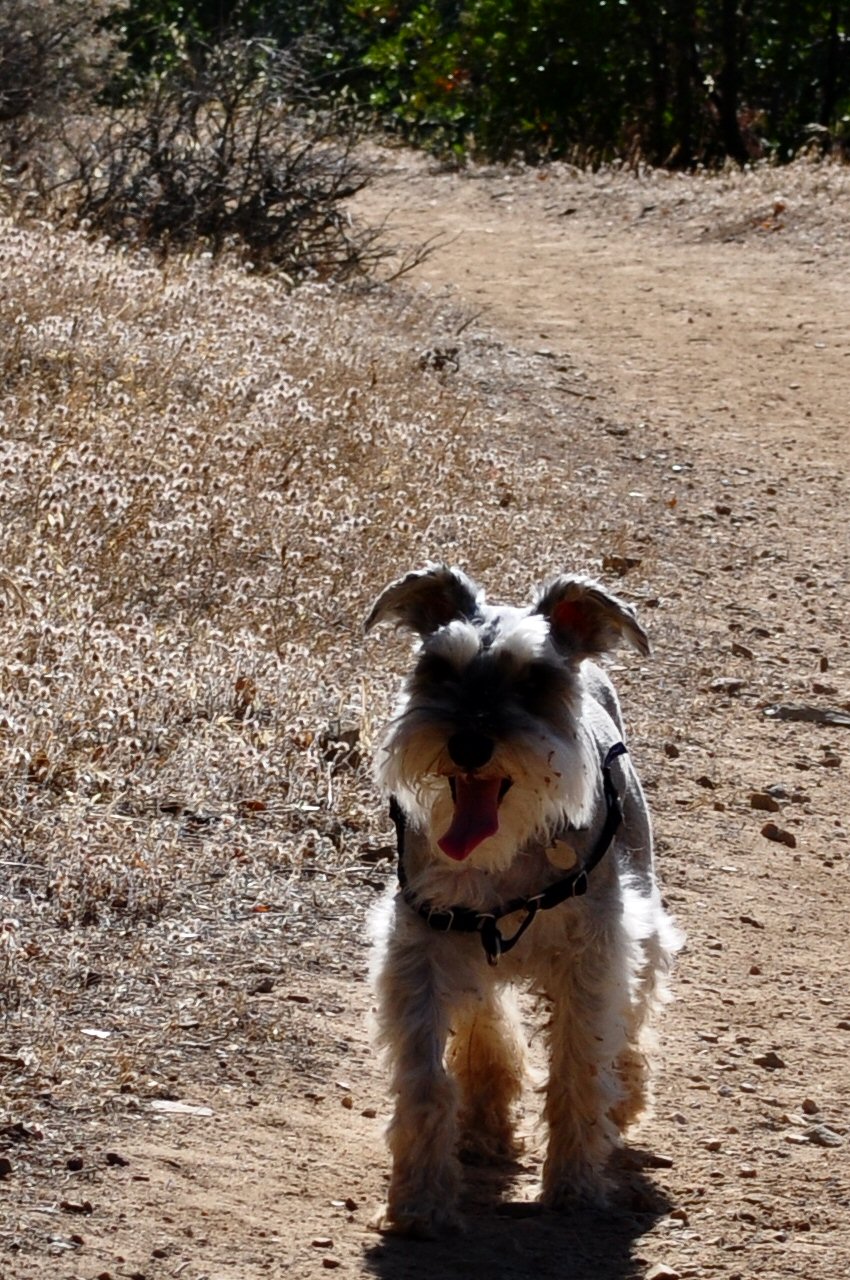
Hot and happy dog.

Hot and happy dog.

We met a few folks along the way: an overachiever who was jogging uphill and a few women who walk it almost every day, one of whom had made a dramatic move from the northern California coastal town of Bolinas to the much drier Sierra foothills.

With the full heat of the sun soon approaching, we left the exploration of a last blind curve for another time, and headed back. This day we had the dog with us and I don’t know if it was he or I who was panting more in the heat.

I have a feeling, though, that we’ll see more of this trail in the spring.


Leave a comment

you may have to carry a fire extinguisher to hike high enough to find Sierra Nevada trout

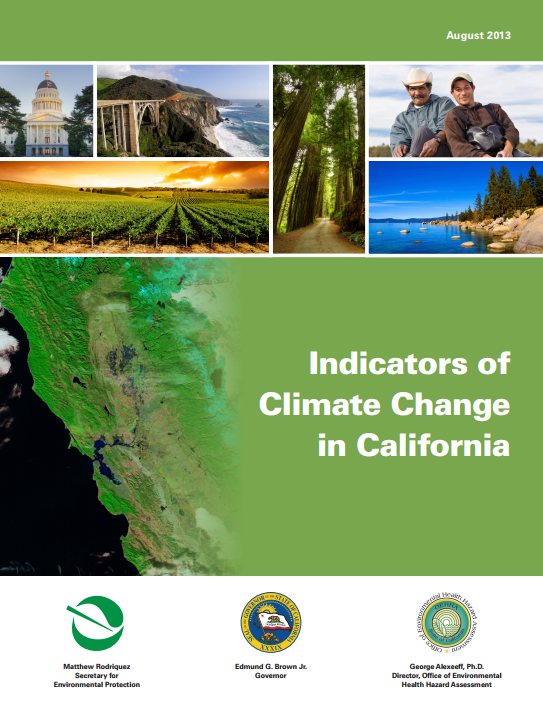
ICCC Report CoverFollowing up its good news/bad news report on Lake Tahoe, the California Office of Environmental Health Hazard Assessment paints a bleaker picture in its August 2013 Indicators of Climate Change in California.

To sum it up, analysis of monitoring data and scientific research from throughout the state outlines the effects of climate change: The spring runoff in the Sierra Nevada has declined over the last century. The period of time when winter temperatures in the Central Valley are cold enough for the development of fruit and nut tree flowers has been decreasing since 1950. River runoff declined during the 20th Century:

River Runoff Percent Decline
in 20th Century
Sacramento River System* 9%
San Joaquin River System 6%
Kings River 6%
Kern River 8%
Mokelumne River 7%
Trinity River 8%
Truckee River 13%
Carson and Walker rivers 5%
*includes the Sacramento River and major tributaries, the Feather, Yuba and American rivers.

Changes in average temperatures have led to die-offs of native vegetation at the lower range of various species’ elevation range (during the last six decades Sierra Nevada conifers have clearly retreated upslope) and is pushing about half of the small mammals in Yosemite National Park to higher elevations. The annual acreage burned by wildfires in the state increased since 1950, with the three largest fire years occurring during the last 10 years. The acidity in the coastal waters around Monterey Bay is increasing at a rate greater than that in the open ocean near Hawaii. The average annual temperature in mountain lakes, including Lake Tahoe, has risen over the last few decades.

And butterflies are emerging earlier during the spring in the Central Valley.

Yet, there’s no real trend that can be discerned from the data. The rise in the sea level rise along the California coast is bucked the global pattern and has be relatively constant during the last two decades.

Cheery stuff.


Leave a comment

maybe you’d better fish those Sierra lakes while you can

The good news is that the clarity of Lake Tahoe improved last year. The bad news is the whys. Precipitation in 2012 was only 71% of average and there was a lack of “deep mixing” during the winter.

While the lack of precipitation means pollutants flowing into the lake, the lake will lose shoreline with any prolonged drought.

And, maybe you'd  fish those rivers, streams and creeks a bit earlier in the year.

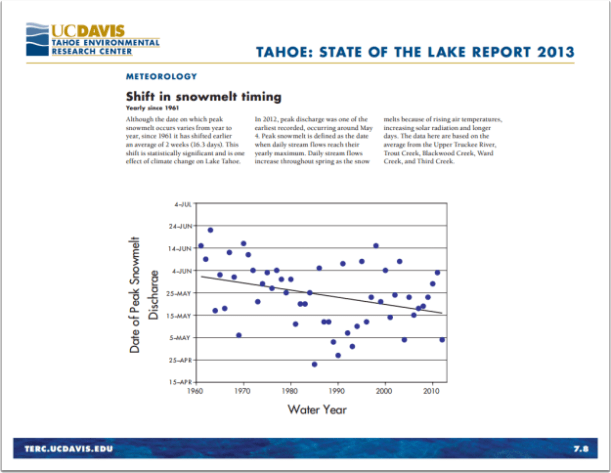
And, maybe you’d fish those rivers, streams and creeks a bit earlier in the year. Snow in the Tahoe Basin is melting nearly a month earlier than it did in 1960.

The lack of deep mixing – cool surface water sinking and forcing nutrients deeper in the lake to the surface, also know by fishermen as “turnover” – suppresses algae growth, which would otherwise cloud the water — but that also means warmer water temperatures. The annual average surface temperature of Lake Tahoe last year was nearly 53 degrees – the highest ever recorded.

Perhaps the scary part is a few lines in the intro to the report written by Geoffrey Schladow, Director of the UC Davis Tahoe Environmental Research Center:

“While Lake Tahoe is unique, the forces and processes that shape it are the same as those acting in all natural ecosystems. As such, Lake Tahoe is an analog for other systems both in the western U.S. and worldwide.”

You can read the relatively short report update here.