fishing for words

(and tossing out random thoughts)


Leave a comment

will travel for food: Show Dogs & Cellarmakers Brewing

I do enjoy living in California. I love our many outdoor options. I live in a suburb of the Bay Area, in a balance of choice and means. But I have a love/hate relationship with our “big city,” San Francisco.

San Francisco was the seventh most visited city in the United States last year, for good reason — cool summers of fog-kissed sunshine, a history that lives on through landmarks such Golden Gate Bridge, Alcatraz Island, Coit Tower and Fisherman’s Wharf. Lending to its picturesque quality are steep rolling hills patrolled by cable cars and dotted by a mix of architecture styles such as Italianate, Mission, Queen Anne, Stick/Eastlake, Craftsman, Art Deco and Streamline Moderne. Parks are sprinkled about, including the Conservatory of Flowers, Japanese Tea Garden and the San Francisco Botanical Garden. Culture abounds with art museums and performing arts. The sciences are represented at the California Academy of Sciences, the Morrison Planetarium and Steinhart Aquarium.

Wandering through neighborhoods like North Beach, Chinatown, Telegraph Hill and SoMa on a sunny day rank among some of my favorite experiences in The City. Christmas can be made more special with a visit to Union Square and a walk by Macy’s holiday windows displaying SPCA cats and dogs looking for forever homes. Personally, I enjoy carspotting and rarely is there not a sighting of a Ferrari or Tesla or the occasional Aston Martin, Bentley, Rolls Royce or Pagini. (BMWs, Audis, Mercedes-Benzes and Porsches are too commonplace.)

San Francisco is also most densely inhabited large city in our state and the second-most densely populated major city in the United States; second only to New York City. High-rise office buildings blot out the sky and create dark canyons that can be 10 degrees cooler. Our visit last weekend was marked by warmish temperatures, which likely gave rise to the rather pungent odors one might expect during a rainless winter.

Some people wanted champagne and caviar when they should have had beer and hot dogs. - Dwight D. Eisenhower

Some people wanted champagne and caviar when they should have had beer and hot dogs.
– Dwight D. Eisenhower

But we will travel for food, which lured us once again across the Bay. Intellectually, I understand the need for and benefits of mass transit; but deep inside I harbor an irrational fear of missing a scheduled stop. (Yes, I know there will be another bus or train, but that means giving up control of my schedule.) However, I’ve become accustomed to the hour-long ferry ride and have recently adopted the mantra “walking is good.”

Walk we did. To get where we were going, we’d skirt the Tenderloin just above SoMa. The situational awareness I’ve been working on, unfortunately, meant I wouldn’t miss that guy relieving himself in the gutter on Turk Street. More than once we walked through a repellent cloud of “skunk” originating from green stuff, not the black and white animal.

In truth, it was more akin to hiking for food and beer, and lunch at Show Dogs Fine Sausages was the reward on the first leg. House-made hot dogs, sausages and condiments, and beer on tap. What’s not to love? And love it we did. Maximizing our opportunity to taste Show Dogs’ offerings, we split a House Maple Pork sausage and Fried Chicken Sandwich, a pint of 21st Amendment’s seasonal Fireside Chat — a nice, rich and semi-dark English-style ale tweaked with spices — and a side of fries. The maple pork sausage was an experience I’d gladly repeat, even without the sprinkling of bacon. The proportion of maple to pork was perfect. Think of that time at breakfast when your sausage rolled into a bit of syrup. The twist for me was the deliciousness of the fried chicken sandwich, it was outstanding. Sure, it’s fried, but the house-made lemon cayenne aioli, coleslaw, pickled ginger and well-matched bun make it something quite special. The fries weren’t as special, but were perked up by the house-made habanero ketchup.

We’d walk another mile or so to pick up something Karen had ordered, then it’d be another mile to Cellarmaker Brewing Co.’s taproom. But it was one o’clock, and the taproom wouldn’t open until two. So, without thinking, began to head to the Ferry Building.

A few blocks later Karen thought to check the ferry schedule. The next ferry wouldn’t leave until 3:45 p.m. Apparently, God wants us to have beer. And Cellarmaker delivered.

Cellarmaker is small, with a ten-barrel brewery and a twelve-tap tasting room inside a former garage in SoMa. It opened last October with four beers and has since expanded it lineup with a rotation of beers. We settled into the cozy taproom and upon learning that some taps were dry, ordered up five ounces of each available beer. It was nice to see that each glass was pre-wetted with chilled water before filling (I expect that it was distilled water).

We ended up with glasses of Coquette, Simcoe Galaxy IPA, Jagged Little Pale Ale, Coffee and Cigarettes and Kelly’s Blackout Stout. All were good enough to order again, but I fell in love with piney goodness of the Simcoe Galaxy. It reminded me of Skagway Brewing’s Spruce Tip Blonde, which is brewed with spruce tips. The Simcoe Galaxy is not, but the herbal, piney and almost earthy fragrance (of the Simcoe hops?) comes forward and lingers. This is an aroma-heavy beer with a light hazy yellow color and a surprising lightness. Karen was fonder of the easy-drinking Jagged Little Pale Ale, a clean almost-IPA. Coffee and Cigarettes stood out for its aggressive aroma of espresso and burnt malt backed up by a lingering smokiness.

I’m a fan of saisons/farmhouse ales, but Cellarmakers Saison Francisco wouldn’t be released for another week; however the Coquette, a grisette, was a good stand-in. This is in the style of a working-class beer: a light, slightly tart, low alcohol wheat saison about as pale as it comes. Envision sitting down and enjoy a pint after mowing that one-acre lawn on a hot summer day.

We ended up walking just over six miles this day. Nothing like enjoying good food and all that beer without gaining too much weight.

2 Comments

practicing for retirement

From the start, we knew it’d require a different mindset. Not since our honeymoon 10½ years ago had Karen and I spent more than three or four days at the cabin. Eight days, however, clearly presented an opportunity for adventure; exploration at our own pace.

Potty-Mouth Wine

Potty-Mouth Wine

I did spend a couple of days fishing, but our destinations most days were only decided the evening before and sometimes only that morning. Our internal alarm clocks — or at least mine — meant I was up by oh-dark-thirty every morning, but that left plenty of time for a full breakfast if desired.

More than anything, we wandered; around town (Twain Harte) and through hill and dale. The higher elevations were colored by fall foliage while below 2,000 feet the grass of the oak woodlands was a pale gold.

Our day-long loop through Copperopolis, Angles Camp and Columbia took us through these distinctly different habitats, past the Sierra Conservation Center (aka prison) and over the very low New Melones Reservoir. In all my years in the area, never has New Melones looked less like a lake and more like a canyon than it did last week.

A map won’t tell you that Copperopolis has something of a split personality. The “real” Copperopolis — near Reeds Turnpike — was established in the 1860s and is a bit unique in that it was founded near a copper mine, not gold. But just north, near Hwy 4, is what looks like a Hollywood set plopped down in the middle of nowhere. It reminded me of the town of Lago, in High Plains Drifter; without the red, of course.

The buildings in Copperopolis Town Square tap historical architectural design of the mid and late 1800s, with retail shops and restaurants surrounding a small park with a gazebo, landscaped fountain and flag pole. Allowing for the fact that we were visiting on a Wednesday, during the fall, it was still quite vacant. It’s clearly designed with a pedestrian focus, including park benches, stone masonry walls and faux old-fashioned gas lamp posts. It was a nice enough place for a leisurely walk, with a stop for a root beer float in an old-style ice cream parlor.

The town square is nice enough, but peeking behind the curtain — actually one block off the main street — reveals paved streets complete with sidewalks and lightposts but devoid of homes; just dirt lots. While folks there will tell you Copperopolis Town Square is a phased development, I couldn’t help but wonder if these vacant lots were remnants of the recession. After all, developer Castle & Cooke did break ground on Copperopolis Town Square in April 2006.

Our loosely outlined plan was to stop in Angels Camp and Columbia before returning to the cabin. One suggestion: Don’t visit Angels Camp on a Wednesday; it seems as if half the businesses were closed.

The drive from Angels Camp to Columbia was interrupted, however, by my sudden veering on to Red Hill Road near Vallecito. During the summer I met a young man dispensing tastes at Mammoth Brewing Co. and learned in the course of conversation that his family owned Twisted Oak Winery. He was taking a break from the wine business to learn about beer, and after I mentioned the cabin in Twain Harte, he suggested a stop at the Twisted Oak tasting room in Murphys. I didn’t know the winery was in Vallecito until I saw the sign.

It was clear this was a place where the folks didn’t take themselves too seriously; the posted speed limit on the driveway is 9 mph. One wine label says it all: “*%#&@!” (described as a potty-mouth Rhone-style red blend). It’s a friendly place, and laughter pairs well with wine, so we lingered, bought some wine then headed on down the road.

We covered about 80 miles that day, agreeing to expand the circumference of our exploration the next time we can take the time to slow down.

It became clear we were enjoying ourselves and spending our time wisely when my sister emailed to ask if we had retired and not told her.

Not yet. But it sure was nice to spend a week acting as if we have.


2 Comments

when every leaf is a flower

Big Trees & Fall Color

Big Trees & Fall Color

I, for one, believe the best adventures of childhood were often found in the backyard or within one’s immediate neighborhood. As adults we learn of the wider world, of places that are ancient and historical, mysterious, full of wild lands and animals. It’s true, but a life lived yearning to visit these places can let the wonder right outside our door slip away unnoticed.

It was expected that this week at the cabin would entail local exploration, the type of exploration allowed only by ignoring the clock and following a path chosen in the few moments before our next step.

So it was that Karen and I found ourselves at Calaveras Big Trees State Park, after, of course, stopping along the way to pick up seasonal favorites: apple cider donuts and fresh-pressed cider. I was familiar with the area, which is about an hour away from the cabin, but only as an extension of my search for new fishing waters, namely Beaver Creek and the North Fork of the Stanislaus River. To explain briefly, Calaveras Big Trees was created to preserver two groves of some of the most massive giant sequoia trees. (Not always the tallest, but volumetrically the world’s largest trees.) These are Sequoiadendron giganteum, the inland relative to the perhaps more familiar coast redwood (Sequoia sempervirens.

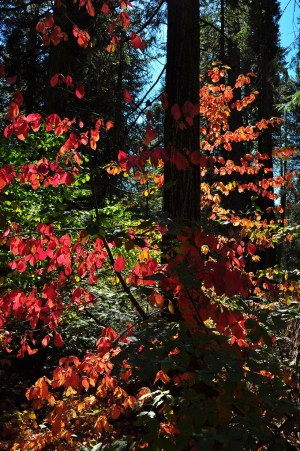
The morning was spend wandering among these enormous trees, looking upward until our neck muscles complained during a hike that covered a few miles. But if the sequoias were the big stars of the show, big leaf maples and dogwoods were the flashy supporting players; this time of year decked out in shades of red, yellow and orange. Their dazzling colors proving that “Autumn is a second spring when every leaf is a flower.”1

Pictures are worth more words than I could possible write, so below is a gallery, a glimpse of what we saw.

1 Albert Camus


5 Comments

coyote, rattlesnake and turkey, oh my! (wild trout too.)

Sean lining up a putt on hole four at Twain Harte Miniature Golf.

Sean lining up a putt on hole four at Twain Harte Miniature Golf.

When it comes to the oldest son, the easiest way to level the playing field is to chase wild trout. While there may be some claim that genetics would ensure that he’d be at least half as good a fly fisherman as his old man, the truth is that there’s no substitute for experience.

The day after our Annual One-Day Tioga/Sonora Pass Tour, we had an agreement to take it easy, meaning no alarms. We were still up and out at a decent hour, though long after the sun had begun to warm things up. This Friday being designated a “Man Day,” our first stop was for convenience store coffee and breakfast. The day would later include miles of dirt roads, a lot of hiking, and a whole heap of fly fishing. Manly stuff indeed.

We were headed northeast to Arnold, cutting across the dry, now golden Sierra Nevada foothills once scoured by ‘49ers. We passed the time during the hour-plus drive with conversation, the usual good-natured ribbing, and a good playlist. The focus of the day was a small freestone stream rumored to be well worth the effort. It could be easily accessed through a state park.

We didn’t want easy.

After inquiring about this stream a few months back, a club member cryptically described in a hushed voice a series of left and right turns leading to a serviceable Forest Service road that eventually crossed Stream X. His tale of the wild trout that lived there was peppered with warnings of fast-moving logging trucks and rattlesnakes.

With the help of a National Forest Service map of the area, I had determined the most likely route. But there’s nothing like local knowledge. We stopped at Ebbetts Pass Sporting Goods for guidance and picked up a few flies from one of the best selections I’ve run across. Bill, owner and long-time resident who’s hunted and fished the area for some 30 years, is always willing to take the time to offer advice. (Based on our conversations, I now have a list of rarely fished and not-so-easily accessed waters.) Bill’s confirmation of our route also included some obfuscation…the first left was after a city limits sign and our destination was near the bridge.

The paved road extended farther than expected. The vegetation here was a bit greener and denser than that around the Family Cabin and a welcome change. Soon enough we were on the dirt road. Not your typical Forest Service road, rather one made more drivable thanks to constant compaction by heavy truck traffic and frequent watering.

It became clear during our pre-fishing ritual — changing into waders and checking rods — that we were in the right place at the right time. Chance would have it that I looked up just in time, over the top the car and through the trees to a bend in the creek about 50 yards away, to catch a glint that could only have been from a jumping fish. An added bonus: it was just us.

Sean was on the stream first and hooked a trout in a small pool. It was about nine inches, and coloration and big parr marks confirmed it as wild. Looking over this stream, it was clear this would be a day of pocket water. At the end of the day, about 75% of the water we’d fish was pocket water and more than 90% of our takes would be on dries.

In typical fashion, we leapfrogged past each other as we headed upstream. Sean lagged behind at one of the better shaded pools in this section. Upstream was a wide, sweeping bend. Trees provided shade on the inside. The outside of the bend must be scoured during heavy runoff, leaving a big field of rounded stones of all sizes. Tire ruts leading down to the stones were left by the logging company’s watering truck and — as evidenced by a pod of obviously stocked trout darkening the center of the bend — a DFW stocking truck. Temptation got the best of me and I got a few planters to take a big stonefly pattern. Sean had since emerged and I moved upstream, only to be halted by a fence extending through the stream and up both banks.

Returning to the bend, Sean and I agreed that, with the two other fishermen who had since arrived, it was suddenly too crowded.

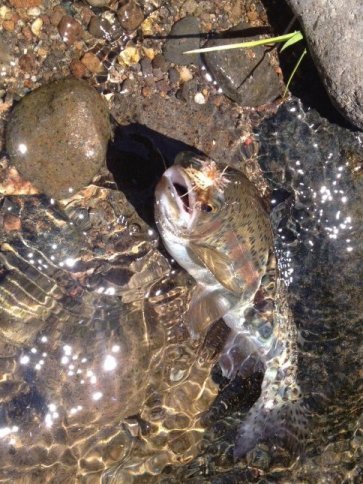
A rainbow trout that's a bit bigger than expected in this small creek.

A rainbow trout that’s a bit bigger than expected in this small creek.

Nice surprise in a small creek.

During my time upstream, the driver of the watering truck had chatted up Sean. While sucking water from a beautiful stream that’s habit for wild trout is uncool, at least the driver offered up details about how to get to a more remote and less-fished section upstream. Following his recommendation, we picked our way down a less-frequented road. This isn’t your graded road, but rather a barren section of forest sprinkled with stones and crisscrossed by fallen branches. The type of road that wouldn’t necessarily require four-wheel drive, but where I would have been thankful to have a bit more ground clearance than offered by my (trusty) Accord.

It was slow going. The road meandered away from the stream and gained elevation before a fork dropped us down to a wood bridge.

Here the character of the stream changes. It’s nearly all pocket water. And skinny.

As expected, the fish were spooky. We didn’t really see the fish; we caught flashes of fast-moving shadows in the periphery of our vision. This is the kind of stream that tests one’s ability to pick out suspect water and adequately present a fly. There might be strikes on your first two drifts. After that, it was time to move on. Thankfully, there was a lot of stream available.

My first cast was to ideal pocket water behind a large boulder. Water tumbled past the boulder into a pool that while not deep, was dark enough to hide fish. That first drift netted a brilliant eight-inch rainbow. This was repeated often as we hiked upstream, with nearly every fish chasing our dry flies.

It’s likely we could’ve spent all day moving upstream. But we did have to pick up a wine club shipment in Murphys, so we headed back to try fishing downstream of the bridge. There were a few spots but it wasn’t too far before the stream enters a canyon narrow enough to encourage a solid risk/reward assessment before continuing.

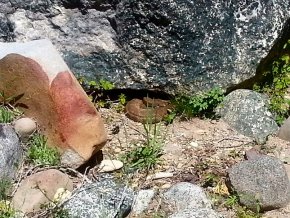
A not-so-nice surprise.

A not-so-nice surprise.

Sean, who wasn’t aware of my decision, was hiking along a deer trail above the stream while I headed back upstream. There was no scream or shout, and it wasn’t until he caught up with me that I learned of the first rattlesnake sighting of the season. Sean was foolish coolheaded enough to linger long enough to take a photo.

We debated stopping to fish again on the way out but decided otherwise. Our drive back to the highway included sightings of a coyote and turkey. After a stop at Ebbetts to report on our success (suitably suppressing how excellent it really was), it was time for a post-fishing beer. Luckily, Snowshoe Brewing wasn’t more than 15 minutes away.

We completed the day picking up that wine, tasting some of that winery’s products, and grabbing decent-but-not-great burgers at a place adjoining a gas station. Music and banter continued on the drive back, with a promise to keep up the illusion that this really-not-so-secret place was our little secret.

I did outfish the boy. I also whooped him in a game of mini golf. Even so, I think he had a pretty great time.


4 Comments

the good side to a bad wet season

The '97 ready to roll.

An excellent combination: sun, clear skies and a motorcycle.

The separation between Northern and Southern California is customarily delineated by rainfall or lack thereof. But not so much this year. The hope of a Miracle March making up for a dry, spring-like January and February is fading fast. I’m just a little bit worried that not all of the recently tied flies will get wet this year.

Still, I shoved aside one hobby for another, rolled the motorcycle out of the garage, geared up, set the choke and pressed the starter. Spark plugs fired, the engine caught, then sputtered and died. I tried a second time, it sounded as if it were flooded. After more thought than it should have taken, it dawned on me that this March day was already warm enough that there was no reason to apply much, if any, choke.

My son and I hadn’t really decided where we might ride, just that we would. But Sean’s suggestion of the Russian River Brewing Co. had lodged in my head, so we headed out Hwy 37, skirting the northern edge of San Pablo Bay (which is part of and north of San Francisco Bay), through the San Pablo Bay National Wildlife Refuge — a significant destination on the Pacific Flyway — and along the southern reaches of the Sonoma and Napa valleys. A cloudless sky and migrating birds looked down upon us.

It was good to be in the saddle again, and though we’ve ridden together less than either of would probably like, I think it’s fair to say that we’ve developed enough awareness to anticipate each other and communicate simple messages through hand motions. A bit of this signaling after we passed Infineon Raceway (the old Sears Point) had us heading north toward Petaluma, past green fields dotted by sheep and their lambs. The last dozen miles or so were the least enthralling; this section of Hwy 101 just south of Santa Rosa is always at some stage of deconstruction, and the redwoods on either side of the road always seem dusty, dirty and thirsty.

Soon enough we pulled into the free public parking (bonus!) offered for motorcycles, which just so happened to be behind the Russian River Brewing brewpub. Winding out way past the bar and through the tables, it was immediately clear that this is a popular place. (I’d later find out that, unless you’re a diehard triple IPA fan, stay away when the brewery releases its ‘Pliny the Younger’ — some folks wait up to five hours in line for the new batch of BeerAdvocate’s top-rated beer for 2009.) We tossed our names at the hostess, stashed the coaster-style pager and gulped down a few glasses of ice water.

Russian River Brewing Co. Menu

The tap menu. We opted for the right side...and it was good. Very good.

The pub is appropriately dimly lit, and the dark wood throughout quickly absorbs any sunshine that makes it past the crowd drinking and generally carousing out front. We were seated about halfway between the front and back of the place, and I had an unobstructed view of the tap menu. We’d learn that the left side tended toward ‘aggressively hopped’ beers; the list to the right was comprised of Belgian-inspired ales and barrel-aged (sour) beers. Selecting the beers in your flight is easy: pick one list or the other or both. It was an easy compromise — I was paying after all — and we opted to try the ales and barrel beers, to be accompanied by a ‘Piaci’ pizza (mozzarella, marinara, gorgonzola and pine nuts) and some hot wings.

Russian River Brewing Co. Flight

The traditional thumbs up from Sean, and a well-deserved thumbs up it is.

The grub was pretty darn good. The beers were crazy good. Our tasting included Redemption (blonde ale), Perdition (bière de Sonoma), Sanctification (blonde ale brewed with Brettanomyces yeast), Supplication (sour aged in pinot barrels), Defenestration (hoppy blonde ale), Damnation (golden ale), Damnation #23 (golden ale, triple aged with oak chips), Temptation (sour aged in chardonnay barrels), Salvation (strong dark ale), Consecration (sour aged in cabernet barrels) and Collaboration (IPA style). Only the Consecration was not to our liking, mostly because the cabernet seemed give the brew an overpowering sweetness.

Our favorites — at least mine — included Sanctification (uniquely tart but crisp), Defenestration (a clean blonde with a hop finish that didn’t linger or kill the taste buds) and Damnation #23 (a full-bodied, semi-spicy golden ale offset with a bit of oak). Thankfully, the sample glasses were 2 ounces, and we lingered over bites of the pizza, the gnawing of the hot wings and discussions of each beer.

A few hours later, well rewarded for the hour-long ride there, we started up the bikes and headed east toward the Sonoma Valley, offloading some beer along the way. After a while, Sean peeled off the main road and I stopped to refill the tank (42 mpg) before the final few miles to home.

Perhaps it’s time to think about hunting steelhead on the Russian River; any unsuccessful day fly fishing could be brightened with a visit to this namesake brewery.


3 Comments

the parent’s 50th wedding anniversary weekend

My parents celebrated their fiftieth wedding anniversary last weekend. They didn’t want a big bash, but wanted the family to get together. And, for the first time in quite a few years, we gathered, with my wife and I, and my sister and her family, flying from San Francisco to Seattle-Tacoma International. Being short on vacation time it was a quick trip for us, flying up Friday and leaving Sunday.

The reason we all gathered in Duvall, Wash.

It was the type of low-key celebration that is more common in my immediate family (except, maybe, for my brother). It started Saturday morning at mom and dad’s house with a get-what-you-want breakfast. There was a lot of catching up and joking around. The nephews got reacquainted.

About mid morning, dad presented mom with an anniversary gift; a communal effort that brought together a heartfelt quotation chosen by dad with a cross-stitch put together by my wife, with the matting and framing coordinated by me. Yes, tears glistened in mom’s eyes, and dad’s voice crackled during his presentation.

That afternoon, in typical Konoske fashion and joined by my wife’s parents, we continued the celebration with a hearty “main meal.” (I’d call it either late lunch or early dinner, as the rest of the family well knows by now.)

At Sunday morning mass, mom and dad’s marriage was blessed at Holy Innocents Catholic Church, with the family in attendance. It was nice, and like our parents, low key. After mass and before some of us had to leave, we enjoyed too much breakfast at Duvall Grill.

But I do think I heard something about mom being up for sainthood.


Below is a slide show of photos from the weekend, or you can visit the album here.

https://picasaweb.google.com/s/c/bin/slideshow.swf


2 Comments

cruising Alaska, part two: Ketchikan and surprise

I was reminded of my childhood when the ship began to dock the third morning of our Alaskan cruise. Years ago my sister and brother and I, still sleeping, would be packed into the car, and we’d wake us up numerous miles down the road. This time it was our captain announcing the successful mooring of the ship and clearance to disembark passengers.

Early morning over Ketchikan, Alaska.

Ketchikan greeted us with sunshine and colorful waterfront shops. The rest of the town huddled between mountains and the sea. Our half-day shore excursion would take us to visit the Deer Mountain Tribal Hatchery and Eagle Center, the nearby Totem Heritage Center, the Saxman Village and the Southeast Alaska Discovery Center.

Though it’s no secret that Ketchikan, as well as Juneau and Skagway, owes much of its financial survival to tourism, our guide/driver that morning exemplified the tourist-friendly attitude that would greet us during all of our on-shore travels.

The collection area for salmon returning to the Deer Mountain Tribal Hatchery.

The Deer Mountain Tribal Hatchery and Eagle Center is within a relatively easy walk east of the dock. Our guide walked us through a town park to the entrance of center, next to a creek in which numerous pink salmon milled about. We were greeted by a docent and resident owl, and entered the eagle habitat. To be honest, I was hoping for something, well, a bit more. However, it did offer an up close look at two of these amazing birds, which haven’t been released into the wild due to injuries. A creek running through the small habitat allows them to hunt spawning salmon.

The Deer Mountain Tribal Hatchery is just as small in keeping with its mission to ensure the survival of various salmon species rather than supply fish for a fishery. Its operation was well described by the docent, though the distraction of big salmon in a holding pen interfered with my hearing everything she had to say.

Perhaps more remarkable was the Tlingit and Haida totems, moved from islands throughout the Inside Passage and now housed a short walk away in the Totem Heritage Center. The unrestored appearance of the totems housed in the center — each 100-plus years old — lend a sense of history. Small, surrounding exhibits cover Tlingit and Haida history and traditions.

Totem in Saxman Village on a nice sunny Alaskan day.

We next visited Saxman Village, a tour highlighted by a carving demonstration and nearby totems. Of note is the Seward Shame totem built to shame the former U.S. Secretary of State for not repaying a Potlatch (a gift-giving festival) to the Tlingit people. While the color red is used to indicate shame, indicating stinginess, red also figures prominently on the nearby pole built out of respect for Abraham Lincoln* and commemorating the U.S. Revenue Cutter Lincoln in its role in helping two rival Tlingit clans establish peace.

Back in downtown Ketchikan, we were dropped off at the U.S. Forest Service’s Southeast Alaska Discovery Center. Worth a visit, the Discovery Center offers displays and information covering a wide swath of the area’s natural and human history, and might have offered a better starting point.

Lunch in Alaska is simple for me: various versions of halibut fish and chips, this time in view of Ketchikan’s Thomas Basin Harbor, at the south end of town.

We’d been warned that all three of our ports of call had been invaded by jewelers who typically started their businesses in other, more tropical cruise ship destinations. My wife, in fact, already wanted to look at a particular ring.

We oohed and ahhed along while strolling diamond row, picking up a few of the compulsory t-shirts along the way. Our last stop was to see “The Ring.”

I hadn’t been warned about the sales folks. They are smooth and slick. It all starts with an innocent question: “What do you think the price is?” Let’s just say it was too much, even with the initial offer of a discount, but it must have been apparent — in our eyes or maybe our body language — that we had no plans to buy. Another substantial discount raised my eyebrow.

Carver at work in Saxman Village. (A totem carved by a master carver can cost up to $4000 per linear foot.)

I’m terrible at picking out jewelry and recently began an early search for a suitable ring for our 10th anniversary, which is not too far off. I was having a heck of a time. But again, I went into a defensive huddle with my wife, shaking my head with such exaggeration that another offer was made. Earrings were thrown into the deal. The sales manager stepped up with calculator in hand. I’d even go so far as to say we had the original salesman sweating, just a bit. Another huddle, another offer, the incorporation of sales tax into the offered price, and a deal was struck.

I was hoping to see ice in Alaska, and I thought it would be in a glacier, but regardless of the profit earned on the sale, we walked back to the ship feeling we’d done okay.


* This one is different from the Lincoln Totem in the Alaska State Museum.

A photo slideshow, already playing. (I’ve added photos since last posting the album):

https://picasaweb.google.com/s/c/bin/slideshow.swf

(You can directly access the Picasa album, with captions, by clicking here.)


6 Comments

making man time and acting like boys

I’ve no way of checking, but I’m pretty sure hell’s frozen over.

After eight years since his last appearance in the Golden State, my brother showed up with no specific plans. That’s where I stepped in as travel agent, outfitter and guide; apparently a role that suits me better than might be expected.

Lembert Dome

Lembert Dome viewed from the Tuolumne Meadows Campground, and where we'd be going.

A visit to the cabin is akin to establishing a base camp. In our case, a base camp stocked with beef jerky, beer and an XBox. One might be inclined to think it was something like a “man cave,” but there’s an irony to my brother and I spending quality man time together. Those who’ve been in the proximity when we get together know that we quickly prove the adage that you can’t take the boy out of the man.

Mark lives in the Evergraygreen state and while he said he’d enjoy seeing California family members, it became clear that he perhaps more happy to see the sun. I swung by the airport to him pick up Wednesday evening and we met up with my oldest son, Sean, at the Bass Pro Shop in Manteca. We secured a two-day nonresident fishing license, grabbed dinner and headed up the hill.

Weather-wise, we’d hit it right. Temperatures had peaked that day and would be still warm but slightly lower the next few days, meaning it would cool off at night; something important for a good night’s sleep in a cabin that has no insulation and no air conditioning.

Before Mark or Sean posts a comment below, I will admit that I was adamant that I would I had expected to wake up and hit the road for Tuolumne Meadows early the next morning. I did wake up at 5:00 a.m. But I rolled over and caught a few more winks.

Mark had asked if we might be able to hike up Lembert Dome. He and I had done so back when we were boys, with my sister and dad. It’s a pretty easy drive from the cabin to Tuolumne Meadows, just about 2½ hours. Since Tioga Pass had opened the week before, we would circle our way back over Sonora Pass.

Olmstead Point Marmot

Mark's friend, the Marmot, at Olmstead Point.

It’s been said many times before, but the blue of the sky is remarkable at higher altitudes, and we weren’t disappointed. With only a few clouds in the sky, we passed through the entrance station and soon arrived at Olmstead Point. Reinforcing that he boy stills lives within the man, Mark was all about seeing and getting photos of the marmots of our childhood at Olmstead. A few marmots obliged.

We next stopped at the Tuolumne Meadows Campground, where we spent many a family vacation camping. Sure, some things have changed — mostly manmade things — but nearly everything was recognizable and Mark and I soon agreed upon the location of “our” campsite, partially based on its position relative to the Tuolumne River, which itself was nearly unrecognizably high. I’m sure Sean was somewhat amused by our reminiscing.

Just down the road we pulled into the parking lot at the Lembert Dome trailhead and loaded up. The trail begins with a modest incline, but starting at about 8,600 feet and rising another 800 feet to the dome’s summit, it was soon clear that our lungs would get the kind of workout not seen in years. The gradient seemed to increase every 100 feet, and even if we were on the trail (we weren’t), it would be covered by extensive snow fields that made the hiking more difficult. At one point, Mark fell through the snow into a waist-high air pocket. Undaunted but pausing more often that we’d care to admit to catch our breath, we pressed on. I’m sure it took a lot of patience for Sean to not charge ahead. (I don’t think he broke a sweat or even breathed hard.)

It’s said that the memory grows hazy over time and Mark and I didn’t remember the last stretch up the back of Lembert Dome being so steep or requiring so much climbing. But climb we did, reaching the top. The view was made a tad more incredible by the fact that we had it to ourselves.

At the Top of Lembert Dome

Me, Mark & Sean a the top of Lembert Dome. (After Mark and I rested for half an hour just a few minutes.)

It was hoped that we’d also find some water to fish. Without much browbeating Mark had asked if he might get a chance to try fly fishing, and I had plenty of gear he could use. We rigged up and flogged the no-so-high-but-higher-than-usual Lee Vining Creek. It was tough going. I was the only one to get two strikes, but missed both fish.

We refueled our egos with some good barbecue at Bodie Mike’s, then headed north to Bridgeport, and I pointed out all of the water that we might have fished. Every single river was the color Yoo-Hoo.

Traveling creates memories, and traversing the Sierra Nevada Mountains can make for some of the most vivid memories. Then there are other things that one doesn’t soon forget.

Our return to the cabin meant a few preparations for the next day, when we’d get out on “Hatchery Creek,” hoping to get Mark into his first trout on a fly rod. Mark looked to verify that his fish license was in his wallet. It was. His driver’s license wasn’t. He searched through my car. Sean looked through his car. I looked around the cabin. Mark began to go through his suitcase. After thinking about it a bit, I called Bass Pro Shop. The customer service rep went through the lost and found, looking for a Washington license with the appropriate name and a goofy looking photo.

Soon we were making the 1½-hour drive back to Manteca. Only a few miles went by without Sean or I reminding Mark of his snafu.

There was an upside to this. We enjoyed a manly dinner at the House of Beef.

Back at the cabin, assurances were made that I’d not linger in bed the next morning as there’d be fish to catch. And I did not.

But Mark’s First Fly Fishing Experience is a story unto itself, and for next week.


(You can find more photos here under “The Brother’s Visit – Tuolumne Meadows, Eastern Sierra, First Time Fly Fishing”.)


6 Comments

chasing frog balls*

Met with a lack of success in finding frog balls during my Opening Day fly fishing trip, I was back at the cabin this past weekend, this time with The Wife, hoping to track down the elusive and delectable pickled morsels.

[singlepic id=1098 w=300 h=452 float=center]

Who said frogs have no style?

We first found these little globes of goodness a couple of years ago at a wine tasting room in the Sierra Nevada foothills. That’s how we found ourselves near the little town of Angels Camp. Perhaps you know it better as “…the ancient mining camp of Angel’s,” or as the setting for “The Celebrated Jumping Frog of Calaveras County.”

What better place or time to find frog balls than at the Calaveras County Fair & Jumping Frog Jubilee?

The Calaveras County Fair is a relatively small affair, condensed into a few buildings, with the obligatory display of hit-and-miss engines powering pumps. One powered an old wash tub. Filling space in one of the buildings was the regular complement of vendors hawking their goods, some unique, some tasty and a few suspiciously smacking of snake oil. Other buildings housed the winning entries in horticulture, art and photography, as well as a display of locally produced wines. Our visit was flavored by the requisite fair food: corn dogs and cotton candy.

Most surprising was the entertainment value of the jumping frog competition. Since 1928, and inspired by Mark Twain’s story, frog jumping is a serious sport in Angels Camp. After all, there are rules:

Frog Requirements
1. Must be at least four inches (4”) from nose to tail.
2. Must begin jump with all four (4) feet, including toes, on the eight inch (8”) launch pad.
3. No substitutions.
4. Evidence of jumping the same frog twice will result in disqualification and forfeiture of prizes.

Jump Measuring
1. The distance will be measured on the third jump in a straight line from the center of the pad to the tail of the frog. A walk or skip is counted as a jump.
2. If a frog jumps into the Jockey or the Jockey’s equipment, the frog will be disqualified.
3. If a frog jumps into other people or other people’s equipment on the stage, the Jockey may allow a re-jump or take the mark.
4. During the jump only the person jockeying the frog may move ahead of the launching pad.
5. Frog catchers shall be on the right– or left-hand corners of the stage and cannot move until the frog has finished jumping.
6. The jump must occur within one (1) minute from start to finish. A one-minute clock will start when the Announcer announces the Jockey’s name. If the jump is not completed within one (1) minute the horn will sound and the frog will be disqualified.
7. Touching the frog after it leaves the pad is cause for immediate disqualification.
8. All marks are final. Any interference by a participant or team member may be cause for disqualification.”

[singlepic id=1089 w=300 h=199 float=center]

Fun with frogs.

An amusing kids’ competition is held to the side of the main stage, with all kids encouraged to kiss their frogs for good luck. Most precious was the look on the younger kids’ faces when their frogs took flight.

On the main stage, however, the competition was serious. Veteran “frog jockeys” competed alongside youngsters. Organized teams competed for top honors, including a trophy at least three feet tall and cash prize of $750. A frog that beats the world record of 21’ 5¾” can earn $5,000 worth of greenbacks for the jockey.

We ended up spending more time than expected watching folks flail their arms, hoot, holler and jump in an effort to motive their amphibian friends. (Not to worry, these athlete frogs, after just about 30 seconds of competitive effort, are pampered at a frog spa under the main stage.)

This year’s winner was a frog named “4Peat,” jockeyed by Michael Wright of Team Bozos. 4Peat’s three jumps totaled 19′ 1”.

The Running Man Frog

With his impression of the the "running man," this frog gained inches fast.

[singlepic id=1097 w=600 h=399 float=center]

This frog showed style...or just showed off...with a mid-air pirouette.

Alas, we were not to find frog balls. Not at the fair, not in local stores. It seems that the purveyor of these spherical snacks pushed prices a bit too high for the retailers we talked with. It was still a good time.

[nggallery id=79]


*No, they’re not real frog balls. They’re pickled Brussels sprouts. The story goes that the man who would make these delicious orbs needed a name for his product. His little sister, when served the vegetable at about six years old, decided that the odd green things on her dinner plate were green like a frog and round like a meatball, thus “frog balls.”


2 Comments

the water was high, but crazy luck abounded. fish caught, beer consumed and recon accomplished. more later.

Laughing Brown

Post Opening Day fishing so fun even the fish were laughing...